60th Anniverary of “The Americans”

“Trolly – New Orleans”, 1955. The photo, part of Frank’s groundbreaking volume “The Americans”, was taken our days after an encounter with the police in Arkansas that darkened this artistic viewpoint. From the New York Times, July 5 2015

Sixty years ago, at the height of his powers, Frank left New York in a secondhand Ford and began the epic yearlong road trip that would become ‘‘The Americans,’’ a photographic survey of the inner life of the country that Peter Schjeldahl, art critic at The New Yorker, considers ‘‘one of the basic American masterpieces of any medium.’’ Frank hoped to express the emotional rhythms of the United States, to portray underlying realities and misgivings — how it felt to be wealthy, to be poor, to be in love, to be alone, to be young or old, to be black or white, to live along a country road or to walk a crowded sidewalk, to be overworked or sleeping in parks, to be a swaggering Southern couple or to be young and gay in New York, to be politicking or at prayer.

via The Man Who Saw America – The New York Times.

Interesting and fairly long (12 page) article in the New York Times Sunday Magazine of 5 July 2015. I’ve blogged about Frank before:

Robert Frank Collection Guide.
Robert Frank is 90 years old.
Robert Frank and Bert Hardy.

I find it hard to understand the almost ‘godlike’ status that Frank has. I guess that so much time has elapsed since “The Americans” came out that it’s difficult to see how significant it was at the time. I imagine that most photography of the time presented the US in almost idyllic terms (I’m thinking here of magazines such as ‘Life’) so when Frank came along and presented the “seamier” side of US life and culture it was jarring. Since then however, and particularly in the Vietnam and post Vietnam period) this has now almost been “done to death”. Maybe if Frank had gone on to many more great works…..But he didn’t. His fame seems to rest mostly on “The Americans” and a number of not particularly well-know movies. Just the same they are impressive photographs, which I like very much. I admire Frank for his photography, but as someone documenting US life and culture I much prefer Walker Evans. I guess it’s hard to be a pioneer.

First photograph of Van Gogh as an adult discovered

Image of Vincent Van Gogh as an adult discovered. Article via DIYPhotography.net

Fascinating! He’s the third from the left – with the pipe.

Photography is probably one of the greatest tools for preserving history.  While present generations stand at a perilous place with all of our memories sitting on hard drives and SD cards, we are thankful for those who had to take the time to develop each shot into a physical medium.  Writings and paintings can only provide so much accurate detail and are often skewed by the perspectives of their creators, but photographs seem to preserve another level of historic accuracy.

Vincent van Gogh, the Dutch post-impressionist painter best known for The Starry Night, his insane preoccupation with selfies, and chopping off bits of ears long before Mike Tyson made it popular, has often been portrayed as a dark and brooding cloud in art history.  Yet, we have never seen a photograph of his face in adulthood…until now.

Known photographs of van Gogh in his youth have been confirmed for a while, but this week, a 1887 photo of van Gogh as an adult sitting around drinking with friends went to auction at The Romantic Agony auction house.  Along with the melancholy painter are pictured such greats as Paul Gauguin, Emile Bernard, Félix Jobbé-Duval, and André Antoine.

via Recently-Unearthed Photo Is the First Confirmed Image of van Gogh in Adulthood – DIY Photography

.

‘The Photographer’ : A Documentary about Edward Weston, Photography and the Photographic process


Interesting (26 minute) documentary on Edward Weston. It’s actually quite low on specifics regarding Weston himself, focusing more on photography generally and the photographic process than on the photographer himself. There’s even a short section highlighting some of the giants of photography (e.g. Daguerre, David Octavius Hill, Matthew Brady, Julia Margaret Cameron, Alfred Stieglitz etc.). Worth seeing, but it’s good that it wasn’t longer.

For more information about Weston I found Edward Weston, by Terrence Pitts to be an inexpensive, but quite thorough introduction with lots of Weston’s pictures on display as well as some interesting essays.

Edward Weston is one of the most important photographers of the 20th century. From his lifetime up until today, several decades after his death, Weston and his body of work hold an important place in the history of photography.

Produced in 1948 by the United States Information Service, “The Photographer” is a short yet information-laden documentary on Weston’s life and work. It follows Weston from his home to workplace and back, while the voice over provides commentary on the photographer’s character, inclinations, and creative process, among many other things. Clocking in at under half an hour, “The Photographer,” directed by Willard Van Dyke who also used to be an apprentice of the photographer, is a short but insightful look at Weston’s craft.

Interestingly, just shortly after the release of this video, Weston had to stop photographing as his affliction with Parkinson’s Disease caused him to no longer be able to use his large format cameras. In a rather cruel twist, Weston made his final image this same year.

via 'The Photographer' Showcases Edward Weston's Life and Work · Lomography.

Josef Sudek

I came across this short piece on one of my favourite photographers: Josef Sudek on the great Art of Photography website.

I love Sudek’s photographs, particularly those that can be characterized as neo-romantic. Maybe this is not so surprising as I’m also very fond of Gustav Mahler and Richard Strauss music. I know that it’s not popular to like ‘pictorialist’ photographs nowadays, but I find that I do. I find Sudek’s photographs to be particularly atmospheric, especially those of the interior of St. Vitus Cathedral in Prague such as the example below:

Sudek: St. Vitus Cathedral Under Construction. Via “From My Window”: The Late Work of André Kertész and Josef Sudek

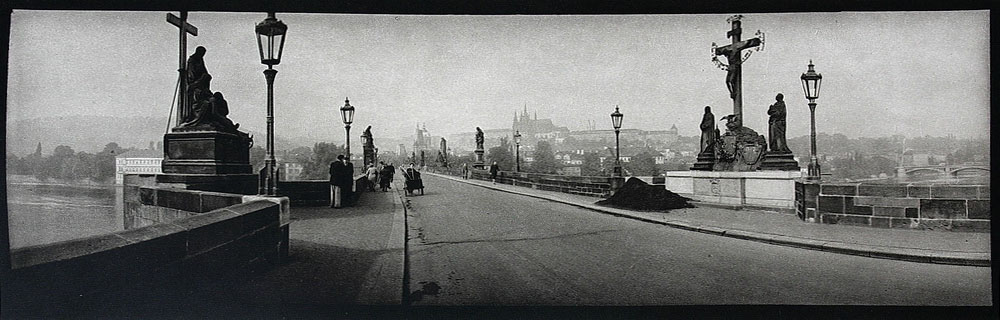
I’m also impressed by his series of panoramic photographs.

Charles Bridge, Prague. Josef Sudek via ‘What is a Film Camera’

Finally apart from the qaulity of his work I find his personal story inspiring. He lost an arm in World War I, but this didn’t stop him from taking photographs, and those days we’re not taking about cameras of the size we mostly use today. We’re talking about something much, much larger (see below). Talk about refusing to let a disability get you down.

Josef Sudek with his large format camera. Via “From My Window”: The Late Work of André Kertész and Josef Sudek

A number of the images in this post are linked to a very interesting article: “From My Window”: The Late Work of André Kertész and Josef Sudek.

Collecting Photography

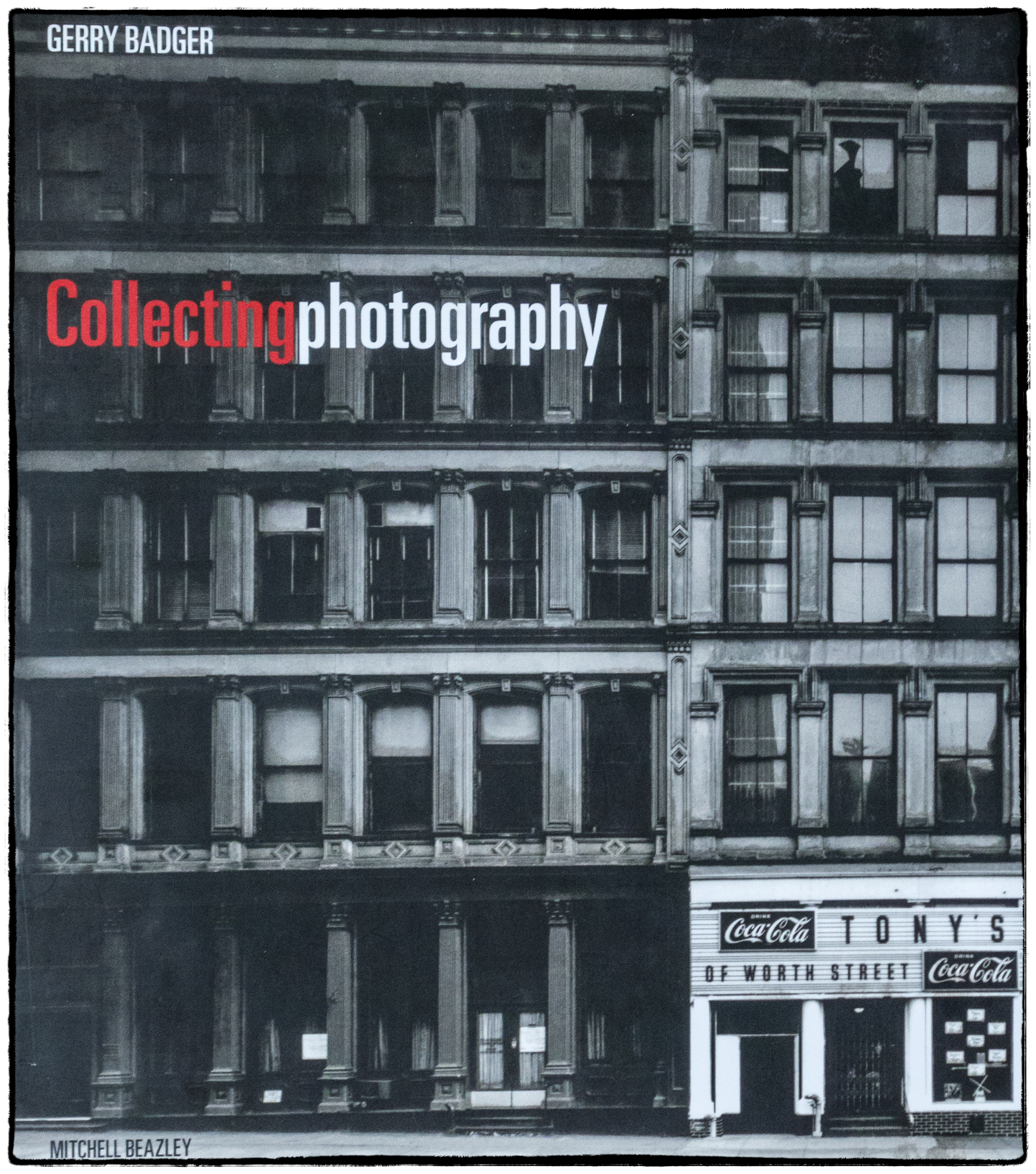
I’ve been thinking of starting collection of photographs for a while, but I didn’t really know where to start. So I picked up this book: Collecting Photography by Gerry Badger, second hand – cost about $8.00. It’s a nice hardback book in pretty good condition and I found it very useful.

The book is divided into two parts: the first part contains the introduction and five chapters dealing with the following topics:

The Art of Photography – deals with photography as an art form and discusses which photographs can be considered to be art, and which not as a guide to deciding which photographs might be worthy of collection. It ultimately concludes with the statement: “For even the most experienced professionals, an emotional response is a more accurate guide than a purely intellectual one, though one’s considered intellectual response is also important. But first of all, look for pictures that hit you in the gut, that ‘go against the grain’, because that is where the art of photography most properly resides.”

Building a Collection – Suggests several areas for collecting e.g. by subject; genre; process; school or historical period; quality; photographer or any combination of the above. Also covers collecting as an investment and concludes with the following guidelines (particularly for investors): Buy the best you can afford; Pay particular attention to condition; Check an images provenance; Avoid restored prints; Consider subject matter; Avoid ephemeral market trends; and Take the long view.

The Photographic Print – Covers issues and problems related to prints including Original prints; Vintage Prints; Later prints; Different print editions including limited editions; Print sizes. I must admit that I hadn’t realized that there were so many issues associated with prints.

Buying and Selling Photographs. Covers different places (and issues associated with each of them) to acquire pictures: Gallery or Dealer; Auctions; From a photographer; Photofairs; The Internet; Photographic archive or library. Also covers selling photographs – apparently not likely to be as fulfilling as buying. The problem of fakes and forgeries is also discussed although it’s apparently not as big a problem as you might think.

Displaying and Caring for Photographs – very useful tips on how to take care of your collection including handling; light; heat and humidity; and chemical pollution. Also deals with issues specific to colour and digital prints and includes sections on storing photographs; restoration (don’t unless you really have to and then have a professional do it); framing and record keeping.

The second part consists of a number of appendices:

An extensive Chronology covering the history of photography.
A glossary (I found the descriptions of photographic processes to be very informative).
A lengthy (almost 30 page) listing of key photographers including, for each, their nationality; dates of birth and death; subject matter they covered; types of media they used; and estimated price ranges for their work.
A listing of galleries and dealers with contact information.
A Bibliography subdivided by subject: General histories; Photography in the 19th century; Photography in the 20th Century; Books on collecting photographs; Books on Museum Collections; Books on private and corporate photographic collections; Books on photographic books; Technical books.

The book is also lavishly illustrated with many beautiful photographs, many of which I was not familiar with. Each one has a short caption with information related to collecting. For example a full page photograph of Edward Weston’s famous pepper is captioned with “Edward Weston. Pepper No. 30, 1931. Silver Gelatin Print. Private Collection. One of the icons of modern photography, which is available printed by Weston’s son, Cole for $2,500.

I enjoyed this book a great deal, but it’s worth mentioning a couple of caveats. First the book was published in 2006 and much has no doubt changed in the field since then, although I imaging basic principles will remain the same. Second I think it’s all probably a bit much for the type of collection I might build (i.e. inexpensive photographs which catch my attention). I’m not likely (at least not at the moment) to spend thousands of dollars on a photograph and consequently some of the issues related to taking care of the collection would be overkill. Having said this, however, I know from my camera collecting that once the ‘bug’ bites you can take off in unforeseen directions.