New York Times Exposes Peter Lik Photography Scheme – artnet News

An earlier post reported on the new world’s most expensive photo. The New York Times questions this claim as it does Mr. Lik’s entire method of work.

Peter Lik may claim to have sold the world’s most expensive photo, with the $6.5 million Phantom (see $6.5 Million Landscape Is World’s Most Expensive Photo), but the artist is artificially inflating his market. (This is not the kind of cheating we had in mind in the story Does Photography Help Artists Cheat?)

via New York Times Exposes Peter Lik Photography Scheme – artnet News.

Some other interesting links:

Is That $6.5 Million Photo Sale for Real? Probably Not!

Artist Jeff Frost Inches Past Recently Set World Record for Most Expensive Photograph Ever Sold

Andreas Gursky — New York Magazine Art Review

Andreas Gursky, Chicago, Board of Trade II, 1999 via The Red List

I think I’m starting to appreciate Gursky more. I’ve never been much of a fan of his work, but I’m starting to realize that the sheer size of the photographs and the amount of detail that can be seen must be quite amazing. So far I’ve only been able to see small images in books and on the internet. I’ll try to find somewhere where I can see some of his work in all of its glory – there must be somewhere in New York City.

The German über-photographer Andreas Gursky was the perfect pre-9/11 artist. He excelled at portraying the border-to-border, edgeless hum and busy obliviousness of modern life, what Francis Fukuyama ridiculously declared “the end of history,” George W.S. Trow called “The Context of No Context,” and Rem Koolhaas dubbed “Junkspace.” Not only did Gursky seem to be critical of all this, but his handsome images of trading floors, hotel lobbies, raves, and landscapes were charged with a visual force and intellectual rigor that let you imagine that you were gleaning the grand schemes and invisible rhythms of commerce and consumption. His amazing picture of a convenience store brimming with goods, 99 Cent II, Diptych 2001, which recently became the most expensive photo in history when it was auctioned for over $3.3 million, fizzed like cherry cola but packed the formal power of a Monet.

via Andreas Gursky — New York Magazine Art Review.

Also found this article interesting: 99 Cent: A Look at the Widespread Confusion Over a Photo Gursky DIDN’T Shoot

Sebastiao Salgado: Genesis.

We were down in New York City to see “On the Town”. After the performance we went around the block to the International Center of Photography to see the Sebastiao Salgado “Genesis” exhibition.

The photographs are stunning: the light is unbelievable and the tonality of the black an white pictures amazing. Seeing something as good as this makes me feel like giving up photography (I won’t though).

“The Guardian” has an interesting review: Sebastião Salgado: Genesis – review.

I also liked this article:

In the rainforest everything is backlit. The light streams towards you, silhouetting the trees. Also the Brazilian sun burns, so children are given broad-brimmed hats. They grow up always looking from shadow into light.

“I realised recently that most of my photographs are shot against the light,” says Sebastião Salgado, “and that is why. I was raised in the shadows. The sun injured my nose and it was necessary to have a hat, so everything came to me from light into shadow.”

via Bryan Appleyard » Blog Archive » Sebastiao Salgado: The Unfiltered Lens.

An In-Depth History of Group f.64

“Bone and Sky.” Circa 1932. Willard Van Dyke, Courtesy of Murray Van Dyke via The New York Times ‘Lens’

In 1967, a 20-year-old photography student named Mary Street Alinder went to the University of Oregon for a workshop featuring several of her idols, four of the original members of the famed Group f.64: Ansel Adams, Imogen Cunningham, Brett Weston and Willard Van Dyke. The experience changed her life, starting with her working for Adams for the last few years of his. She was a co-author of the best-selling “Ansel Adams: An Autobiography,” and later wrote a biography, which has just been re-released. In the process she got to know members of Group f.64 and entwined herself with photographic history.

Fittingly, she just published “Group f.64,” the first comprehensive history of the movement. The project took 16 years, which is twice as long as Group f.64 existed. But the result is a thoroughly researched book that investigates the founding and life cycle of one of the most famous collectives in the history of photography. As its members battled the Great Depression while grappling with the evolving role of photography in society, it seems an apt story to tell in 2014.

via An In-Depth History of Group f.64 – NYTimes.com.

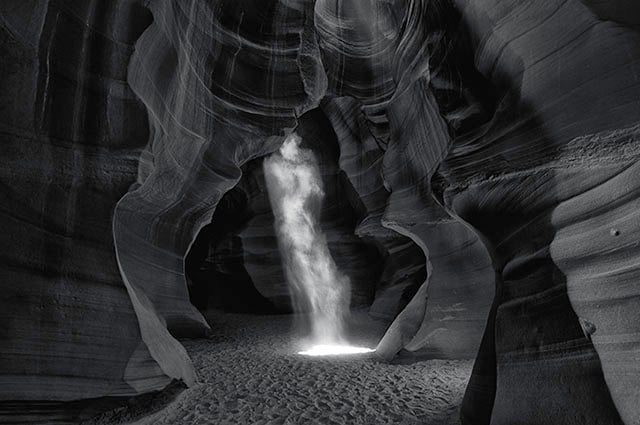
“Phantom”, a print by Peter Lik said to sell for $6.5 Million breaking record for the most expensive photograph.

Peter Lik Print Sells for $6.5 Million, Shattering Record for Most Expensive Photo

According to Petapixel:

Australian landscape photographer Peter Lik has taken the crown for most expensive photo ever sold. “Phantom,” the picture shown above, was sold to a private collector for a staggering $6.5 million. The record was previously held by Andreas Gursky’s “Rhein II”, which sold for $4.3 million back in 2011.

via Peter Lik Print Sells for $6.5 Million, Shattering Record for Most Expensive Photo.

The official press release reads:

LAS VEGAS, Dec. 9, 2014 /PRNewswire/ — Today, LIK USA™ announced the sale of the most expensive photograph in history by world-renowned fine art photographer, Peter Lik. “Phantom” sold to a private collector for an unprecedented $6.5 million. The purchase also included Lik’s masterworks “Illusion” for $2.4 million and “Eternal Moods” for $1.1 million. With this $10 million sale, Lik now holds four of the top 20 spots for most expensive photographs ever sold. He already has a position in the ranking with a previous $1 million sale of famed image, “One.”

“The purpose of all my photos is to capture the power of nature and convey it in a way that inspires someone to feel passionate and connected to the image,” said award-winning fine art photographer Peter Lik.

“Phantom” and “Eternal Moods” are black and white representations of Lik’s iconic images “Ghost” and “Eternal Beauty.” Lik is known for his artistic approach to landscape photography and capturing Mother Nature’s vibrant colors. His use of black and white imagery is a rare and compelling departure from his normal style.

“Certain textures and contours found in nature lend themselves beautifully to black and white photography,” said Lik. “The intensity of contrasting light and dark spaces was surprising, but made for some of the most powerful images I’ve ever created.”

The private buyer is represented by Joshua Roth of the Glaser Weil Fink Howard Avchen & Shapiro, LLP firm, 10250 Constellation Blvd., 19th Floor, Los Angeles, Calif. 90067, who indicated his client preferred not to be publicly identified for security and privacy reasons. Peter Lik and LIK USA™ are represented by their attorney, Mark G. Tratos of Greenberg Traurig, LLP.

“It is noteworthy that the sales of these photographic works denote another milestone in the development of fine art photography, as well as a new benchmark for the value of Peter Lik works,” said Tratos.

These sales may be confirmed through the buyer’s counsel, Joshua Roth.

“Our client is a long-time collector of Lik’s works and is delighted to add these one-of-a-kind photographs to his impressive collection,” said Roth.

Jonathan Jones of The Guardian didn’t care for it much: “The $6.5m canyon: it’s the most expensive photograph ever – but it’s like a hackneyed poster in a posh hotel“. Interestingly The Guardian’s Sean O’Hagen chose to disagree with his colleague in a follow-up article: Photography is art and always will be.

While I don’t agree with Jones’s comments about photography not being art (I thought that debate closed some time ago) I have some sympathy with some of his other thoughts. Can any photograph really be worth $6.5 million? Particularly one like this. It’s a nice picture, but doesn’t really seem to be that special. Still I suppose the fine art market works according to its own rules and if someone wishes to spend $6.5 million on something like this who am I to say that they shouldn’t.
