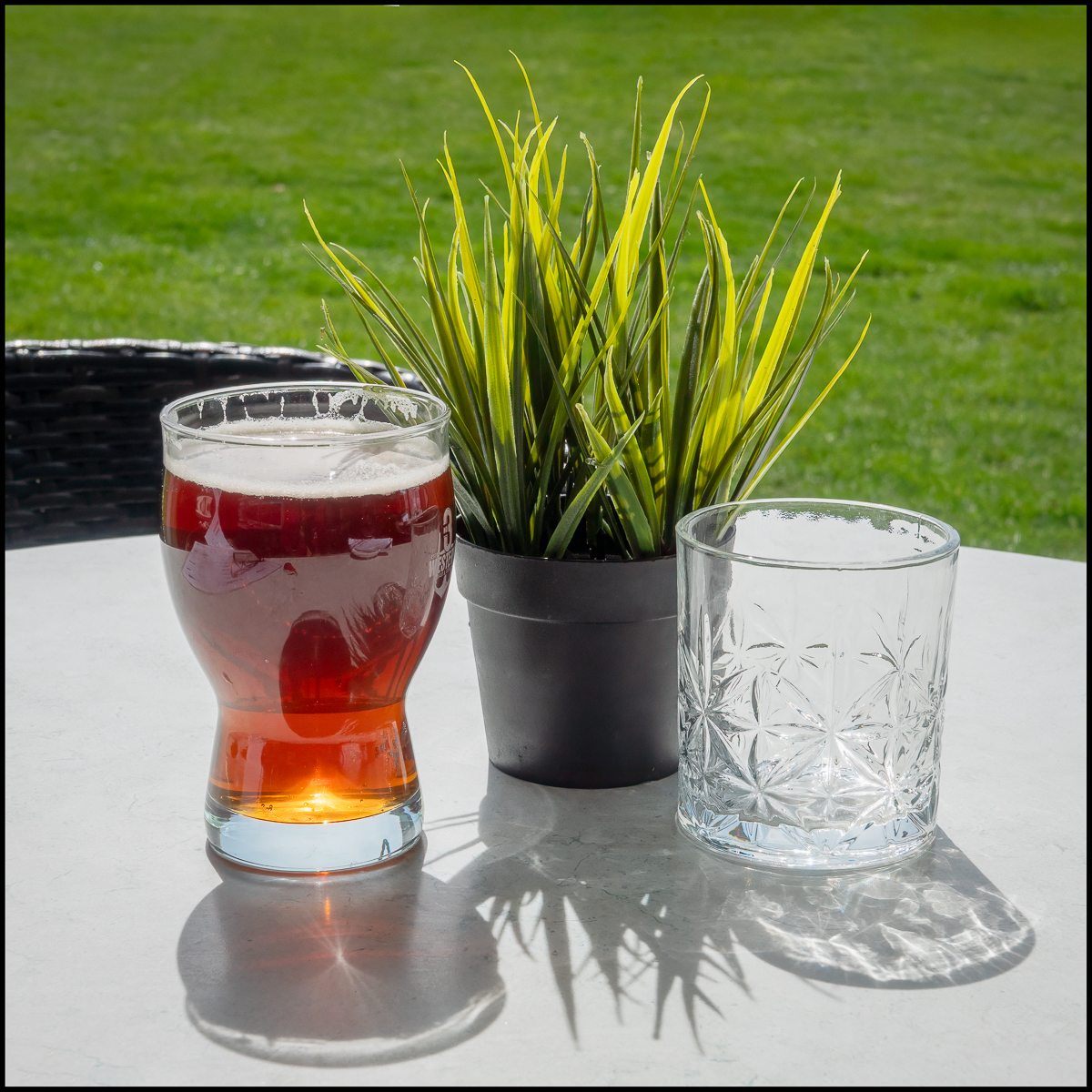
Reading by the river

I generally go for lunch by the Hudson on Sundays. After a big lunch I’m usually in need or a nap, so I usually go straight home.

It was a nice day, so I decided to sit by the river for a while and read. I ended up staying for about two hours.

By that time, I was quite hot and thirsty so since I had been sitting near 3 Westerley I decided to pop in and have something to drink: two pints of Smithwicks.

Taken with a Sony RX10 IV

A new personal Photobook

A couple of weeks ago I felt like going for a walk in the woods. I almost talked myself out of it. The woods would be bare, the light was wrong etc. It would have been so easy to stay home and read. But I forced myself to go to some nearby woodland. It’s called the Hardscrabble Wilderness Area.

This 235-acre green space features an undisturbed pond, and a leisurely hiking trail, suitable for moderate hikers, children, and canine companions (providing that you stick to the rather draconian dog walking rules).

Westchester County, NY is known for its beautiful trees, especially dazzling in Autumn. Blooming tulip trees, hemlocks, sassafras, red maple, and flowering dogwood make the Hardscrabble Wilderness Area a glorious day trip, hike, or picnic spot. This area also features wildflowers and is a popular destination for birdwatching.

I decided to explore an area that I hadn’t been to before. I’d noticed it before, but the problem was that I usually walked the white trail, which is quite long and the area I wanted to explore was right at the end. By the time I got there I was usually quite tired and didn’t feel like exploring further.

This time I had a brainwave. I would still walk the white trail, but in the opposite direction. That way the part I wanted to explore would be near the beginning of my walk. Don’t know why I didn’t think of that before

Previous visits had been in Summer and I couldn’t see the area I was interested in too well because of the leaves. In that sense the bare trees were an advantage.

I came across a number of interesting rock outcroppings, which I thought would work well in black and white. Had a great time.

A new photobook

I like to see my pictures in print. I don’t have a good enough printer to make prints, and even if did I wouldn’t have anywhere to put them. So, I make photobooks. This is my latest. It’s called “Teahouse”.

I usually use the Book module of Lightroom to do the layout and then upload to Blurb for printing. This time, however, I decided to try Blurb’s own standalone software Bookwright (for more on Bookwright see here). I like Bookwright more than the Lightroom Book Module and will use it for future books.

Halsey Pond Park is a 30-acre scenic and tranquil area that is located in Irvington, NY. Nestled between a golf course and private residences, it’s a peaceful oasis drawing families and dog walkers alike. The park is touted as Irvington’s best kept secret. Halsey Pond Park is open to village residents for passive recreation activities. New York State fishing license required for fishing (catch & release). Halsey Pond Park is open from dawn to dusk. The park is managed by the Irvington Recreation & Parks Department.

A wide 1/2 mile long crushed stone path circles the scenic pond, passing old stone walls, a dam, and the Beltzhoover Teahouse that overlooks the pond. A haven for birdwatchers, on any given day, you may see ducks, geese, herons, cormorants, warblers or even an Osprey.

Rochroane castle was built between 1902 and 1905 for Melchior S. Beltzhoover, an oil and cotton magnate from Natchez, Mississippi. The 44 room stone castle, once part of a 200-acre estate overlooking the Hudson River, was designed by Arthur. J. Manning, a New York City architect who also lived in Irvington. The stone was quarried from the land upon which it was built. This “Rhine castle” featured a spectacular stained-glass window by Louis Comfort Tiffany that depicted the Hudson River view as seen from the castle.

Benjamin Halsey bought Rochroane castle in 1927, and renamed it “Grey Towers.” After Halsey’s death in 1956, his widow began donating portions of the estate to the Immaculate Conception Church, ending with the mansion itself in 1976. Gutted by fire a few months later, the mansion and 38 acres were sold to a developer who, in 1980, deeded Halsey Pond and its folly, sometimes called Halsey Teahouse, to the Village of Irvington in exchange for permission to remove Rochroane/Grey Towers and subdivide the rest of the property.

Beltzhoover Teahouse, the last remaining structure of the once-grand estate, is a little turn-of-the-century castle, with an open hexagonal tower featuring gothic arched windows and a roof terrace overlooking Halsey Pond.

Neglect and years of deterioration threatened the survival of this rare historic architectural resource. Beltzhoover Teahouse was preserved through the initiative and support of concerned citizens, the Village of Irvington Trustees and Irvington

Landmarks Preservation, Inc.

A Plaque reads:

Beltzhoover Teahouse on Halsey Pond

Largest remaining structure of “Rochrome”, the 200 acre Belzhoover Estate built in 1905. Melchior Beltzhoover was “President” of Irving ton from 1904 to 1916. The Halsey family owned a portion of the property from 1927-1976. The pond area became village land in 1980.

From 1994 to 1997 many citizens volunteered their time, expertise, and craftsmanship to save the structure. Preservation of the Teahouse was financed equally by private donations and Village funds.

Irvington Landmark Preservation, Inc.
1997

Two New Photobooks

A friend of mine grew up quite close to Yellowstone National Park and from time to time speaks of it fondly. Since I’ve never been there and don’t have any plans to go there any time soon, I thought I’d get a couple of books instead.

The first is titled: “Yellowstone. A Land of Wild and Wonder” by Christopher Cauble. It’s an attractive 11×11 inch color photobook with a dust cover bearing the same image as that on the front cover of the book. According to the book’s “About the Photographer”:

Christopher Cauble grew up in Helena, Montana where he began his passion for photography by exploring the mountains with a 35mm camera passed down from his parents. After graduating from the University of Montana with a bachelor’s degree in geography, he became a freelance photographer working mostly in Montana and Yellowstone National Park. His work has been featured in magazines and books, including A Montana Journal and the popular children’s book, What I saw in Yellowstone. Cauble is also a dedicated nature cinematographer, and his videos have been published on many national and international news sites and television programs. He lives near Yellowstone in Livingstone, Montana, with his wife, Sarah. His work can be found on his website, www.caublephotography.com and on social media.

The book has 120 pages, which, apart from a short (approx. half page) introduction are all beautiful photographs covering landscapes, wildlife and thermals.

The second book is called “Found Photos of Yellowstone. Yellowstone’s History in tourist and employee photographs. It’s a 176-page softcover book full of black and white, historical photographs divided into thirteen sections:

  • Foreword
  • Introduction
  • From Rustic to Refined
  • The Wonders of Wonderland
  • Getting Around Was Half the Fun
  • The Evolution of Camping
  • Activities Abound
  • Hard Work and Lots of Play
  • Famous Figures
  • Exploring Yellowstone Dude Ranch Style
  • Time Well Spent: Civilian Conservation Corps
  • The U.S. Military to the Rescue
  • Wildlife Attractions

Amazon describes it as follows:

“Found Photos of Yellowstone” presents a collection of over 200 photographs, captured by park visitors and employees between 1880 and 1940. These unguarded snapshots unveil unseen moments from the park’s past, offering unique perspectives on accommodation, transportation, leisure activities, wildlife, and summer employment. The images were discovered by Michael Francis, a seasoned Yellowstone photographer, who has amassed a collection of over 11,000 historic Yellowstone photographs. Each image in this book has been carefully selected by renowned Yellowstone historian Lee Whittlesey, who also co-authored the captions with acclaimed writer Amy Grisak. These pictures are sure to astonish and charm all Yellowstone enthusiasts. They illustrate the transformation of Yellowstone over the years, while also highlighting the enduring charm that has captivated visitors and employees for over a century”.

It’s quite different from the Cauble book. Where that book is pretty much entirely photographs, this one is rich in text. There’s a short, two-page introduction and each of the sections has its own description. The photographs all have detailed captions. Another way it differs from the Cauble book is that it doesn’t just show the awe-inspiring vistas, wildlife, thermals etc. Apart from tiny figures near the base of Grand Geyser and Old Faithful, there are no people. There’s only one photograph of a building: “Old Faithful Geyser and Inn Under the Milky Way”. I was surprised to find that contrary to what some of Cauble photographs suggest, Old Faithful is not “in the middle of nowhere”. Rather it’s a stone’s throw from the Old Faithful Inn.

This book shows that there were a number of beautiful, old, rustic Inns at one time. Have they all gone? Apparently not, as a cursory Google search reveals that a number of them are still operational. This book is full of people enjoying themselves, buildings and other structures, vehicles (cars, boats, trains, horse drawn carriages etc.).

So, which one do I prefer…

The photographs in the Cauble photobook are definitely superior: sharp, well composed, well exposed by a very talented professional who clearly knows how to produce lovely images. I enjoyed the book, but somehow, it didn’t touch me. Apart from creating a feeling of awe at the beauty of Yellowstone the photographs didn’t really inspire any other feelings. This may be typical of landscape photography. When I first started taking photography seriously in the late 1970s, Ansel Adams was starting to become very popular. At that time, I felt that this was the type of photography I wanted to do. I wanted to be Ansel Adams. I have a number of books of Adams photography, and I still admire him for all the things he did, both for photography and for nature conservancy in general. However, I recently looked through one of the books: “Ansel Adams. 400 photographs“. I was surprised to find that only a few of the 400 photographs made me feel anything much. The photographs in the Francis book are nowhere near as good as those in the Cauble book. They’re just snapshots, but I suspect that they give a more accurate picture of the real Yellowstone. I can feel the joy of people having a great time; sadness that maybe a simpler age has now gone; excitement while looking at the beautiful hotels, etc.

But then again maybe that’s just me. I love photography, but I also love history (I’m the Vice President of our local historical society), so my preference if for “Found Pictures of Yellowstone”.

Daido Moriyama – Record

An exceptional selection of photographs by Japan’s leading photographer from Record, the artist’s self-curated journal, published in the early 1970s and from 1996 to the present day. It has 230+ pages, 50+ in color. There’s a short (five page) introduction by Mark Holborn.

Inspired by Japanese photographers, as well as by William Klein’s seminal photography book on New York, Daido Moriyama moved from Osaka to Tokyo in the early sixties to become a photographer. He became the leading exponent of a fierce new photographic style that corresponded perfectly to the abrasive and intense climate of Tokyo during a period of great social upheaval. Between June 1972 and July 1973 Moriyama produced his own magazine publication, Kiroku, which was then referred to as Record. It became a diaristic journal of his work as it developed. Ten years ago, after a decades-long interval, he was able to resume publication of Record. Now this book collects work from all thirty published issues, edited into a single sequence, punctuated by Moriyama’s own text as it appeared in the magazine. After this volume was produced, Moriyama continued with “Record”. Subsequently, a second volume, the direct sequel to Record was created and called Record 2. This volume presents a selection of photographs from Daido Moriyama’s magazine publication Record, from issues 31 to 50 and spanning 2017 to the present.

The book is exceptionally well made. The reproduction of the photographs is of very high quality, and the whole book is contained in a slipcase.

If, like me, you’re a fan of Moriyama’s style (grainy, high contrast, not always ultra sharp images) you’ll love this book).