In Manhattan. A Mural

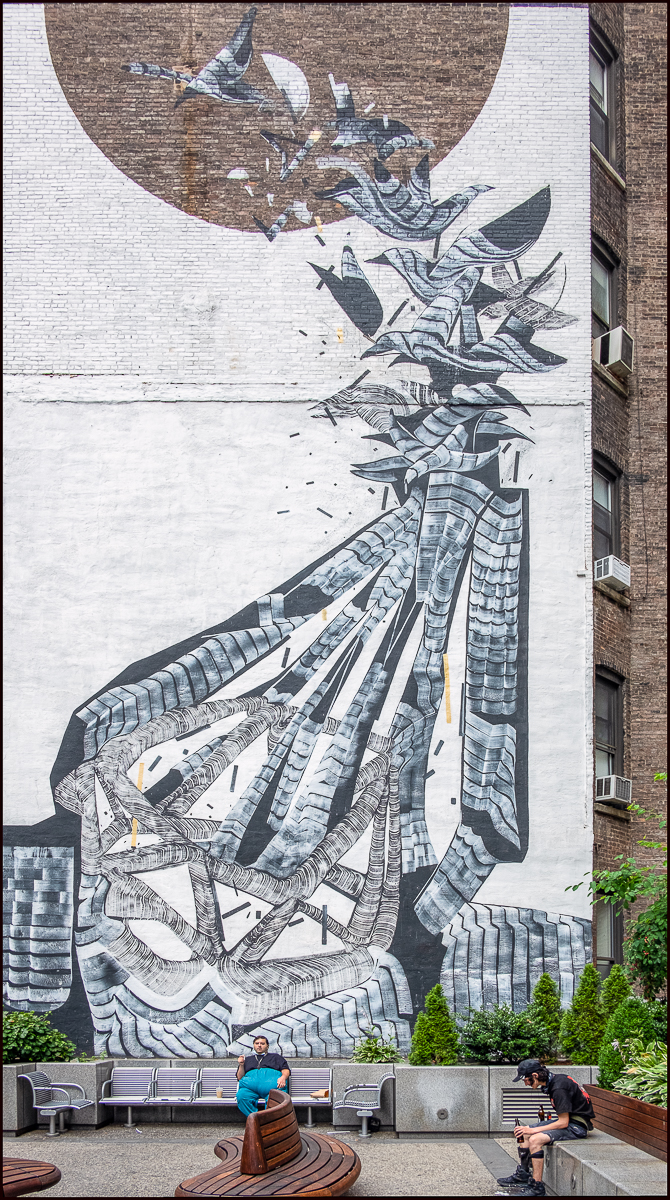
“An internationally known graffiti artist was visiting New York City last month when he spotted the perfect place for his next mural — St. Francis Residence I. Located on East 24th Street between Park and Lexington Avenues, the six-story building provides a home for those who have a chronic mental illness and financially destitute.

Jacopo Ceccarelli approached Tom Walters, OFM, who was at Residence I that day, and asked if he could paint the wall,” said John Felice, OFM, co-director of St. Francis Friends of the Poor. “Tom spoke to me and John McVean, OFM, as well as the staff at the residence, and we all agreed it would be an exciting experiment.”

Ceccarelli, also known as “Never 2501,” is an Italian street artist who has painted distinctive monochromatic images on walls all over the world. His style usually includes a combination of circles, and manipulation of lines, resulting in a somewhat hypnotic effect.

Because Ceccarelli had four days to paint the mural at Residence I, Tom was skeptical “because nothing happens that fast in New York.” But on Friday, Aug. 28, a lift arrived in the plaza of the apartment building next to the residence and Ceccarelli got to work.

st-francis-residence“After painting five of the six stories of the Residence a brilliant white, he began creating a dramatic image of something like steel beams reaching up to the sky,” said John Felice. “Those beams then opened up, transforming into to birds that fly free skyward. All of us were amazed by the artist’s speed and skill.”

Tom remained with Ceccarelli through Sunday, when his work was completed. Ceccarelli interviewed and filmed Tom as part of an international documentary on his work.

“What most impressed Ceccarelli was the work of the residences,” John said. “He was deeply moved by the 85 men and women at Residence I with their long histories of homelessness and chronic mental illness. He even came into the residence to give an art class to some of the tenants.

“Tom found Jacopo to be a kind and understanding man with a real interest in the well being of others,” John added. “He flew back to Rome on Monday but left the residence a permanent image of his renowned skill.”

Originally a 100-unit single-room occupancy hotel, St. Francis Residence I opened in 1980 as a place for the chronic mentally ill homeless to live. The residence is one of three operated under St. Francis Friends of the Poor, a non-profit that was founded to care for those with nowhere else to go.” (Franciscan Friars Holy Name Province website, September 17, 2015).

Taken with a Fuji X-E3 and Fuji XF 18mm f2 R

A visit to Dia Beacon – Artists I don’t care for, or don’t understand – Robert Smithson

I first visited Dia in April 2014. When I came across these installations/displays I initially thought that they were unfinished i.e. that someone was in the process of building an installation. My tastes in art have evolved a lot since then but I still have problems understanding why a pile of broken glass, a pile of sand, a pile of cement and a couple of mirrors are important art. Clearly I still have a way to go. Having said that I do rather like some of his large scale exterior works such as Spiral Jetty and Broken Circle/Spiral Hill.

Wikipedia describes Robert Smithson as follows:

Robert Smithson (January 2, 1938 – July 20, 1973) was an American artist known for sculpture and land art who often used drawing and photography in relation to the spatial arts. His work has been internationally exhibited in galleries and museums and is held in public collections. He was one of the founders of the land art movement whose best known work is the Spiral Jetty (1970).

For (lots) more information see here.

Taken with a Sony A7IV and Samyang 45mm f1.8

A visit to Dia Beacon – Artists I don’t care for, or don’t understand – On Kawara

Above museum visitors studying the work of On Kawara. Clearly I have to more studying to do too. I just don’t get it, but then I still struggle with conceptual art of all kinds. However, I seem to come across his work everywhere so apparently lots of people, gallery owners, museum owners, critics etc. must feel that it’s important. I must be missing something.

The Dia Beacon website describes him as follows:

On Kawara was deeply concerned with the ways humans experience and record time. Kawara began his Today Series of paintings on January 4, 1966, and continued to work on them until his death in mid-2014. Adhering to a rigorous set of rules that he established, Kawara required that each painting be completed on the date depicted on its surface and in the language and grammar of the country in which it was completed. In addition to these formal conventions, the Today Series paintings are stored in handmade cardboard boxes along with a clipping from the local newspaper. Occasionally these boxes are exhibited, and particularly in earlier works, phrases or text from the clippings would form part of the title as well. Combining the individual with the universal, the Today Series is both a deeply personal journey (asserting that I was here on this day), but also the story of humanity and struggles experienced on a much larger scale—as captured through the lens of daily newspaper reportage.

The Today Series was presented at Dia Center for the Arts from January 1 through December 31, 1993; each calendar month saw a different rotation of Date Paintings, chosen exclusively from those made in New York City—a thousand works in total. Kawara’s One Million Years was also presented for the first time as an audio piece in that exhibition. Alternating between two voices, a female reader for even years and a male reader for odd years, One Million Years is an oral reading from Kawara’s twenty four-volume publication by the same title. Both artworks reflect the influences of the micro and macro in Kawara’s work, and how an individual lifespan forms a part of human history.

Taken with a Sony A7IV and Samyang 45mm f1.8

A visit to Dia Beacon – Other artists I liked – Imi Knoebel

According to Artnet:

Imi Knoebel is a German painter and sculptor known for his contributions to and shaping of 20th century Minimalist abstract art. Often working with large-scale modular shapes, Knoebel’s work is regarded as an ongoing, elliptical investigation into formalism and the medium of painting itself. Born in Dessau, Germany in 1930, he went on to study at the Darmstadt School of Arts and Crafts and then the famed Kunstakademie Düsseldorf, where he befriended Joseph Beuys and Blinky Palermo. Though his early work was often monochromatic, Knoebel became interested in the teachings of renowned colorist Johannes Itten, and much of his later work is characterized by its bright palette and strong color relationships. One of his best-known pieces, 24 Colors for Blinky (1977)—made in memoriam of his friend’s untimely death—consists of a irregularly shaped panels each painted in a specific, memorable hue, and is featured in the permanent collection of Dia:Beacon in upstate New York. Knoebel has been the subject of solo exhibitions at such institutions as the Haus der Kunst in Munich, the Stedelijk Museum in Amsterdam, and the Hamburger Bahnhof in Berlin. He lives and works in Düsseldorf, Germany.

For more information see here at the Dia Beacon website.

Taken with a Sony A7IV and Samyang 45mm f1.8