Pipilotti Rist: Pixel Forest 1

Last November we went to see an exhibition at the New Museum in New York City. It was by Swiss Artist Pilotti Risk and I must admit that I’ve never seen anything quite like it. It spanned several floors and the Museum’s website describes it as follows:

Over the past thirty years, Rist (b. 1962) has achieved international renown as a pioneer of video art and multimedia installations. Her mesmerizing works envelop viewers in sensual, vibrantly colored kaleidoscopic projections that fuse the natural world with the technological sublime. Referring to her art as a “glorification of the wonder of evolution,” Rist maintains a deep sense of curiosity that pervades her explorations of physical and psychological experiences. Her works bring viewers into unexpected, all-consuming encounters with the textures, forms, and functions of the living universe around us.

Occupying the three main floors of the Museum, “Pipilotti Rist: Pixel Forest” is the most comprehensive presentation of Rist’s work in New York to date. It includes work spanning the artist’s entire career, from her early single-channel videos of the 1980s, which explore the representation of the female body in popular culture, to her recent expansive video installations, which transform architectural spaces into massive dreamlike environments enhanced by hypnotic musical scores. Featuring a new installation created specifically for this presentation, the exhibition also reveals connections between the development of Rist’s art and the evolution of contemporary technologies. Ranging from the television monitor to the cinema screen, and from the intimacy of the smartphone to the communal experience of immersive images and soundscapes, this survey charts the ways in which Rist’s work fuses the biological with the electronic in the ecstasy of communication.

Pipilotti Rist was born in Grabs in the Rhine Valley, Switzerland, and currently lives and works in Zurich. She studied graphic design, illustration, and photography at the University of Applied Arts in Vienna and audiovisual communications and video at the Basel School of Design. Solo exhibitions of her work have been presented internationally at venues including Kunsthaus Zürich (2016); Kunsthalle Krems, Austria (2015); Times Museum, Guangzhou, China (2013); Leeum, Samsung Museum of Art, Seoul, South Korea (2012); Fondazione Nicola Trussardi, Milan (2011); the Hayward Gallery, London (2011); the Wexner Center for the Arts, Columbus, OH (2011); Museum Boijmans Van Beuningen, Rotterdam, the Netherlands (2009); the Museum of Modern Art, New York (2008); Centre Georges Pompidou, Paris (2007); and the Contemporary Arts Museum Houston, TX (2006); among many others. Rist was awarded the Zurich Festival Prize (2013), the Harper’s Bazaar Art China Prize (2012), and the Joan Miró Prize (2009).

The picture was taken on the first floor we encountered. It was actually a lot darker than it appears in the photograph.

Did I like the exhibition? Yes, I believe I did. Unfortunately, it closed in January, 2017

Peekskill Riverwalk Park – Fjorward

A nearby sign reads

FJORWARD
Christine Corday
Weathering Steel

The Hudson River is a fjord that was carved by ancient ice flows, and moves both north and south. This is abstracted by a circular band that is held in tension by two directional plates, separated by an inch of air. It represents a continuous carving of time and space, just as the ice flow did millennia before. The weathered Cor-ten steel is reminiscent of Peekskill’s historic iron foundries. “Fjorward” phonetically echoes the natural history of the site, but also symbolizes human progress as people move through the sculpture – one visitor at a time.

2014

According to Wikipedia:

Christine Corday (born in 1970, Laurel, Maryland) is an American painter and sculptor. Her work draws from earlier studies in astronomy, cultural anthropology, chemistry, and sensory perception science. Corday’s artistic approach consist of manipulation of matter into different states, producing massive sculptures that viewers are meant to experience through touch, leaving memories on the surface of her work. Her works are found in private international collections: Paris, Madrid, Dublin, Tokyo, Los Angeles, San Miguel de Allende, Dubai, Brussels, Washington DC, and New York City. With Corday’s first solo exhibition: PROTOIST SERIES: SELECTED FORMS, presented at the Los Angeles County Museum of Art.

Peekskill Riverwalk Park – Tides

A nearby sign reads:

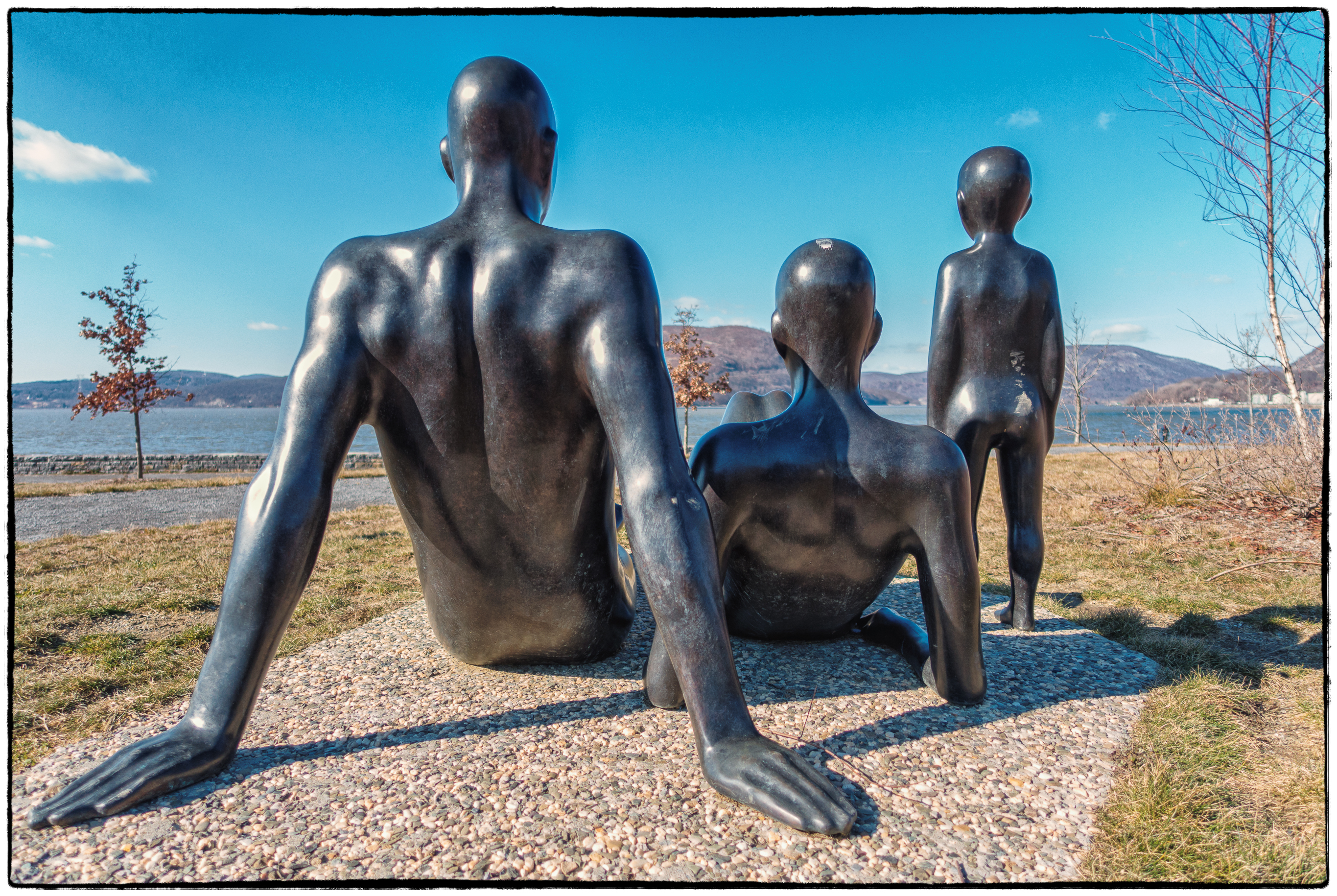
Tides
Emil Alzamora
Bronze

Tides represents the spirit of eternal relaxation and enjoyment of two things that are dear to us – family and loved ones and communion with the world in which we live. Tides softened details bring to mind subtle aquatic forms – waves, ripples, reflections – that one might find in the Hudson River on a calm day. The smooth surfaces transport the figures through a timeless doorway into another dimension, inviting the viewer to join them in a place of ease and contentment, forever observing the ebb and flow of the waters before. us.

2014

According to the Emil Alzamora website (in the bio/artist statement):

Emil Alzamora was born in Lima, Peru in 1975. His family moved to Boca Grande, Florida when he was two. He later attended Florida State University where he graduated Magna cum Laude in 1998 earning a Bachelor’s Degree in Fine Arts. Alzamora harnesses a wide range of materials and techniques to deliver unexpected interpretations of the sculpted human figure. He often distorts, elongates, deconstructs, or encases his forms to reveal an emotional or physical situation, or to tell a story. Alzamora’s keen interest in the physical properties of his materials combined with his hands-on approach allow for the process to reveal and inform at once the aesthetic and the conceptual.

Alzamora started his sculpting career in the Hudson Valley of New York working with Polich Tallix in the fall of 1998. Since his departure from the art foundry in early 2001, he has produced his work full-time and shown regularly throughout the United States, Europe and Asia. Alzamora’s works have been exhibited in multiple solo and group shows, many national and international art fairs as well as the United Nations Building, Pepsico World Headquarters, The Queens Museum of Art, The Hudson Valley Center for Contemporary Art, and The Museum of Biblical Art in Dallas. His work has been reviewed by publications such as The New York Times, The Brooklyn Rail, The L Magazine, El Diario, Boston Metro News, Juxtapoz, High Fructose, ArteFuse and Cool Hunting. He currently lives and works in Beacon, NY.

Peekskill Riverwalk Park – Launching Ball

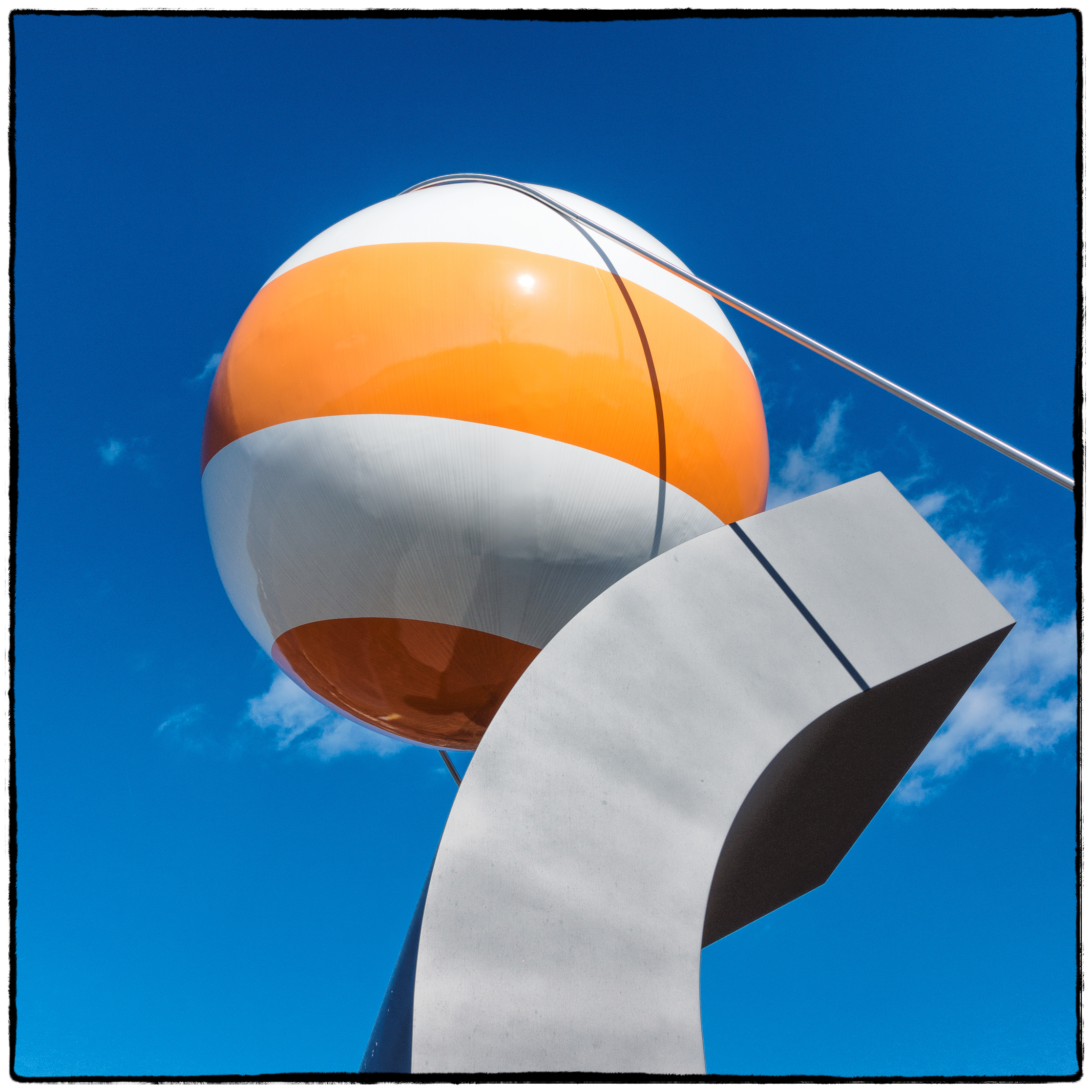
‘Launching Ball’ by Korean artist Jong Oh (aluminum, stainless steel, paint. 19 x 6.5 x 8 feet (580 x 200 x 245 cm ). 2014

According to the Marc Straus Gallery

The Korean artist Jong Oh (born in 1981) creates site-specific spatial installations. He carefully approaches a particular setting and responds to the given spatial situation through his works. Oh describes this process as follows: “Responding to a site’s nuanced configuration, I build spatial structures by suspending Plexiglas and painted strings in the air. These elements connect or intersect with one another, depending on the viewers’ perspectives. Viewers walk in and around these paradoxical boundaries constituted by three-dimensionality and flatness, completion and destruction. The viewers’ experience becomes a meditation on perception’s whim.”

In these compositions, Oh makes use of a limited selection of materials: string, fishing line, Plexiglas, and wooden rods. The strings are sometimes painted on one side and are thus visible from one side only or almost entirely invisible. By constantly arranging these materials anew, Oh adds the suggestion of additional dimensions to the three-dimensional space. Lights and shadows extend these configurations by offering visual effects so that the highly fragile works resemble optical illusions of falling perspectives. In this dialogue of lines and planes, Oh is testing the limits of visibility. The works require an increased awareness of delicate oscillations and variations. Jong Oh is thus clearly making a case for an attention to small details, especially in the hectic bustle of everyday life. In a highly formal language that is almost completely free of narrative moments, Oh appeals above all to the viewers’ experience of the world. Alternating between sculpture and intervention, intangible image and installation, Oh considers each of his works as a carefully composed visual poem: “The works become subtle and restrained visual poems. Each only a few lines long, but addressing the universal.”

Jong Oh was born in 1981 in Mauritania, North Africa and moved to Korea at age 15 earning his BFA from Hongik University in Seoul and eventually his MFA from School of Visual Art in New York, where he now lives and works. He had a recent 2016 solo exhibition at the University of Connecticut Art Galleries. In 2014-5 he has had solo exhibitions at Krinziger, Austria; Jochen Hempel, Leipzig; and MARSO, Mexico City. He has been in numerous group exhibits worldwide. In 2011, Oh was one of 12 artists in FIRST LOOK at the Hudson Valley Center for Contemporary Art, a juried show of leading art graduates in the US. In 2014 he won a competition to create a large scale public installation along the Hudson River in Peekskill, New York.

Oh talks about his philosophy and process in this video.

Peekskill Riverwalk Park – Your repetitive view

A 2000 piece by Olafur Eliasson. I found this to be the most fascinating artwork I came across in the Peekskill River Walk Park – and I almost missed it. From a distance it looks like a bright blue container. Only when you get up to it do you notice that there’s a viewing window at one end. Looking through this is like looking through a huge kaleidoscope, showing multiple reflections of whatever is seen through the other end – in my case a tree and a view of the Hudson.

According to Wikipedia:

Olafur Eliasson (Icelandic: Ólafur Elíasson; born 1967) is a Danish-Icelandic artist known for sculptures and large-scale installation art employing elemental materials such as light, water, and air temperature to enhance the viewer’s experience. In 1995 he established Studio Olafur Eliasson in Berlin, a laboratory for spatial research. Olafur represented Denmark at the 50th Venice Biennale in 2003 and later that year installed The Weather Project in the Turbine Hall of Tate Modern, London.

Olafur has engaged in a number of projects in public space, including the intervention Green river, carried out in various cities between 1998 and 2001; the Serpentine Gallery Pavilion 2007, London, a temporary pavilion designed with the Norwegian architect Kjetil Thorsen; and The New York City Waterfalls, commissioned by Public Art Fund in 2008. He was a professor at the Berlin University of the Arts from 2009 to 2014 and is an adjunct professor at the Alle School of Fine Arts and Design in Addis Ababa since 2014.