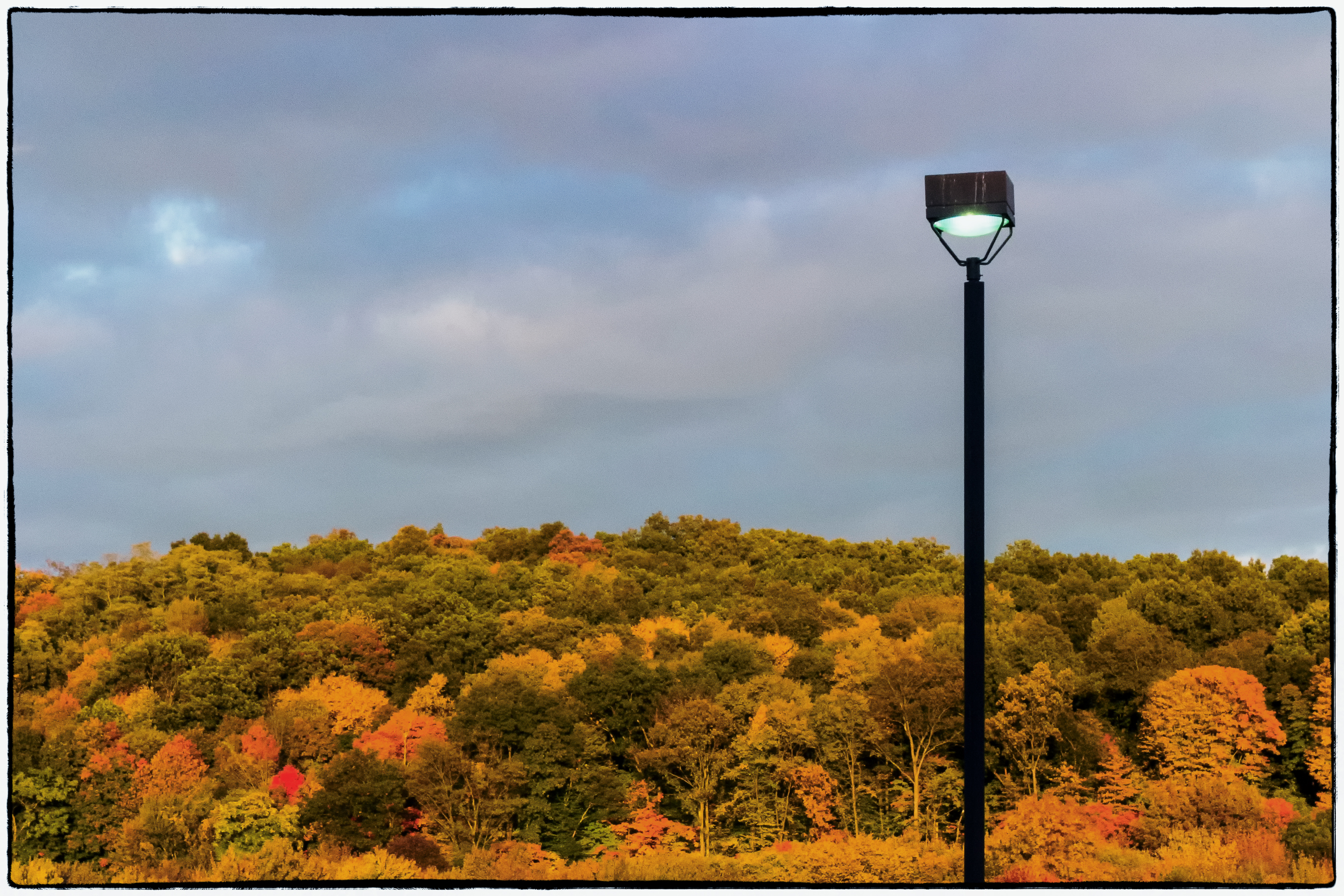
It’s not much of a picture, but it does illustrate a point. We had taken the dog to be groomed and when we went to pick him up I noticed wonderful light on the hills opposite the store. The trouble was that it was difficult to get a picture because the hills were on the other side of a parking lot with lots of lights that partially obstructed the view. So I thought that if I moved to a different position I might be able to find somewhere where the lights weren’t to obvious. I set out walking across the parking lot. Part of the way across I noticed that the light was disappearing and decided to take a picture before it went altogether. It was already to late – the wonderful light that I’d seen earlier had gone. A few seconds later the hills were almost completely dark. A short walk (probably only a minute or so) across a parking lot had been enough for the light to evaporate.
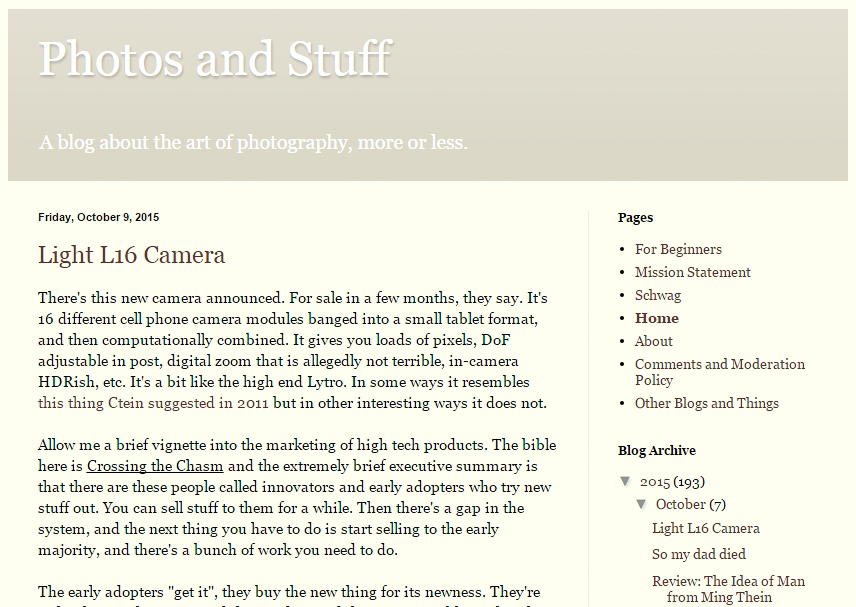
Photos and Stuff
I came across this blog from Kirk Tuck’s wonderful site: The Visual Science Lab.
This blog’s ‘About’ page says the following:
I’m a cranky old bastard who has been taking crappy pictures for 20 years or so. I’m full of opinions and ideas about photography, but not terribly good at putting them into practice. So it goes.
This blog is a place for me to put those ideas and opinions, so that I don’t have to keep them bottled up inside, nor try to explain them off the cuff and on the fly.
There’s much to like in this blog. The author seems to be very knowledgeable in a number of areas. He writes well and is often quite amusing. As he suggests in his ‘About’ section he’s “full of opinions and ideas about photography” and he’s certainly not afraid to voice them. He’s also quite prolific so there’s no want of things to read. As I only came across his blog yesterday I spent a large part of the day reading it and I thoroughly enjoyed it. I also learned a great deal.
For a photography blog I was surprised to find so little actual photography. The blog is virtually devoid of photographs. Maybe he likes to keep his opinion pieces separate from his photographs. If so then I had great difficulty finding them on the internet. Again maybe he prefers print rather than internet.
Although I like the blog there’s something about it that makes me a bit uneasy. First he really seems to have it in for Ming Thein. Don’t get me wrong these attacks are not directed at Ming himself, as much as they are about what he represents: a certain type of photography pundit that appears to thrive on the internet. He’s even somewhat complementary (very rarely) to some of Ming’s work. I understand, and largely agree, with what he’s saying but after a while harping on this issue becomes too much. The first couple were fun, but after a while I started to thing “Oh no! Not another piece on Ming Thein”. As Internet attacks go though his anti-Ming diatribes are quite mild. Maybe I’m over-reacting. After all I’m British and as someone once said the British and excruciatingly polite to their enemies and insult their friends.
As mentioned above the author is very good at opinion pieces. However, it would be wise not to forget that these are just that:opinions – not gospel. I have a friend who is somewhat similar. He can formulate opinions extremely quickly, perhaps faster then anyone else I know. He too is also very articulate and expresses his opinions quite forcefully. He comes across as if he has all the answers. Unfortunately, knowing him as I do I also know that often his quickly formed opinions are based on quite scanty knowledge. There’s nothing wrong with this and I admire him greatly for the way he’s able to do it. It’s very much a case of ‘buyer beware’. It’s up to those receiving the opinions to validate their worth. The reader must not uncritically take on the views of the author just because they sound convincing.
There’s an interesting section For Beginners.
I heartily recommend this blog. Go take a look!
Photography: An Eightfold Path Toward Self-Discovery
Interesting article by Andy Ilachinski at The Luminous Landscape.
True photography, as a creative medium meant to express (and only rarely just to impress) requires a lifetime of dedication, practice and patience. In an age of ready access to all kinds of photo gear, from low end to high, and near instant self-gratification with “Wow, another stunning shot!” tweets from friends and family admiring our constant stream of smartphone image uploads, it is easy to forget that. The result is not an immediate, but ultimately short-lived, reward; rather, it is a slow, meditative, Zen-like journey toward self-discovery.
via Photography: An Eightfold Path Toward Self-Discovery – Luminous Landscape.
The following are the 8 steps.
1. Joyful snapshots of anything and everything.
2. A passive stirring of aesthetic value.
3. Willful engagement of the environment.
4. Recognition of the power of expression.
5. One picture is not enough.
6. Need to tell a story.
7. Stories of Stories.
8. Self-discovery.
It’s not always easy to understand from the titles exactly what the author means and sometimes the differences between the various steps are quite subtle so you really have to read the article to get a good sense of what he’s saying.
I don’t altogether agree with him. It seems to me that the article is very much specific to his own situation. He has felt the need to get beyond the single image and to tell stories, but I’m not sure that that necessarily applies to everyone. I must say though that I feel that I’m going in the same direction. So which stage am I at? I’d say stage 5, possibly stage 6.
At the Bookstore
I’ve always been an avid reader and before I got my Amazon Kindle part of my weekend routine was to visit our local bookstore and spend an hour or two browsing. Now much of my reading is done electronically (although not photography books which I still buy in hard copy. The photographs just don’t work on the Kindle), but I still go to the bookstore from time to time. I find a couple of interesting books, go to the coffee shop, have a coffee and read for a bit.
Of course, I always look at the photography books. Generally there are two sections. One, called “Digital Photography” that for the most part contains books on photographic technique and cameras. The second is usually called “Art and Photography” and contains books by photographers e.g. I recently noticed books by Sally Mann, Annie Leibovitz, Dorothea Lange, Drew Barrymore and a bunch of books by Ansel Adams.
Of late I’ve noticed more of a certain kind of book in the first section, books not focused on individual cameras, not focused on what f-stop to use in a certain situation. For want of a better word I’ll say that I’m seeing more books devoted to inspiration, vision, creativity etc. Some Examples:
Achieving your potential as a photographer.
The Creative Fight.
Inspiration in Photography.
Learning to see creatively.
The Essence of Photography.
Can it be that photographers (mostly amateur photographers I imagine) are finally realizing that sophisticated cameras and a good knowledge of photographic technique can only take you so far? The problem is that it’s quite easy to learn how to use a camera. It’s a bit more difficult (but not much) to learn photographic technique. At a certain point I realized that I was buying books on photographic technique and my pictures weren’t getting any better. I knew as much about technique as I needed to. Now it was just practice and developing some kind of vision. The latter is the hard part. I’ve read some of the above books and, while interesting, I’m not at all convinced that they helped much. In my darker moments I think that either you have vision/creativity/inspiration etc. or you don’t – and if you don’t there’s not a lot you can do about it. Then the gloom dissipates and I start to think that with persistence, resolve and practice some kind of vision will evolve. As Henri Cartier-Bresson once said: “Your first 10,000 photographs are your worst.” Someone I came across on a photography forum added something like: “And in my case the second 10,000 are not much better”. I couldn’t agree more.
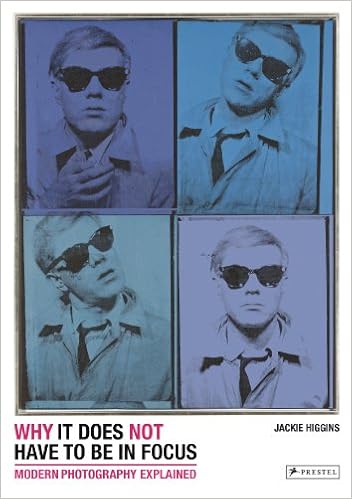
Why It Does Not Have to be In Focus: Modern Photography Explained
I suppose this book’s subtitle should really be “Modern art using a camera as a tool”. I’m strangely fascinated by this book. I bought it some time ago and I find that I often pick it up and browse throught it. If you’re looking for a book on photographic technique then this book isn’t for you. It doesn’t talk about ISO, shutter speeds, f-stops, rule of thirds or any of the other things commonly found it photography “how to” books. Instead about 100 images are organized according to the following categories: portraits/smile; document/snap; still lifes/frieze; narrative/action; landscapes/look; and abstracts/dissolve. Each picture is from a different photographer and for each one the author: “Describes the artist’s approach, process and technique; Locates the image in its historic and artistic context;…provides additional incremental information; and lists examples of similar images by the same photographer. Quotations (both attributed and unattributed) are also scattered throughout the book.
To give a flavor of what the book’s about I’ll provide a few examples of the photographs provided:
Second Beauty Composite by Nancy Burson, 1982. A single face which is actually a composite of five famous female movie stars: Jane Fonda; Jacqueline Bisset, Diane Keaton, Brook Shields and Meryl Streep. As the book says “This face belongs to non one; it has never existed”.
Untitled [Cowboy] by Richard Price, 1989. Re-photographed ‘Marlborough Man’ photograph blown up to gallery size. Has become known as “appropriation art”. This was the first photograph to sell for more than $1 million.
Poll by John Demand, 2001. Looks like a real office, but is actually an elaborately constructed set made of card, which is then photographed subsequently destroyed.
Strip by Jemima Stehli, 1999. A series of pictures of a woman (the photographer I think) with her back to the camera. She takes off her clothing in front of a man (a different man in each picture) who sits on a chair holding a remote shutter release and who presumably decides when to take the picture.
99 Cent by Andreas Gursky, 1999. A huge 81 1/2 by 132 1/4 inch picture of the shelves in .99 store.
Damage/Drown/Canal, 168 hours, June 2003 by Catherine Yass, 2005. According to the book “Yass photographed the canal on her large-format(4×5 inch) camera. Returning to where she exposed the image, she tied a large print to the edge of the canal and floated it in water for one week”.
I think I like this book so much because it encourages you to break rules and explore boundaries – something which I find very hard to do, and probably the reason why my photographs are so conventional. It would never have occurred to me to even try to do any of these things. I guess I keep hoping that if I go back to the book often enough something will rub off. It hasn’t so far, but who knows…
This book certainly won’t teach you photographic technique, but it will hopefully give you lots of ideas.