Tables turned on Richard Prince

Richard Prince Gets a Taste of His Own Medicine; $90,000 Prints offered for $90

I must admit that when I first heard of Richard Prince and his “appropriation” art I was somewhat shocked. It’s bad enough that you can “steal” other people’s work without giving them credit. I don’t understand how it is that some can sue for the most minor copyright infringement (one hears stories of the Girl Guides being sued by a large corporation because it owns the copyright to “Happy Birthday” and they were singing it around the campfire without permission). It’s even worse when the product is then sold for very large amounts of money with the original creator getting nothing. It was then with great joy that I read the piece below. Good for them!

I also liked this video: Richard Prince Smells Bad from The Art of Photography by Ted Forbes.

Prince’s latest controversial “art” is basically a series of screenshots of various Instagram photos, along with the uploader’s name and some of the comments. In order for the work to be considered his own, Prince added a comment to the original photo – and voila! The magic of appropriation in its most embarrassing moment.

The so-called ‘face’ of the story has been blue-haired Doe Deere, but while she has stated she will not “go after him”, another party involved in this disgraceful incident has decided to take action, and in the most appropriate way.

One of the ripped-off photos belongs to SuicideGirls, and its founder Missy announced yesterday that they’re fighting back by selling prints of Prince’s appropriated work for just 0.1% of his selling price.

via Richard Prince Gets a Taste of His Own Medicine; $90,000 Prints offered for $90 – DIY Photography.

Fact and Fiction in Modern Photography – from the New York Times

World Press Photo Strips Giovanni Troilo of His First Prize Win for Misrepresenting Photo via PetaPixel

There is a struggle going on in documentary photography between proponents of journalistic ethics and practices and those who believe that new visual and storytelling strategies are needed to communicate effectively in the modern world. The controversies surrounding this year’s World Press Photo awards have amplified this debate.

via Fact and Fiction in Modern Photography – NYTimes.com.

An interesting article. I find myself pretty much in agreement with Santiago Lyon. Vice president and director of photography, The Associated Press when he outlines the following tenets, which I summarize here:

  • Photographer must be truthful. Scenes must not be created or recreated.
  • Image should not be altered later electronically e.g. remove and inconvenient element.
  • Image should not be darkened or lightened in a way the portrays the scene differently from originally seen.
  • News or sports photographer should not interfere with or direct subjects.
  • Other forms of photography (the example given was portraiture) should be clearly described as something other than photojournalist along with an indication of what was done “to achieve the image on scene, in camera or in postproduction.”


There are those, myself included, for whom the basic journalistic values outlined here are paramount while others are frustrated by the perceived restraints of convention and cliché and seek broader storytelling latitude.

The two notions need not be mutually exclusive. I am all for creativity and artistic provocation; I merely seek clear definitions of the work produced so that we don’t damage that ever important trust — so crucial to our credibility and survival as journalists.

Thankfully I’m not into any form of photojournalism so I can do with my photographs as I will – all in the name of fine art photography.

It’s Your Image Do What you Like to it

Quite some years ago when I was doing my Fine Art Degree at University I was working on an image which I wasn’t quite sure about. My tutor came over and asked what was wrong. I told him that I thought people wouldn’t like one aspect of it. He looked at me and said, “It’s your image, you can do anything you like to it.” Ever since then I keep repeating those words to myself.

via It's Your Image Do What you Like to it.

Interesting article and also an interesting set of comments.

The article focuses on processing of images and whether or not certain types of processing would meet with the approval of certain types of people. My wife likes to paint from time to time and a while ago I was in Montreal and she wanted me to get her some painting supplies. I checked around and found a store close to my hotel. While I was getting her stuff I got talking to the woman in the shop. I told her that I had once tried painting, but that my attempts were almost universally ridiculed by my family even though I quite liked the result. I had painted a horse with woods in the background. I liked the way the woods came out, and most of the horse. However, I’ll be the first to admit that one of the rear legs of the horse was somewhat ‘off’. But, I thought, not bad for a first attempt. My family apparently didn’t think so and I can still hear their mocking laughter today. I never tried painting again! The woman in the store essentially said that you don’t paint for other people. You paint for yourself. I’ve taken this lesson to heart with my photography. I do it for me, not for other people and I don’t really care too much what others think. Actually that’s not entirely true. I welcome constructive criticism, especially from those whose opinions I respect because it makes my work better. I think this article is saying the same thing.

The comments, while generally agreeing with the article, take the discussion in a different direction: If a photograph is substantially enhanced through post-processing is it still a photograph. Or is it, as some of the comments suggest, “digital art”? To me it’s still a photograph. Photographers have always enhanced their photographs through post-processing even in the days of film. The pictorialist photographers did a lot to their images to make them look like paintings and even Ansel Adams manipulated (if that’s the right word. It sounds too negative.) his negatives and prints to get them to realize the vision he had when he pressed the shutter release. I probably spend more time processing an image than I do taking it. When I take a picture I have a particular result in mind. Sometimes, rarely, I get this right out of the camera. More often than not I have to ‘tweak’ it to get the result I had in mind when I took the picture. I think I soured of photography at one point because, unlike Adams, I never learned how to develop my own negatives and make my own prints. This meant that I was at the mercy of commercial labs, which generally produced results, which I could not match with the idea I had in my head of what my picture would look like. Essentially I couldn’t control the entire process. Now, in the digital world, I can – at least up to a point. I don’t often print my photographs, but when I do I have to rely on a lab. One day I’ll get a better printer, understand better how printer profiles work and be able to get prints, which match the vision I had when I pressed the shutter release. Then I’ll only have to learn how to matte and frame the prints.

I suppose that is my ultimate goal – to be able to control the entire process from pressing the shutter release to viewing a print on the wall. I didn’t realize I was such a control freak.

One final thought. If you look for a definition of photography you tend to come up with something like ‘the art or practice of taking and processing photographs’. It would be wise not to forget that the word originally meant ‘drawing with light’. Under that definition both traditional approaches and “digital art” would both be considered to be photography.

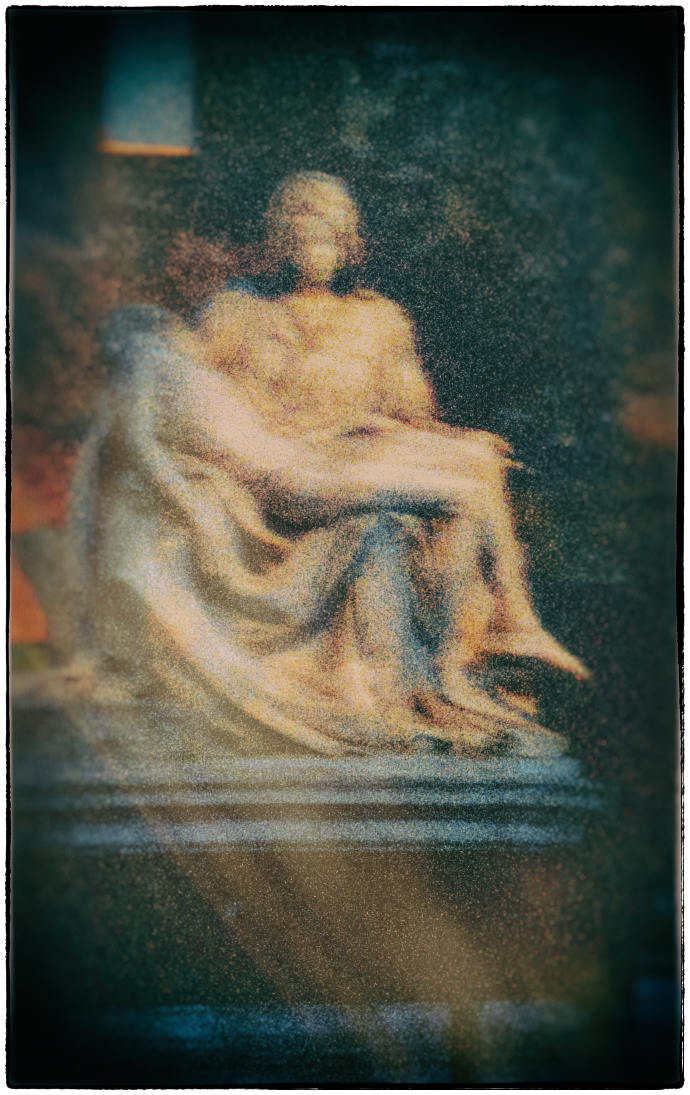
Impressions of a pieta

My wife posts old pictures on Facebook every Thursday. She calls it ‘Throwback Thursday’. My job is to provide the raw materials, which often requires scanning old prints and negatives. A recent ‘Throwback Thursday’ covered Italy – or at least Rome, Florence and Venice. So I set about scanning some old negatives, one of which was of the Michelangelo Pieta in St. Peters, Rome. This was a really bad picture taken many years ago when my technical skills were even less developed than they are now. It’s extremely dark, blurred because of the very slow shutter speed, and very grainy. I couldn’t include it in her ‘Throwback Thursday’, but it did give me something to play around with. By deliberately increasing the blur and bumping up the ‘graininess’ could I make this into something almost impressionistic. I also added some light streaks. So does this reflect a new direction in my work. Something more ‘out of the box’ going beyond my usual cliche’d images? Is this a more artistic Howard? Nah! Still just a lousy picture. Proves once again that “You can’t make a silk purse out of a sow’s ear” or in this case you can’t produce Monet from a digitally enhanced awful photograph. Although as I look at this again it’s starting to grow on me …..

Learned Something New Today: Film Swaps

Film Swap Result

One of the people who follow me on Flickr today “faved” some of my pictures so I thought I’d take a look at some of hers. I noticed that a number of her albums were entitled “Film swap with person XXX”; “Film swap with person YYY” etc. I took a look and I could see that they were something to do with multiple exposures, but I wasn’t exactly sure how the process worked so I dug a bit deeper.

Read More