
Photography Today – From the BBC

Audience 1 Florence, 2004 by Thomas Struth

Is photography art? Today the answer is simple, indeed photography is more popular than ever and arguably the visual art of choice for the masses, but half a century ago the debate still raged.

In a new book, Photography Today, writer, artist and lecturer Mark Durden analyses more than 500 works by 150 artists from the past 50 years, exploring the impact of various genres, from pop art to documentary.

Here Durden offers his insight on ten important photographic works from the book”.

via BBC News – Photography Today.”

The ten (from 150) photographers chosen for the article are: Thomas Struth; Sarah Jones; Peter Fraser; Saidou Dicko; Alfredo Jaar; Anna Fox; David Goldblatt; Joel Sternfeld; Gillian Wearing; and Erwin Wurm.

As you can imagine when you do this kind of selection it inevitably leads to often passionate discussion as to why some are chosen and some are not. See this discussion from Rangefinder Forum, which gets into the photographers selected as well as a broader discussion about art and photography. I liked the Andy Warhol quote: “Art is what you can get away with”.

To my eternal shame I’d never even heard of 8 of the 10 chosen (although I’ll now certainly try to find out more about them).
Robert Frank and Bert Hardy

I was looking through my copy of the extended edition of “The Americans” by Robert Frank. I haven’t spent as much time with this book as I should have – it’s really interesting. Unfortunately it’s also large and very heavy and I find it uncomfortable to read. Maybe I should just have bought the regular (and I believe much smaller) edition.

At 89 Frank is still very much alive and seems to have attained almost god like status among many photographers. I’m not entirely sure why this is. “The Americans” was not initially popular. In fact it was panned by many critics. Many of the pictures are striking though. It came out in 1958 during what many would consider “the good old days” in the US. It presents a rather dark and despairing view of the US. Maybe this is why “The Americans” was not initially liked. It puts forward a somewhat critical view of the US and as Alexis de Tocqueville noted in the 1830s Americans do not like their society and lifestyle to be criticised – especially not by foreigners (Frank is Swiss). Maybe it’s the overall gloom that I don’t like.

Around the same time as I was looking at “The Americans” I came across this on the photographer Bert Hardy:

The photographer Bert Hardy would have celebrated his 100th birthday (in 2013) this year. Though a gifted war photographer, Hardy’s spontaneous and sharp images of people in everyday situations were more characteristic of his work. An exhibition of his images is at the Photographers’ Gallery in London from 4 April to 23 May

via Bert Hardy's photographs – in pictures | Art and design | The Guardian.

I knew nothing about Hardy, but he seems to have spent a lot of his time documenting the UK in the same way that Frank documented the US in “The Americans”. I much prefer Hardy’s pictures. They’re lighter and much more “upbeat” than Frank’s. Perhaps it’s just because I’m British and can relate more to the culture he portrays.

They’re both infinitely better photographers than I am or ever will be so I should probably just keep my mouth shut.

Another documentary: The Colourful Mr. Eggleston

Fascinating. He seems to be another irascible character. I’m still not sure how much I like his work, although I must say that it seems to be growing on me. I could see that he deserves some credit for popularizing color photography, but at first his pictures seems to me to be too snapshot like. As I spend more time looking at them though I’m seeing something else: pictures of the mundane somehow brought to life. At little bit like the pictures by Eugene Atget. At first they just seem like ordinary pictures of buildings, parks etc. in old Paris, but as you look at them you realize that there’s more to it than that. I’ve tried to take pictures like Atget and I can’t. Although Eggleston’s pictures look like simple snapshots I suspect that I couldn’t take pictures like his either. I have a feeling that as I continue to look at this work I’ll get to like it more and more.

Eric Kim has an interesting take on Eggleston in 10 lessons William Eggleston taught me about street photography.

Prints and Frames

I post pictures to this blog. I post to Flickr. I occasionally post to Facebook. But, like many people I imagine, I rarely print any of the pictures (except for the rare photobook). If I print them small they have a way of disappearing for decades in boxes and albums. If I print them larger I have nowhere to put them. So generally I don’t print.

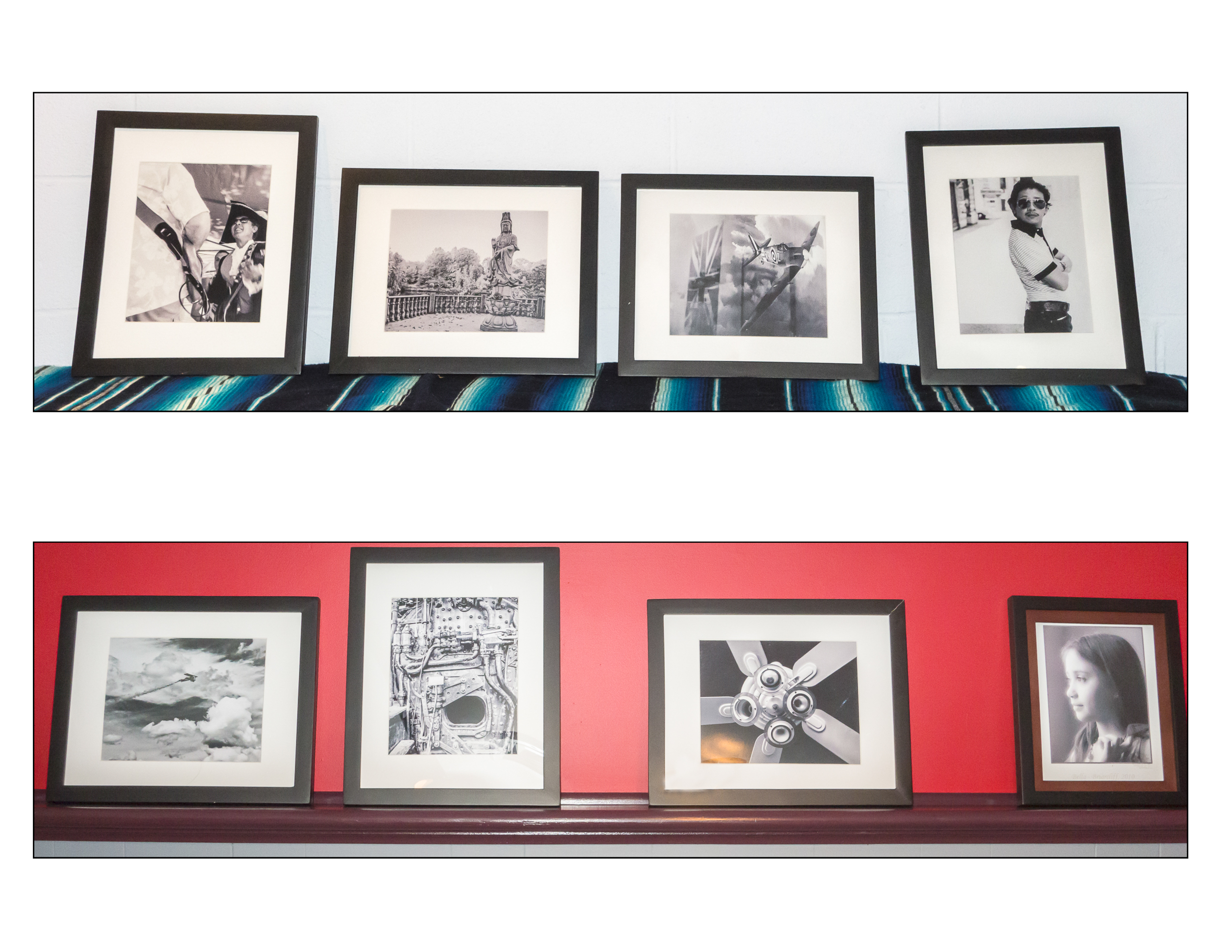
Just lately we did some work on our basement and this gave a little more space for putting up pictures. I didn’t want to spend a lot of time and effort into it, but I had the urge to see what some of my pictures would look like up on the wall. I bought a couple of inexpensive frames from Amazon.com, had a few “quickie” 8x10s done at Walmart and CVS and put them in the frames.

I haven’t hung them yet, let alone thought about a good way of lighting them. But even just propped up I like the way they look. It’s completely different from viewing on screen.

I think I’ll do some more.

Exhibition of photographs lost for 60 years reveals a bygone London

Spitalfields in April 1912 by CA Mathew


Interesting article from the Guardian, UK.

On a spring morning in 1912, a man with a tripod and a heavy camera walked out of Liverpool Street station and into the heart of London’s East End, capturing the children playing with hoops and skipping ropes, the busy shoppers, the pubs, the horse-drawn delivery carts competing with lorries, the tailors promising individual garments at wholesale prices in an area famous for centuries for textile workers, a now vanished world. He then went home to his new photographic studio at Brightlingsea in Essex, and vanished from history.

His photographs of the streets and alleys of Spitalfields, which are going on public exhibition for the first time, are almost all that is known of CA Mathews: his studio is only known because the mounts of the photographs carry its address in tiny neat black ink letters. He took up photography in 1911, and within five years he died, soon after his wife, in late 1916. They may have been victims of the terrible epidemic of Spanish flu that killed more people than the first world war.

via Exhibition of photographs lost for 60 years reveals a bygone London | Art and design | The Guardian.

Unfortunately there are only a few photographs – I wish there were more.

The following caught my attention: “Many streetscapes are instantly familiar to both men – like the corner of Artillery Lane, where Dyson is about to begin restoration work on two houses – but others have been obliterated, including the grand houses in Spital Square. Some redeveloped since the photographer’s day, such as the grand Fruit and Wool Exchange, are controversially facing demolition.”. I think that this is partly why I like to take pictures of old buildings: over time they tend to disappear. One of my photographic idols is Eugene Atget who spent considerable time documenting a Paris that was disappearing. Perhaps a few of my pictures will be the only documentation of something which has long since gone. Of course the chances of this are quite slim nowadays. When Atget and Mathew were alive very few people took pictures. Nowadays everybody has a camera and there are probably millions of pictures of anything you can think of. So the chances of any of my pictures being the only document of a particular building are remote. Still you never know….