
A fascination with cemeteries?

In earlier posts I’ve mentioned that I’ve been looking for a focus for my photography. The conventional wisdom seems to be that you should photograph things which you are “passionate” about and I’ve struggled to discover what that is. I’m interested in a lot of different things, but not really “passionate” about any of them (I’m British after all and and they tend to knock “passion” out of us at an early age).

I do know what kinds of photography I’m not much interested in: anything involving people (moreover I’m never sure about the legality of using the people photographs I take, and I’m aware that nowadays many people do not like their picture to be taken); wildlife photography (this would interest me, but I think I lack the patience and the expensive gear that seems to be required); sports photography (I never go to live sports events and rarely watch sports even on TV).

I’ve also had a few false starts. I once thought I was interested in landscape photography and I guess I still am to a certain extent, but it’s not something that I get really enthusiastic about. I continue to have an interest in old, preferably ruined buildings, but they can be hard to find.

Recently, however, I noticed that I take a lot of pictures of cemeteries. As I’ve mentioned before it’s not because of an obsession with death. Quite the contrary. When I take I pictures in cemeteries I rarely (if ever) think about the people who are buried there. To me cemeteries are pleasant, tranquil places with interesting architecture; picturesque statuary; and beautiful trees, shrubs, plants and flowers. The only time I think of the people buried there is when there is an interesting story behind one of the gravestones or mausoleums.

Could it be that cemeteries are my “passion”? In a recent post (How I found my passion in life) Eric Kim states: “But honestly in today’s world, we use the word ‘passion’ and ‘enthusiasm’ interchangeably. So let’s continue, assuming you want to find your passion or what you are enthusiastic about.” This sounds about right to me. I don’t jump up in the morning thinking I’ve absolutely got to go and take pictures of a cemetery. However, a trip to the two large cemeteries (Greenwood in Brooklyn, and Woodlawn in the Bronx) in New York City that I haven’t yet visited does make my heart beat a little faster. We may go to visit our daughter in Europe later this year and I’m really excited about the possibility of getting to Père Lachaise Cemetery in Paris.

In their excellent book: “On being a photographerBill Jay and David Hurn identify the following as the “basic principles of subject selection”:

Is it visual? You can safely eliminate such fascinating (to you) topics as existential philosophy or the Old Testament or the existence of intelligent life on other planets.

Is it practical? You can cut out topics which are difficult or impossible to photograph at your convenience on a regular basis. For example, if I were a photographer of limited means living in, say, Denver, I would have to eliminate the topic of Japanese pagodas, at least as far as photography is concerned. Or I would cut out an interest in famous film stars — the subject must be not only practical but continually accessible.

Is it a subject about which I know enough? Eliminate those subjects about which you are ignorant, at least until you have conducted a good deal of research into the topic. For example, you are not contributing anything to the issue of urban poverty by wandering back streets and snatching pictures of derelicts in doorways. That’s exploitation, not exploration.

Is it interesting to others? This is a tricky one, but it is worth asking yourself: if you have several remaining topics all of which are equally fascinating, which one is interesting to others? This is tricky only in that it ignores the issue of your intended audience, which might be a small, specialized one, and the issue of pandering to public appeal.

How does my cemetery idea stack up against these criteria?

Is it visual?. Absolutely!
Is it practical?. Definitely! There are lots of them around: small, medium and large; old and new etc.
Is it a subject about which I know enough?. Yes. I already know quite a lot about cemeteries, their history and symbology and my knowledge continues to grow.
Is it interesting to others?. As Jay and Hurn point out “this is a tricky one”. Many people (including my wife) don’t like cemeteries and don’t like to be reminded of death. However, judging by the number of books, websites, blogs etc. related to cemeteries there are also quite a few people who have an interest. In any case I take pictures largely for myself not for other people.

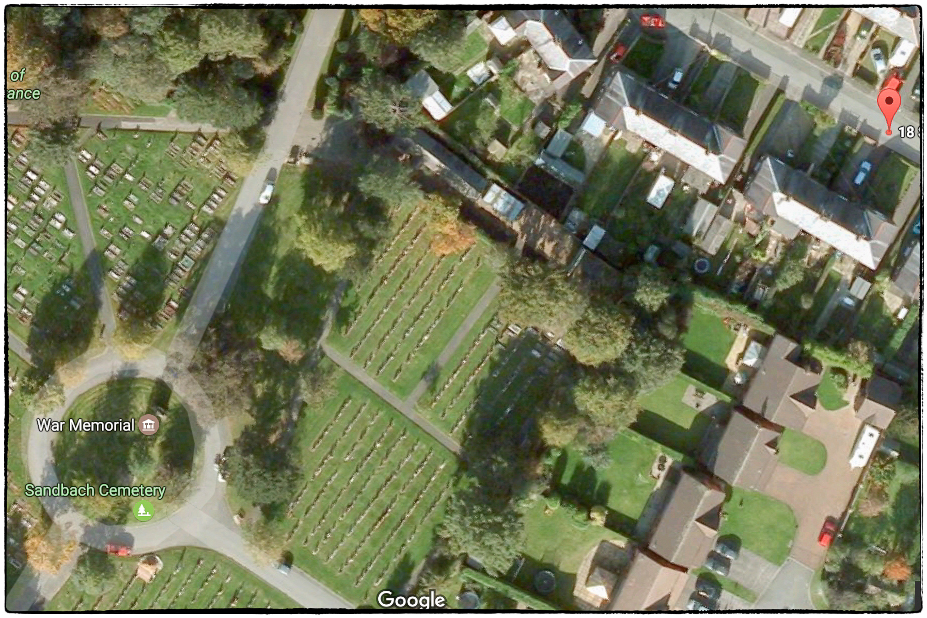
While thinking about this post I started to wonder where this interest in cemeteries might have come from and then it hit me: I grew up right next to one. The picture at the top of this post is an aerial view of Sandbach cemetery in the town where I grew up. In the top right corner you’ll see a red marker, which shows the house were I lived from birth to about 8 years old. I have few memories of my early childhood, but I feel sure that a curious child would certainly have explored this area. I certainly remember walking past the entrance many times.
2016 – The Year in Review

The year got off to a sad start with our friend Dandy’s funeral. He passed away at the end of December, 2015. Soon afterwards it was our wedding anniversary, which we celebrated with a meal at La Cremaillere. February saw us in New York City for a performance of ‘Something Rotten’. My wife’s birthday is in March so we went into the city again – this time to see ‘The King and I’.

April was a very busy month. Our friend Ken returned from Bangkok and stayed at the house in Briarcliff Manor for a few weeks. A visit to the Orchid Show at the NY Botanical Garden was a particular highlight (we went with friends Ken, Menchie and Chita). Other events included a meal at the Hudson Room in Peekskill with friends Roxana, Olga and Gustavo; a piano recital at Our Lady of Restoration Chapel, Cold Spring, NY; a meetup at the Fig and Olive in New York City with my brother-in-law; two nieces and one nephew. My brother-in-law stayed with us for a few days and we took him to Chuang Yen Monastery, Boscobel and Springwood: the FDR Mansion in Hyde park. The month concluded with my birthday celebration: ‘Man of La Mancha’ at the Westchester Broadway Theatre with friends Ken and Roxana.

My wife made her annual pilgrimage to Europe in May to visit and assist children and grand children. This time she went to Switzerland, France and the UK. As usual I stayed home looking after the animals and the houses.

June saw us down in Hastings-on-Hudson for a garden party at our friend Marcia’s house. We also paid a quick visit to nearby Stonecrop Gardens and participated in the Roaring Brook Lake (RBL) annual Garden Tour.

Our older daughter and her family (husband and three children) came to stay in July/August. We also had a visit from old friends Menchie and Chita. We took them to see a Hudson Valley Shakespeare Festival performance of ‘As You Like It’ at picturesque Boscobel

Friends Marcia and Grace came to visit in August, as did the de la Piedras and some of their relatives. We also visited the remarkable Untermeyr Gardens in Yonkers.

September took us to Staatsburg for a visit to the Mills Mansion. We also hosted a meeting (about 30 participants) of the RBL Garden Club at our house (one of the monthly meetings that we regularly attend); had a very pleasant evening by the lake at our neighbors Kate and Terry. Old friend and colleagues Tony and Safiye also came to visit.

Highlights of October include dinner with may wife’s dance mate and her husband at Chatterbox 54 in Briarcliff Manor and Latin Night at the Tompkins Corners Cultural Center.

November was another busy month with a fundraiser at Whitby Castle in Rye; A dinner cruise on the Hudson (with the de la Piedras); a trip into New York City to see Spamilton (with Roxana and her mother); and a visit from our younger daughter with whom we went to the “Pipilotti Rist: Pixel Forest” exhibit at the New Museum of Contemporary Art in New York City followed by a performance of ‘On your feet’. Thanksgiving was spent with a very congenial group at our friend Paul’s.

In December both of our son-in-laws were in town. One came to stay at the lke and we went to nearby Char Steakhouse for dinner. We went to see the other in New York City for lunch at Brasserie Ruhlmann. The year concluded with the annual Garden Club Christmas Party and yet another trip into NYC to see “The Front Page” with Nathan Lane.

We finished off the year with a party at my wife’s friend Carmen’s house.

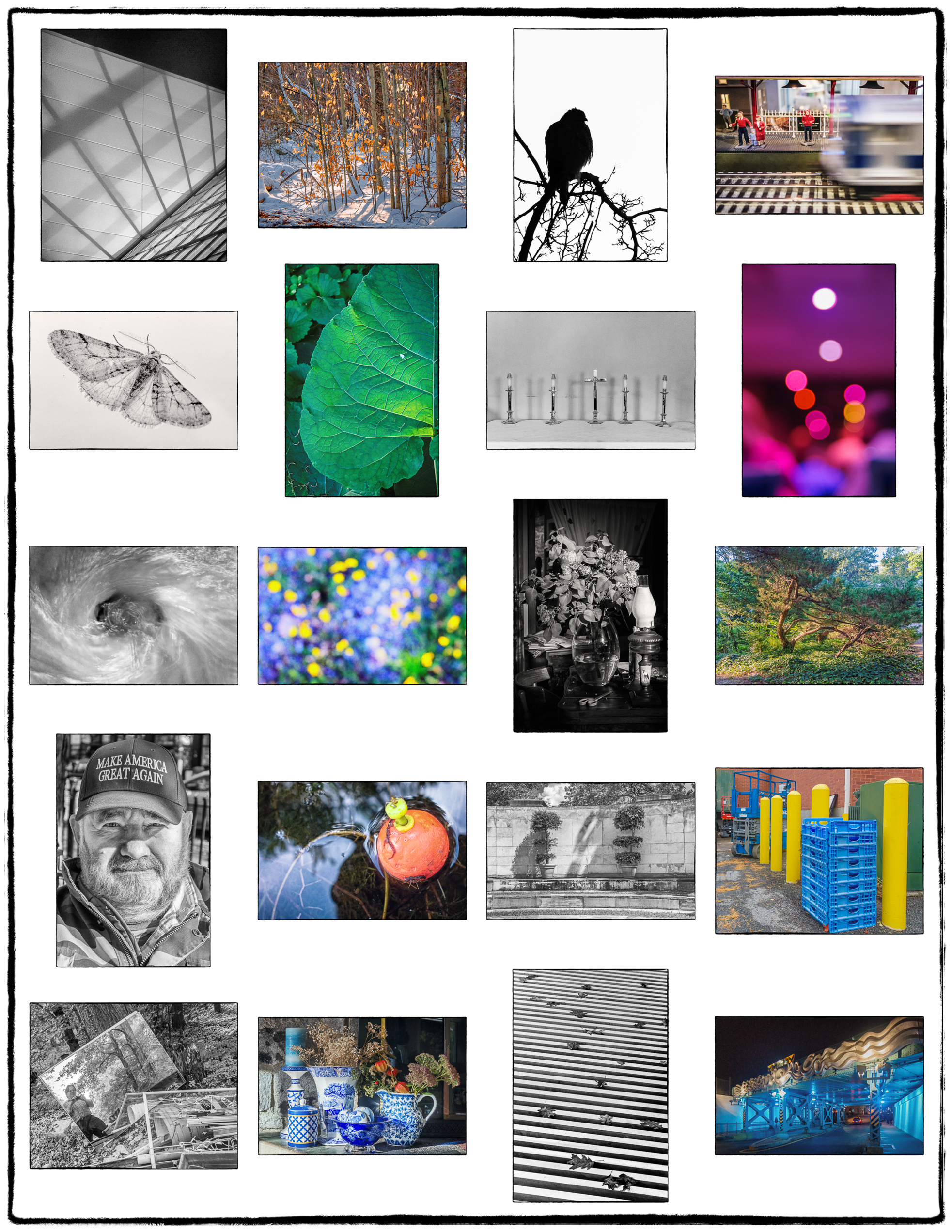
On the photography front, I continue to get out a lot and take pictures. This year I ended up keeping over 2,000 (and probably deleted twice as many). I continue to maintain this blog, which now has more that 1,500 posts with more than 500 being added in 2016 (average 43 per month). I gave the blog a new look in September and since then have been updating the header image every month. I also reconfigured my workspace to make it a bit more pleasant and framed a few pictures to put on the walls.

Disk space was getting tighter and tighter so I did a major cleanup and deleted a large number of older photographs. However, the writing was on the wall: no matter how much I deleted I was still going to run out of space soon. The only answer was more disk space so I acquired a 2Tb drive and moved all of my image files to it, reconfiguring Lightroom as I went.

My photography library continues to grow. This year I added books on John Cohen, Robert Capa (whose grave I unexpectedly came across in a local cemetery), Diane Arbus, William Eggleston, Irving Penn, William Henry Fox Talbot, Edward Steichen, Josef Sudek, and Saul Leiter as well as books by Art Wolfe, Freeman Patterson and Beaumont Newhall’s wonderful ‘History of Photography’.

I’ve also added a few vintage cameras to my camera collection, but not too many. Last year I said that I wanted to use these film cameras more but I’m afraid I haven’t been very successful with this resolution. This is clearly one to carry over into 2017.

My trusty Sony RX100 model one went belly up on Christmas Day. This would normally have been a cause for great consternation. It wasn’t because I’d already been considering an upgrade but had managed to talk myself out of it because of the cost. The demise of of the RX100 m1 gave me all the excuse I needed to get an RX100 m3. It arrived yesterday and my initial impressions of it are very positive. It’s actually the first completely new camera I’ve bought in six years.

Election 2016

It’s finally over! After a year and a half of some of the worst invective I’ve ever encountered in my 30+ years living in the US. By the end it had really worn me down.

I struggled to come up with a photograph to illustrate this post and then one day while walking along the lake I came across this combination of Trump/Pence campaign paraphernalia, a US flag and a couple of other somewhat tattered flags. I think it’s the only example still up around the lake. I don’t know the owner of the house, but since one of the signs reads “Veterans for Trump” and one of the worn flags is a US Marine Corps flag, I’m guessing that he’s a veteran.

I think that many felt the need for change. The system hasn’t been working for them and inequality in the US has been getting worse and worse. I knew it was bad, but until recently I hadn’t realized just how much wealth was concentrated in the hands of such a small group of people. Also the political game-playing in Washington had lead to an almost a complete paralysis in government. Democrats missed this entirely. We were only to willing to type Trump supporters as under-educated, racist, mysoginistic, rednecks. Maybe a small number of them are, but not the 60+ million who voted for him. Many who voted for him didn’t seem to like him that much, but they liked Hillary Clinton less. To them Trump represented change and Clinton represented status quo and the status quo was not longer acceptable to them.

So now we will have President Trump. Things are what they are. At the moment the Presidency, the House, the Senate, and soon I imagine the Supreme Court are all Republican dominated. This represents an incredible opportunity for Trump to achieve some tangible results. We now have to give him a chance to do so.

Many said that he would never be the nominee of a major political party. He was. Many said that he’d never be elected President. He was. Many said women would not vote for him. They did. Many said minorities would never vote for him. They did. Many are now saying that he’ll be the worst President in history. Maybe he’ll surprise us again?

Bolt revisited

I’m not referring to Usain Bolt here (although I do have a picture of him on the blog: see What an amazing photograph of an incredible athlete). Rather I’m referring to the rabbit that has recently started to appear in our garden (see A new visitor) and which one of our granddaughters has named “Bolt” after the famous Usain – I suspect because the rabbit ran so quickly.

I was walking the dog around the lake when I started to think about why I take photographs. In my reading I’ve been advised that it’s not enough to take a picture just because I liked the way something looks. I need to know why I liked it. To know what I was feeling when I took the picture.

For some reason I started to think about why I’d taken the picture of the rabbit. One reason was I thought that it was really cute. A second was that our six year old granddaughter was really excited to see it. A third was that it’s not every day that we see a rabbit in our garden and I wanted to document the occasion.

Then my thoughts wandered to rabbits in general and all kinds of thoughts came flooding back:

I have a clear memory from when I was young of seeing a rabbit with milky-white eyes. It was quite traumatic and I later learned that it was a victim of a horrible disease called Myxomatosis that appeared in the UK in the 1950s and decimated the rabbit population (fortunately rabbits breed – well like rabbits – and they the rabbit population in the UK has since recovered and also developed immunity to the disease).

I also remembered my grandfather, who was a bit of a poacher who would from time to time bring home rabbits for dinner (or tea as we used to call it). I hadn’t realized that rabbits were for eating so this was quite a shock. I was very close to my grandfather and it was nice to have this memory of him return.

Watership Down – a book about rabbits. I started to read it our kids at bedtime when they were quite young. We never did finish it!

Could it be that, unknown to me, these thoughts were hovering around just below the surface and influencing my decision to take the picture?

I had also read that a photograph should be able to stand by itself and should not need words to explain it. All well and good, but I doubt that I could come up with a picture of a rabbit that by itself could conjure up all of these feelings – unique to me – in another person.

Or maybe I just liked seeing a cute furry animal in a place where I didn’t expect to see it?

This isn’t what makes an artist!

I came across this post (An Illustrated Case of the Misguided Photographer Believing his Work is Art) the other day and I can’t say that I agree with it.

The authors main point seems to be that art has to be created from nothing. You start with a “blank canvas” and you make something:

For a photographer to be an artist, the photographer will have to create something. Photographing something that is already in existence, whether landscape, still life, or even street candid photography is not creating something. It’s documentation.

According to him only certain types of photography qualify as art: i.e. staged photography. Anything else is just documentation. Not surprisingly his photographic works of art have been created by photographers famous for staging their photographs:

You see, I’ve seen works of art in photography. It’s usually rather elaborate. It’s not one of those things that happen with a quick snap. Of the works I’ve seen, the most memorable piece is by David LaChappelle, titled “Jesus is my Homeboy.” I remember absolutely loving it, when I first saw it many years ago. Though now being more mature, I find the connection to Leonardo Da Vinci’s “The Last Supper” to be rather unoriginal.

In recent years, I’ve moved on to Gregory Crewdson. And believe me, his photographs didn’t just happen overnight (in the figurative sense, though literally, it was taken overnight). I especially love the surreal in his hyperrealistic photographs of Middle America. There’s always something just not quite right, that makes you take a second longer look at details of his work.

So once you’ve seen art in photography, you will never mistaken photographic documentation as art.

To me art is something that moves me; something that makes me come back again and again to re-consider it; something that arouses my passions; something that makes me think. It’s got nothing to do with whether or not it was created from nothing. Shakespeare is a great artist, not because he created something from nothing, but because even 400 years after his death he makes us laugh; makes us cry; makes us feel joy; makes us feel sad; makes us come back again and again to his plays. Also remember that when Da Vinci painted the Mona Lisa he wasn’t gazing at a blank wall. He had model. So it must be “documentation” then. Can’t possibly be art.

I particularly disliked the condescending tone:

To be fair to this blogger. I too am not an artist. I am a content creator. What I have over him is an education in fine art, and career experience as a designer. So I have a better understanding of what art is.

Presumably the pictures the author presents are his own (and I quite like them) so I can’t comment on the pictures he refers to, but one would think that the curators of such prestigious institutions as the NY Museum of Modern Art would have a decent “understanding of what art is” yet they still insist of having exhibitions of “documentation”. The Met Breuer presently has a exhibition of works by Diane Arbus. She took pictures of freaks, outcasts, prostitutes, carnival people. Clearly “documentation” right? So why does the Met Breuer exhibit such stuff?

I thought the discussion about whether or not photography was, or was not, art ended some time ago. Apparently not.