
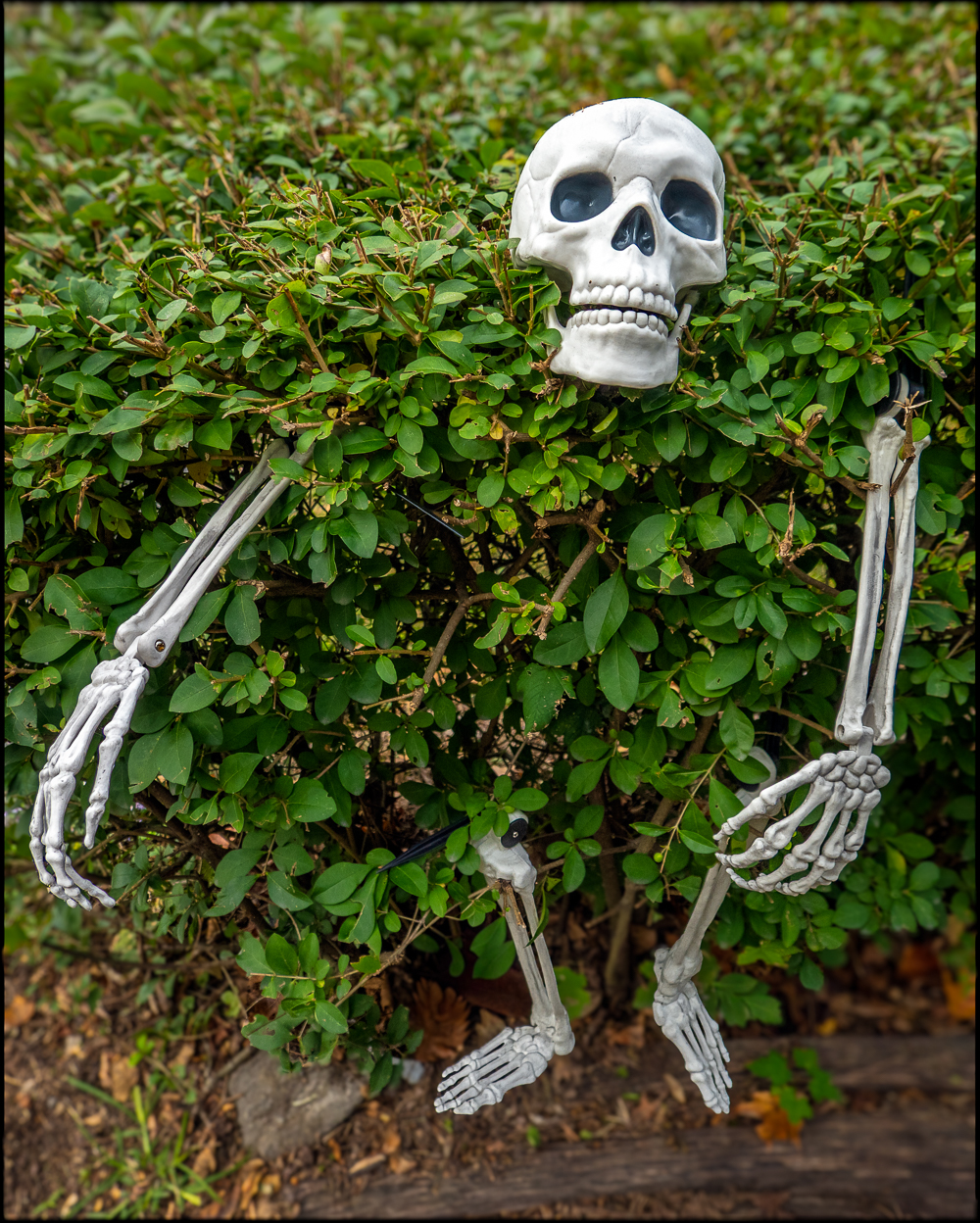
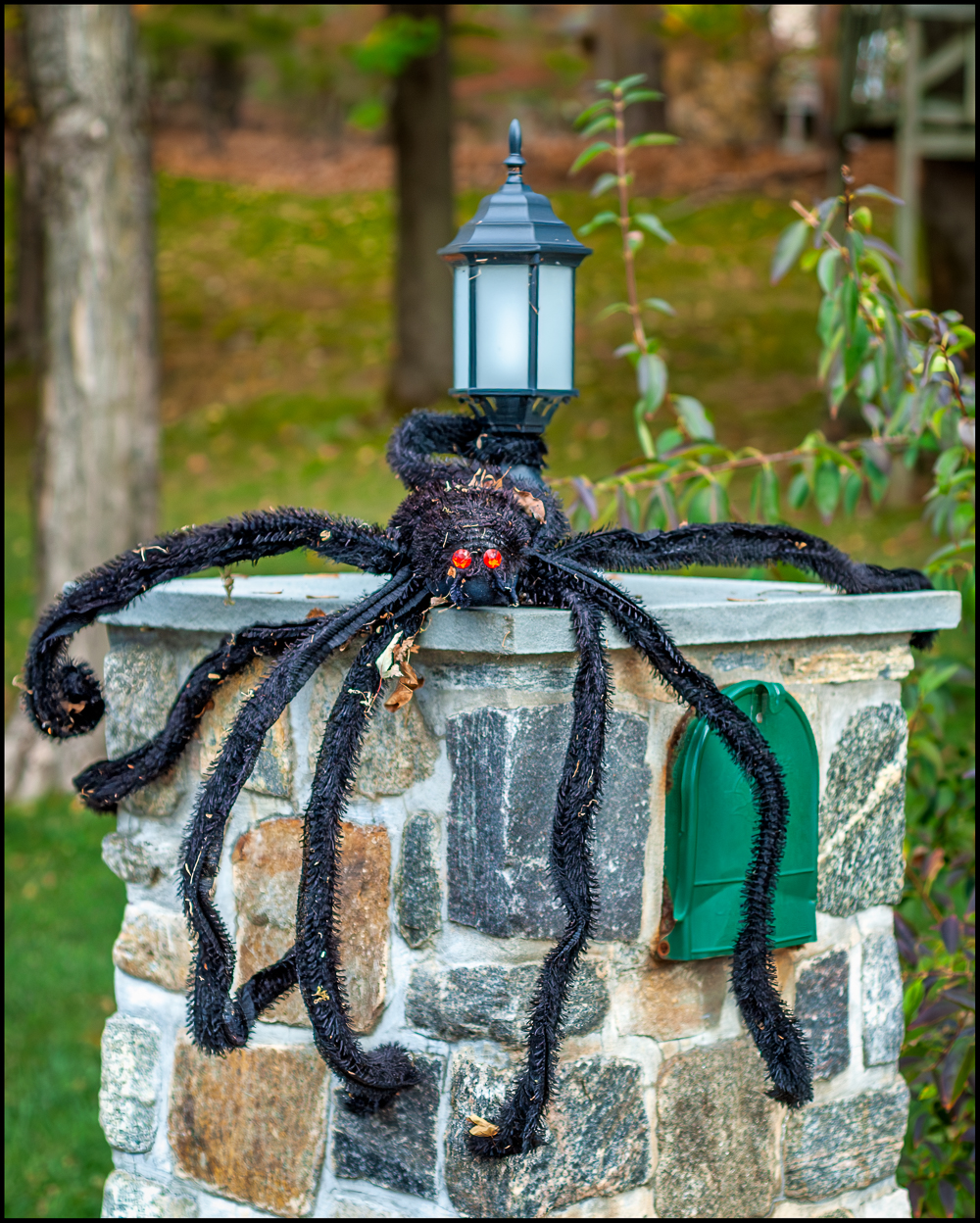
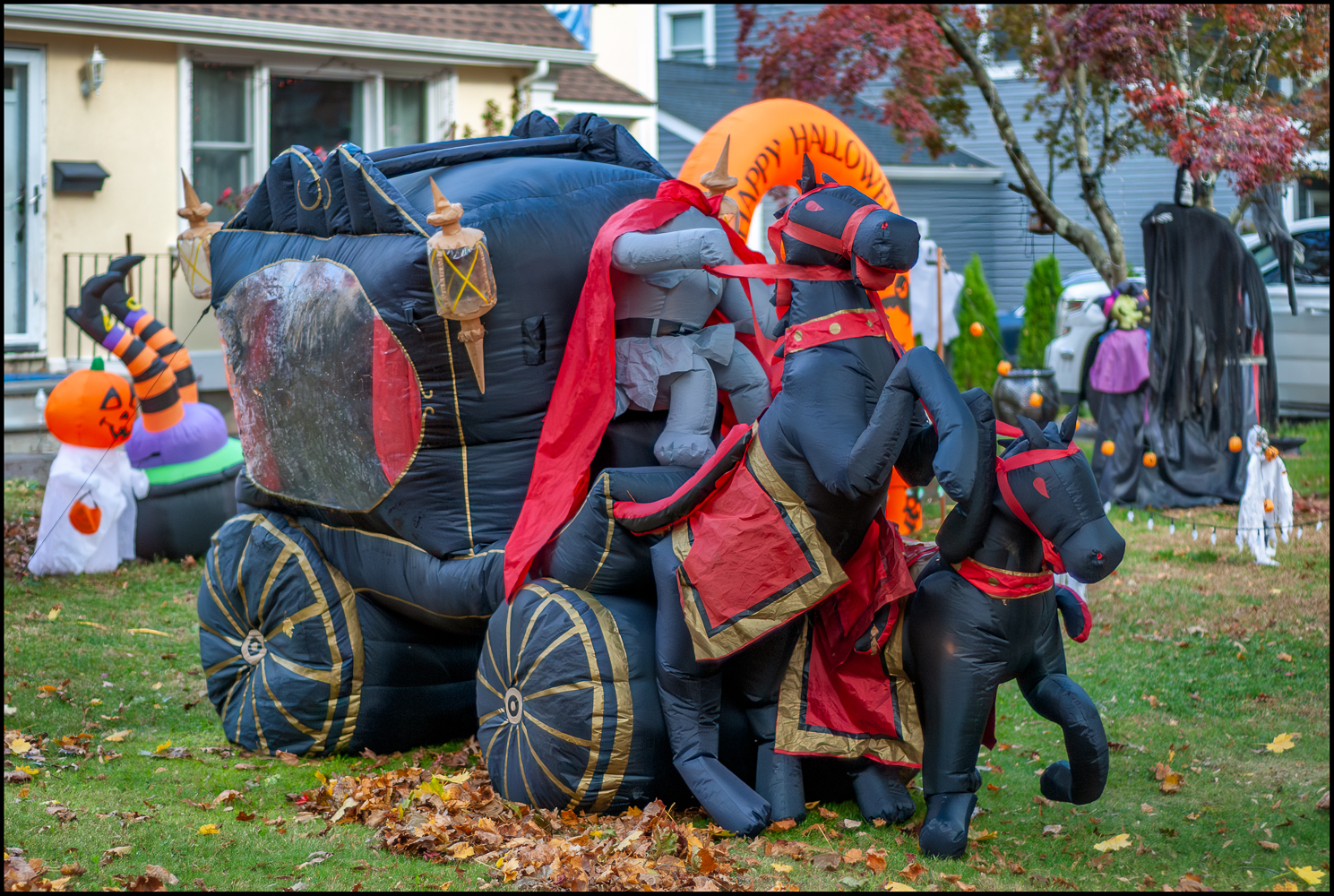
The title says it all. I particularly liked the skeleton and the spider.

Taken with a Nikon D200 and Nikkor 50m f1.8 D (except for the skeleton which was taken with a Sony RX100 VII.
Photographs and thoughts on photography and camera collecting

The title says it all. I particularly liked the skeleton and the spider.
Taken with a Nikon D200 and Nikkor 50m f1.8 D (except for the skeleton which was taken with a Sony RX100 VII.
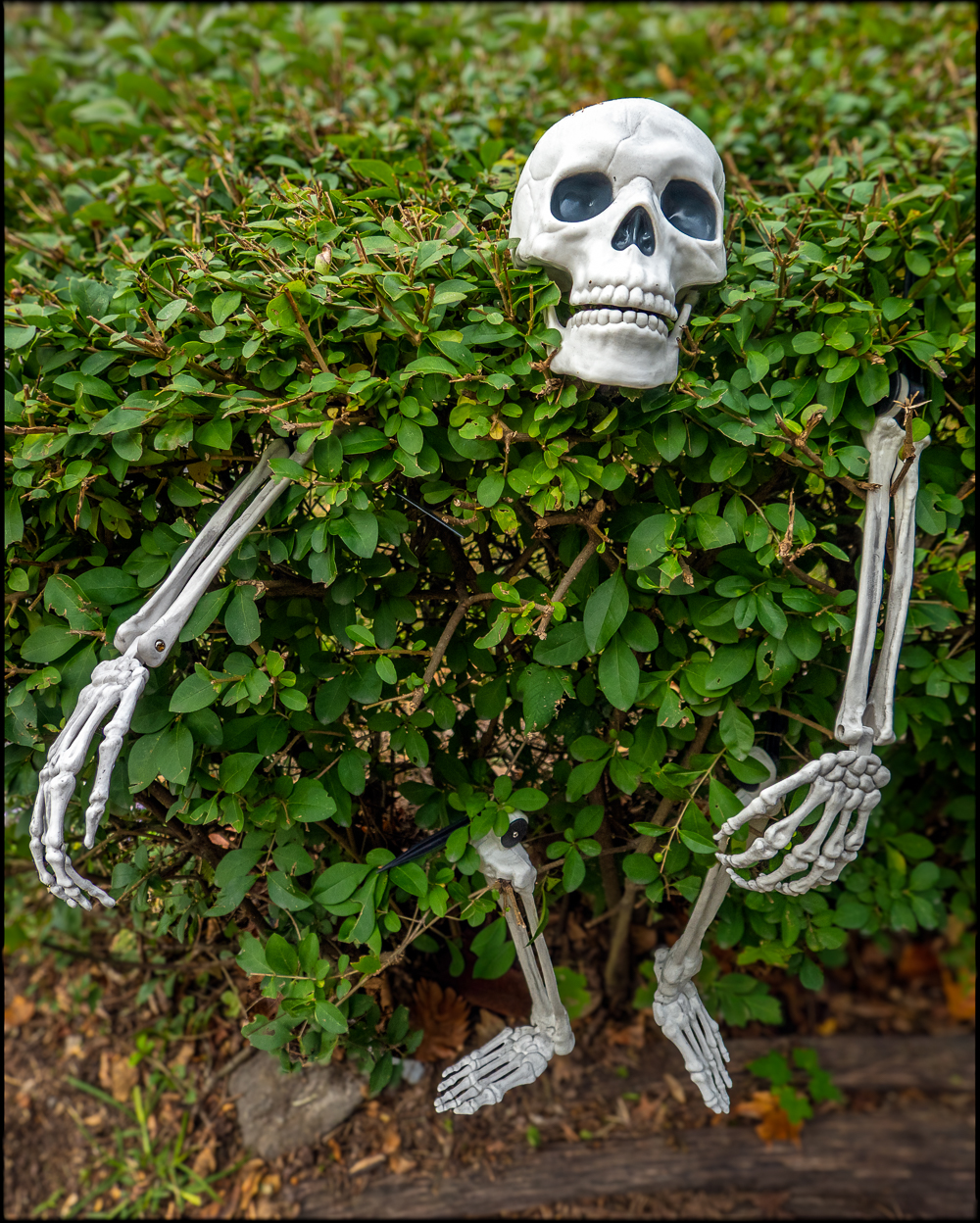
Not something you see every day? Well, maybe you do, at least here in Sleepy Hollow country a week before Hallowe’en. I’ve seen lots of skeletons before, but I can’t recall seeing one stuck in a hedge. So maybe it is “something completely different” after all.
Taken with a Sony RX100 VII

Some more pictures of houses west of the train tracks (there are a lot more east of the tracks, but I didn’t have the time to tackle those). They form part of the Cold Spring Historic District. Indeed, the plaque on the wall of the building in the picture above reads:
According to Living Places USA Neighborhoods & Towns
The Cold Spring Historic District is concentrated along the long east-west axis of Main Street, a commercial street with scattered municipal, ecclesiastical and residential structures. All of Main Street from the Hudson River east to the village limits is contained within the district. Portions of residential streets intersecting Main Street are also included in the district and include the distinctive examples of the full range of styles, buildings types and construction methods spanning over a century of growth in the community.
As an eighteenth century Hudson River landing, the village was initially focused around the shoreline. The area between the river and the railroad on Market, Main and West Streets represent the earliest configuration of the village. Today this area is distinguished by nineteenth century structures, however the character of the landing is maintained.
In the early nineteenth century, with the completion of a turnpike travelling to the interior, a plan was established for the development of the village by Frederick Phillipse. The orderly arrangement of commercial structures on Main Street, the flanking residential streets, and large estate houses higher up on the hillside are indicative of this early building plan. The thorough mix of early, middle and late nineteenth century structures throughout the district document the phases of the village’s growth within the established pattern of streets. Many of the buildings have had alterations made to their storefronts, window sash or siding material yet to historic character, scale and setting of the district survives substantially intact.
The commercial district of Main Street is an eight block section that stretches from the river to New York Route 9D (Morris Avenue/Chestnut Street). The construction of the railroad in the 1850’s severed Main Street and traffic must detour to a bridge south of the commercial district to reach the landing. Two and three story buildings front on Main Street on narrow lots. Architecturally, it is an extremely eclectic streetscape with early nineteenth century frame buildings and later brick structures of various scales juxtaposed along its lengths. Details from the many building periods are intact: bracketed cornices, cast-iron window lintels, mansard roofs, storefronts, porches, etc.
Morris Avenue and Chestnut Street (Route 9D) intersects Main Street about midway along its length. This major intersection is distinguished by Cold Spring’s most notable church, St. Mary’s Episcopal Church, a hotel, and a modern gas station. Opposite the church on Chestnut Street, a group of substantial town houses suggest the prestige of the location. Impressive Second Empire homes face Morris Avenue north of the intersection. Capitalizing on the view of the river and the highlands available at higher elevations, the wealthier members of the community built on Paulding Avenue, named for one of Cold Spring’s prominent families. Below these estates on Chestnut Street, Academy Street and Cherry Street is more modest middle-class housing, and a small, yet distinguished, Presbyterian Church. This character of housing, though earlier, continues east on Main from Route 9D to the village limits. A brick Methodist Church and the Philipstown Town Hall are buildings of particular architectural interest in this section of the district.
Two other residential areas adjacent to Main Street are included in the historic district. Kemble Avenue, south of Main Street, contains a significant surviving row of duplex workers’ houses built for laborers at the West Point Foundry which was immediately to the south. The archeological remains of the foundry site were listed on the National Register, April 11, 1973.
North of Main Street, adjacent to the railroad tacks is a residential neighborhood reflecting the railroad’s role in village life. The passenger station survives intact and re-used as a restaurant. Railroad Avenue and Stone Street contain small neat houses from the railroad era. Fair Street contains more substantial homes and a church and parsonage in exceptionally good condition. The streets not included in the district contain larger numbers of substantially altered buildings or were developed since the 1930’s.
The Cold Spring Historic District contains approximately 225 structures of varying types periods and methods of construction.
Significance
The first mention of ‘Cold Spring’ appears in the minutes of a meeting in Philipse’s Precinct in April of 1772. Philipse Precinct later became the town of Philipstown, in which Cold Spring is a village. It had been patented by a grant, to Adolph Philipse, in June 1677. Frederick Philipse, a descendent, was the first male member of the family to reside in the precinct and he laid out most of the streets, sold lots and regulated the growth of the area until it was incorporated in 1846.
By the beginning of the nineteenth century, only a few houses formed a hamlet down by the shore of the Hudson. In 1815 the first road was built from Cold Spring to Patterson (Main Street – Route 301) on the east side of the county, with toll houses at various intervals. It was constructed by the Philipstown Turnpike Company. In 1816 it was rumored that a foundry was to open and the waterfront area became the nucleus of the later, important industrial community of Cold Spring which centered around the West Point Foundry. The foundry was chartered in 1818. Two years later the first gun contract was signed and great prosperity occurred in the village. Homes for foundry operators sprang up, built by the West Point Foundry on its own land.
In 1837 the decision to consolidate some foundry departments of operation at New York in Cold Spring again increased the size of the population and community. Cold Spring became a commercial and manufacturing center in the Hudson Highlands. The Gouveneur family, owners of large tracts of land, began to sell small lots in 1839. More streets were built, churches established and stores multiplied.
During the Civil War, the West Point Foundry reached its peak with the invention of the Parrott rifle gun and projectile by Robert Parker Parrott, a West Point graduate, former assistant professor of Mathematics at the Academy, and supervisor of the Foundry. Parrott used his fortune from the Parrott rifle to beautify the village and build homes for his employees. In 1868 he donated the property and contributed toward the building of the Church of St. Mary’s in the Highlands.
Many of the structures within the historic district survived the fires of 1862 and 1875. Several stores and buildings on the south side of Main Street were destroyed in 1862, though most were rebuilt. It was again the south side of Main street, but above the tracks, that suffered severe damage and loss in 1875. The railroad (N.Y.C. & Hudson River Railroad) had been built during the 1850’s dividing Main Street, east of Market Street. By 1868 it was determined that a town building was necessary for public meetings and the present Philipstown town hall was built at the district’s eastern-most boundary. A few random properties were built between the late 19th century to the turn of the 20th century, as the community attained its present size.

Taken with a Sony RX10 IV.

I met my daughter outside the theater, and we were, finally, ready to see the show.
Did I enjoy it? Well, first a little history. I saw the movie many years ago (and loved it). When the show first came out in 1993 it opened first in London. Since I was in New York I wasn’t able to see the show, so I bought the original cast recording instead. I loved that too. Eventually I saw the show in London. I’ve seen a lot of shows in New York and for some of them I didn’t care for the production. But I’ve never seen a poor performance. The depth of talent in New York City is incredible. When I saw the show in London the production was good, but the performances (particularly of the female lead) were less so. I was a bit disappointed, but I hoped to see it again sometime.
Fast forward to the present day. The performances were wonderful, especially those of the male and female leads. Nicole Scherzinger was particularly impressive despite the fact that she was rather too young, and perhaps too attractive to play the part. But what a fantastic voice.
Unfortunately, I have mixed feelings about the production. There were no sets. The earlier production I saw had realistic period (1940s) sets and costumes. This one had neither: just a pretty much empty stage and uniform black/grey costumes. It was a bit dreary, and at times could potentially cause problems. Near the end some asks something like “Who’s Norma Desmond?”. In the earlier production the walls were covered with pictures of her (showing how narcissistic she was). The male lead answers by pointing at pictures in turn and saying “That’s Norma Desmond! That’s Norma Desmond! That’s Norma Desmond!”. Of course, in this production there are no pictures to point at. Seemed a little strange. I could give other examples. I also thought the giant screen, although effective at times, was used too much. Finally, I find Norma to be a very sad person. Although the original production had a certain amount of humor, I felt this one poked too much fun at Norma’s expense. It was a bit like kicking a homeless man.
Still, I shouldn’t be so critical. You can’t always repeat the same production over and over again. It was a valiant attempt, which I felt didn’t quite work. Just the same I enjoyed it immensely!
Taken with a Sony RX100 MVII

This picturesque doorway is in the Paramount Building:
1501 Broadway, also known as the Paramount Building, is a 33-story office building on Times Square between West 43rd and 44th Streets in the Theater District neighborhood of Manhattan in New York City. Designed by Rapp and Rapp, it was erected from 1925 to 1927 as the headquarters of Paramount Pictures. The building is designed in the Art Deco and Beaux-Arts styles. The office wing on Times Square contains numerous setbacks as mandated by the 1916 Zoning Resolution, while the rear wing housed the Paramount Theatre from 1926 to 1967. Newmark & Company owns 1501 Broadway.
The facade is mostly designed with brick walls, though the first five stories are ornamented with limestone piers. The main entrance is on 43rd Street. There is also a five-story arch on Broadway, facing Times Square, which leads to a Hard Rock Cafe; it is an imitation of the former Paramount Theatre entrance. Atop the building is a four-faced clock, with two large faces and two small faces, as well as an illuminated globe that could display the time. The ground floor historically had an ornate lobby leading to the theater, which had 3,664 seats over four levels. The modern building contains office space in both the original office wing and the theater wing.
Paramount predecessor Famous Players–Lasky proposed the theater in 1922, but Rapp and Rapp had revised the plans to include an office tower by 1924. The theater opened on November 19, 1926, though the offices did not open until the following year. The clock and globe on the roof were blacked out during World War II. A group led by David Rosenthal converted the theater to offices in 1967 and removed the theater’s original arch. The Paramount Building’s facade became a New York City designated landmark in 1988. The arch, clock, and globe were restored starting in the late 1990s, and the main entrance was relocated in another renovation in the 2010s.
The building has a much more spectacular entrance, which now serves as the entrance to the Hard Rock Cafe. I didn’t take a picture of it because I already have pictures from an earlier visit.
For more information, and some lovely historical photographs) of the Paramount Building see here.

Taken with a Sony RX100 MVII


