
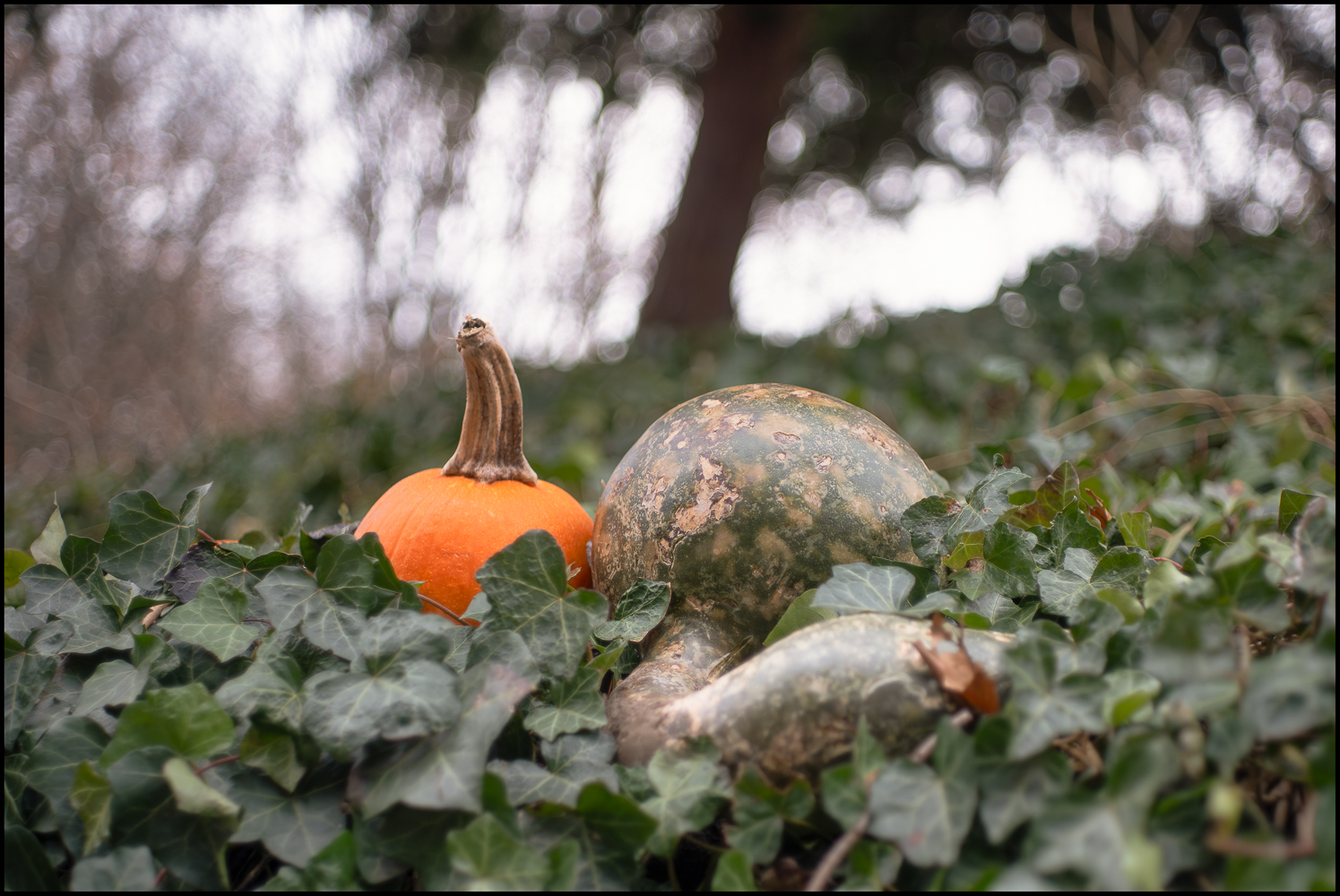
Unless I’m very much mistaken the object on the left is a pumpkin, the one on the right a gourd. But what’s the difference? According to Laura Miller on gardeningknowhow.com:
“In the simplest terms, we carve pumpkins, cook squash and decorate with gourds. Yet, the lines between these three terms are somewhat blurred. Not all pumpkins are grown for jack-o-lanterns and some gourds can be eaten when young.
Let’s unravel this mystery by first talking about the similarities between the three. They are all members of the Cucurbitaceae family. In addition to pumpkins, squash and gourds, this family is also home to cucumbers and melons. As you may have guessed, cucurbits are herbaceous vining plants. However, some members like zucchini grow on very short vines.
…
One way we often distinguish between gourds and squash ([note: pumpkins are a type of squash]) is that gourds are grown primarily for decoration or use in crafts, while squash is cultivated for food. Yet, some types of gourds, like the snake gourd (Trichosanthes cucumerina) can be eaten when young and tender. Other gourds, however, have bitter, stringy flesh and are largely considered inedible.
The difference between pumpkin and gourd classification also becomes fuzzy when we consider varieties like miniature pumpkins. Are these cultivars in the Cucurbita pepo species edible or solely for decoration? Turns out, you can eat them.
However, they are often sold alongside inedible varieties of C. pepo gourds. Purchasing these adorable miniature pumpkins for consumption is not advisable as decorative fruit may have been sprayed with poisons like shellac to preserve their beauty.
Bottom line, Cucurbita is a Latin word whose English translation means gourd. Thus, the term gourd can technically refer to any of the tendril-bearing members of the Cucurbitaceae family. In addition to pumpkins, squash and gourds, this also includes fruits and vegetables such as cucumbers, watermelon and cantaloupe.”
So, there you have it: you eat squash (including pumpkins) and decorate with gourds. My family tells a story from long ago when I bought the wrong kind of gourd thinking it was something you could eat. I tried very hard to prepare it but couldn’t even penetrate the tough outer layer. It did look nice though.
Taken with a Sony A7IV and approx. 50-year-old 55mm Minolta Rokkor-X f2.


