Lost cat

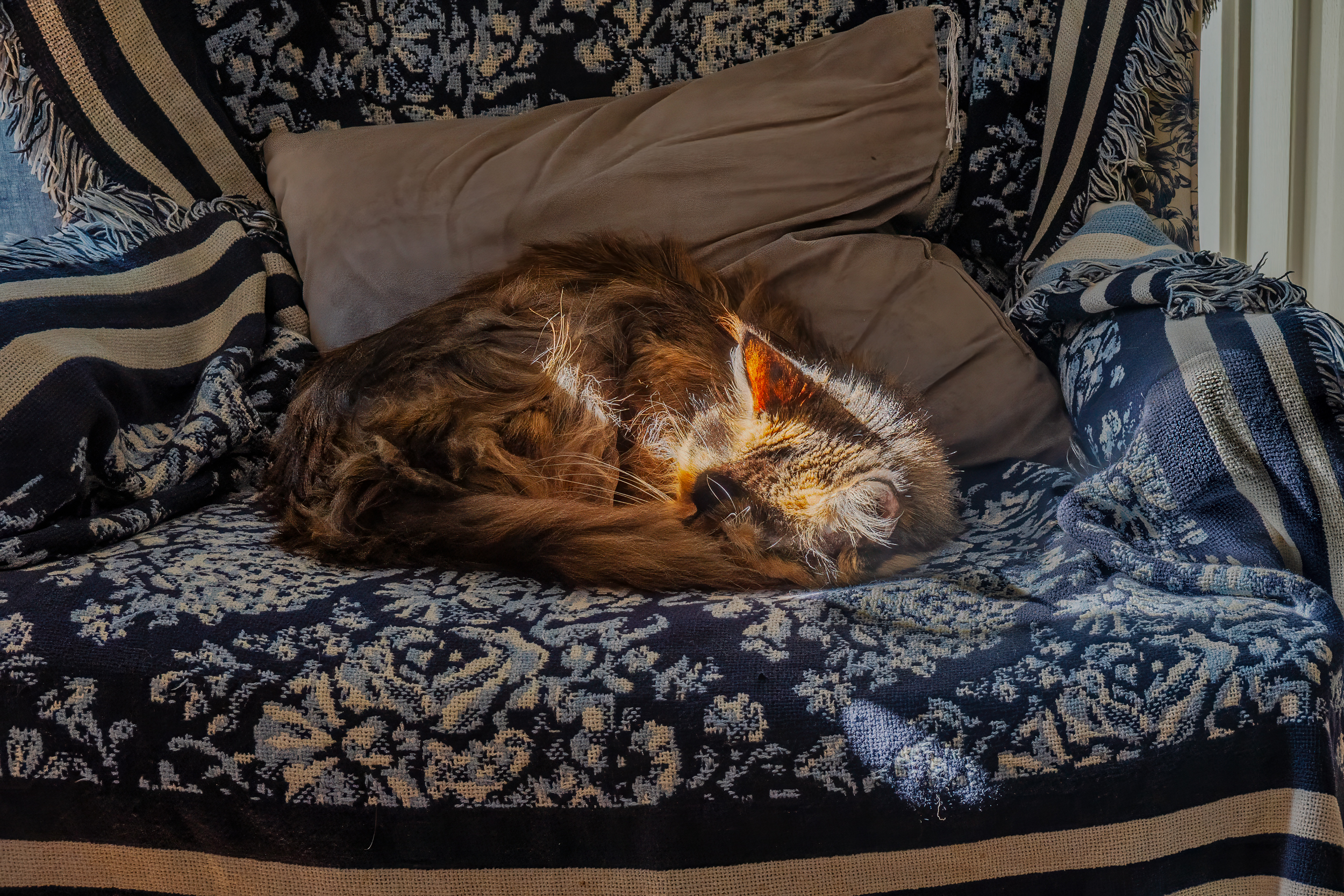
My cat is a creature of habit. When I wake up, she jumps onto the bed (if she’s not already on the bed) and wails for her treats, which I dutifully give to her. Then, when I go down to make my coffee, she follows me and demands her food.

This morning was different. When I woke there was no cat. I rattled the container for her treats. That usually brings her out, but not this time. She’s not a young cat and as I searched the house, I feared that maybe she had passed away during the night. However, the house was devoid of cat corpses. I looked everywhere…nothing, until I noticed that on the lower level of my house a door was open. That’s where her cat litter is. I’d opened the door and closed the screen door to get some of the smell out. My house cleaner was coming that day and I didn’t want to subject her to the smell of the cat litter.

What I think had happened was that, for some reason, the cleaner had opened the screen and forgotten to close it. The cat had probably gone out through there. She’s a house cat and until very recently had shown no interest in going out. However, just lately she has taken to going out onto the deck outside my bedroom. Maybe this had given a taste of the outdoors, and she now wanted to explore further.

This calmed me down a lot. I’ve had outdoor cats before (one of which would disappear for days at a time) and discovered that eventually the come home, usually when they’re hungry! I figured that unless a bald eagle or a coyote (we have both in my neighborhood) got her she’d be fine.

Sure enough a few hours later I happened to open the front door and there she was sitting nonchalantly outside as if nothing unusual had happened. Typical cat behavior!

So, all’s well that ends well.

Taken with a Sony A7IV and Rokinon/Samyang AF 75mm f1.8 FE

Cormorants

Cormorants have a voracious appetite and can consume up to a pound of fish in a single day? These birds are renowned for their incredible diving abilities and unique characteristics.

Cormorants possess unique physical attributes that distinguish them from other avian species. They have a distinct appearance that allows them to blend seamlessly with their surroundings. They have long necks, hooked bills, and dark plumage, making them well-suited for life in aquatic environments. Their plumage, consisting of dense, waterproof feathers, plays a crucial role in their ability to maintain buoyancy while diving and swimming underwater. These feathers contribute to their sleek and streamlined bodies, enabling efficient movement through the water. The beak of a cormorant is sharp and pointed, perfectly adapted for its diet and hunting techniques. With their beaks, cormorants can catch and grip fish effectively, facilitating successful hunting and feeding. A notable feature of cormorants is their webbed feet, which aid in their swimming abilities. These specialized feet provide greater propulsion and maneuverability in the water, enabling cormorants to swim swiftly and pursue their prey with agility.

They are highly adaptable creatures that can be found in a variety of habitats, both freshwater and saltwater. They have managed to populate different environments worldwide, showcasing their resilience and wide-ranging adaptability. Whether you’re exploring serene lakes, mighty rivers, picturesque coastal areas, or even remote islands, you may come across these remarkable birds. Cormorants are particularly well-suited for aquatic habitats, and they thrive in both freshwater and saltwater ecosystems. Their sleek bodies and webbed feet make them excellent swimmers and divers, enabling them to navigate through various bodies of water with agility. They are often observed in areas with abundant fish populations, such as estuaries, marshes, and mudflats.

In addition to fish, cormorants also incorporate aquatic invertebrates into their diet. These include small crustaceans and insects, which they find in their watery habitats. The inclusion of aquatic invertebrates in their diet allows cormorants to access a broader range of nutrients, contributing to their overall health and survival.

Cormorants are social birds that often gather in large groups, called colonies. These colonies serve important purposes such as breeding, nesting, and roosting. The social behavior of cormorants contributes to their overall survival and reproductive success as a species. During the breeding season, male cormorants perform elaborate courtship rituals to attract females. These rituals involve displays of agility, strength, and vocalizations. By showcasing their desirable traits, male cormorants aim to impress and win the affections of the females within their colony. Cormorants build nests, constructing them out of twigs, grass, and other materials. The nests are typically located on cliff sides, trees, or the ground, depending on the available habitat. Cormorants are diligent nest builders, creating sturdy structures that provide a suitable environment for their eggs and young.

Cormorants have an average life span of around 20 to 30 years. With proper conditions and without significant threats, these birds can live for several decades.


Taken with a Sony RX10 IV

Deer in the headlights

Or at least it would be if…it wasn’t daylight, and I wasn’t walking rather than driving. This deer just walked out of the “woody” area to the side of the road and stopped in the middle of the road. There was very little traffic along the road at this time, but I became a little concerned when I heard a car coming. However, the car slowed down (and eventually stopped) some distance from the deer. At this point the deer ambled back into the trees.

Taken with a Sony RX10 IV

Law Park Pond – Part 2

In an earlier post (See: Law Park Pond) I wrote about how I had failed miserably at getting pictures of damselflies on a nearby pond.

In that post I mentioned that I thought the reasons I had failed were:

  • I had the wrong camera/lens. But then this begs the question: what would be the right camera/lens? And in any case that was the only camera I had with me.
  • Because of the above I couldn’t get close enough (unless I wanted to wade into the pond) and had to crop too much thus reducing quality.
  • The camera was certainly able to focus on, and capture what I wanted, but I couldn’t react fast enough.
  • Perhaps a better approach would have been to wait until one of them landed on a nearer reed. I should have been more patient and waited longer.

I also wrote that I would:

… go back with a better camera/lens and hope that a higher resolution sensor (to facilitate cropping) will help. I’ll also take a lens with more reach. I’ll try to be more patient. It’s also clear that I need to practice taking pictures of fast-moving insects.

Today I went back and tried again, this time with a camera with a 33-megapixel full frame sensor (the camera in the earlier post had a 20-megapixel 1″ sensor) and a 28-300mm zoom used mostly at 300mm (the other camera had a 24-200mm lens used mostly at 200mm).

This made a big difference and I’m much happier with the results. I’m now fairly confident that I can get a decent picture of a damselfly when it has landed. What I’m still unable to do is get a picture of one in flight. I tried but they’re quite small, incredibly fast in flight and really hard (almost impossible for me at the moment) to capture. So, I’ll need to do some reading to try to get some tips on how to do this. And I’ll have to practice more.

I’ll keep trying.


Taken with a Sony A7IV and Tamron 28-300mm f/4-7.1 Di III VC VXD lens.