Mr. Law, we need a church – Overview

Every year the Briarcliff Manor-Scarborough Historical Society (where I volunteer) organizes a series of presentations on topics related to the history of the village. This year is the 50th Anniversary of the Society and the centennial of the death of Walter W. Law, the founder of our village. We usually hold these presentations in the Village Vescio Community Center. But this year we’ve decided to do something a bit different. We’ve decided that the focus of our Anniversary year will be on Walter Law himself, and we’re going to try to hold the presentations in some of the village’s Houses of Worship.

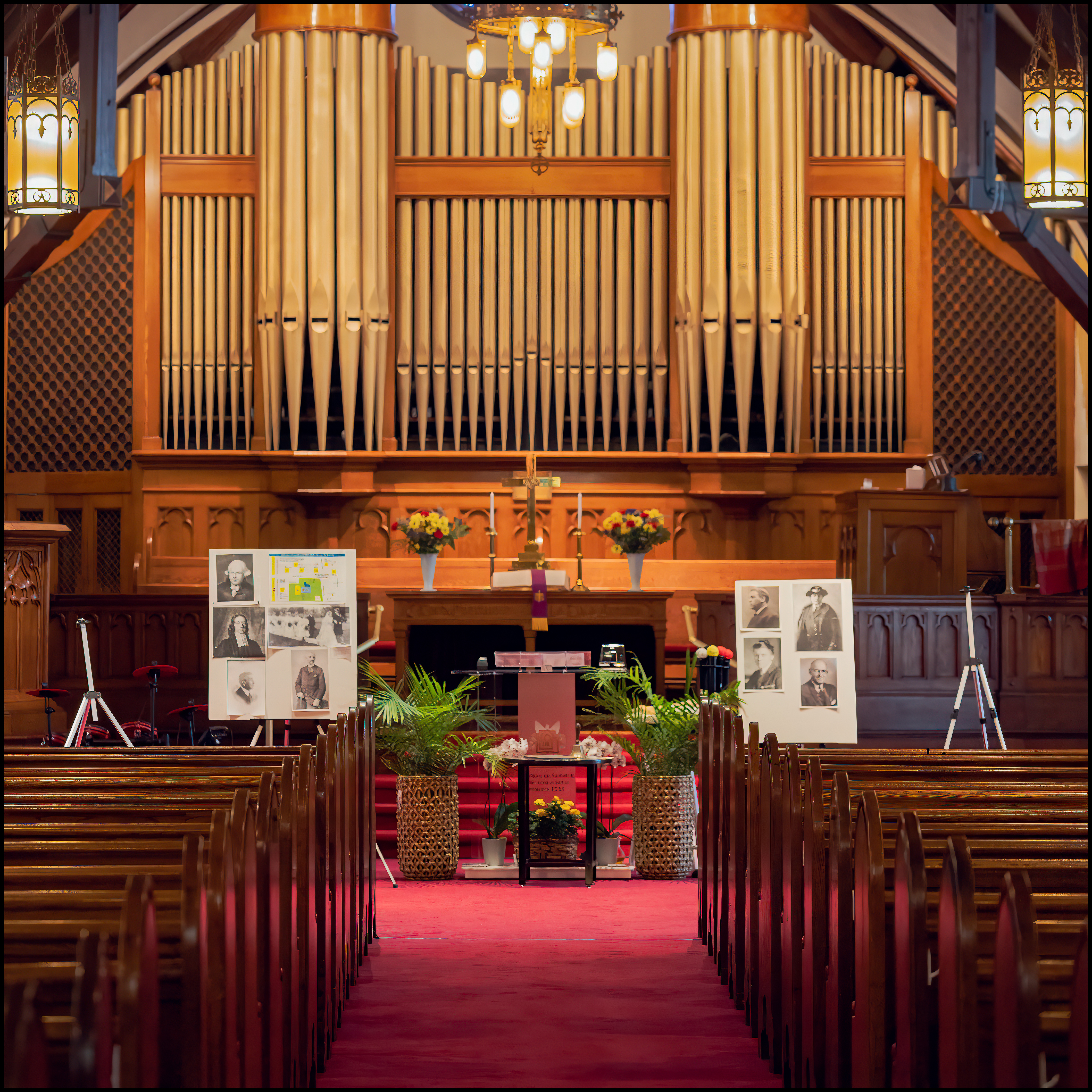
We decided that the first of these presentations would be at the Briarcliff Manor Congregational Church (BCC) because of the close relationship between Law and the church: Law contributed the land on which it was built and also donated a number of the spectacular stained-glass windows.

Pastor Todd Farnsworth of the BCC eagerly accepted to give the presentation, which took place February 17th, 2024, and was entitled “Mr. Law, We need a church.”

Above: The church, ready for the presentation.

Taken with a Sony A7IV and Rokinon/Samyang AF 75mm f1.8 FE
Stone Lantern by Night

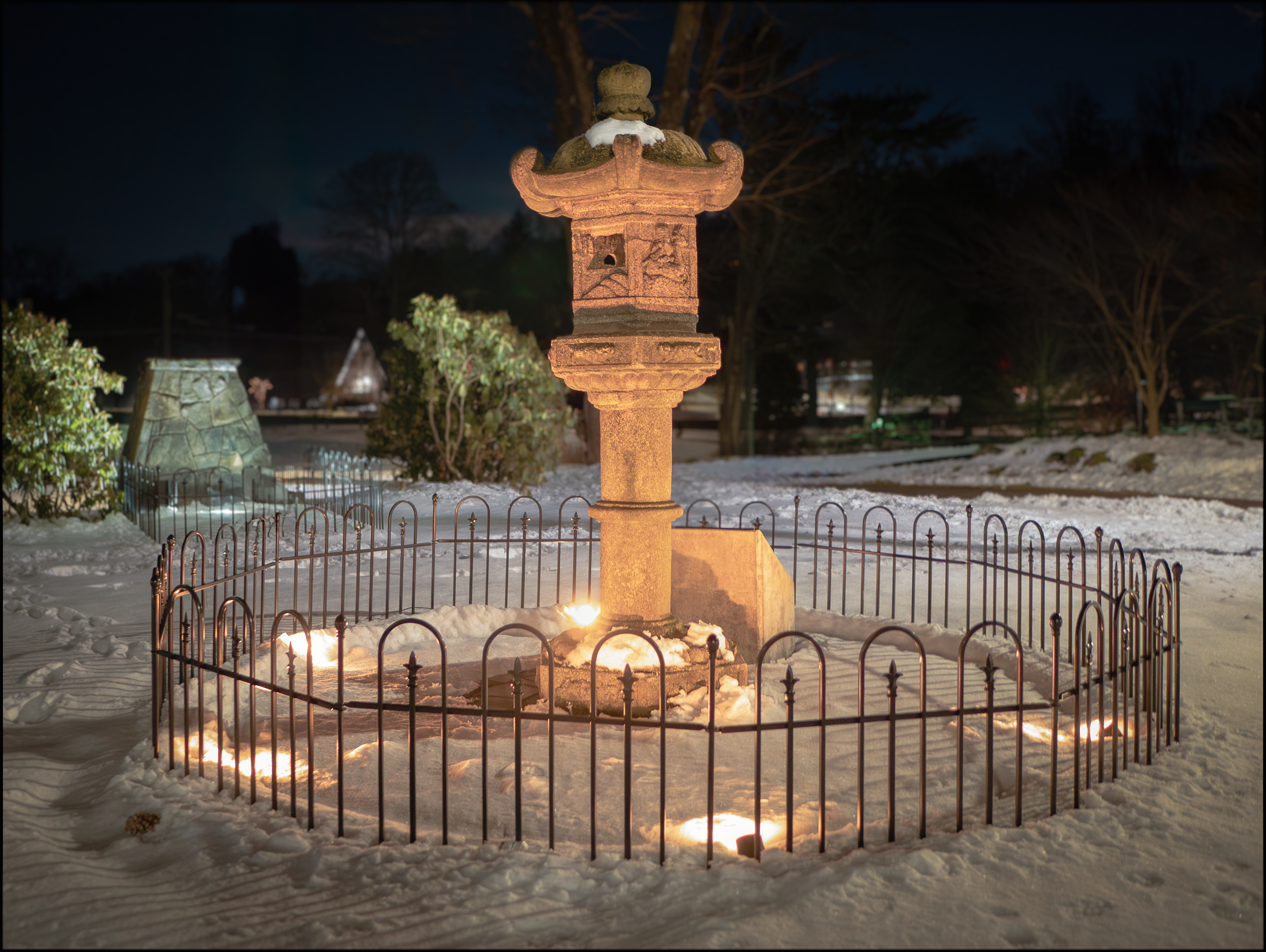
This is one of Briarcliff Manor’s famous stone lanterns.

It was long believed that W.W. Law (the founder of Briarcliff Manor) imported them by 1902 from the Far East with the assistance of some Christian missionaries. The lanterns were the “finishing touch” on several of Law’s projects. It seems that the lanterns originated in Japan but came to us via China. The prevailing opinion is that they were brought by missionaries. However, this may not be the case. Based on evidence that the Briarcliff Manor-Scarborough Historical Society (BMSHS) has discovered, we now believe that the lanterns were brought back by members of the Law family who were in China at that time. This one stands in the Village Park: Law Park. According to the BMSHS Website:

The Briarcliff Lodge initially had a nine-hole golf course which extended from Central Drive West to the top of Central Drive to Dalmeny Road. (Later the course extended to 18 holes across 9A to the undeveloped land, subsequently named the Crossways.) This lantern had been on the first 9-hole portion since the early 1900s. In 2018 the Sears family who lived there gave our intern, Nathan Feist, an opportunity to photograph all aspects of the lantern and he did an in-depth study of its iconography.

In anticipation of the family’s move to Connecticut in 2020, they made a gift of the lantern jointly to BMSHS and the Village. In addition, they gave us a corroded 50 yard-marker they had found buried in an area they determined had previously been a sand trap. “I couldn’t get anything to grow there for the life of me!” Mayor Vescio and Village Manager Zegarelli supported us on every step of the way to the installation of this lantern in Law Park, as you see it today. On Tuesday 20 September 2022 the official ceremony to welcome this lantern to our town park, Law Park took place. See below for some pictures taken at the ceremony.

For more on the lanterns see: The Story of the Stone Lanterns – Notebook Vol. 2023-3

Taken with a Panasonic Lumix GX85 and Leica DG Summilux 15mm f1.7

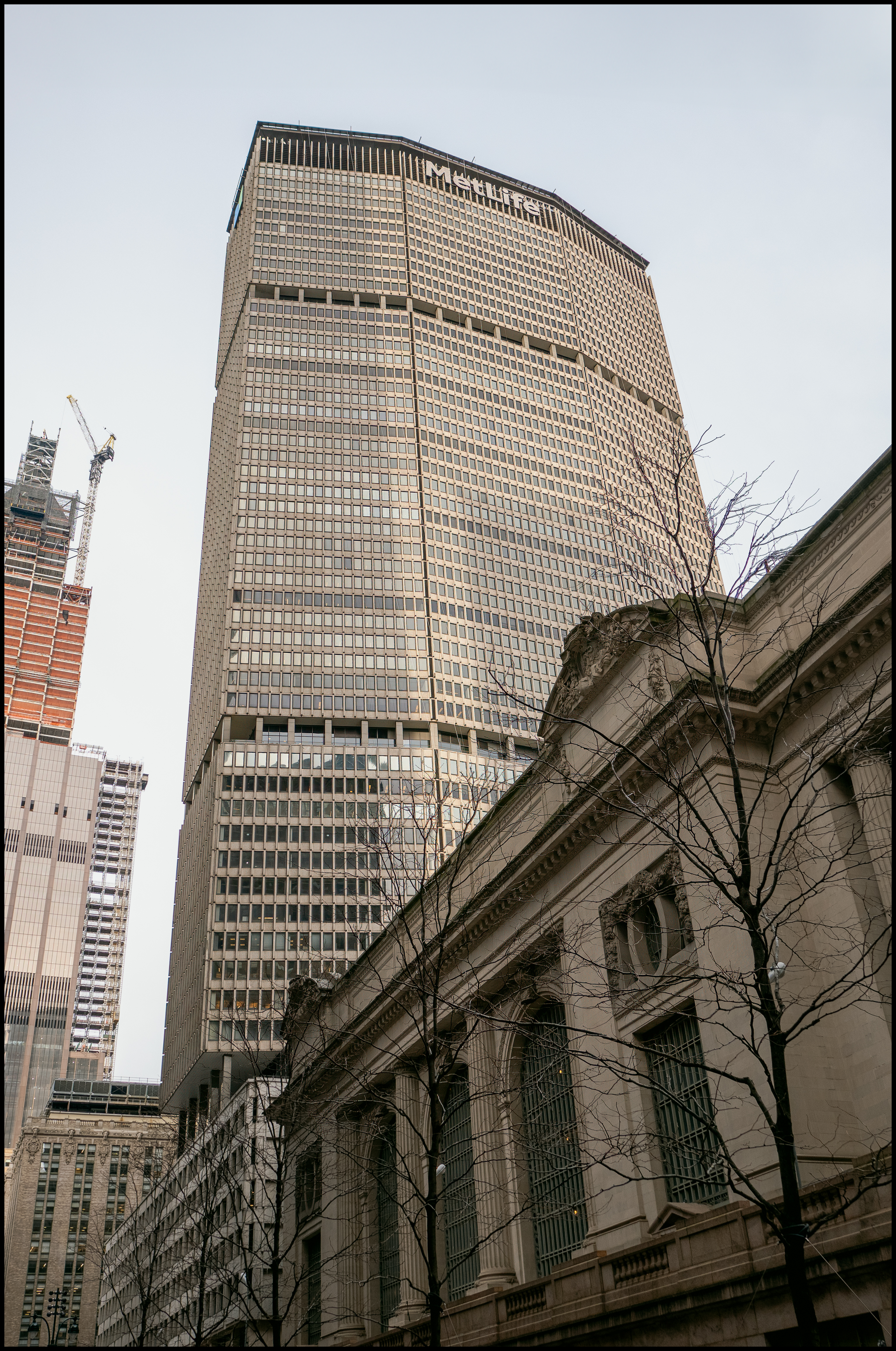
The Met Life Building

I noticed this building soon after my arrival in New York in 1974. It was then called the Pan Am Building.

According to Wikipedia:

The MetLife Building (also 200 Park Avenue and formerly the Pan Am Building) is a skyscraper at Park Avenue and 45th Street, north of Grand Central Terminal, in the Midtown Manhattan neighborhood of New York City. Designed in the International style by Richard Roth, Walter Gropius, and Pietro Belluschi and completed in 1962, the MetLife Building is 808 feet (246 m) tall with 59 stories. It was advertised as the world’s largest commercial office space by square footage at its opening, with 2.4 million square feet (220,000 m2) of usable office space. As of November 2022, the MetLife Building remains one of the 100 tallest buildings in the United States.

The MetLife Building contains an elongated octagonal massing with the longer axis perpendicular to Park Avenue. The building sits atop two levels of railroad tracks leading into Grand Central Terminal. The facade is one of the first precast concrete exterior walls in a building in New York City. In the lobby is a pedestrian passage to Grand Central’s Main Concourse, a lobby with artwork, and a parking garage at the building’s base. The roof also contained a heliport that operated briefly during the 1960s and 1970s. The MetLife Building’s design has been widely criticized since it was proposed, largely due to its location next to Grand Central Terminal.

Proposals for a skyscraper to replace Grand Central Terminal were announced in 1954 to raise money for the New York Central Railroad and New York, New Haven and Hartford Railroad, the financially struggling railroads that operated the terminal. Subsequently, plans were announced for what later became the MetLife Building, to be built behind the terminal rather than in place of it. Work on the project, initially known as Grand Central City, started in 1959 and the building was formally opened on March 7, 1963. At its opening, the building was named for Pan American World Airways, for which it served as headquarters. The Metropolitan Life Insurance Company (MetLife) bought the Pan Am Building in 1981 and used it as their headquarters before selling the building in 2005. The MetLife Building has been renovated several times, including in the mid-1980s, early 2000s, and late 2010s.

Taken with a Panasonic Lumix GX85 and Leica DG Summilux 15mm f1.7