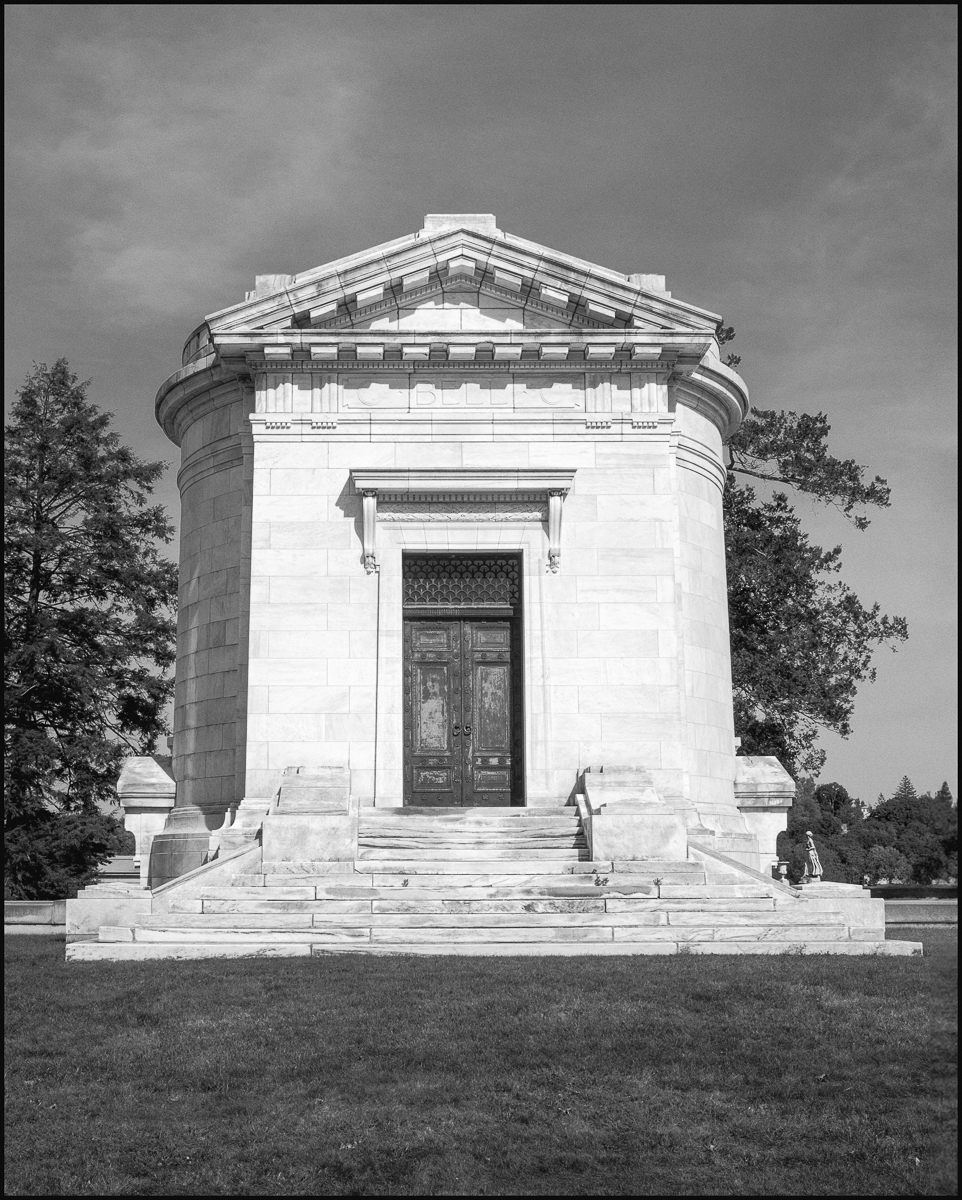
A wonderful example of the architectural influence of ancient Rome. The gravesite in the name of Bell is on a rise with dignified steps leading to the decorative door. The rounded shape of the mausoleum and the pediment above the entrance are clearly derived from Roman architecture. This is the largest mausoleum in Kensico in terms of square footage.
It’s the mausoleum of Henry Hillary Bell (1857 to 190d). According to his obituary (as found as an image on his entry on the Find a Grave website):
Hillary Bell, the famous dramatic and music critic of the New York Press, dropped dead suddenly last Thursday evening. His death was due to a heart failure, although previous to Wednesday he was in good health. On Thursday afternoon Mr. Bell had been writing some gossip for the press which read:
“This year Charles Frohman has all …ed (? unreadable) to Father Henry. Father Henry then recommended a girl. She was selected by Mr. Bell, who asked her to come to his home at once. She had to get her baggage, which was in the Barge Office, and Mr. Bell accompanied her. Just as the baggage was being carried to a desk in the Barge Office Mr. Bell reeled as if fainting. Before he could be helped, he had fallen on the floor, dead. He had given no sign that he was ill.
When his death was announced, his many friends among the newspaper men were greatly shocked and grieved. He had among his admirers and intimates many editors throughout the country.
Hillary Bell was born near Belfast, Ireland in 1857. He was educated by private tutors, studied art, and came to the United States. At first, he worked as a portrait painter with much success.
In 1888 he married Miss Rita Ireland, and soon afterward entered newspaper work, devoting himself principally to dramatic criticism.
Mr. Bell became editor of the Home Journal, of New York. His style attracted the attention of the management of the London Era, and he became its American correspondent. His analytical article on Richard Mansfield’s Nero led to his engagement on the New York Press.
He became interested in life insurance and became connected with the Mutual Reserve Life Insurance Company. He was made finally an officer and director in the corporation.
Later he formed a syndicate of western newspapers, to which he contributed regularly on dramatic topics. At the same time he found opportunity, by “economizing the minutes”, as he used to express it, to become the editor of a publication devoted to insurance interests.
Taken with a Sony Nex 5N and Sigma 30mm f2.8