A Memorial

I have a weekly lunch with my friend Ken. We are trying to combine the lunch with a visit that has some kind of connection to the American Revolutionary War. We alternate choosing the restaurant/revolutionary war site and this week it was Ken’s turn and he chose the Quaker Meeting House because it apparently had the kind of connection we were looking for.

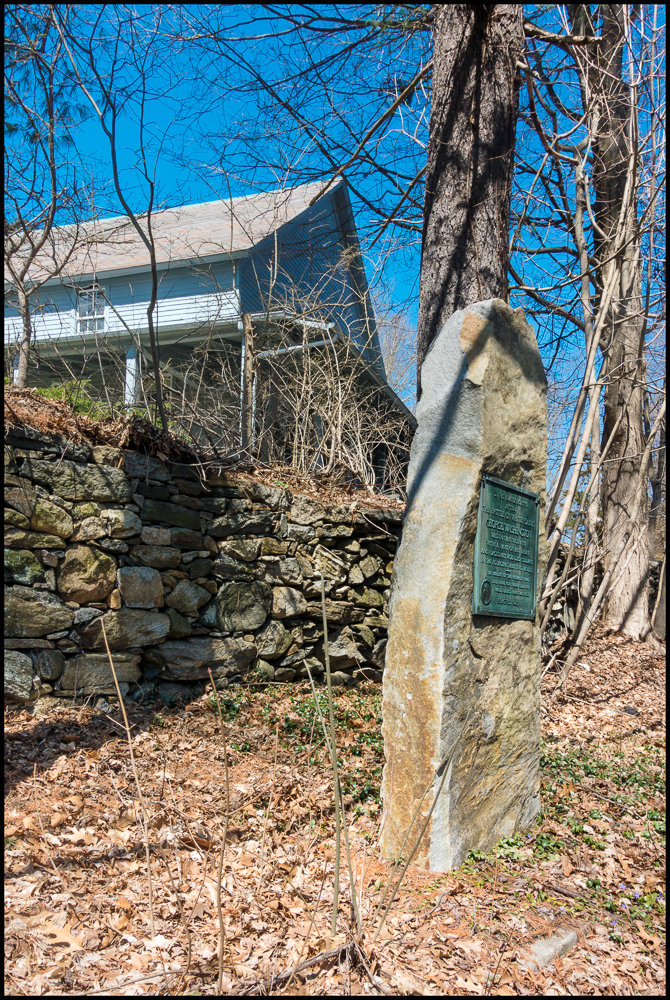
After walking around for a while we were unable to verify this. Then I saw, down by the road, a slab of rock a little away from the meeting house and down by the road. This must have some significance I thought so while Ken went to get the car, I walked down to the road to take a look.

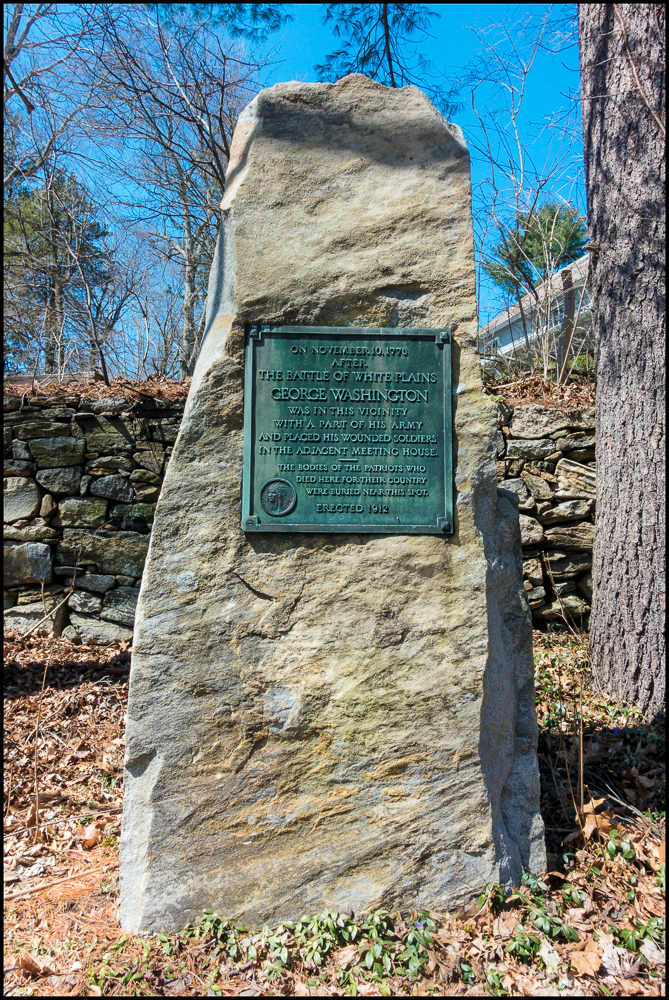
Sure enough a plaque was attached to the slab. The inscription reads:

On November 10, 1776 after the Battle of White Plains, George Washington, was in this vicinity with a part of his army and placed his wounded soldiers in the adjacent meeting house. The boides of the patriots who died here for their country were buried near this spot. Erected 1912.

Taken with a Sony RX100 M3.

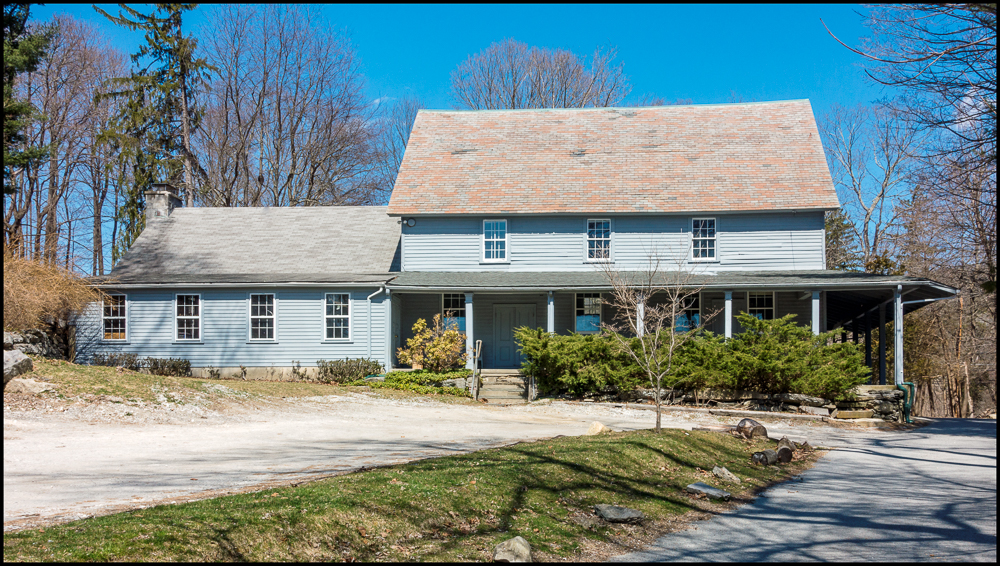
Quaker Meeting House, Chappaqua, NY

According to its website:

By the early 1700’s Quakers had become a significant part of the spiritual, economic and political life in what is now the tri-state area. In the Town of North Castle records from 1736-1791, Quaker names were prominent among yearly appointments for the Town government. Meetings were established in 1685 in the town of Westchester (now the Bronx), and in Mamaroneck, (now the Scarsdale Friends Meeting). In 1695, John Harrison purchased a tract of land from Native Americans and large numbers of Friends came to settle in what they called “Harrison’s Purchase,” or simply “The Purchase” (now Purchase, NY).

Around 1720, Abel Weeks, a third-generation American Friend from Long Island, came with his family to North Castle and built a house at a bend of a road between Shapiqua and New Castle Corners (now Mt. Kisco). The first meetings of Shapiqua Friends were held there, reportedly in a log lean-to. Membership outgrew the house and in 1753 construction began on the first house of worship to be built in (what is now) Chappaqua. The meetinghouse is the oldest documented building in New Castle.

In 8th month 1745 a request for approval to establish a Meeting at Chappaqua was minuted at the Purchase Monthly Meeting. Three acres of land on Quaker Road were given by John Reynolds for a meetinghouse and cemetery. At the time, a black couple, Reynold’s freed slaves lived in a cabin on the property and their deaths in 1745 marked the first burials in the newly deeded cemetery.

Space was the important need and the style of new meetinghouse was defined by simplicity both within and without. There were no stained-glass windows, no cross or decorative elements. This is still true today.

By 1763 a shingled meetinghouse 20 by 26 feet with 18 foot high supporting posts was completed. In 1780 it was extended by a 20 by 12 feet addition with a sliding panel between to accommodate separate business meetings for men and women. Side and front porches were added in the mid 1800s.

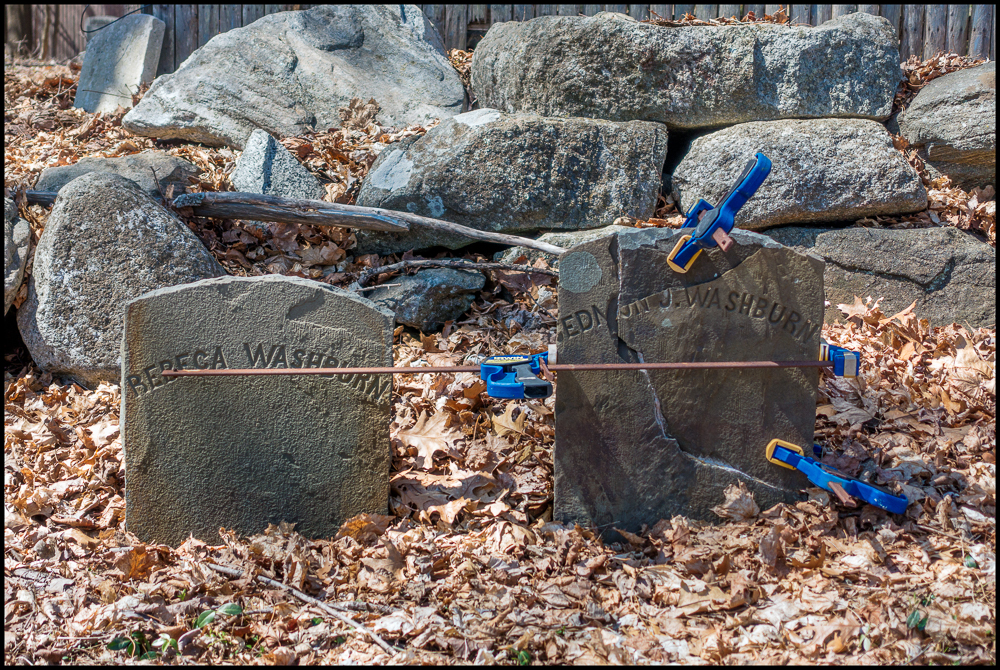
During the Revolutionary war the meetinghouse served as a ‘hospital’ for some of Washington’s wounded soldiers who were brought there following the Battle of White Plains on October 28, 1776. Some American soldiers are apparently buried in the grave yard.

By l778 the Meeting House had become the hub of a growing Quaker settlement and had to be enlarged. The 1790s brought further enlargement, and the present roof was framed. Members had freed and given land to all their slaves in North White Plains by 1779. During the years prior to the Emancipation, families of Chappaqua Meeting participated in the Underground Railroad, notably Moses and Esther Pierce.

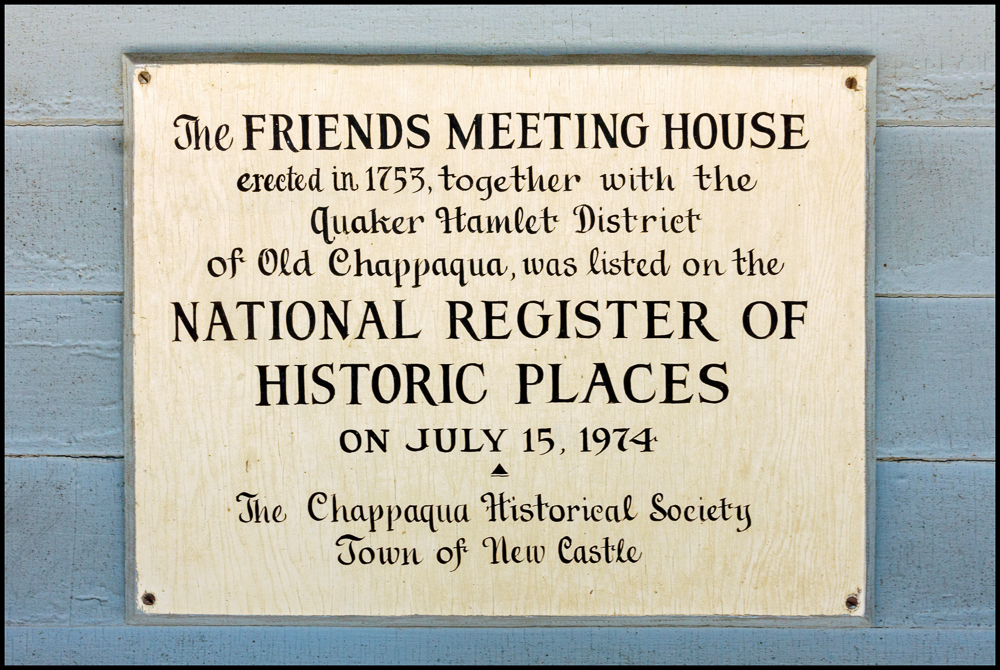
Chappaqua Monthly Meeting was affected by the Hicksite/Orthodox schism of 1828, and a second meetinghouse was built on the property to accommodate the dissenters. The split was apparently without rancor, and it was not unusual for family members to worship in separate meetinghouses. In 1885 the Orthodox building was taken down piece by piece and moved to King Street in Chappaqua. The two meetings continued their separate existences until 1960, when they reunited. The King Street meetinghouse was sold and the proceeds used to finance a sizable addition to the Quaker Road meetinghouse. The funds provided for a nursery school room, social room, four classrooms, kitchen and bathrooms. The meetinghouse was listed on the National Register of Historical Places in 1974.

Before the new addition was added, Phebe Washburn remembers, “I was a wee baby when my parents became members of the Meeting. There was no running water, we used a pot-belly stove. Until the ’60s we felt no need for central heating. The Quakers are a do-it-yourself, make-do people.” (The Journal News, Feb. 14, 2010)

Over the 285 years since its founding, Chappaqua Monthly Meeting has waxed (largest in the late 18th century) and waned (lowest in the early 20th) By the second half of the 20th century the Meeting began to show renewed vitality which the Chappaqua Meeting shared in, and — more recently — benefited from the presence of a number of new members with children. Today, Chappaqua Monthly Meeting has about 60 formally registered members, as well as a thriving First Day School and a number of regular and occasional attendees.

Taken with a Sony RX100 M3.

Quaker Hamlet District of Old Chappaqua

The other day I went for a quick tour around the Quaker District of Old Chappaqua followed by lunch at the Jardin du Roi.

According to Wikipedia:

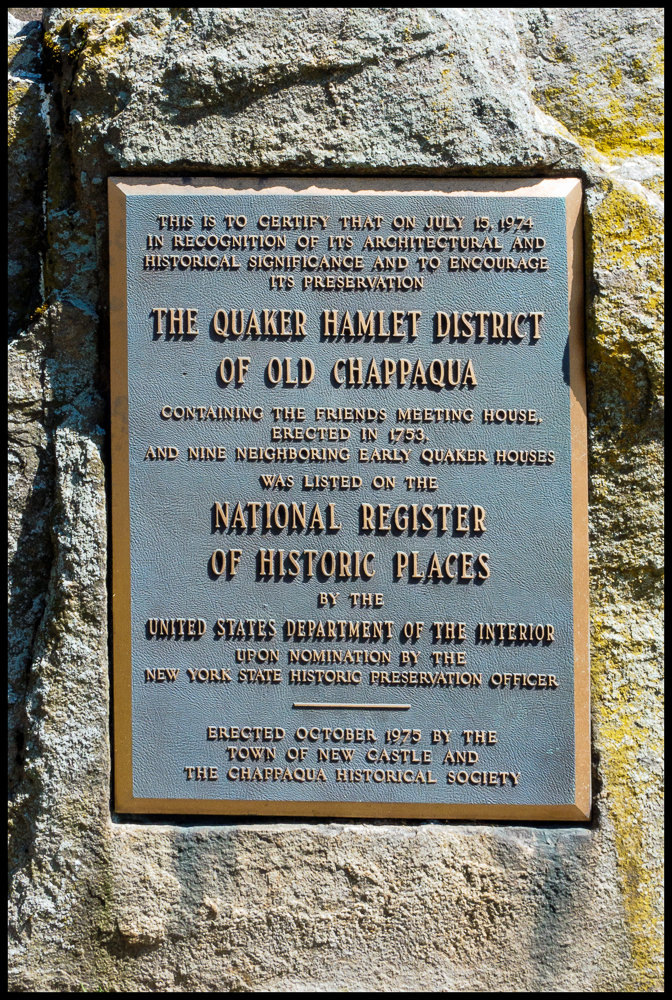
The Old Chappaqua Historic District is located along Quaker Road (New York State Route 120) in the town of New Castle, New York, United States, between the hamlets of Chappaqua and Millwood. It was the original center of Chappaqua, prior to the construction of the Harlem Valley Railroad and the erection of its station to the south in the mid-19th century. In 1974 it was recognized as a historic district and listed on the National Register of Historic Places.

What is today Chappaqua was first settled around 1740 by a group of Quakers from Long Island. They built the still-used meeting house, the oldest known building in the town, around which the district centered a decade later. The other contributing properties, all timber frame buildings up and down the road on either side near the meeting house, are the surviving buildings from some of the farms established then and later. They have been preserved intact from that time.

Quakers, fleeing religious persecution in England as Dissenters, settled in British colonies during the 17th century. One group established a meeting on Long Island in 1645. By the early 18th century their offshoots had crossed Long Island Sound to Westchester County, where they established Mamaroneck and Purchase by 1727.

In 1730, further offshoots of those groups moved further inland, to Wampus Pond (now Armonk) and “Shapequaw”. Ten years later one of them, John Reynolds, established a 100-acre (40 ha) farm that included the area of the future district, along Quaker Road from Kipp Street to Roaring Brook Road. By 1747 there were enough Quakers in Shapequaw that they began petitioning the Purchase meeting to establish their own. Permission was granted shortly thereafter, and Reynolds donated two of his acres (8,100 m2) to the group so it could build a meeting house and burial ground.

The meeting house

By 1753 the meeting house was finished. In 1776 it would serve as a hospital for Continental Army soldiers injured at the nearby Battle of White Plains. Two years later a wing was built on it.

The original Reynolds farm was eventually subdivided. Other farmers, like Samuel Allen and Elnathan Thorn, built houses near the meeting house. By 1825 the area had become the community of what was now known as Chappaqua. The residents were largely self-sufficient farmers with side businesses as craftsmen.

That ended with the construction of the Harlem Valley Railroad (still in use today as Metro-North Railroad’s Harlem Line) in 1846. It followed the river valley, and so the station was built a mile (1.6 km) south of the meeting house. Gradually that area became developed and grew into the downtown Chappaqua that exists today. Allen built a couple of small houses across the road from the meeting house, and cabinetmaker Henry Dodge built a large house at what is today 386 Quaker, moving the older Thorn house in the process. That was the last development in the district related to the original Quaker settlers and their families.

As the railroad spurred the suburbanization of northern Westchester in the later 19th and early 20th centuries, the meeting house and associated farm buildings remained in use. However, the economy changed. With the railroad close by, the farmers switched to growing cash crops for the New York City market, and sold some of their larger landholdings.

Some buildings, such as the outbuildings on the Thorn–Dodge property, were destroyed by the 1904 tornado. New construction in the district did not replace any of the historic structures. In 1961 another wing was added to the meeting house. There have been few other changes to the older buildings since then.

Taken with a Sony RX100 M3.