From Charlie Kirk – 102 things I have learnt about street photography – a slightly flippant and deliberately controversial guide.

Hilarious – at least if you’re into photography. I particularly liked the following:

38. I’d love to put Bruce Gilden in a room with Joerg Colberg.
42. If you shoot film you’re a photographer, if you shoot digital you’re an editor.
54. A badly composed picture of a beautiful woman is always a good photo.
65. Using the high contrast black and white mode on the Ricoh GRD doesn’t make you artistic.
66. Nor does shooting wistful portraits on a Mamiya 7 and desaturating the colours.
67. Using a Leica does.
70. And the Japanese have the highest number of great photographers that no-one has heard of.
73. Are there cliques, sycophants, politics and divisions in landscape photography? Or is it just in relation to street photography?
87. I’ve never understood why “serious photographers” take pictures of dogs but not cats, and horses rather than cows.

102 things I have learnt about street photography – a slightly flippant and deliberately controversial guide.

via – 102 things I have learnt about street photography – a slightly flippant and deliberately controversial guide..

Ruins on Dennings Point, Beacon, NY

According to Thomas E. Rinaldi on the site: Hudson Valley Ruins:

NOT MANY PEOPLE alive today can remember the time when the Hudson Valley was arguably the most important center of brick making in the world. In 1910, more than 130 brickyards operated on the river between New York and Albany. The number declined steadily thereafter, until the last Hudson River brickyard (the Powell and Minnock plant near Albany) shut down in 2002. Remarkably there is very little left of the yards themselves, and the ruins of the Dennings Point Brick Works at Beacon are among just a small handful of Hudson River brickyard structures that survive in the 21st century.

DENNINGS POINT hooks out into the river just below the city of Beacon. Its unusually complex history has been chronicled in a great book by Jim Heron entitled “Dennings Point: A Hudson River History.” Archeological evidence suggests that the point was inhabited as early as 4000 B.C. More recently, Washington traversed it during the American Revolultion. Alexander Hamilton penned the first of the Federalist Papers while visiting an estate that existed here through much of the 19th century.

More detailed information on the history of Dennings Point can be found on a site focusing primarily on brick collecting in the Hudson Valley and New England: brickcollecting.com.

The only manufacturing building remaining from the Brickyard.

Inside a structure added by Durisol (who manufactured construction panels) and was later used by Noesting who made pins.

Graffiti

Open Space with Tree

In 2003 Dennings Point was chosen for the site of the $27 million dollar Beacon Institute for Rivers and Estuaries. One of the old buildings has already been converted and is now the Center for Environmental Innovation & Education. Reconstruction of the old Noesting/Durisol factory) was supposed to have begun soon afterwards, but so far little seems to have happened.

A different building. I don’t know what it is/was, but it’s right alongside the Hudson.

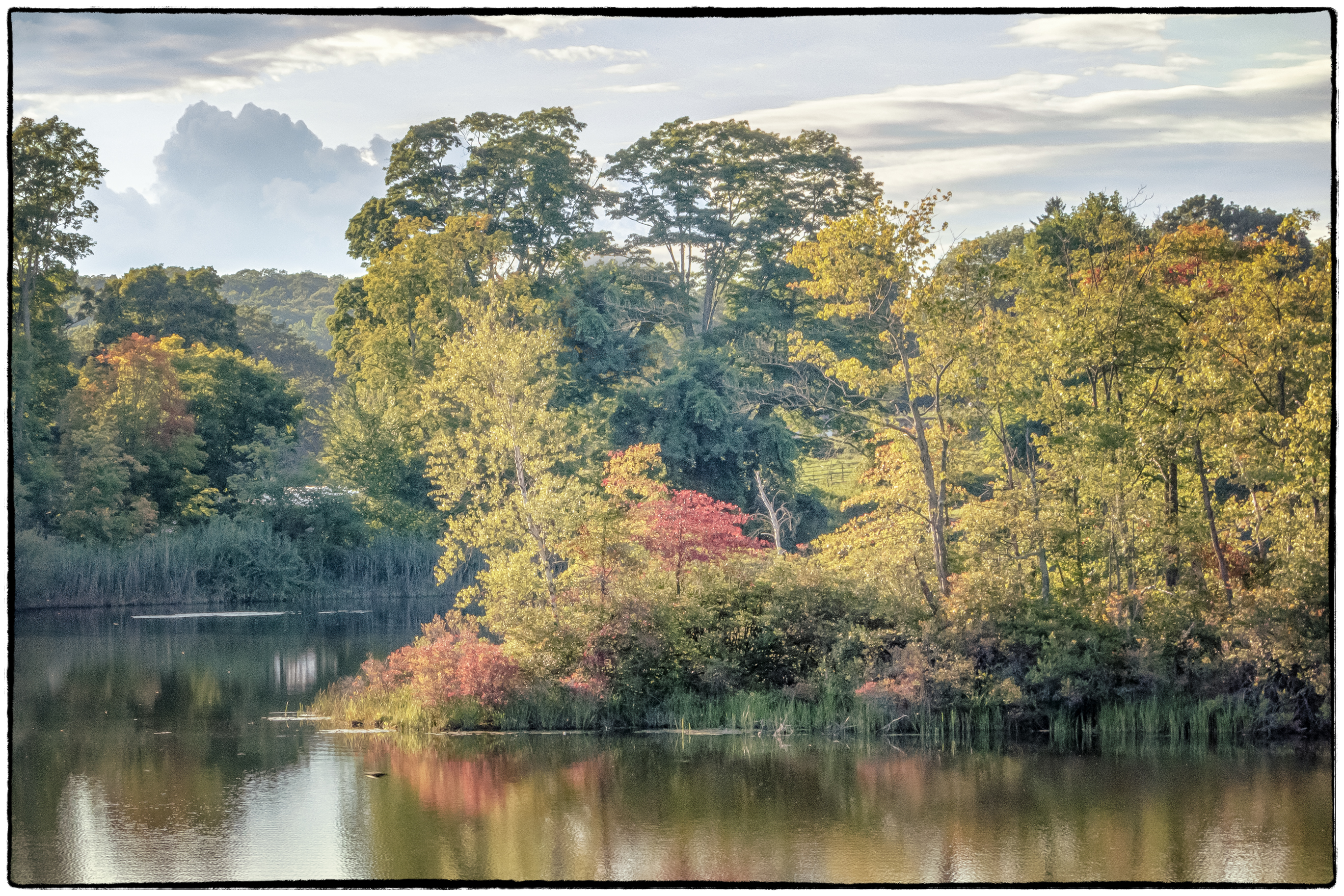
On Jordan Pond

From Route 9 near Cold Spring, NY turn right onto Route 301. After about 2.8 miles you’ll see a trailhead marker on the left side of the road. It’s marked Charcoal Burners. Follow the red (charcoal burners) trail for about 20 minutes until you come to the white (cabot trail) markers by a cairn on the left. Follow this until you get to Jordan Pond: a very pleasant and tranquil spot. Continue along the white trail until you come to a clearing. Turn left and very shortly after you’ll see the yellow trail go off to the left. Follow it back to where you parked. It took me somewhere between 1 1/2 to 2 hours.

More detailed directions (complete with pictures) can be found on the Hike the Hudson Valley site, a great site with information, at the time of writing this, on 59 hikes. Very useful.