Ansel Adams: A Documentary Film 2002

When I was just getting into photography Ansel Adams was the first major photographer that I knew and that made an impression on me. I have a vague memory (possibly faulty) that his photograph: “Moonrise Hernandez Mexico” had recently become the most valuable photograph in the world. I also recall that someone had loaned me his book “The Camera”. Until then I’d been buying “gear” thinking it would dramatically improve my photographs (of course it didn’t). Then I saw some pictures in his book taken with a pinhole camera. This convinced me that it isn’t the “gear” that makes the picture it’s the photographer. For a while, influenced by Adams, I thought I wanted to be a landscape photographer.

Later, as I got deeper into photography, I got to know other famous photographers: e.g. Weston, Strand, Evans, Cartier-Bresson, Atget etc. I realized that other genres (e.g. documentary photography; abstract photography) appeal to me more than landscape. I also realized that photographs by other photographers provoked more of a reaction in me than Adams’ landscapes. I still consider Adams’ photographs to be technical masterpieces. I also recognize his influence on photography – as a photographer, advocate and teacher. I just don’t find his photographs as “earth shattering” as I once did. I also find his categorical rejection of all photographic styles other than the pure photography he espoused hard to take. To me no single style is intrinsically better than another. It’s the quality of the end product that counts.

I enjoyed this documentary. I was nice to actually see and hear John Szarkowski. I’d heard about him and I own a number of books written by him, but this was the first time I’d actually seen him speak.

I also missed a few things I’d expected to find. I recently finished a book on “Group F.64“, the famous US West Coast group of photographers (Adams was a member) that broke away from pictorialism in favor of pure or straight photography. A very influential group that wasn’t mentioned in the documentary. I also found it strange that there was no mention of the Zone System or Adam’s famous trilogy of books (The Camera; The Negative and The Print) was not mentioned. In fact his role as an educator was rather downplayed.

Give my regards to Broadway

Taken in March, 2010 at Duffy Square (between Broadway-7th Ave and 45-47th Street) in Manhattan, NY. In case anyone reading this is not familiar with New York City, Duffy Square makes up the northern part of the Times Square neighborhood. Statues: in the foreground George M. Cohan and in the background Father Francis P. Duffy.

Cohan is, of course, a famous singer, dancer, producer and all-around entertainer, considered by many to be the originator of the Broadway Musical. His life is commemorated in the movie: “Yankee Doodle Dandy” starring a singing/dancing James Cagney. If you only know Cagney from his gangster movies and impressionist takes (“You dirty rat…”) this seems odd, but he was originally a dancer. Wikipedia has this to say about Cohan:

Cohan began his career as a child, performing with his parents and sister in a vaudeville act known as “The Four Cohans.” Beginning with Little Johnny Jones in 1904, he wrote, composed, produced, and appeared in more than three dozen Broadway musicals. Cohan published more than 300 songs during his lifetime, including the standards “Over There”, “Give My Regards to Broadway”, “The Yankee Doodle Boy” and “You’re a Grand Old Flag”. As a composer, he was one of the early members of the American Society of Composers, Authors, and Publishers (ASCAP). He displayed remarkable theatrical longevity, appearing in films until the 1930s, and continuing to perform as a headline artist until 1940.

Known in the decade before World War I as “the man who owned Broadway”, he is considered the father of American musical comedy. His life and music were depicted in the Academy Award-winning film Yankee Doodle Dandy (1942) and the 1968 musical George M!.

Father Francis P. Duffy (after who the square is named) is perhaps lesser known. Wikipedia has this to say about him:

Francis Patrick Duffy (May 2, 1871 – June 27, 1932)[1] was a Canadian American soldier, Roman Catholic priest and military chaplain.

Duffy served as chaplain for the 69th Infantry Regiment (known as the “Fighting 69th”), a unit of the New York Army National Guard largely drawn from the city’s Irish-American and immigrant population.[2] He served in the Spanish–American War (1898), but it is his service on the Western Front in France during World War I (1917-1918) for which he is best known. Duffy, who typically was involved in combat and accompanied litter bearers into the thick of battle to recover wounded soldiers, became the most highly decorated cleric in the history of the United States Army.

Taken with a Panasonic Lumix ZS-3, a very small digital point and shoot camera with tiny sensor and a long zoom range. In poor light pictures taken with this camera can look a little like watercolor, but it good light it could produce great results and was very easy to carry around.

The Birds

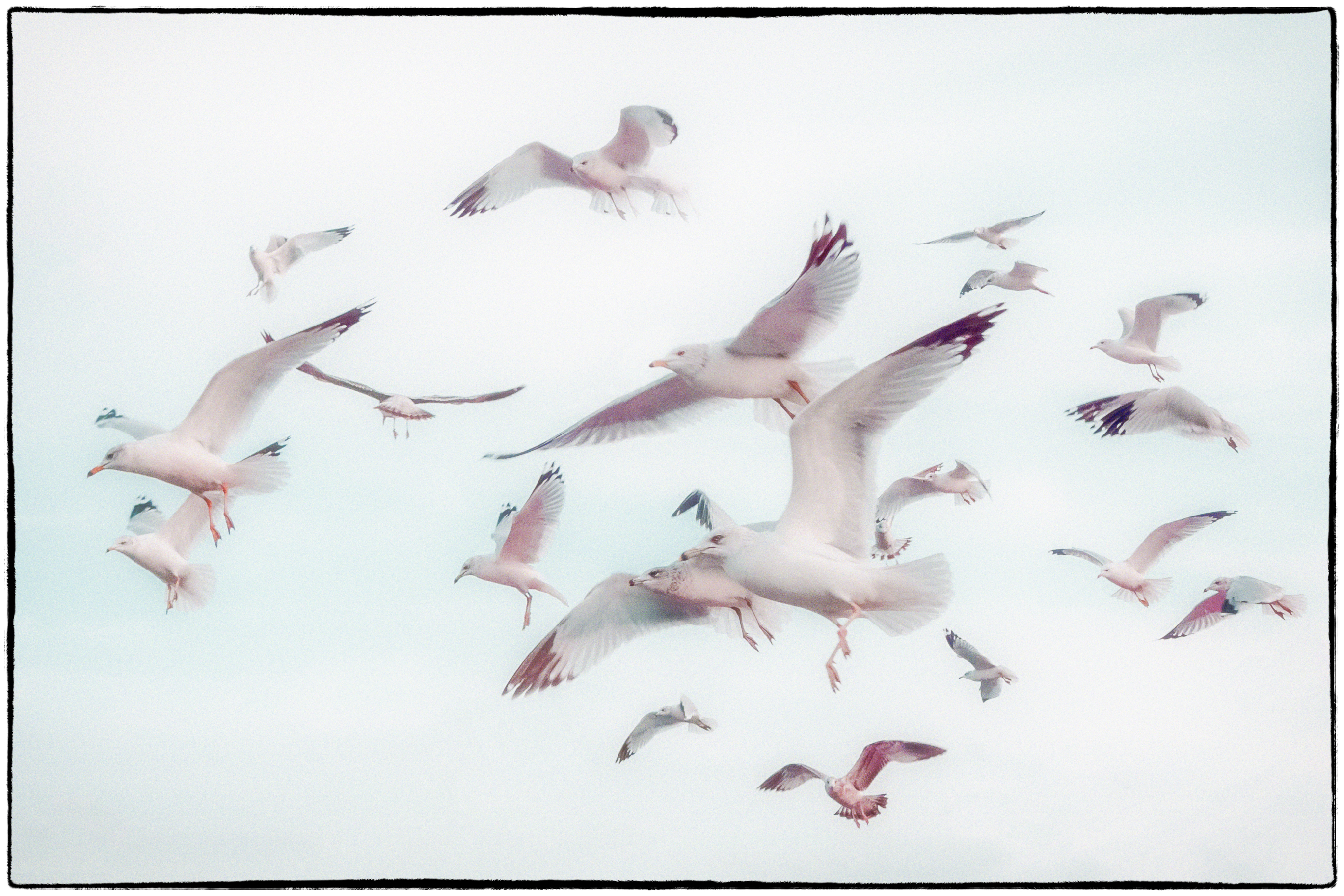
This was taken back in December, 2010 with a Panasonic Lumix LX-3. But doesn’t the LX-3 have a very limited zoom range you may ask? And you’d be right – it does. This picture was actually taken in the parking lot of a Sams Store near where live. Garbage was strewn around and this had attracted this flock of seagulls. They were quite close to the ground and didn’t seem to have much fear of the people. As they hovered in the air just over my head it was pretty easy to capture a bunch of them – even with the LX-3. And aren’t seagulls supposed to be near this sea. This was taken about five miles from the nearest body of water (The Hudson River).