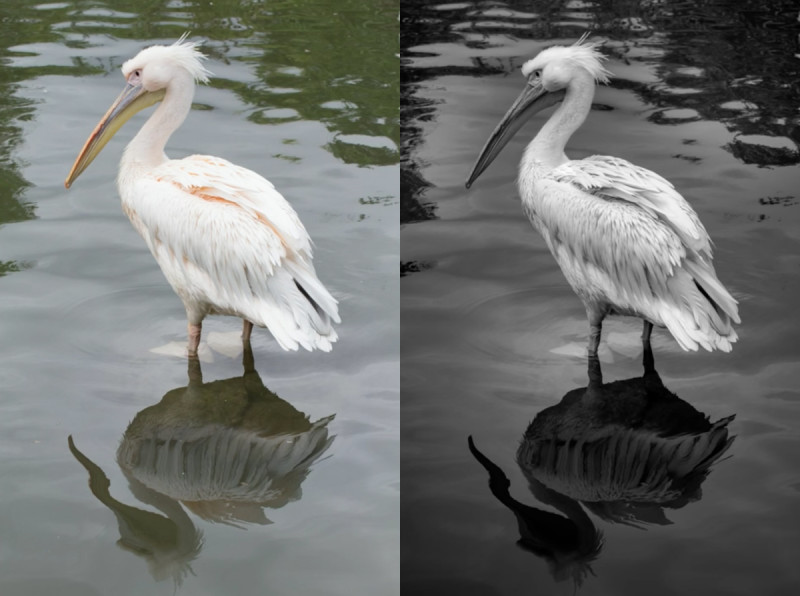
Can you really transform a bland picture into “fine art”???

In this video, Swiss photographer and YouTuber YuriFineart shows you how he took a bland snapshot and turned it into a “fine art” looking black and white image. Scroll down and hit play to see how he does it:

Source: Petapixel – How to Transform a Bad Snapshot Into ‘Fine Art’ with Lightroom

What an astonishing title! Hopefully it’s not meant to be serious? A bad snapshot is a bad snapshot no matter what you do to it. And certainly converting it into black and white doesn’t turn it into “fine art”, or art of any kind for that matter. I know – I do it all the time, but I’m not under the illusion that it turns them into “art”. I just like the way they look a little more.

Notice that the extract above reads: “YuriFineart shows you how he took a bland snapshot and turned it into a “fine art” looking black and white image”. Maybe it should be changed to: “…shows you how he took a bland snapshot and turned it into a black and white bland snapshot”.

To be fair to the article it does later say:

Obviously, the final product is not all of a sudden a beautiful image. There are still issues, and to reiterate the idiom, you can’t make a silk purse out of a sow’s ear—but the final image is significantly nicer than the original snapshot.

Photography and the art of seeing

I’ve mentioned in earlier posts that I’m fond of David Duchemin and his books on cultivating photographic vision. He also does a series of video podcasts and in one of them (unfortunately I don’t remember which) he heartily recommended Freeman Patterson and in particular his book “Photography and the Art of Seeing. A Visual Perception Workshop for Film and Digital Photography“. I’d been given an Amazon.com gift certificate for my birthday so I decided to pick up a copy.

I very much enjoyed it. It’s relatively short (152 pages) and contains numerous pictures to illustrate his points. The major sections are as follows:

Barriers to seeing
Learning to observe – thinking sideways; Relaxed attentiveness
Learning to imagine – imagining; abstracting and selecting
Learning to express – the challenge of expression; unique properties of photography; how a camera sees space; thinking about visual design; elements of visual design: tone; elements of visual design: color; principles of visual design; working with visual design
Photography and the art of seeing

I particularly liked the exercises he proposed, mostly in the “Thinking Sideways” section. I tend to get in a photographic rut where I take pretty much the same type of picture over and over again. I know this, but I have great difficulty figuring out how to break out. Some of these exercise offer an opportunity to do so. One example:

Lock yourself in your bathroom with a camera, a tripod, and a standard lens. Give yourself 20 minutes to make 10 pictures. This is an example I have tried with several students – the resulting slide show have been both hilarious and instructive, and the variety of pictures amazing.

My only criticism is that one of the longer sections: “Thinking about visual design” is completely devoid of illustrative examples.

Well worth reading!

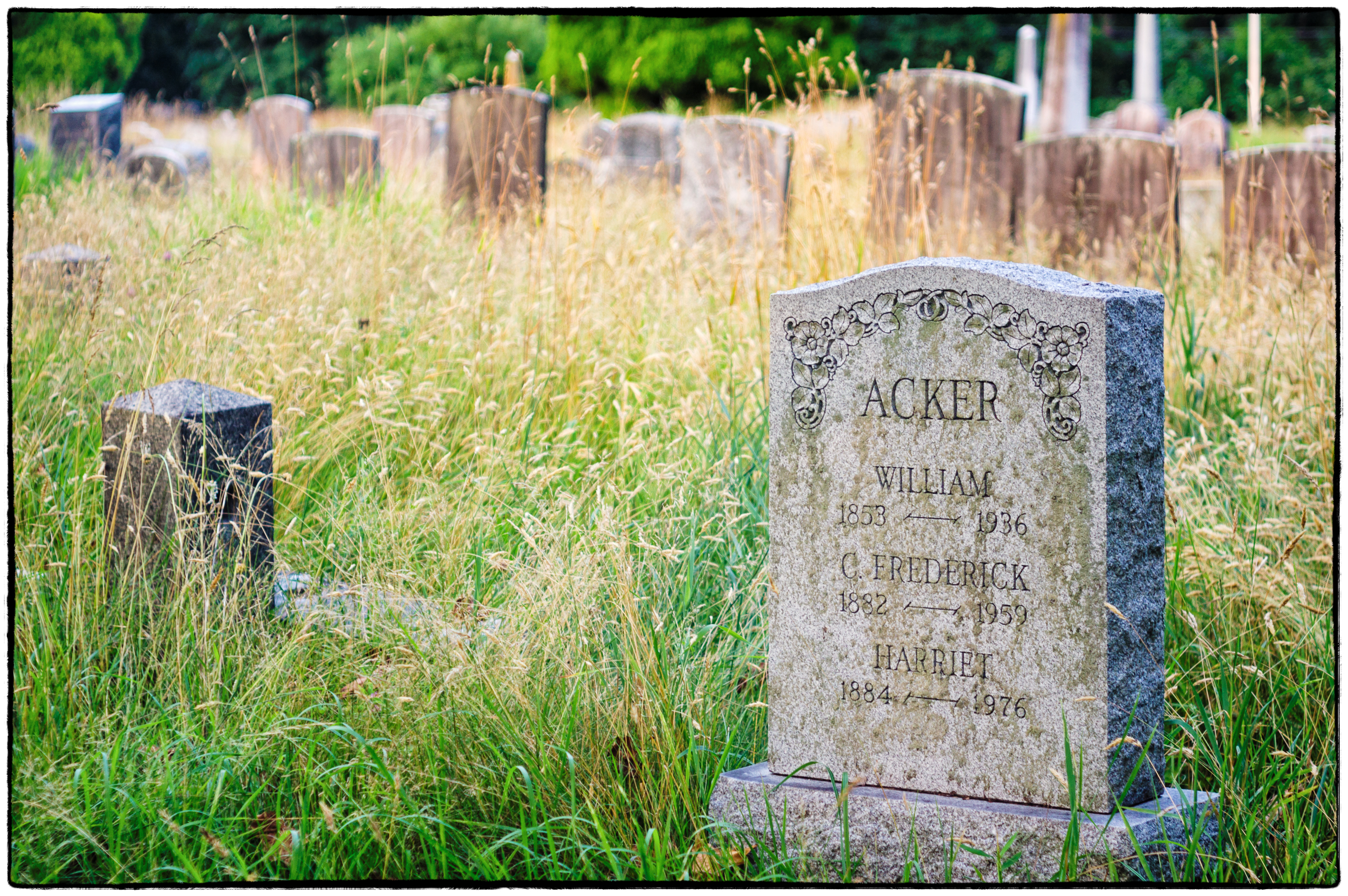
Here lies William Acker

I have no idea who Mr. Acker was other than what’s on the grave marker: he was born in 1853 and died in 1936 making him 83 at the time of his death. He seems to be buried with two other people: Frederick and Harriet who I’m guessing from their ages were perhaps a son an daughter. He’s buried in Sparta Cemetery in Ossining, NY. That’s the extent of my knowledge.

The topic of this post is, however, not Mr. Acker. It’s my Sony Nex 5N. I bought this camera late in 2011. At that time I was having trouble relating to my DSLR (A Sony Alpha 500) and as I got older I didn’t like carrying around all the DSLR gear. So I was looking for something smaller and lighter and the NEX fit the bill. I’d also read about the possibility of using legacy lenses with this camera (with an appropriate adapter) and since I’d started to collect old cameras/lenses I thought I might be able to use them with the NEX. I used the camera almost exclusively for quite some time.

My quest for something smaller and lighter continued and in January, 2014 I picked up a heavily discounted Sony RX100 model 1. This camera is so small and light that I began to carry it with me all the time and it quickly became my most used camera. I would occasionally take out the NEX but the RX100 had become my primary camera.

I’ve been looking back over my older pictures of late and I’m finding that most of the ones I really like were taken with the NEX. Where the RX100 is very sharp and contrasty, almost clinical, the pictures taken with the NEX have less contrast, are frequently less sharp but have a certain quality to them. The native e-mount lenses I have seem to have quite low contrast (with the exception of the Sigma 30mm f2.8). I have quite a few legacy lenses and pictures taken with them vary greatly in terms of their “look”. With the RX100, of course, the lens is fixed so the “look” is always pretty much the same.

I don’t think I’ll stop using the RX100 any time soon. It’s just so convenient to carry around. But I do think I’ll start to use the NEX again. Now I just have to clean the dust spots on it’s sensor…

The picture above was taken with the NEX 5N and an Industar 61 lens. This 55mm f/2.8 lens originally came from the Arsenal factory in Ukraine – at the time it was made part of the former Soviet Union. I’ve found the lens to be sharp and the colors to be quite vibrant. It’s in Leica Threat Mount and obviously used with an adapter on the NEX.