Hudson river cruise – Manhattan view

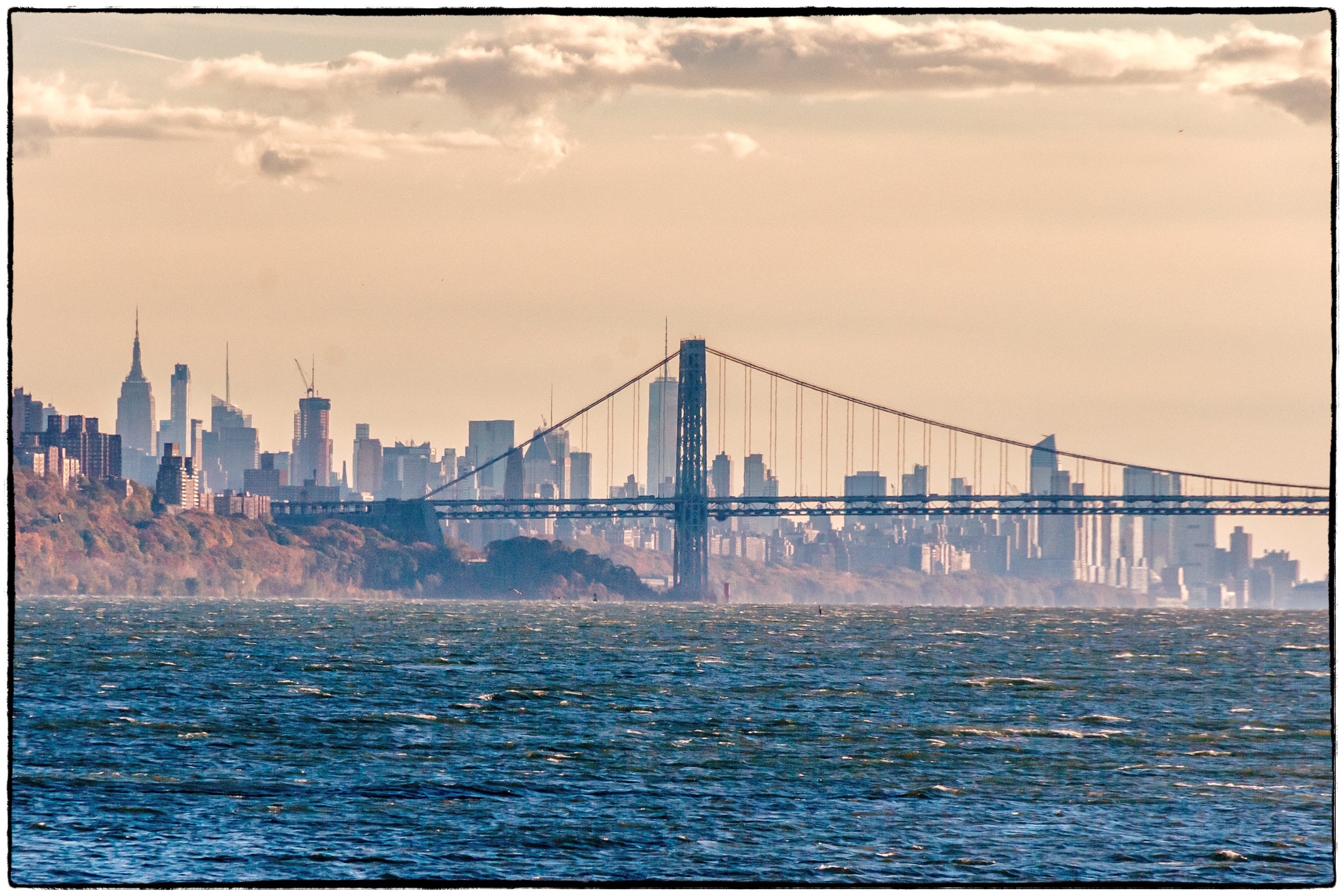
View from the rear of the departing boat, of the Manhattan skyline, almost 20 miles to the South. The George Washington Bridge (GWB) is in the foreground and the Empire State Building to the far left. The tall building just to the left of the GWB pier is (I believe) One World Trade Center.

The George Washington Bridge, and the Empire State Building have been around for some time and are pretty well known. One World Trade Center is quite new and is possibly not so well known to those outside NY.

According to Wikipedia:

One World Trade Center (also known as the Freedom Tower, 1 World Trade Center, One WTC and 1 WTC) is the main building of the rebuilt World Trade Center complex in Lower Manhattan, New York City. It is the tallest building in the Western Hemisphere, and the sixth-tallest in the world. The supertall structure has the same name as the North Tower of the original World Trade Center, which was completely destroyed in the terrorist attacks of September 11, 2001. The new skyscraper stands on the northwest corner of the 16-acre (6.5 ha) World Trade Center site, on the site of the original 6 World Trade Center. The building is bounded by West Street to the west, Vesey Street to the north, Fulton Street to the south, and Washington Street to the east.

The building’s architect was David Childs, whose firm Skidmore, Owings & Merrill (SOM) also designed the Burj Khalifa and the Willis Tower. The construction of below-ground utility relocations, footings, and foundations for the new building began on April 27, 2006. One World Trade Center became the tallest structure in New York City on April 30, 2012, when it surpassed the height of the Empire State Building. The tower’s steel structure was topped out on August 30, 2012. On May 10, 2013, the final component of the skyscraper’s spire was installed, making the building, including its spire, reach a total height of 1,776 feet (541 m). Its height in feet is a deliberate reference to the year when the United States Declaration of Independence was signed. The building opened on November 3, 2014.

On March 30, 2009, the Port Authority of New York and New Jersey (PANYNJ) confirmed that the building would be officially known by its legal name of “One World Trade Center”, rather than its colloquial name of “Freedom Tower”. The building is 104 standard floors high, but the tower has only 94 actual stories.

The new World Trade Center complex will eventually include five high-rise office buildings built along Greenwich Street, as well as the National September 11 Memorial & Museum, located just south of One World Trade Center where the original Twin Towers stood. The construction of the new building is part of an effort to memorialize and rebuild following the destruction of the original World Trade Center complex.
Hudson river cruise – Leaving

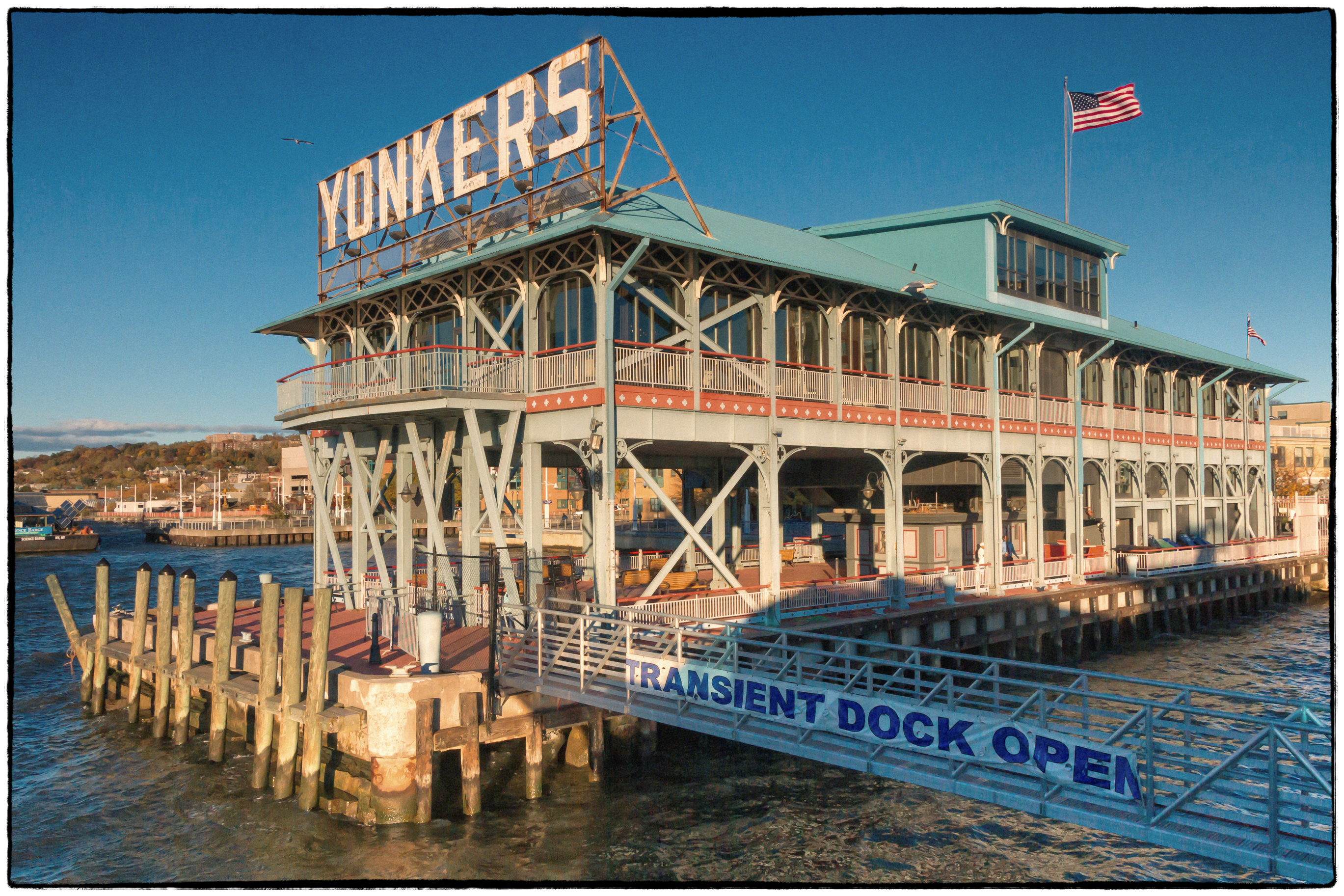
We recently went with some friends on a cruise on the Hudson starting from the Yonkers Pier and going up the river as far as Ossining and back. The purpose of the cruise was to raise money for the museum at Sing Sing prison. The cruise featured a buffet meal; a live band; and dancing.

According to an Daily News article: New Life for Yonkers Pier:

Built in 1901, the pier was one of eight built along the Hudson and East rivers to service the ferry and passenger boats that dotted the shoreline. But by the 1940s, railroad and road transportation had become the favored means of commuter and residential travel. Seven of the piers had been torn down and replaced by sturdier, less ornamental docks that could handle commercial cargo ships. Only the two-story neo-classical Yonkers pier was left standing. The pier, with its large letters announcing the city’s name, remained a favored spot for Yonkers fishermen and strollers but had deteriorated. In recent years, when talk of riverfront rehabilitation heated up in Yonkers and Hudson River ferry travel was revived, the pier became a focal point for the city.

The top part of the the pier now has an excellent restaurant: Xaviars X20 on the Hudson with great food and spectacular view south to the Manhattan skyline and north to the Tappan Zee bridge.

Make America Great Again

We went to see a play in a small theater on West 72nd Street NY city. A friend dropped us near the 72nd subway and while my wife was checking out a nearby Bloomingdales Outlet I walked around looking for photographic opportunities.

I came across this guy sitting in Verdi Square and did something I very rarely do. I went up to him and asked if I could take a picture of him. He looked like the epitome of a Trump supporter: grizzled beard; camouflage jacket and a bright red “Make America Great Again” hat.

We got talking about the election. It turns out that he’s actually a registered Democrat who felt the need for change and he didn’t think the Democrats were offering that. He didn’t even like Donald Trump all that much, but he though that Hillary Clinton would be worse.

He was a very pleasant, thoughtful person and I enjoyed the experience.

In retrospect maybe this photograph would have been better in its original color so the bright red of the hat could be seen in all its glory.

For some additional thoughts on the election see: Election 2016

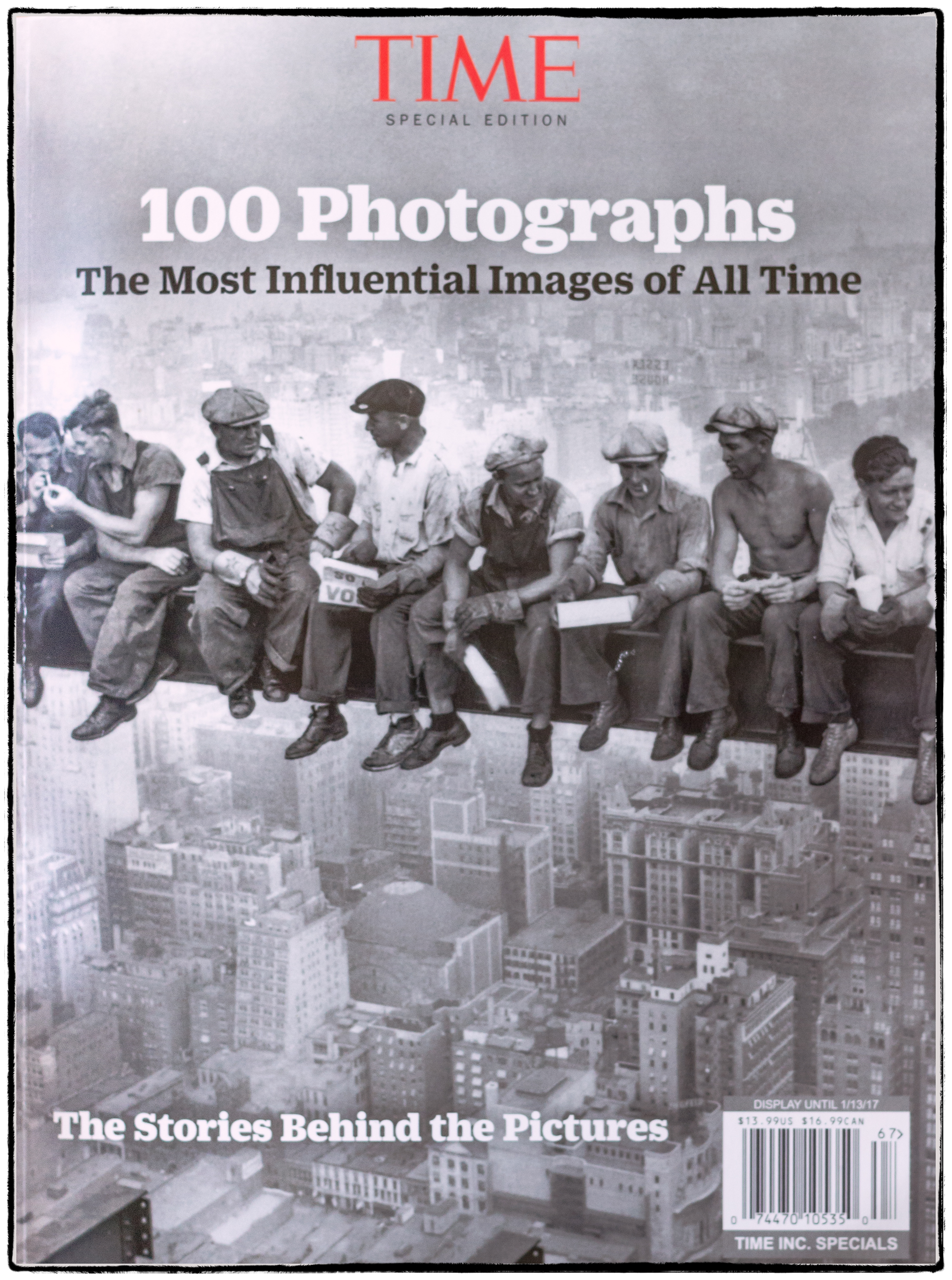
Time. 100 photographs. The most influential images of all time.

I went grocery shopping the other day and as I was standing in line at the checkout I noticed this publication. I’d read that Time was about to publish such a volume, but had then forgotten about it. It seemed like it might make an interesting read so into my cart it went.

I’m glad I got it. The subtitle is “The Stories Behind the Pictures” and I certainly found the introduction and the short textual “stories”, which accompany each picture to be of interest.

Anyone who compiles a ‘best of…’ list is looking for trouble. You can’t please everyone so there will always be complaints. Time has set itself a particularly difficult task in that it has tried to identify the ‘most influential’. They do spend some time in the introduction explaining what criteria they used and how they applied these criteria, but trying to determine influences is always hard. I couldn’t help but feel in some cases that the pictures didn’t so much ‘influence’ as much as they did just reflect an already existing trend.

In my opinion this publication also reflects a couple of biases: 1) a concentration on US photography; and 2) a preference for photojournalism/reportage. Considering the history of ‘Time’ I suppose this should be no surprise.

Of course I have my own thoughts as to what should have been included, and what not. For example – the daguerreotype was certainly very influential in the early days of photography, but ultimately turned out to be a dead end as it produced a positive image, which could not be reproduced. I could argue that Willam Henry Fox Talbot’s calotype process (and other processes which produced negatives e.g. collodion etc.) was ultimately much more influential as it formed the basis for photography for the next 150 years or so. Likewise you could make the case that, although Carleton Watkins came first and influenced the establishment of the Yosemite National Park, Ansel Adams was ultimately more influential both in terms of the environmental movement and the development of photography. But these are mere subjective quibbles that inevitably come up whenever anyone attempts a list of this kind.

Generally I liked this publication a lot and I’m glad I bought it.

Yonkers window

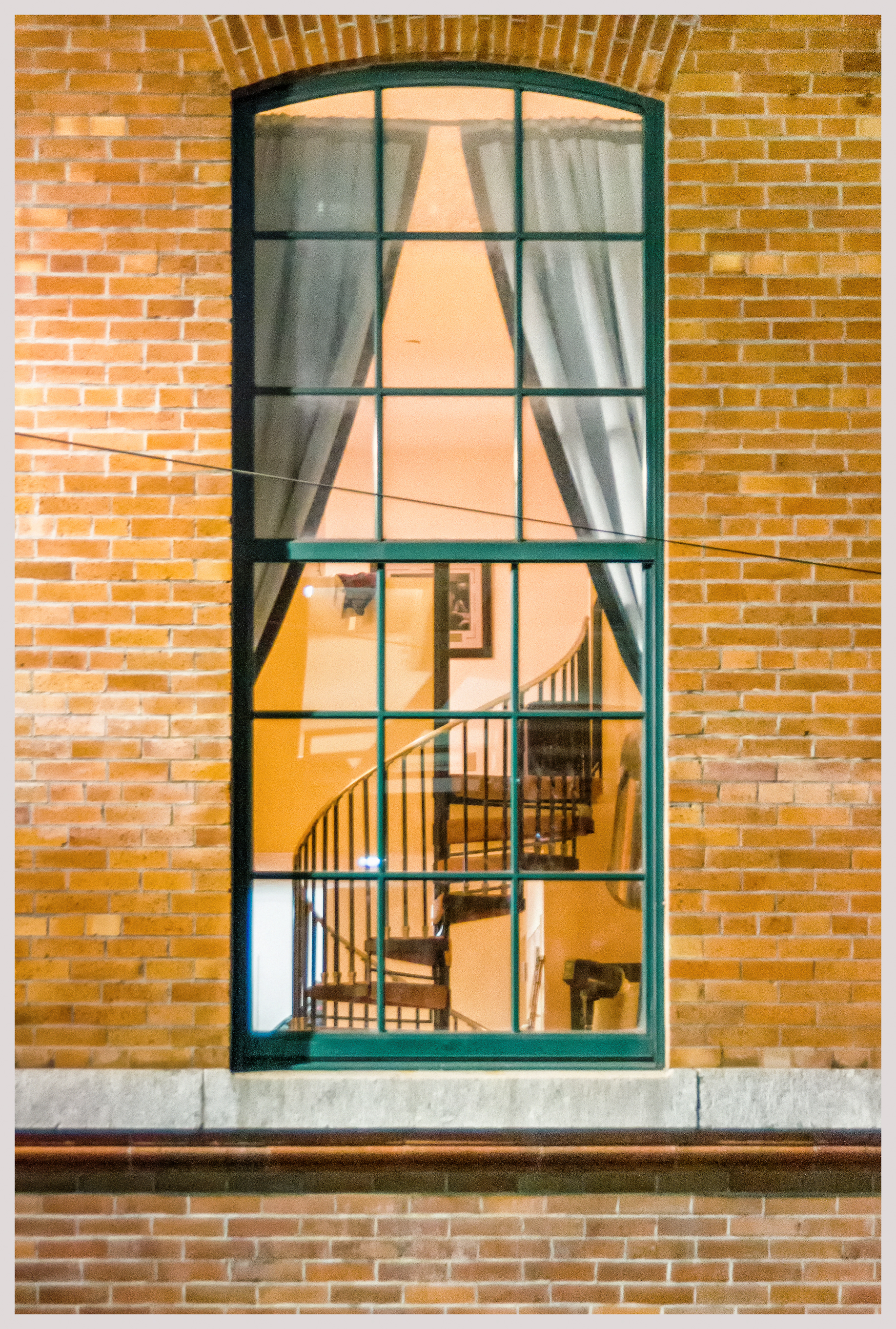
We’d been out with some friends and were returning to the car when I spotted this window. It was actually dark out, but a nearby light was illuminating the outside wall and of course the interior was lit. I’m not entirely sure why I like this picture. Maybe it’s the way the spiral staircase curves around inside the window frame? Most of the other elements in the picture are either horizontal or vertical so the curving staircase is a bit of a surprise. This curve is also picked up by the only other curve in the picture: the drapes. There’s something about it that I find soothing.