Milk Churns and Wooden Barrels

I grew up in a rural part of northern England. My grandmother owned a farm and I remember seeing lots of these milk churns. As I recall (perhaps imperfectly) she would milk the cows, some of whom were quite aggressive – I recall one of them kicking her, and the milk would end up in these churns. Then someone from the dairy would come to pick them up.

I haven’t seen one for years.

The churn bears the name Bordens, which Wikipedia describes as follows:

Bordens was an American producer of food and beverage products, consumer products, and industrial products. At one time, the company was the largest U.S. producer of dairy and pasta products. Its food division, Borden Foods, was based in Columbus, Ohio, and focused primarily on pasta and pasta sauces, bakery products, snacks, processed cheese, jams and jellies, and ice cream. It was best known for its Borden Ice Cream, Meadow Gold milk, Creamette pasta, and Borden Condensed Milk brands. Its consumer products and industrial segment marketed wallpaper, adhesives, plastics and resins. By 1993, sales of food products accounted for 67 percent of its revenues. It was also known for its Elmer’s Glue and Krazy Glue.

After significant financial losses in the early 1990s and a leveraged buyout by KKR in 1995, Borden divested itself of its various divisions, brands and businesses. KKR shuttered Borden’s food products operations in 2001, and divested all its other Borden operations in 2005. Borden dairy brands are currently used by both Dean Foods and Grupo Lala (as Borden Milk Products) for milk and by Dairy Farmers of America for cheese. As of Jan 2015, Grupo LALA (of Durango, Mexico) is the new owner of all Borden trademarks in the US.

For an interesting short, early history of Borden’s in New York State (particularly it’s relationship to the hamlet of Walkill in Orange County) see: Everyone Knows Elsie: A Short History of the Borden Company on the New York History Blog.

Fort Montgomery – Route 9W Bridge over Popolopen Creek

It’s all very confusing. Doing my research for this series of posts on the area around Fort Montgomery I’ve discovered that both this bridge (where Route 9w crosses over Popolopen Creek) and the footbridge (See: Fort Montgomery – Footbridge over Popolopen Creek) are described as “The Popolopen Creek Bridge”.

According to Wikipedia:

During the American Revolution, the mouth of Popolopen Creek was spanned by a pontoon bridge. Much later, the road north from Hessian Lake to Fort Montgomery once crossed the lower part of the gorge by an iron bridge. The steep descents into the gorge and sharp turns onto this bridge made it dangerous for auto traffic. In 1916 the road (then Route 3, renumbered U.S. Route 9W in 1930) was rerouted over a high steel viaduct further downstream, near the site of Fort Montgomery, in 1916. Another bridge was built immediately adjacent in 1936.

Called Popolopen Bridge, the 1936 structure is of the deck truss design, more than 600 feet long, 48 feet wide. It rises about 150 feet above the mouth of Popolopen Creek. As of 2000, its average daily traffic was about 18,000 vehicles. Although rehabilitation was performed in 1992, additional repairs were completed in 2007. The 1916 bridge was demolished in the 1950s, although its high stone abutments remain.

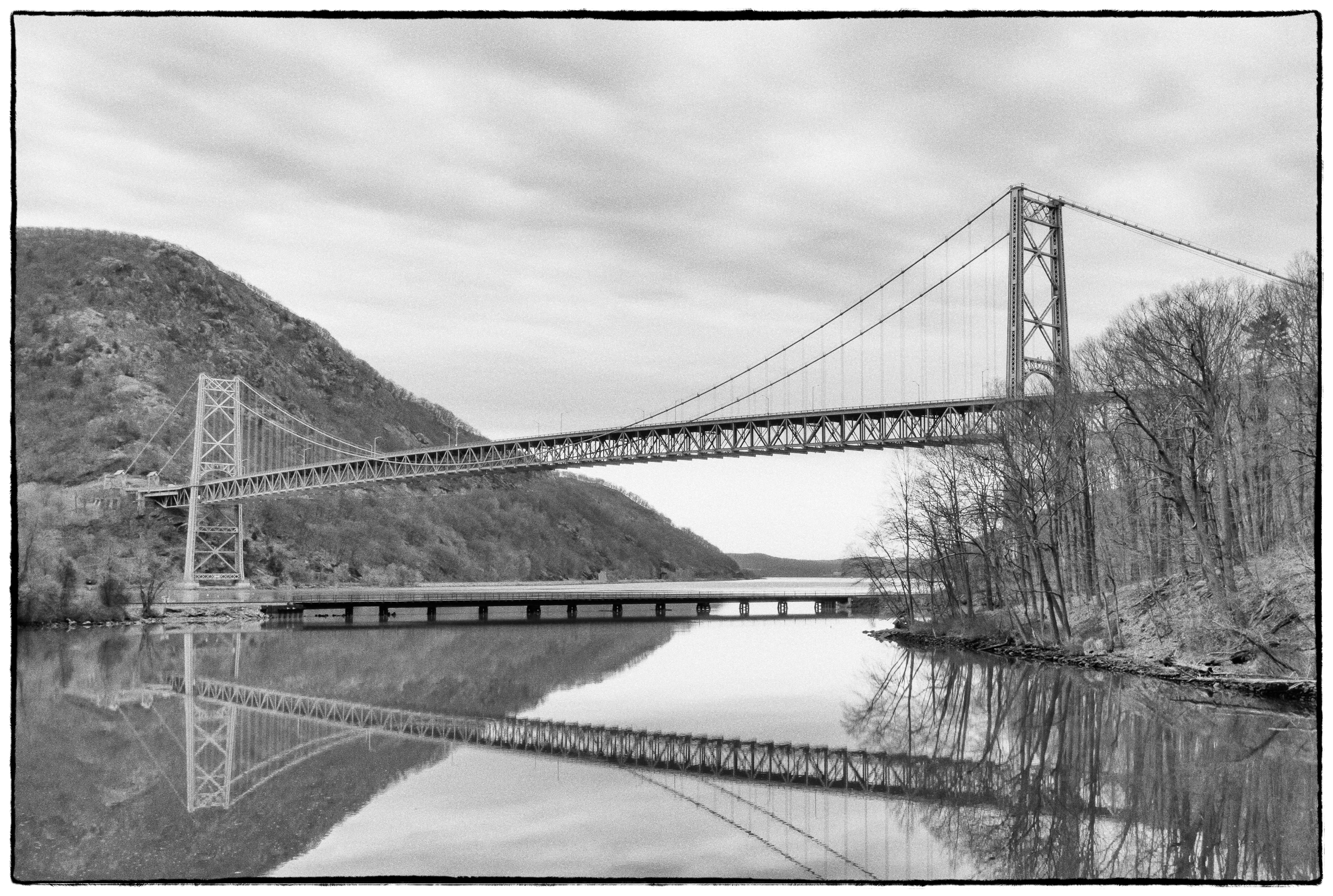
Below – 9W bridge reflected in Popolopen Creek.

Fort Montgomery – Footbridge over Popolopen Creek.

As mentioned in earlier posts the pontoon bridge that crossed Popolopen Creek during the Revolutionary war was eventually (and much much later) replaced by a permanent structure. According to Wikipedia:

The red-blazed Popolopen Gorge Trail runs along the south side of the creek to a foot bridge just south of Popolopen Torne. Here, it joins the blue-blazed Timp-Torne, 1777 West and 1779 trails. These run along the north side of the creek from Hell Hole to the bridge, with the Timp-Torne detouring over the summit of Popolopen Torne. They cross the footbridge and join the Popolopen Gorge Trail to detour around West Point property, and the combined trails turn southwest and follow the valley of Queensboro Brook.

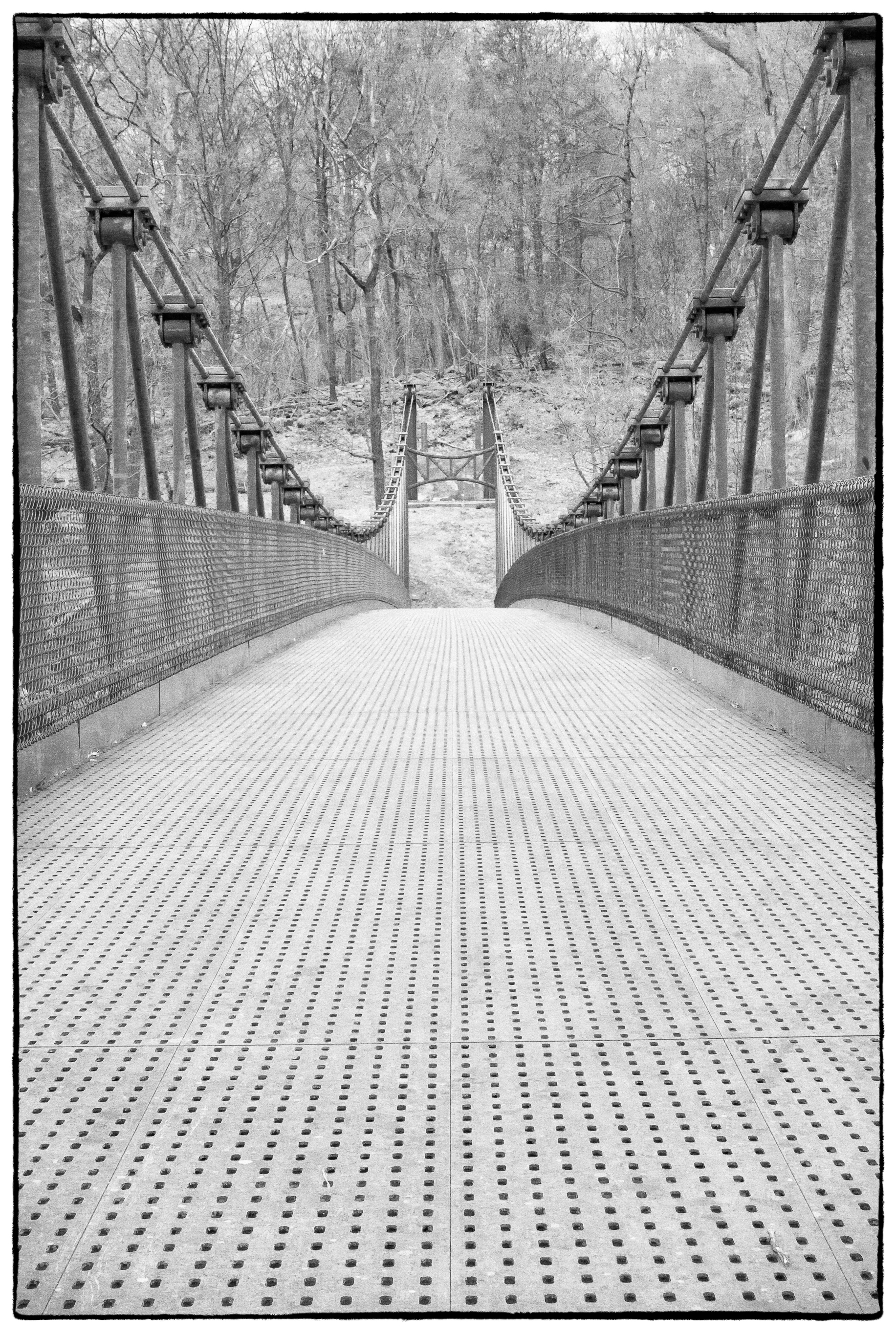
On October 6, 2002, New York Governor George Pataki dedicated a long suspension foot bridge which spans the creek a short distance further downstream. The novel design embracing a stiffened Suspended Rope Truss Bridge was proposed by Bruce Ramsay & Jim Hume of Cleveland Bridge Ltd. The final design & construction was carried out by Cleveland Bridge Ltd. The foot bridge connects the Twin Forts Trail to its intersection with the Appalachian Trail on the western side of the Bear Mountain Bridge.

As noted above a new footbridge (built 2002) has been constructed across the Popolopen Creek just downstream from this bridge. The concept design of this bridge was proposed by Bruce Ramsay & Jim Hume of Cleveland Bridge Pty. Ltd. of the U.K., Cleveland Bridge were also responsible for its construction. The footbridge was designed as a suspended rope truss, which results in a very stiff bridge due to its diagonal braces. Another special feature is the fiber composite deck in lieu of a traditional timber deck for this type of structure. The fiber composite deck adds lightness, long term durability and reduced maintenance requirements.

According to the Dorman Long Technology (the US arm of Cleveland Bridge) site:

Completed in 2002, the Popolopen Creek Footbridge was designed by DLT to create an economic and aesthetically pleasing river crossing of 140m main span on the Appalachian Trail in Bear Mountain Park, Fort Montgomery, NY. The bridge is a hybrid of a suspension bridge and a truss bridge and was designed for ease of construction. The suspension cables alone support the dead weight of the bridge whilst the live loads are resisted by a combination of the suspension cables and the truss formed by the suspension cable, suspenders, diagonal bracings and the deck edge girder. The result is a stiff bridge that is comfortable to walk across despite having a visually pleasing low span to sag ratio for the main suspension cables. The deck panels are fibre reinforced composite panels that bolt to the steel deck frame. Use of these panels significantly reduced the dead weight of the bridge. Main cables are anchored to rock at either end of the bridge at the top of slopes leading down to the bridge.

A plaque on the bridge reads:

The William J. Moreau Popolopen Bridge. “Bill” Moreau, Chief Engineer at the New York State Bridge Authority for 27 years. He is recognized world-wide and at home in the Hudson Valley for his strong willed, expert dedication to safe bridge design, function and maintenance for long-lived and beloved bridges. Dedicated 27 June 2014.

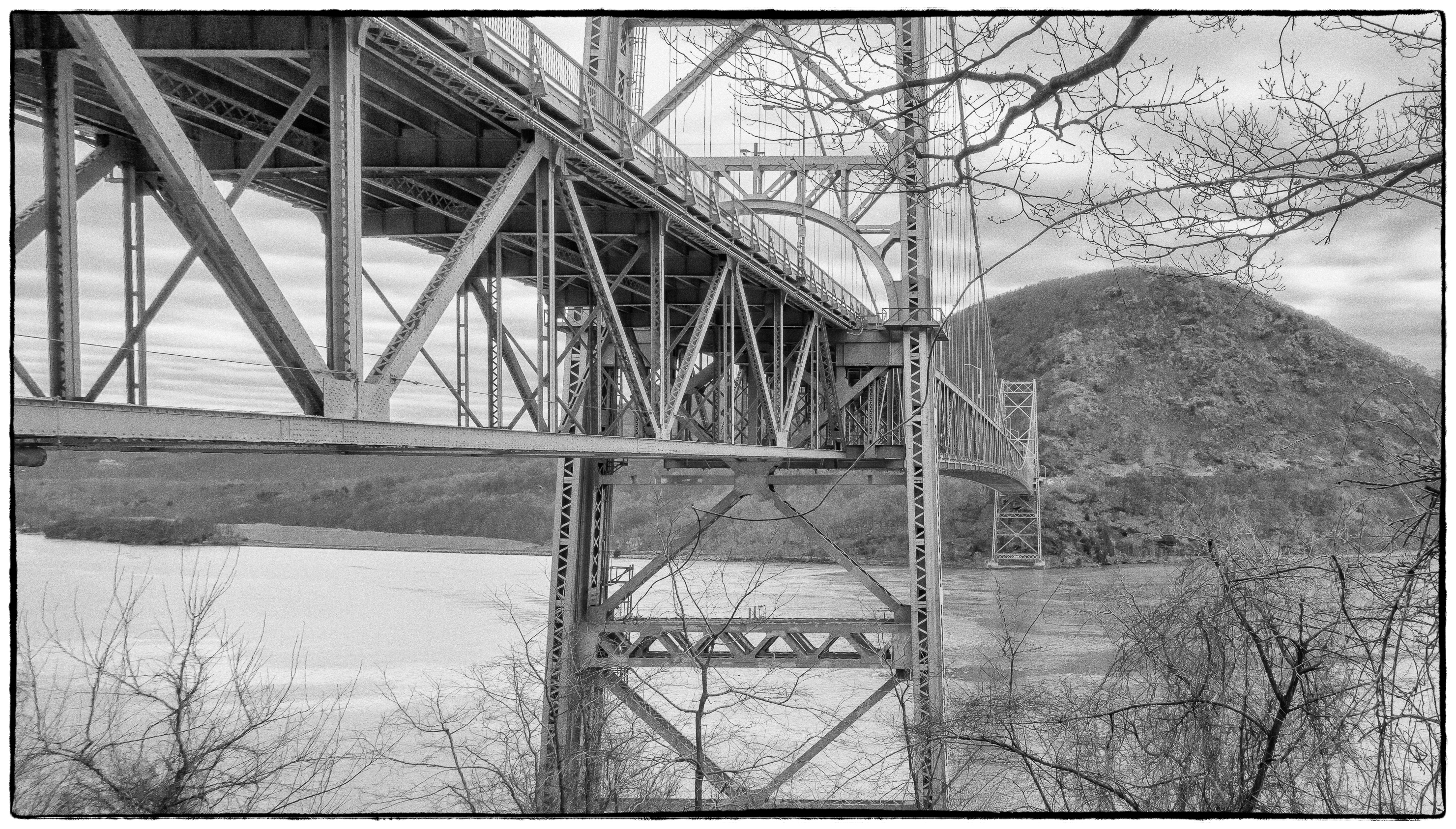
Below a view of the Bear Mountain Bridge from the footbridge.

Fort Montgomery – A view from the 9W bridge

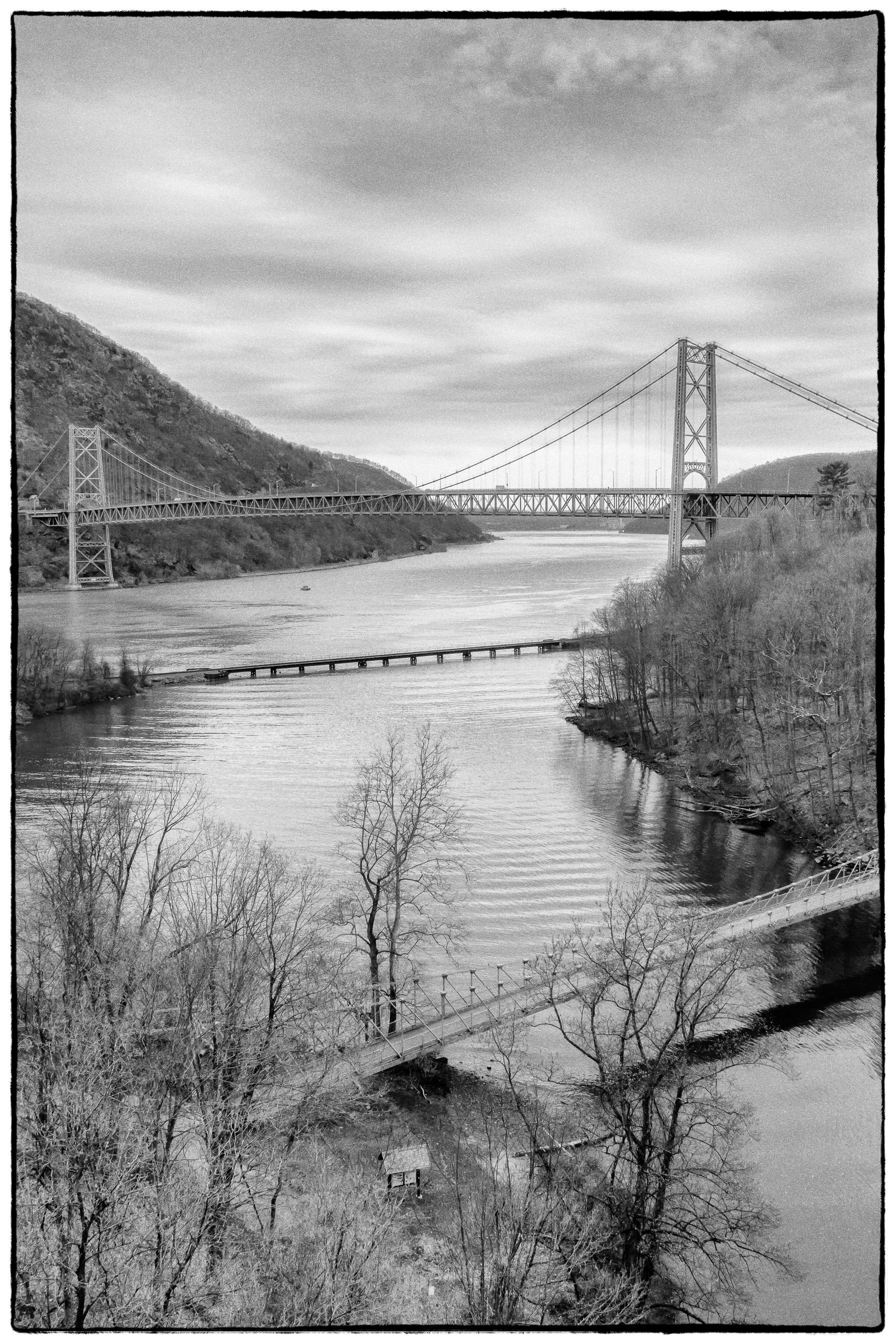
Route 9W passes across a bridge over Popolopen Creek just steps away from Fort Montgomery. This is the view from the bridge. Farthest away is the Bear Mountain bridge over the Hudson River. Next comes a railway bridge and finally the footbridge over the creek that replaced the pontoon bridge in use during the Revolutionary War to connect Forts Montgomery (on the left in the picture) to Fort Clinton (on the right).

I read somewhere (but can no longer remember where) that the bulk of the ammunition for the twin forts was stored at Fort Clinton – to be taken down and over Popolopen Creek to the more heavily fortified Fort Montgomery as required. Unfortunately the British surprise attack over the Timp pass, through Doodletown and down Popolopen Creek cut Fort Montgomery off from Fort Clinton and meant that it soon ran out of ammunition.

Fort Montgomery – A view from Fort Clinton

Once upon a time Fort Montgomery sat on the heights above the north side of Popolopen Creek. On the heights on the other side of the creek stood Fort Clinton. Almost nothing of Fort Clinton remains today, but it once stood where the Bear Mountain tolls now stand. This is taken from a spot just below the tolls looking across towards Anthony’s Nose, and I imagine this is pretty much what the view from Fort Clinton looked like – without the commanding presence of the Bear Mountain Bridge of course.

According to Wikipedia:

Fort Clinton (demolished) was one of a pair of American Revolutionary War fortifications located at the confluence of the Popolopen Creek and the Hudson River. It stood on the south side of Popolopen Gorge, and its companion fort, Fort Montgomery, stood on the north side. The forts defended a Hudson River Chain that stretched from Fort Montgomery on the west side of the Hudson River to Anthony’s Nose on the east side. The sites of both forts are in present-day Highlands, Orange County, New York.

The Fort Clinton site is near the west end of the Bear Mountain Bridge. Fort Clinton’s garrison of 300 soldiers was smaller than Fort Montgomery’s, but it was built on higher ground, and its defenses were more complete. The fort was commanded by General James Clinton, for whom it was probably named.

On October 6, 1777, Forts Clinton and Montgomery were attacked by the British 63rd Regiment led by Sir Henry Clinton (no relation). The Battle of Forts Clinton and Montgomery was intense but brief: Both forts were overrun within an hour, and the wounded General James Clinton retreated with his men through Popolopen Gorge. Fort Clinton and Fort Montgomery were razed by the British, and the iron chain they defended was dismantled.

Although the ruins of Fort Montgomery survive and the site is a National Historic Landmark, the Fort Clinton site was destroyed in the 1920s during the construction of U.S. Route 9W and the Bear Mountain Bridge. Today, the Fort Clinton site is part of Bear Mountain State Park and is used for the Trailside Museum and Zoo.