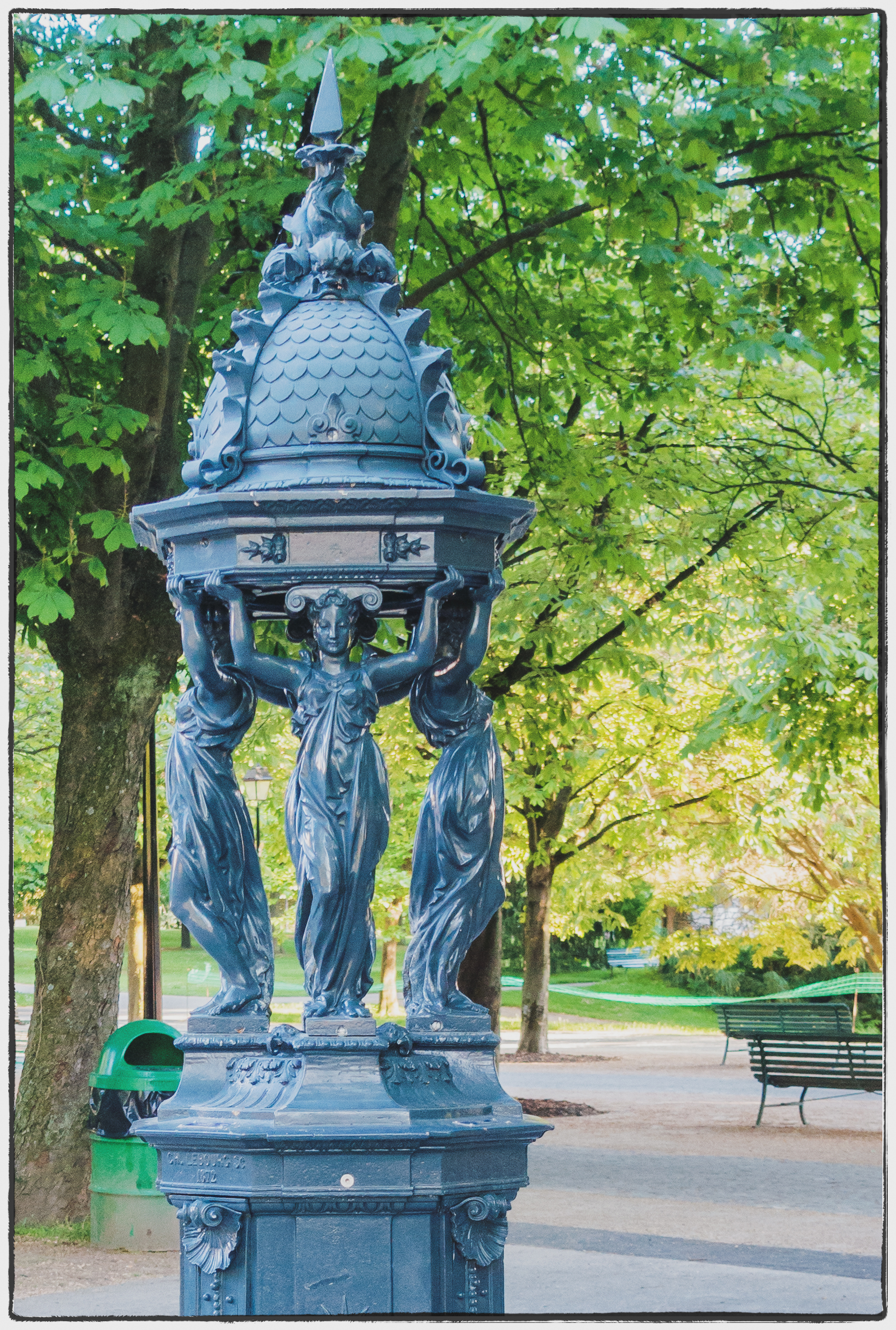
Geneva – Parc des Bastions, Wallace Fountain

The key to identifying this piece was the inscription on the base: “Ch Lebourg SC 1872”. The photograph is a great example of how a fairly decent picture can be ruined by not looking carefully around the subject to see if there are any distractions. It was late in the day. I’d been walking for a couple of hours and was looking at a long walk home. So my excuse is that I wasn’t concentrating at this point. If I had been I might have noticed the ugly garbage container and done something to hide it behind the sculpture. This mistake annoys me so much that I almost didn’t include this picture. In the end I decided to let it go, despite the garbage can, because I like the story behind it.

This piece was created by Charles-Auguste Lebourg, and it was a so-called Wallace Fountain. According to Wikipedia:

Wallace fountains are public drinking fountains designed by Charles-Auguste Lebourg that appear in the form of small cast-iron sculptures scattered throughout the city of Paris, France, mainly along the most-frequented sidewalks. They are named after the Englishman Richard Wallace, who financed their construction. A great aesthetic success, they are recognized worldwide as one of the symbols of Paris. A Wallace Fountain can be seen outside the Wallace Collection in London, the gallery that houses the works of art collected by Sir Richard Wallace and the first four Marquesses of Hertford.

Apparently the fountains were designed by Richard Wallace ( himself and intended them to be beautiful as well as useful. The fountains had to meet several strict guidelines:

  • Height: They had to be tall enough to be seen from afar but not so tall as to destroy the harmony of the surrounding landscape.
  • Form: Both practical to use and pleasing to the eye.
  • Price: Affordable enough to allow the installation of dozens.
  • Materials: Resistant to the elements, easy to shape, and simple to maintain.
  • The locations, as well as the color (a dark green, like all urban development of that era, in order to blend in with the parks and tree-lined avenues), were quickly decided upon by the city government.

Wallace created two different models, which were followed by two additional models, so, in all, there were four types of Wallace fountains varying in such properties as height and motif. The material that was used to create them was cast-iron. Inexpensive, easy to mold, and robust, it was one of the most popular materials of the age. The majority of the cost was paid for by Wallace. The city of Paris allocated 1,000 francs for the large model and 450 francs for the wall-mounted model.

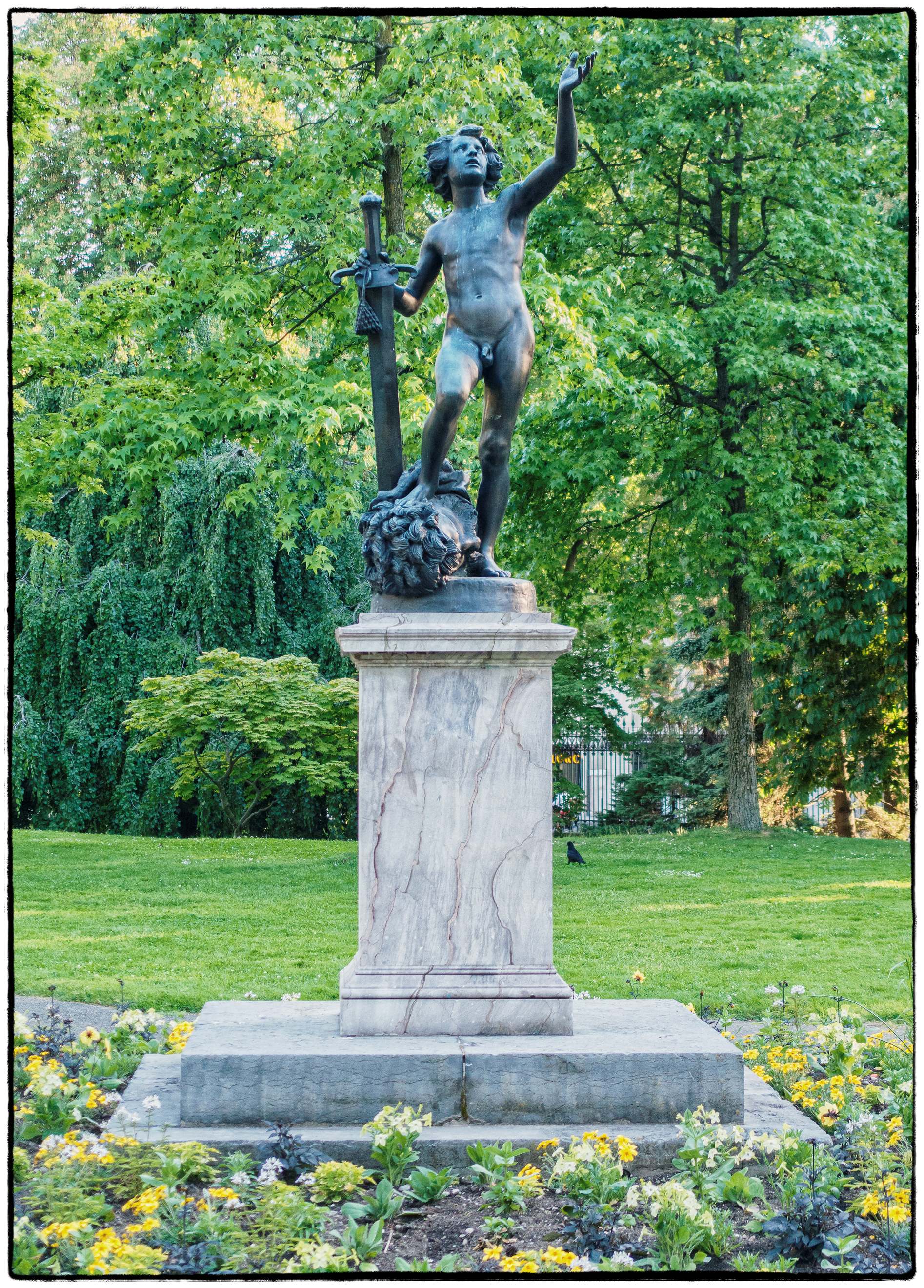
Geneva – Parc des Bastions, David and Goliath Statue

This bronze statue is called “David remerciant Dieu d’avoir frappé Goliath” (“David thanks God for being able to strike Goliath”), and also known as “David vainqueur de Goliath” (“David defeats Goliath”), and it refers to the Biblical story of young hero who managed to defeat the giant who was threatening his village.

The statue was created by the 19th Century French sculptor Jean-Etienne Chaponnière. According to Wikipedia:

John-Étienne Chaponnière (July 11, 1801 – June 19, 1835), also known as Jean-Étienne Chaponnière (sic), was a Swiss sculptor active in Italy and France.

Chaponnière was born in Geneva, where he studied at the school of the Société des Arts under Joseph Collart and Charles Wielandy. He moved to Paris in 1822, where he studied first at the École Gratuite de Dessin and then under sculptor James Pradier, who advised him to abandon painting for sculpture. After a period in Naples from 1827-1829, he moved to Florence where he lived with Lorenzo Bartolini, and then onwards to Rome. In 1827 he created his first major piece, la Jeune captive pleurant sur le tombeau de Byron, which he sold to the Musée Rath in Geneva. It was sufficiently well-received that he was made an honorary member of the Société des Arts. His subsequent works, including the Son of William Tell, an allegorical bas-relief for the bust of Marc-Auguste Pictet, and a Hunting and Fishing Group (later renamed Daphnis and Chloe), were also successful in Geneva in 1829. After a brief time in Switzerland, he returned to Paris, where his Daphnis and Chloe proved successful enough in 1831 that Adolphe Thiers commissioned a bas-relief of the taking of Alexandria for the Arc de Triomphe (which was subsequently shown in the Salon of 1834). Chaponnière retitled his Jeune captive figure as Une captive de Missolonghi, under which title it was exhibited in the Salon of 1833. His 1834 David and Goliath was also a success, and was in 1854 cast in bronze for Geneva’s promenade des Bastions. In rapidly declining health, Chaponnière died in 1835 at Monnetier-Mornex (Haute-Savoie), near Geneva.

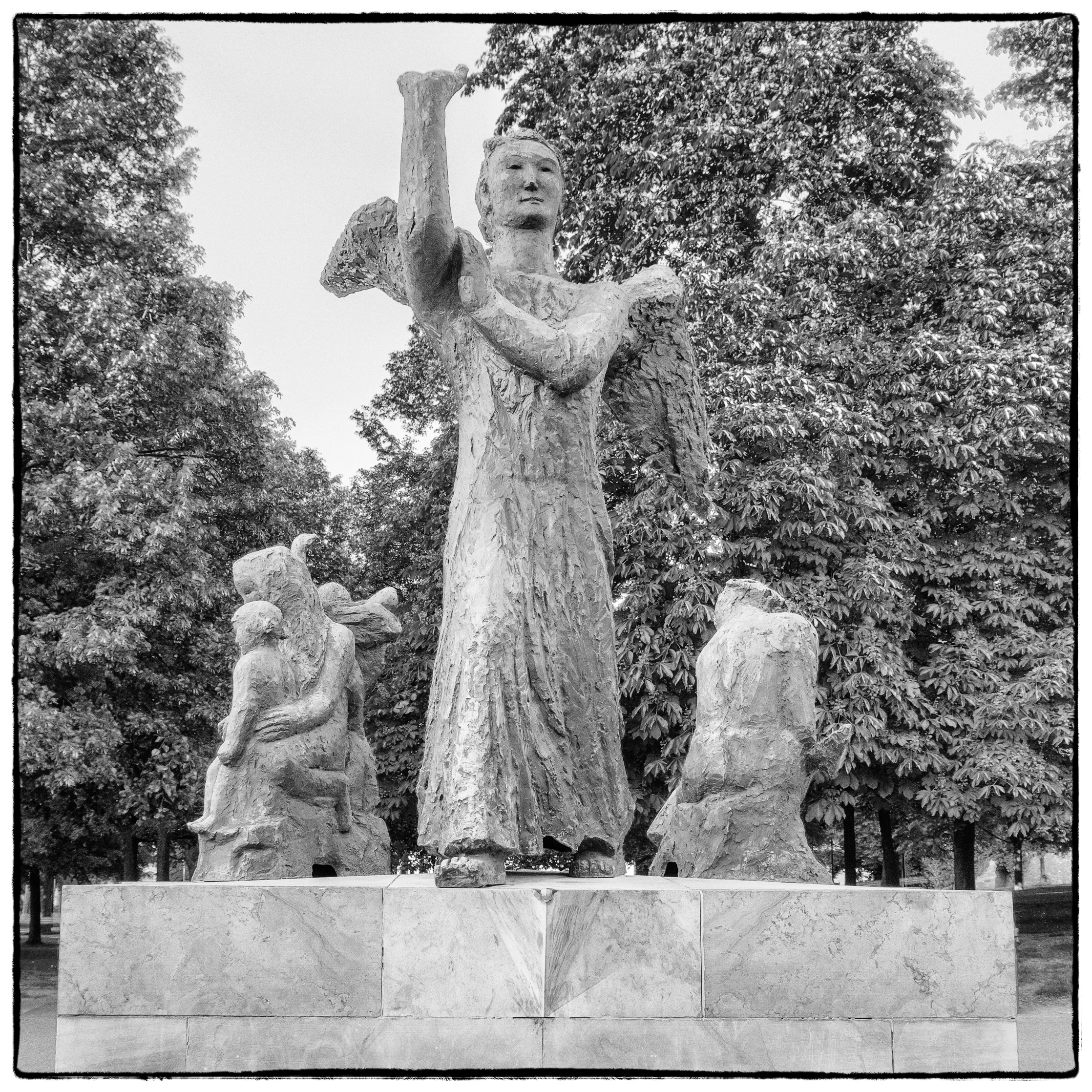
Geneva – Parc des Bastions, Henri Dunant Monument

Above: Protective Angel.

According to the web site of the International Committee of the Red Cross (ICRC) (which he founded):

The Red Cross came into being at the initiative of a man named Henry Dunant, who helped wounded soldiers at the battle of Solferino in 1859 and then lobbied political leaders to take more action to protect war victims. His two main ideas were for a treaty that would oblige armies to care of all wounded soldiers and for the creation of national societies that would help the military medical services.

Dunant put down his ideas in a campaigning book, A Souvenir of Solferino, published in 1862. The Public Welfare Committee in his home town of Geneva took them up and formed a working group (the embryo ICRC, with Dunant as secretary), which first met in February 1863. The following October, an international conference was convened, to formalize the concept of national societies.

The conference also agreed on a standard emblem to identify medical personnel on the battlefield: a red cross on a white background. (The red crescent emblem was adopted by the (Turkish) Ottoman Empire in the 1870s.)

In August 1864, delegates from a dozen countries adopted the first Geneva Convention, which put a legal framework around these decisions and made it compulsory for armies to care for all wounded soldiers, whatever side they were on.

These developments put the ICRC at the origin of both the International Red Cross and Red Crescent Movement – today grouping the ICRC, the national societies (185 in 2007) and their International Federation – and of modern international humanitarian law: the four Geneva Conventions of 1949 and their three Additional Protocols of 1977 and 2006.

At the outset, the ICRC’s task was to encourage the creation of national societies (the first was in the German state of Württemberg, in November 1863) and to act as a channel for communication between them. Its first field operation was in 1864, during the war between Germany and Denmark: delegates were sent to work on each side of the front line. This heralded the start of the ICRC’s operational role as a neutral intermediary between belligerents.

Dunant’s ideas found a positive response among leaders and benefactors, welfare groups and the public. In the following years, national societies were established throughout Europe. The Geneva Convention was later adapted to include wounded, sick and shipwrecked in warfare at sea, and governments adopted other laws (such as the Hague Conventions) to protect war victims.

At the same time, the ICRC expanded its own work, undertaking new activities such as visiting prisoners of war and transmitting lists of names, so that their families could be reassured.

By the end of the 19th century, Henry Dunant – whose vision had helped start the whole process – was living in obscurity in a Swiss mountain village; his business failures had forced him to withdraw from Geneva and from an active role in the Red Cross. But in 1901 he became the first recipient, along with the French pacifist, Frédéric Passy, of the Nobel peace prize.

Dunant died in 1910. By then, in Europe, North and South America, Asia and Africa, the Red Cross and the Geneva Conventions had taken root. Both were to be put to a severe test during the First World War.

For more information on Henri Dunant see the relevant Wikipedia article.

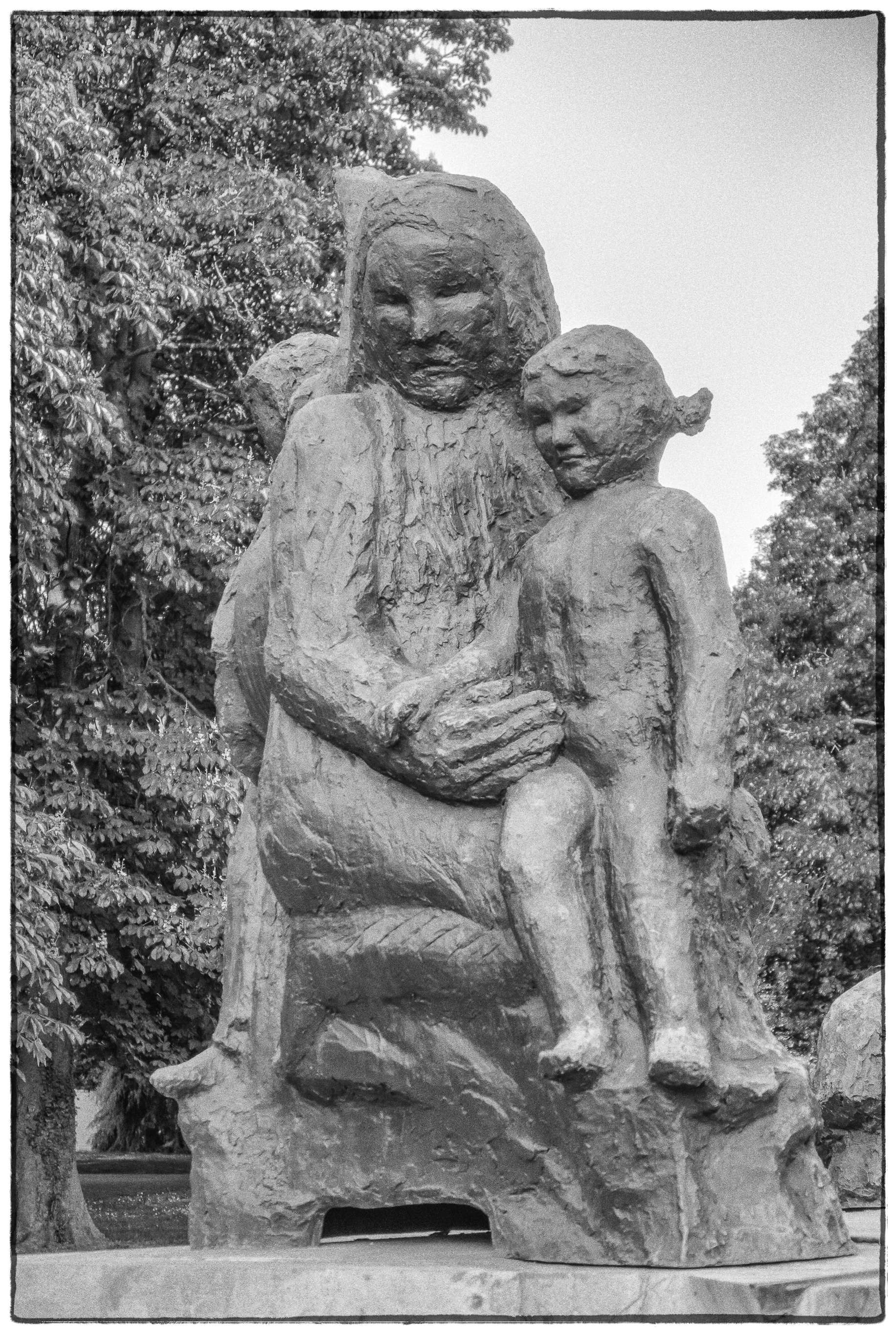
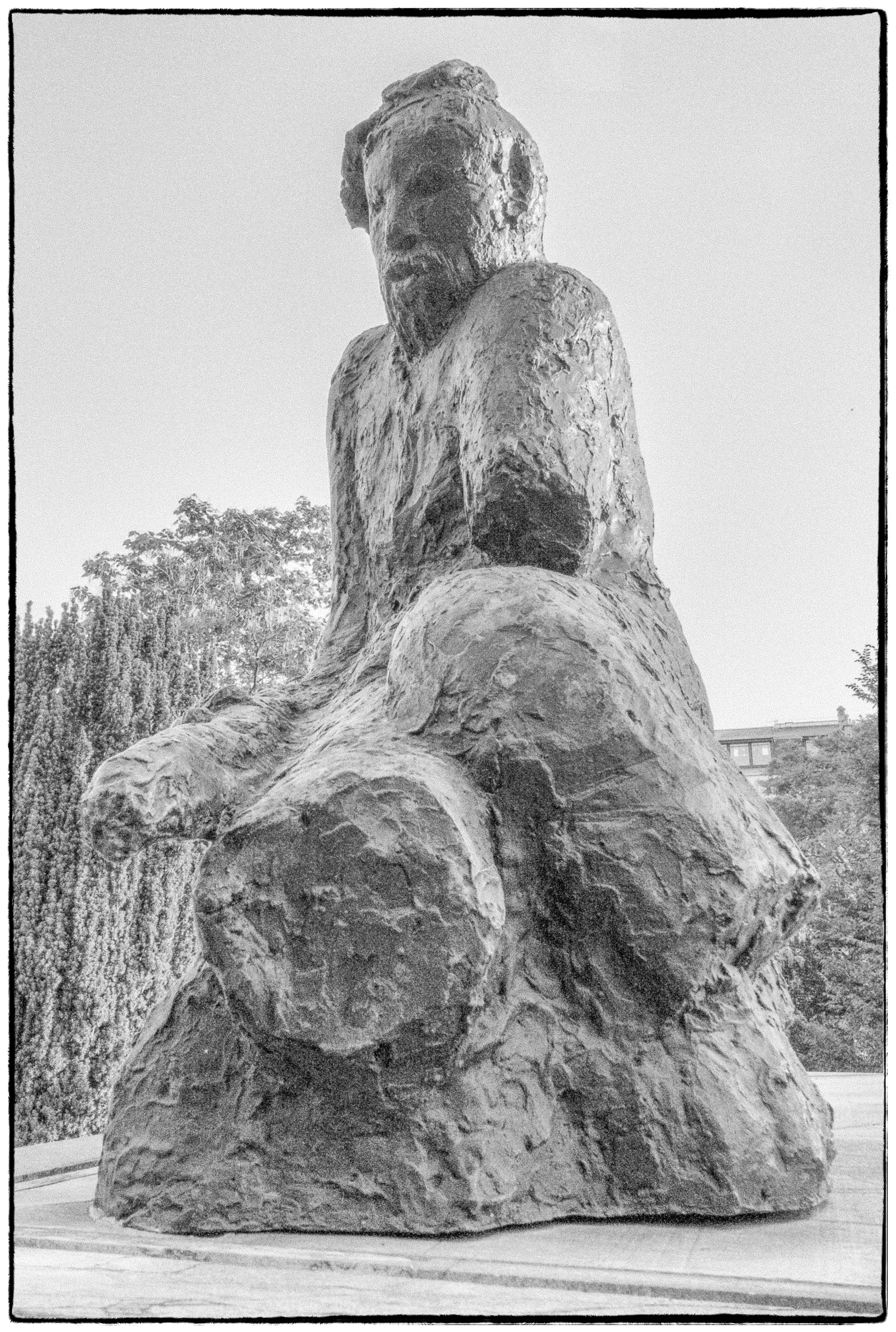
The monument by Jakob Probst (1963) is in the form of a tryptch: Protective Angel (also described as the Archangel Gabriel); Starving Mother with children; and dying warrior.

Starving Mother with Children.

Dying Warrior.

I can’t say that I like it very much.

Geneva – Parc des Bastions, Augustin Pyramus de Candolle Monument

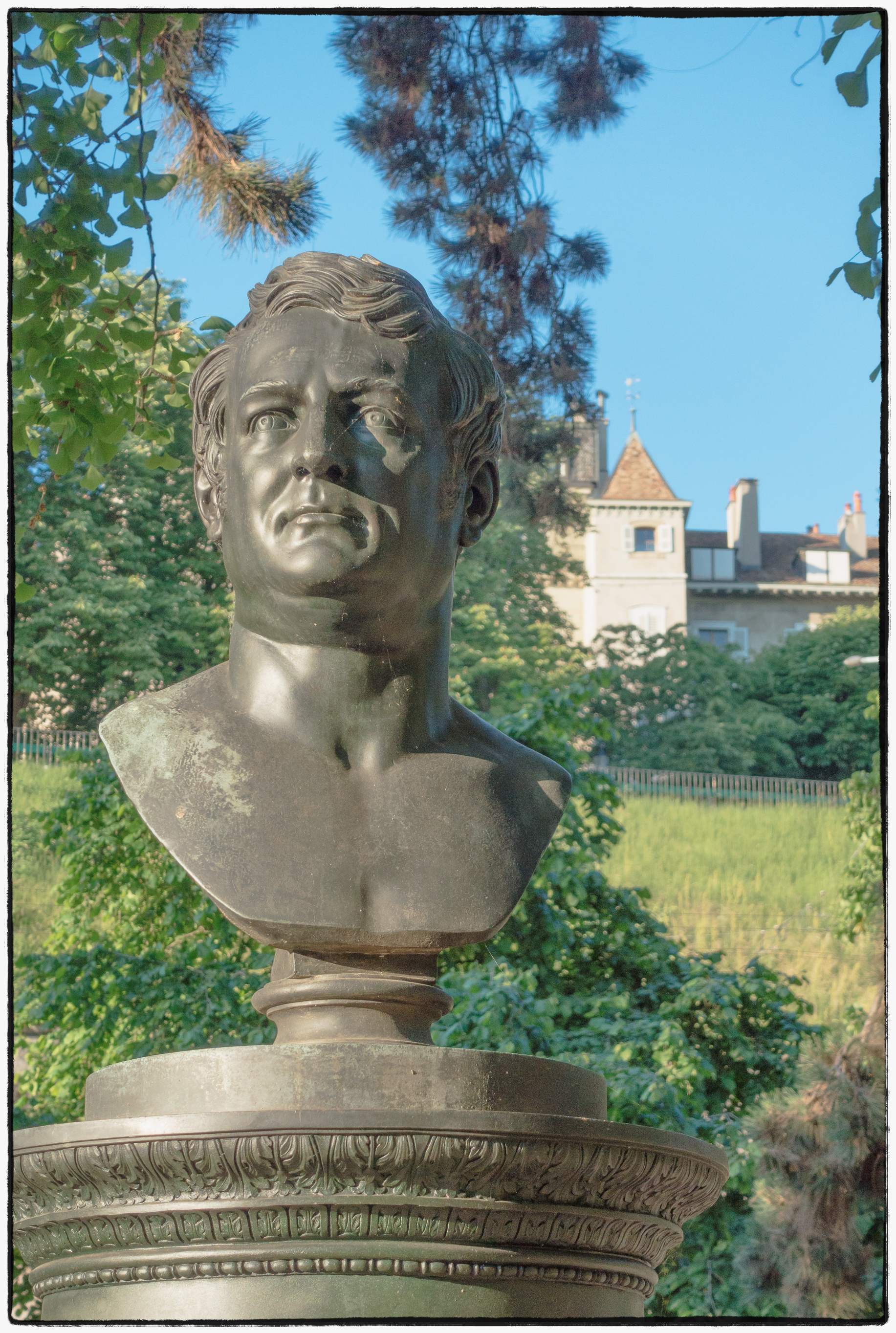
While walking around I came across this bust of Augustin Pyramus de Candolle (Geneva Old Town in the background).

According to Wikipedia:

Augustin Pyramus de Candolle also spelled Augustin Pyrame de Candolle (4 February 1778 – 9 September 1841) was a Swiss botanist. René Louiche Desfontaines launched de Candolle’s botanical career by recommending him at an herbarium. Within a couple of years de Candolle had established a new genus, and he went on to document hundreds of plant families and create a new natural plant classification system. Although de Candolle’s main focus was botany, he also contributed to related fields such as phytogeography, agronomy, paleontology, medical botany, and economic botany.

Candolle originated the idea of “Nature’s war”, which influenced Charles Darwin and the principle of natural selection. de Candolle recognized that multiple species may develop similar characteristics that did not appear in a common evolutionary ancestor; this was later termed analogy. During his work with plants, de Candolle noticed that plant leaf movements follow a near-24-hour cycle in constant light, suggesting that an internal biological clock exists. Though many scientists doubted de Candolle’s findings, experiments over a century later demonstrated that ″the internal biological clock″ indeed exists.

Candolle’s descendants continued his work on plant classification. Alphonse de Candolle and Casimir Pyrame de Candolle contributed to the Prodromus Systematis Naturalis Regni Vegetabilis, a catalog of plants begun by Augustin Pyramus de Candolle.

Candolle also created the impressive Geneva Jardin Botanique/Botanical Garden. I was privileged that my office of many years overlooked the Jardin Botanique.

The bust had a very elaborate cylindrical base (see above and below) bronze reliefs of the four seasons with their Greek names. These picture above depicts Summer, while the one below bears the Geneva coat of arms (an eagle clutching a key). If I’d known what I have since learned about this monument I would have taken pictures of the other seasons too.

It also bears the inscription “Augustin Pyramus de Candolle. Mort à Genève le IX Septembre MDXCCCXLI (1841)/”Augustin Pyramus de Candolle. Died, Geneva 9 September, MDXCCCXLI” (1841). J. Pradier de Genève. SCULP”. A second inscription reads: “Augustin Pyramus de Candolle. Né à Genève. Le IV Fevrier MDCCLXXVIII. Exécuté en 1913 par Fumière et Cie, Paris d’après le modèle fondu à cire perdue par Eugene Gonon en 1843″/”Augustin Pyramus de Candolle. Born, Geneva, 4 February, MDCCLXXVIII (1778) after a model forged in “cire perdue” by Eugène Gonon in 1843″. NOTE: “Cire perdue” is a process used in metal casting that consists of making a wax model (as of a statuette), coating it with a refractory (as clay) to form a mold, heating until the wax melts and runs out of small holes left in the mold, and then pouring metal into the space left vacant. This is a replica of Pradier’s bust of 1845, originally in the botanical garden, but later in the Musée d’Art et Histoire; Inaugurated 9 May 1914.

According to Wikipedia:

James Pradier (born Jean-Jacques Pradier, pronounced [pʁadje]; May 23, 1790 – June 4, 1852) was a Swiss-born French sculptor best known for his work in the neoclassical style.

Born in Geneva, Pradier was the son of a Protestant family from Toulouse. He left for Paris in 1807 to work with his elder brother, Charles-Simon Pradier, an engraver, and also attended the École des Beaux-Arts beginning in 1808. He won a Prix de Rome that enabled him to study in Rome from 1814 to 1818 at the Villa Médicts. Pradier made his debut at the Salon in 1819 and quickly acquired a reputation as a competent artist. He studied under Jean-Auguste-Dominique Ingres in Paris. In 1827 he became a member of the Académie des beaux-arts and a professor at the École des Beaux-Arts

Unlike many of his contemporaries, Pradier oversaw the finish of his sculptures himself. He was a friend of the Romantic poets Alfred de Musset, Victor Hugo, Théophile Gautier, and the young Gustave Flaubert, and his atelier was a center, presided over by his beautiful mistress, Juliette Drouet, who became Hugo’s mistress in 1833. After the liaison with Drouet ended, he married Louis d’Arcot in 1833 but they would separate in 1845.

The cool neoclassical surface finish of his sculptures is charged with an eroticism that their mythological themes can barely disguise. At the Salon of 1834, Pradier’s Satyr and Bacchante created a scandalous sensation. Some claimed to recognize the features of the sculptor and his mistress, Juliette Drouet. When the prudish government of Louis-Philippe refused to purchase it, Count Anatole Demidoff bought it and took it to his palazzo in Florence. (It has since come back to the Louvre).

Other famous sculptures by Pradier are the figures of Fame in the spandrels of the Arc de Triomphe, decorative figures at the Madeleine, and his twelve Victories inside the dome of the Invalides, all in Paris. For his native Geneva he completed the statue of the Genevan Jean-Jacques Rousseau erected in 1838 on the tiny Île Rousseau, where Lac Léman empties to form the Rhône. Aside from large-scale sculptures Pradier collaborated with François-Désiré Froment-Meurice, designing jewelry in a ‘Renaissance-Romantic’ style.

He is buried in the Père-Lachaise cemetery. Much of the contents of his studio were bought up after his death by the city museum of Geneva.

Geneva – Parc des Bastions, Reformation Wall, Three Shields

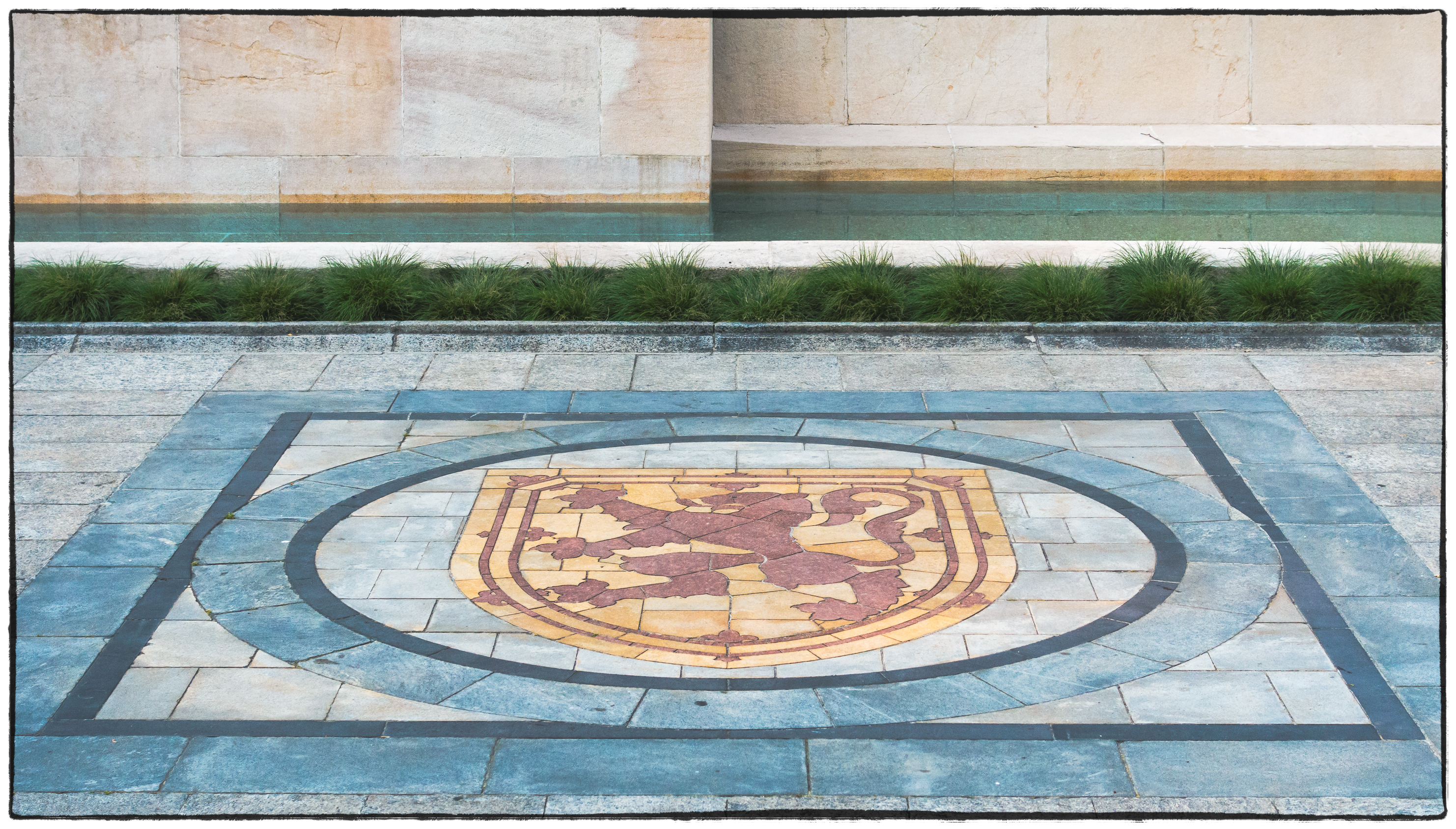
Three colorful shields can be found in the pavement in front of the Reformation Wall. I’m not entirely sure what the one above represents. I’ve read in a couple of places that it’s the Scottish coat of arms. It certainly looks like it, but why it should be part of the Reformation Wall eludes me.

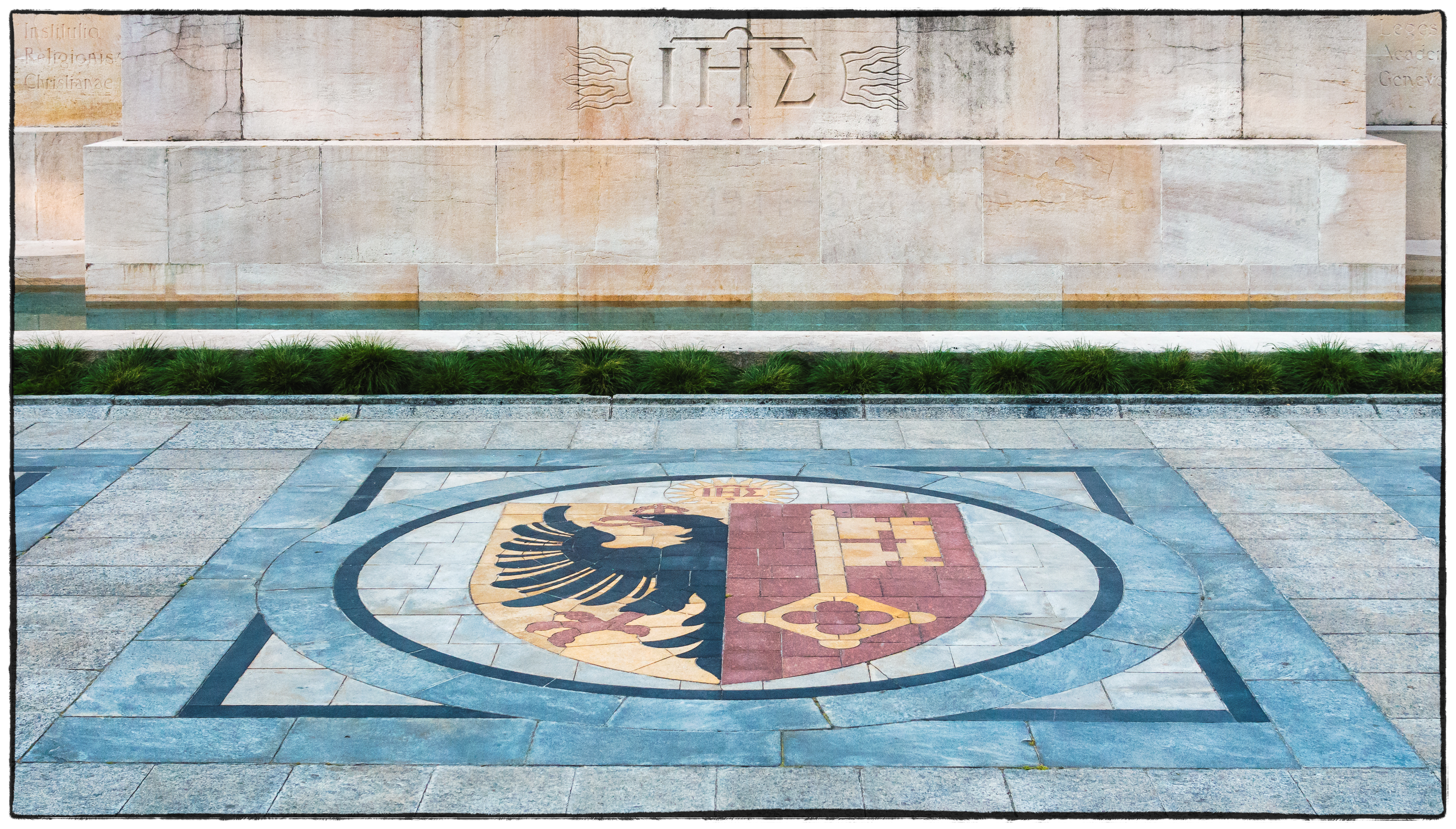
This one is easier – the Geneva coat of arms (See also: Geneva – Parc des Bastions, Eagle Statue).

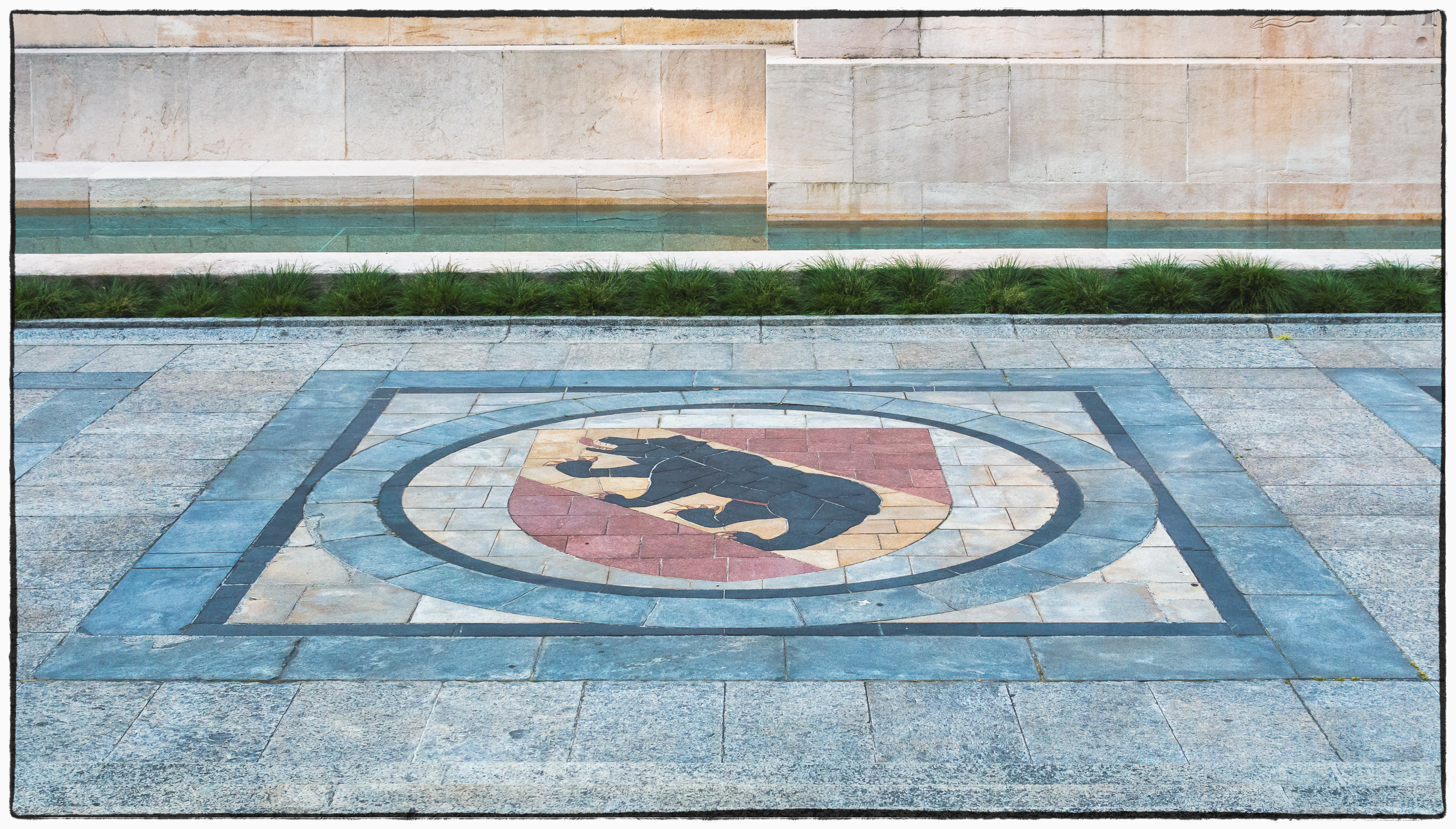
This appears to be the Bern coat of arms: the capital of Switzerland.