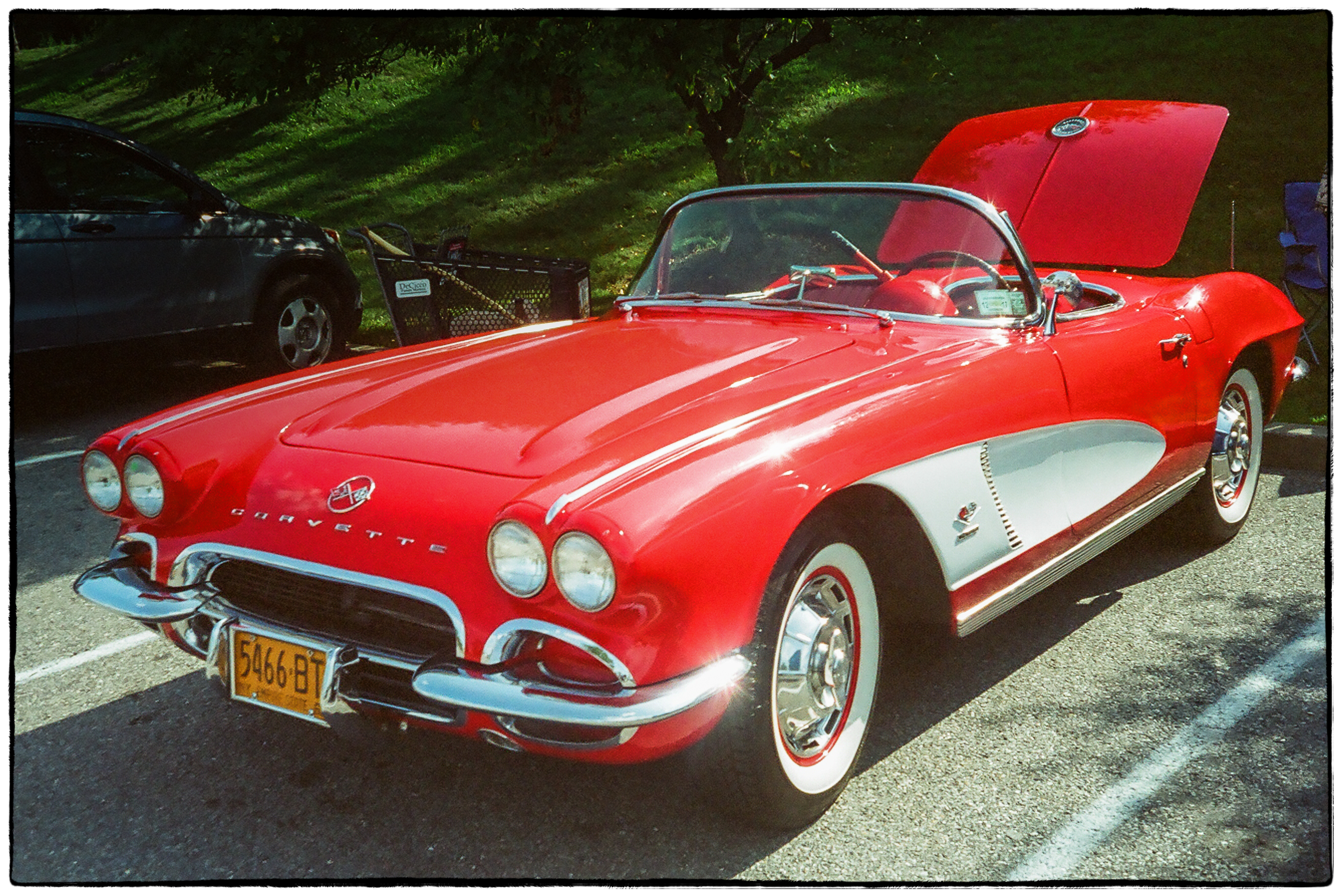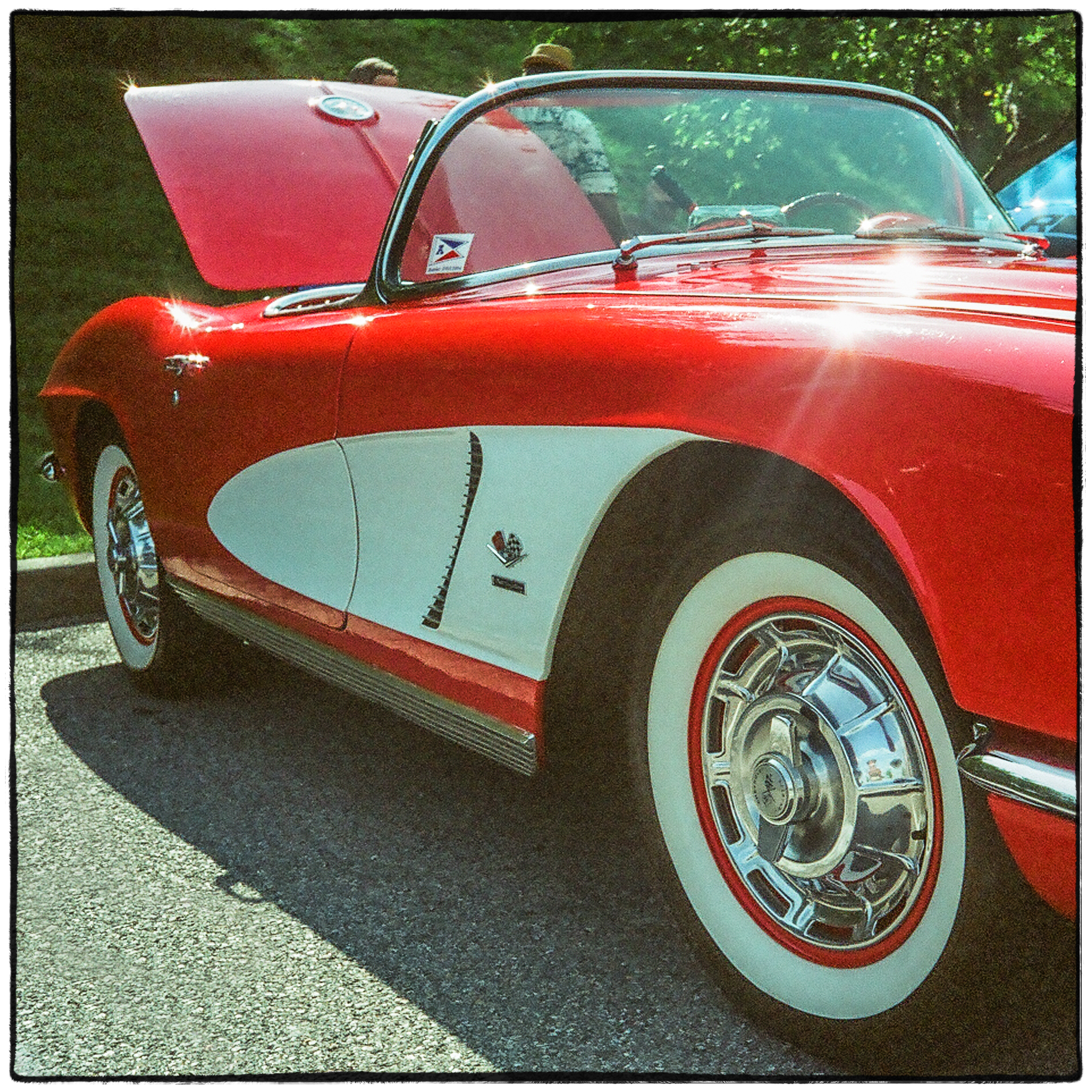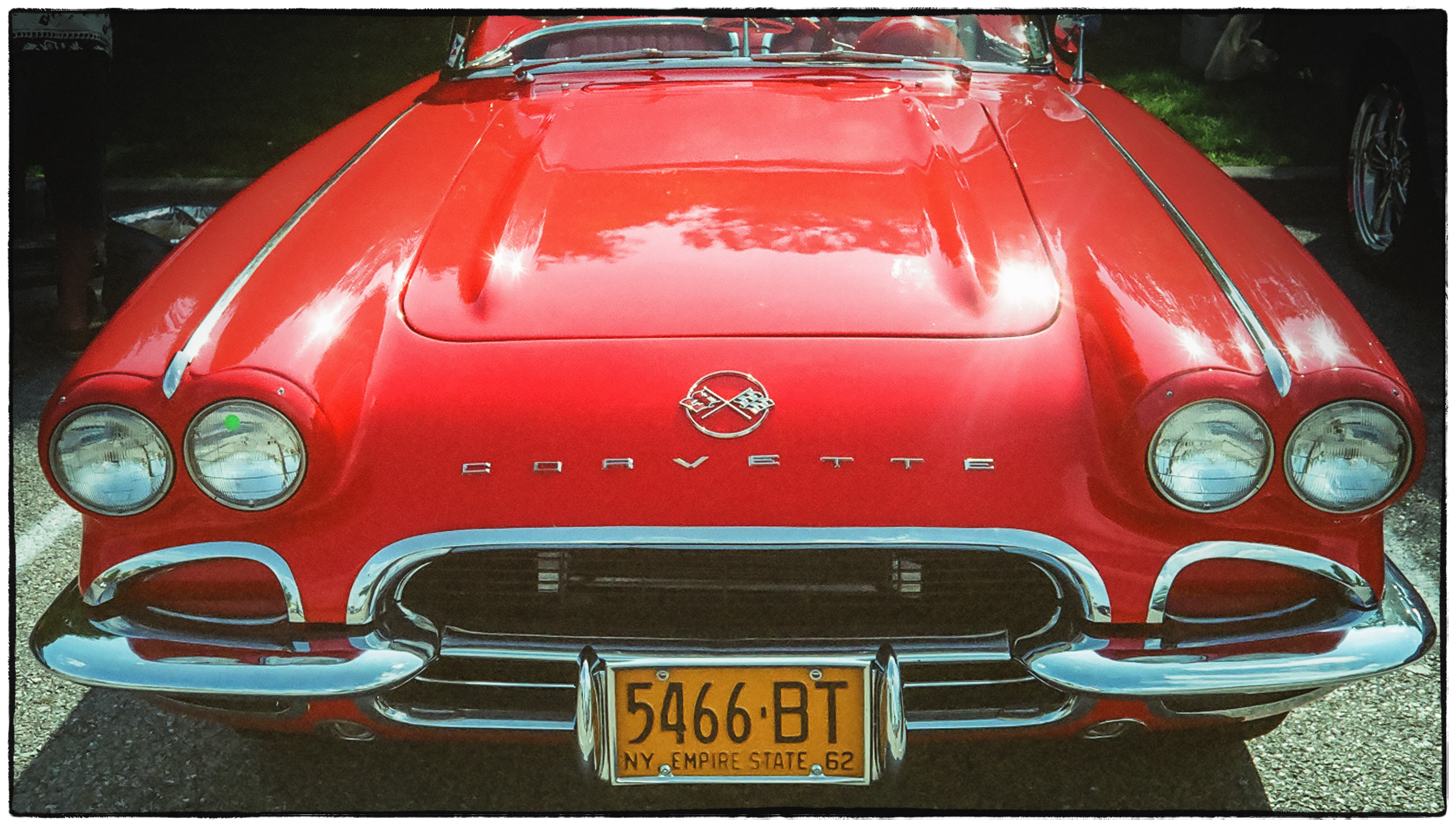
Corvette Stingray

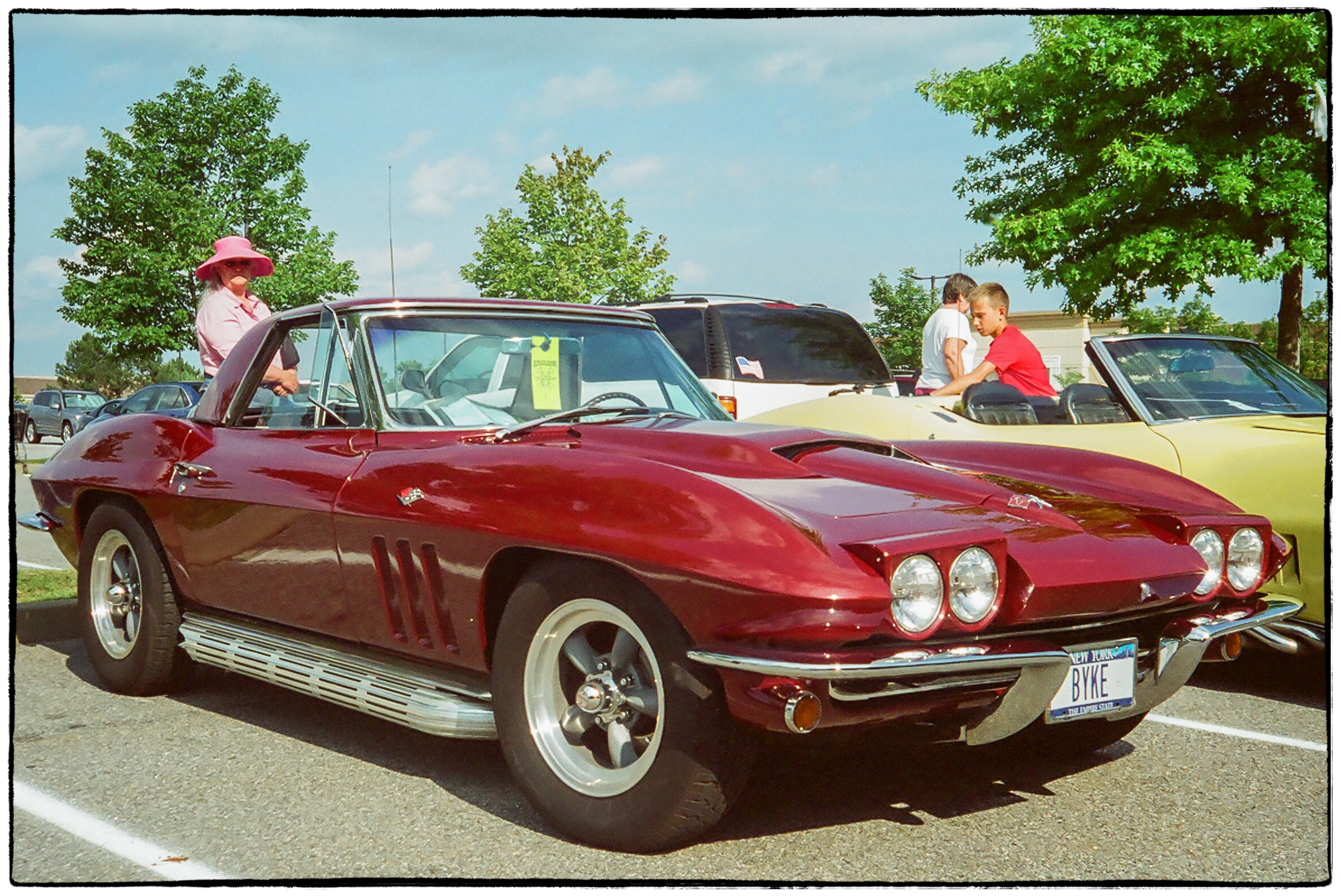
This is the last picture I’m posting of the vintage cars outside DiCicco Market in Brewster. It’s also my personal favorite: it looks like it was taken in the 1960s. The woman with the hat is just perfect.

I’ve always been fond of Stingrays and I believe this is one of the early ones circa 1963-67.

According to Wikipedia:

The 1963 Sting Ray production car’s lineage can be traced to two separate GM projects: the Q-Corvette, and perhaps more directly, Mitchell’s racing Sting Ray. The Q-Corvette, initiated in 1957, envisioned a smaller, more advanced Corvette as a coupe-only model, boasting a rear transaxle, independent rear suspension, and four-wheel disc brakes, with the rear brakes mounted inboard. Exterior styling was purposeful, with peaked fenders, a long nose, and a short, bobbed tail.

Meanwhile, Zora Arkus-Duntov and other GM engineers had become fascinated with mid and rear-engine designs. It was during the Corvair’s development that Duntov took the mid/rear-engine layout to its limits in the CERV I concept. The Chevrolet Experimental Research Vehicle was a lightweight, open-wheel single-seat racer. A rear-engined Corvette was briefly considered during 1958–60, progressing as far as a full-scale mock-up designed around the Corvair’s entire rear-mounted power package, including its complicated air-cooled flat-six as an alternative to the Corvette’s usual water-cooled V-8. By the fall of 1959, elements of the Q-Corvette and the Sting Ray Special racer would be incorporated into experimental project XP-720, which was the design program that led directly to the production 1963 Corvette Sting Ray. The XP-720 sought to deliver improved passenger accommodation, more luggage space, and superior ride and handling over previous Corvettes.

While Duntov was developing an innovative new chassis for the 1963 Corvette, designers were adapting and refining the basic look of the racing Sting Ray for the production model. A fully functional space buck (a wooden mock-up created to work out interior dimensions) was completed by early 1960, production coupe styling was locked up for the most part by April, and the interior, instrument panel included was in place by November. Only in the fall of 1960 did the designers turn their creative attention to a new version of the traditional Corvette convertible and, still later, its detachable hardtop. For the first time in the Corvette’s history, wind tunnel testing helped refine the final shape, as did practical matters like interior space, windshield curvatures, and tooling limitations. Both body styles were extensively evaluated as production-ready 3/8-scale models at the Caltech wind tunnel.

The vehicle’s inner structure received as much attention as the aerodynamics of its exterior. Fiberglass outer panels were retained, but the Sting Ray emerged with nearly twice as much steel support in its central structure as the 1958—62 Corvette. The resulting extra weight was balanced by a reduction in fiberglass thickness, so the finished product actually weighed a bit less than the old roadster. Passenger room was as good as before despite the tighter wheelbase, and the reinforcing steel girder made the cockpit both stronger and safer.

Taken with an Olympus Infinity Stylus (Mju).
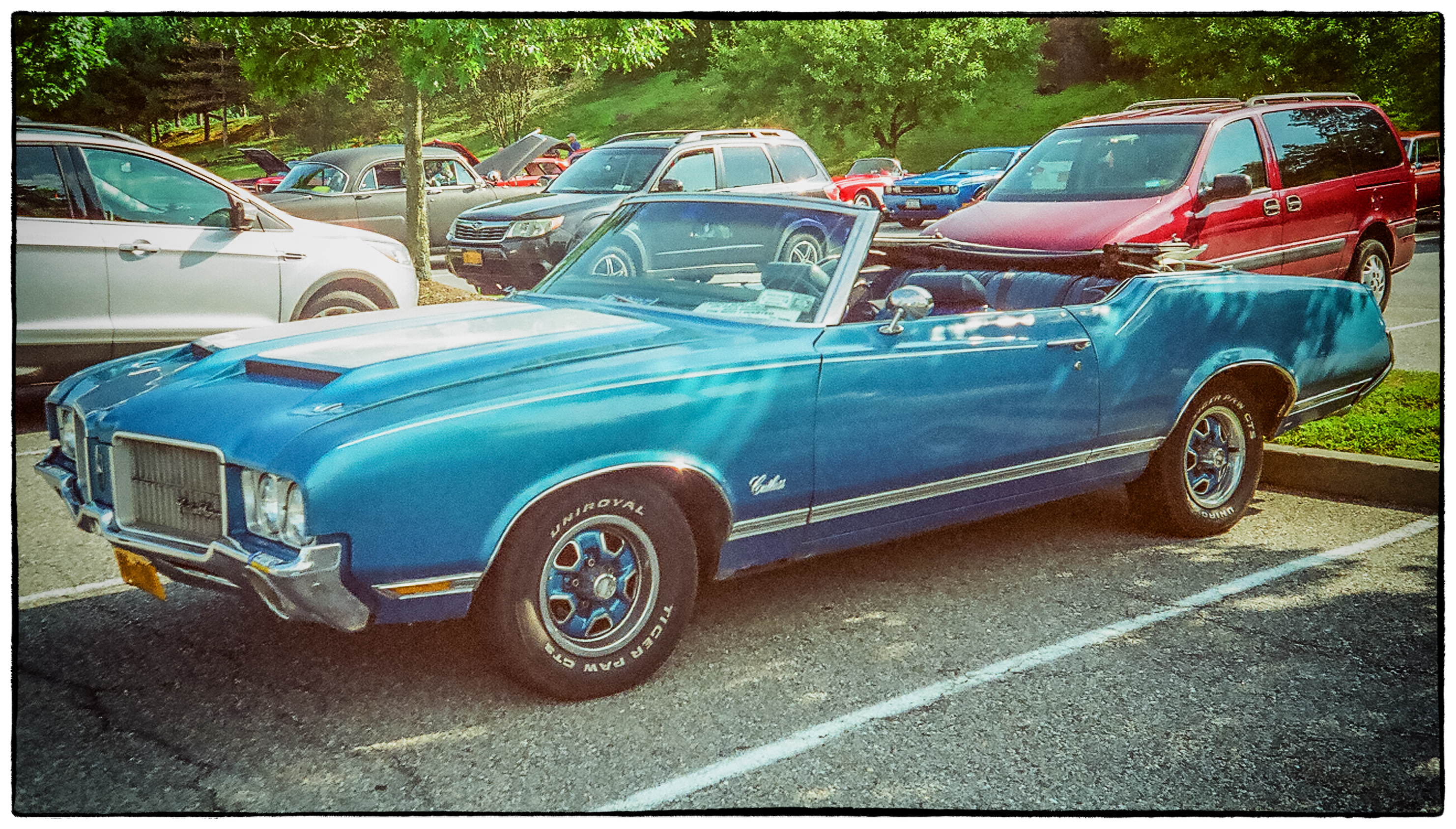
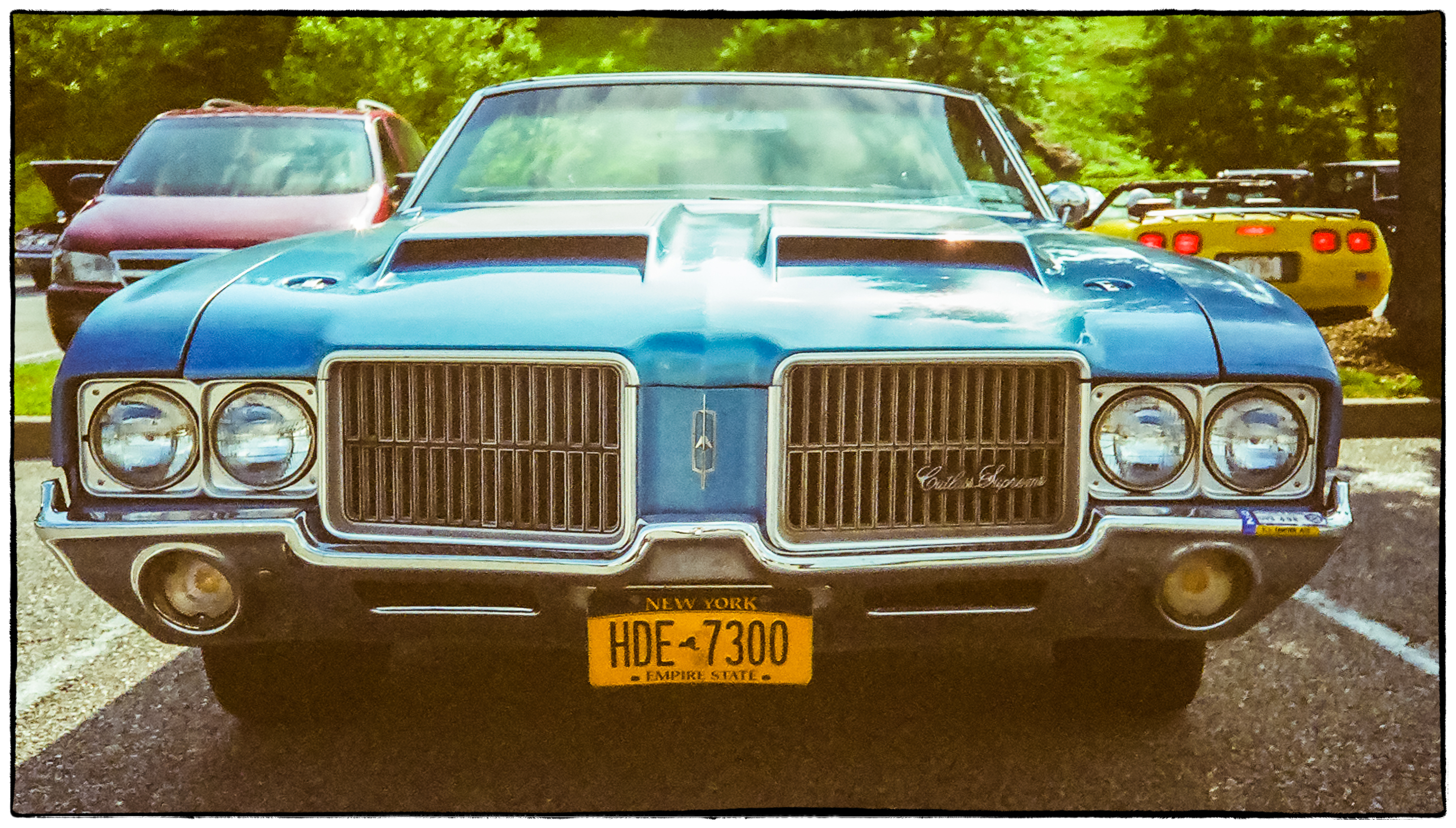
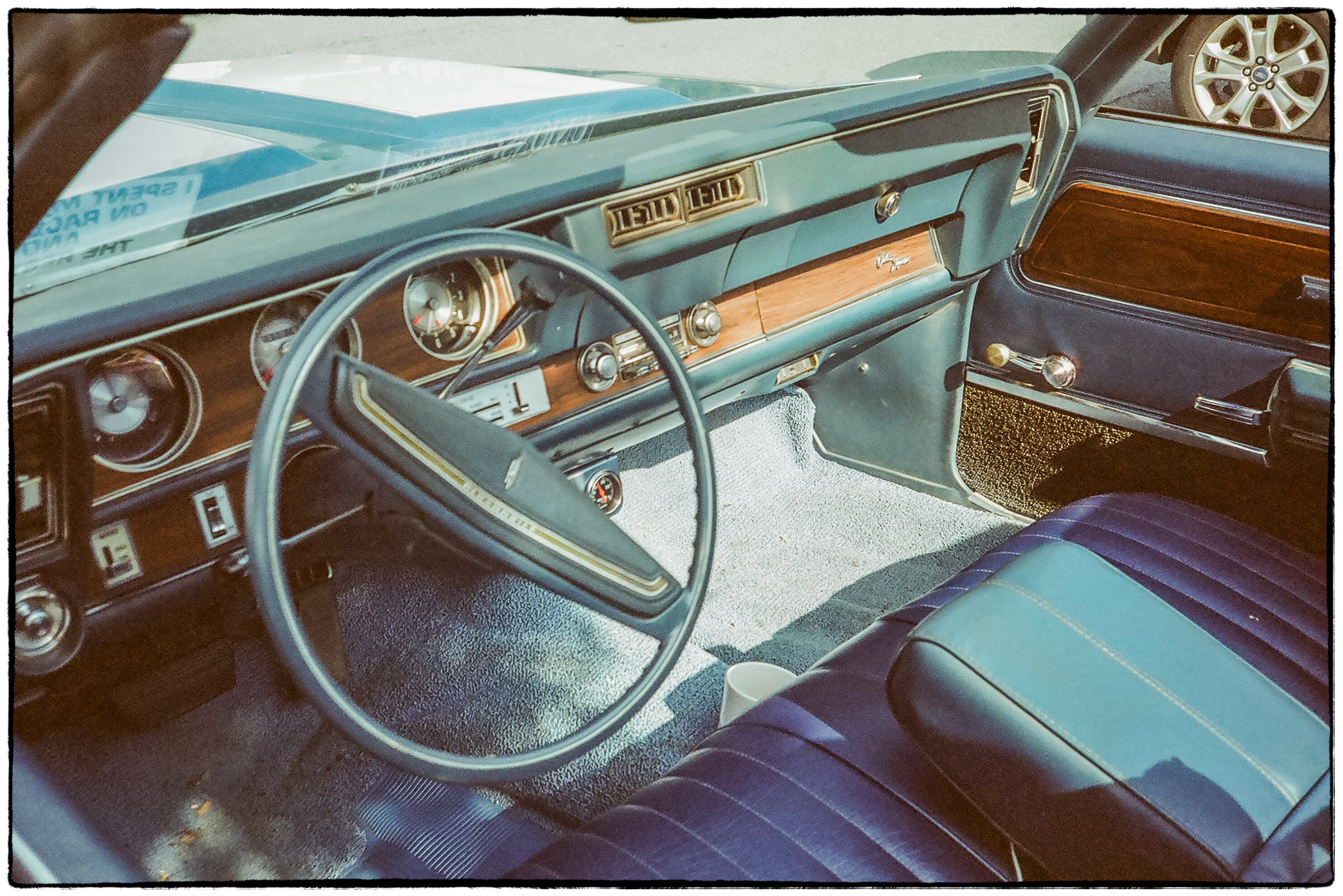
Blue Oldsmobile Cutlass Supreme

Another one from the mini vintage car show outside DiCiccos Market in Brewster. According to Wikipedia:

The Oldsmobile Cutlass Supreme is a mid-size car produced by Oldsmobile between 1966 and 1997. It was positioned as a premium offering at the top of the Cutlass range. It began as a trim package, developed its own roofline, and rose during the mid-1970s to become not only the most popular Oldsmobile but the highest selling model in its class.

It was produced as a rear-wheel drive two-door hardtop, sedan, and station wagon into the 1980s, and a convertible through 1972. In 1988 Oldsmobile sought to capitalize on the brand equity of the Cutlass Supreme marque by replacing it with a downsized front-wheel drive model based on the GM10 platform W-platform.

When production ended there was no direct replacement for the Cutlass Supreme, although the Intrigue introduced for 1998 was designed in size and price to replace all the Cutlass models.

I’m not at all sure what model this is, but to me it looks a lot like the 1972 version described in Car of the Week: 1972 Olds Cutlass Supreme

Taken with an Olympus Infinity Stylus (Mju).
Red Corvette

We’d been to Home Depot in Brewster and decided to stop at the nearby DeCicco Market to pick up some groceries. There was a small vintage car show in the parking lot and since I had the Olympus Infinity Stylus (Mju) with me I decided to take a few pictures. One was of this bright red corvette.

Although I love the look of vintage cars I know very little about them. However, after a bit of research I think this one is from the late 1950s/early 1960s – possibly the 1958 model.

According to Wikipedia:

The first generation of Corvette was introduced late in the 1953 model year. Originally designed as a show car for the 1953 Motorama display at the New York Auto Show, it generated enough interest to induce GM to make a production version to sell to the public. First production was on June 30, 1953.

This generation was often referred to as the “solid-axle” models (the independent rear suspension was not introduced until the second generation). Three hundred hand-built polo white Corvette convertibles were produced for the 1953 model year.

The 1954 model year vehicles could be ordered in Pennant Blue, Sportsman Red, Black, or Polo White. 3,640 were built, and sold slowly.

The 1955 model offered a 265 cu in (4.34 L) V8 engine as an option. With a large inventory of unsold 1954 models, GM limited production to 700 for 1955. With the new V8, the 0-60 mph time improved by 1.5 seconds.

1956 Chevrolet Corvette transistorized “hybrid” (vacuum tubes and transistors) car radio option
A new body was introduced for the 1956 model featuring a new “face” and side coves; the taillamp fins were also gone. An optional fuel injection system was made available in the middle of the 1957 model year. It was one of the first mass-produced engines in history to reach 1 bhp (0.75 kW) per cubic inch (16.4 cubic cm) and Chevrolet’s advertising agency used a “one hp per cubic inch” slogan for advertising the 283 bhp (211 kW) 283 cu in (4.64 L) Small-Block engine. Other options included power windows (1956), hydraulically operated power convertible top (1956), heavy duty brakes and suspension (1957), and four speed manual transmission (late 1957). Delco Radio transistorized signal-seeking “hybrid” car radio, which used both vacuum tubes and transistors in its radio’s circuitry (1956 option).

The 1958 Corvette received a body and interior freshening which included a longer front end with quad headlamps, bumper exiting exhaust tips, a new steering wheel, and a dashboard with all gauges mounted directly in front of the driver. Exclusive to the 1958 model were hood louvers and twin trunk spears. The 1959–60 model years had few changes except a decreased amount of body chrome and more powerful engine offerings.

In 1961, the rear of the car was completely redesigned with the addition of a “duck tail” with four round lights. The light treatment would continue for all following model year Corvettes until 2014. In 1962, the Chevrolet 283 cu in (4.64 L) Small-Block was enlarged to 327 cu in (5.36 L). In standard form it produced 250 bhp (190 kW). For an extra 12% over list price, the fuel-injected version produced 360 bhp (270 kW), making it the fastest of the C1 generation. 1962 was also the last year for the wrap around windshield, solid rear axle, and convertible-only body style. The trunk lid and exposed headlamps did not reappear for many decades.

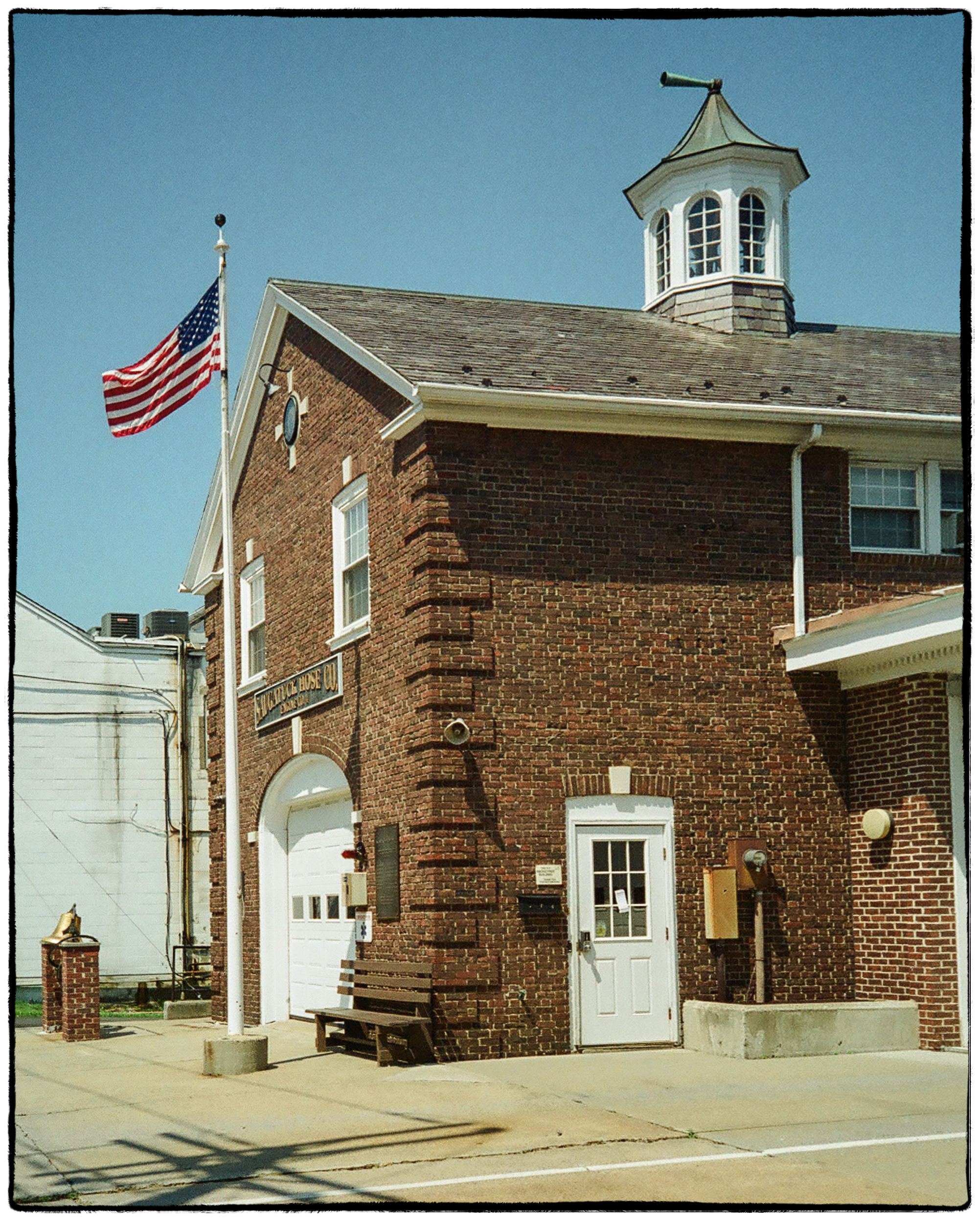
Westport Fire Department – Station 4

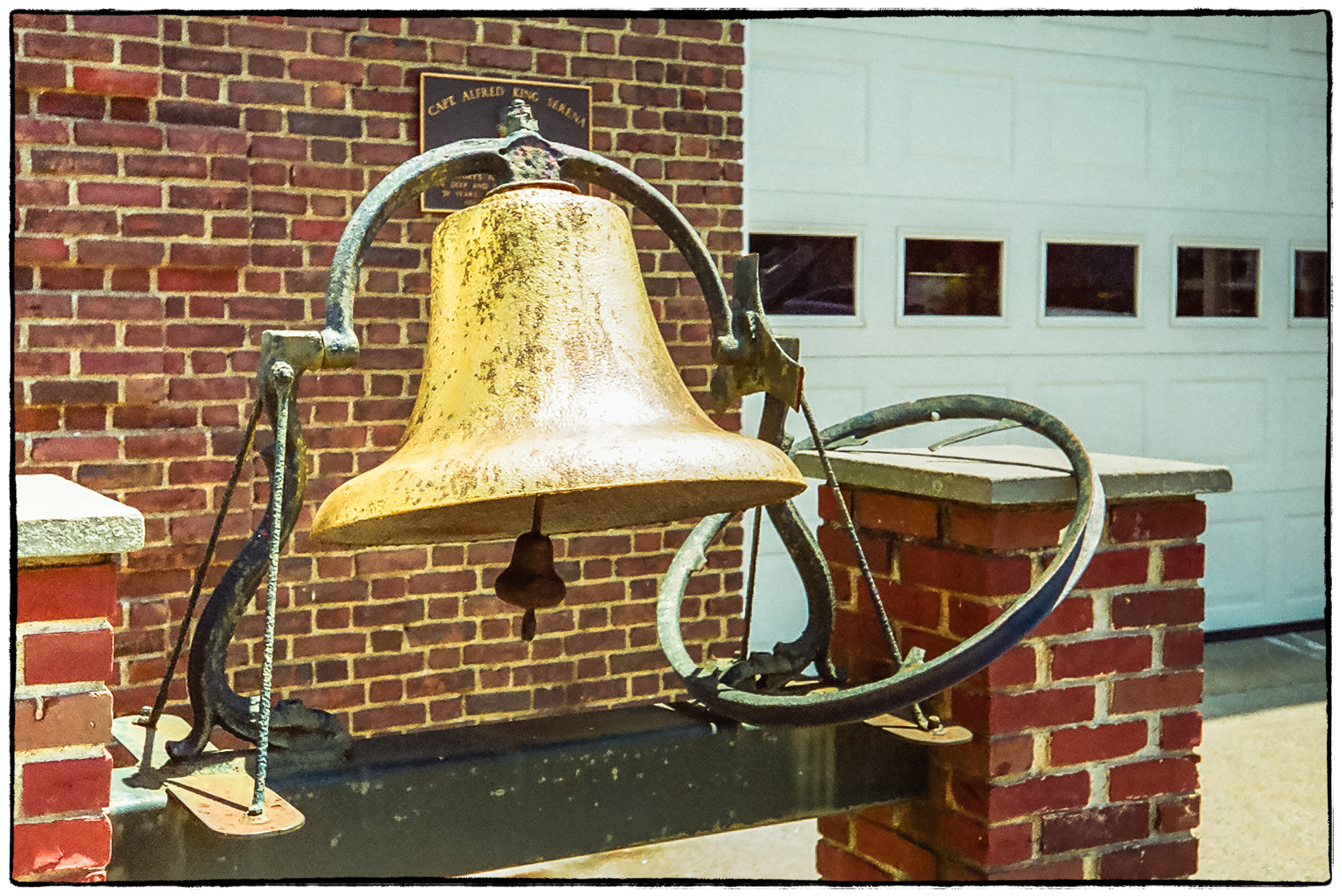
After I’d decided to try out my July film camera (see: June Film Camera – Olympus Infinity Stylus and Olympus Infinity Stylus – Results) I started off by taking a few pictures in Westport, CT where my wife had gone to meet with some friends for lunch. These two shots are of the Westport Fire Department – Station 4 (also known as the Saugatuck Hose Company No. 4).

According to Wikipedia:

The town of Westport is protected by the paid, full-time firefighters of the Westport Fire Department (WFD). Established in 1929, the Westport Fire Department currently operates out of 4 Fire Stations, located throughout the town, and maintains a fire apparatus fleet of 6 Engines, (4 first line and 2 reserve) 1 Truck, 1 Rescue, 1 Fireboat, 1 High Water Unit, 1 Utility Unit, and a Shift Commander’s Unit. The fire department also has the Fairfield County Hazardous Materials Truck, housed at Westport Fire Headquarters. The Westport Fire Department responds to, on average, approximately 4,000 emergency calls annually.


Taken with an Olympus Infinity Stylus (Mju). I think these pictures show what the little camera can do in the right conditions.
Olympus Infinity Stylus – Results

I enjoyed using this camera. There’s really not a lot to think about other than turning off the flash whenever you turn the camera on (unless you actually want to use the flash of course). It’s small and fits into the pocket easily and the sliding door offers quite a bit of protection. Just point and shoot.

I’d read a few pieces on the Internet indicating that some people have had trouble with poor focus of distant objects. I’m glad to say that I didn’t experience this problem. I did have a few slight problems with framing though. What I saw in the viewfinder wasn’t what I actually got. I also had another problem with the viewfinder: I found that I could’t see the two LEDs indicating locked focus and flash required unless I moved my eye around a lot.

I also had a few problems with exposure. I suspect (but I’m really just guessing here) that in certain conditions the camera would underexpose and subsequent film processing compensated for this in a way that made the negatives somewhat low in contrast and grainy. Most of it was fairly easy to correct in post processing though. I’d used some long expired Kodek Gold 200 and that may also have contributed to the exposure issues I suppose.

In one case I had what looked at first like a light leak, but it didn’t appear on any of the other pictures so I concluded that since the picture was taken into the light it was probably flare. I also detected some slight vingnetting in some the of the pictures. Other than that I was not displeased with the results, and some of them I really liked.

Although I liked the camera, I’m not sure that I’d every use it much even though the results were pretty good. The need to turn the flash off whenever you turn the camera on is a minor annoyance and not enough in itself to stop me from using the camera. Nor are the quibbles to do with framing, viewfinder issues, focus etc. I guess the main reason I wouldn’t use is because of an issue which concerns all cameras of this type: ignorance of what the camera is actually doing. I bothers me that I have no sense of what the aperture and shutter speeds are. Maybe I want to blur the background. I’d have absolutely no idea how to do that. Stop the motion of a moving object. How could I know how to do that. I’d trust the camera to usually get the exposure and focus right, but beyond that I’d miss having any kind of control.

Still from time to time it’s nice to get away from all the complex controls that more complex cameras have, and not to have to worry about anything other than composition.

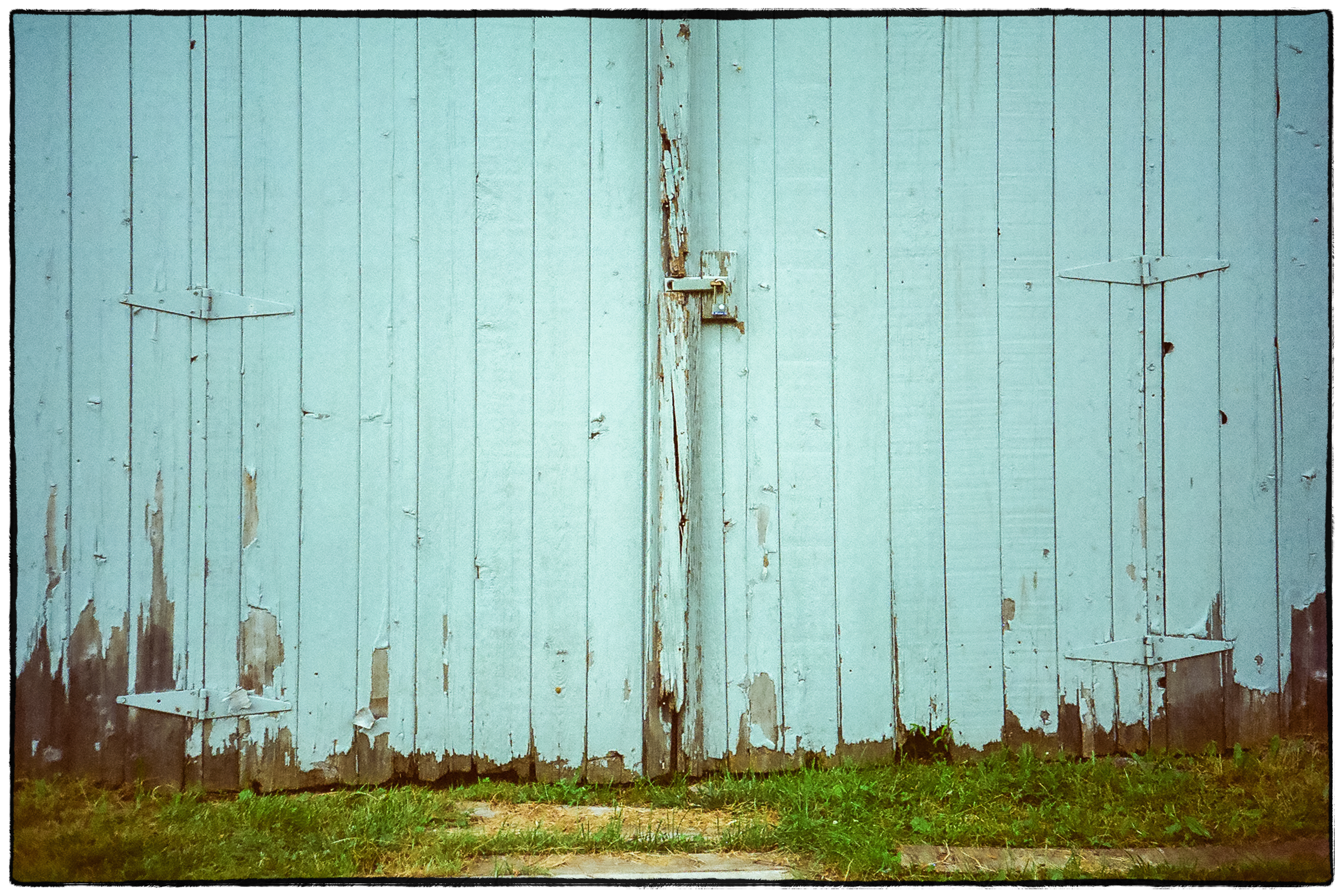
Above: Old weathered barn door.

African mask. Not particularly sharp. Maybe I got too close? This was also the last picture of the roll, taken late in the day. Possibly the relatively dark conditions led to a slow shutter speed and blur?

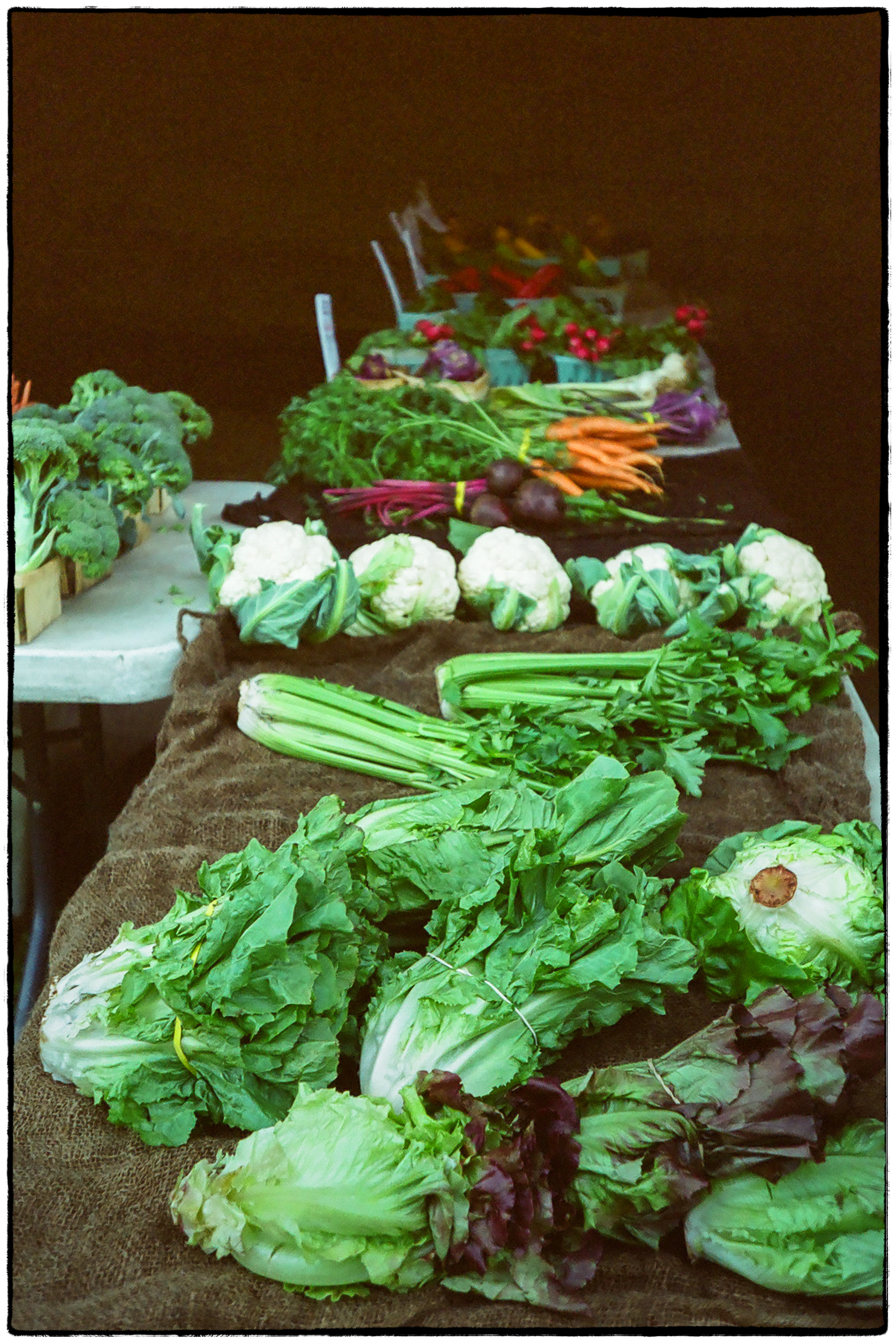
Lettuce and other vegetables. The lettuce in the foreground is quite sharp and then blurs nicely into the dark background. Shows something of the camera’s out of focus areas.

Yellow corvette.

Old Ford.

For more pictures taken with this camera see: