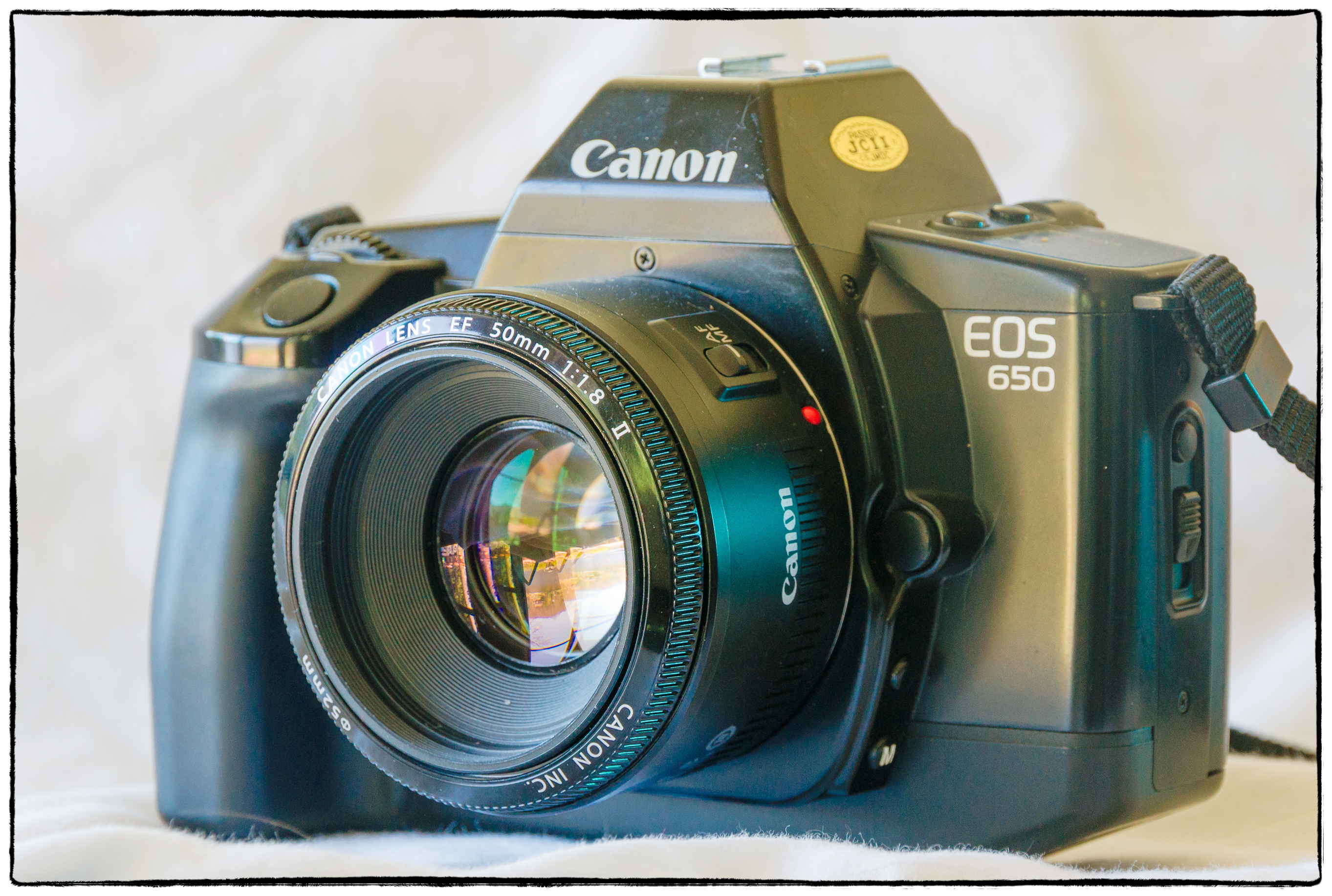
March film camera – Canon EOS 650

Some time ago an old friend gave me a Canon EOS Elan IIE (also known as the EOS 50E and EOS 55 in other markets) with 28-80mm Zoom Lens. I took a few pictures with and liked the feel and operation of it. I felt the urge to try it with a faster prime lens. Then I came across this Canon EF 50mm f1.8 with a Canon EOS 650 body attached to it for a very reasonable cost (it seems that they almost give away these older autofocus film cameras nowadays) and decided to go for it.

At first I wasn’t particularly interested in the body, but then as I read up on it I discovered that there was something a bit special about it. In 1987 Canon introduced a new lens mount (EF Mount) on it’s new line of Electro-Optical System (EOS) cameras. I remember feeling annoyed about this because at the time I had a Canon AE-1 and a few lenses. I understand that the new mount enabled Canon to “get a jump” on Nikon in the area of Autofocus Lenses. However, this move had one major downside: The old lenses would no longer work on the new cameras. So if I wanted to upgrade to a new body, I had to buy new lenses too. I decided not to upgrade and this is probably the reason why I completely missed autofocus film SLRs. I stuck with my older body and lenses until the digital era arrived, when, after a few digital compacts I finally upgraded to Minolta and subsequently Sony DSLRs.

What was so special about the EOS 650? You’d think that the first camera in Canon’s EOS line would be the EOS-1. But you’d be wrong. That camera was not introduced until 1989. For some reason the weird naming schemes that seem to afflict camera manufacturers dictated that the first EOS camera be called the EOS 650. So this camera introduced a mount that survives to this day. Modern canon DSLR’s have the same mount. Hence, the EOS 650 has some historical significance as the first of the line.

I liked the camera a lot. It feels solid to me and doesn’t overwhelm me with buttons and menu items. It has a mode button, an exposure compensation button, and an on/off dial (which also allows you to turn beeps on/off and to select full auto operation). A small button to the top right allows you to activate ‘partial metering’, which seems to be a 6.5% spot combined with auto-exposure lock (the normal metering is 6-segment evaluative (Matrix)). A fold down panel on the rear exposes buttons for manual film rewind, AF mode selection, drive mode and self-timer, and battery check. Manually setting ISO requires you to push two of the buttons simultaneously and then turn the dial on top. It’s rather cumbersome, but I guess you probably wouldn’t need to use it that much. Two buttons near the lens barrel are used for depth of field preview and manual aperture setting (the procedure for this seemed somewhat convoluted so I didn’t try it). A small LCD panel to the top right shows exposure information, current autofocus mode and exposure modes, a frame counter and battery check indicator. Changing exposure mode is easy. Just hold down the mode button on the left and turn the dial on the right. Options include Manual (M), Programme (P), Shutter Priority (TV), Aperture Priority (AV) and a rather unusual DEPTH mode where you select two focus points and the camera selects an aperture to give optimal depth of field. There are also indicators to show that the film has been wound correctly and whether the film wind mode is single or continuous. It’s a pity that to toggle between ‘one shot’ and ‘servo’ (i.e. continuous) you have to flip down the panel to the lower rear, hold the small button and turn the dial on top). It’s cumbersome if you change autofocus modes a lot. Luckily I don’t, almost always using ‘one shot’. The rear has a small window to show what film is in the camera. It’s all pretty minimal, and I like it.

The viewfinder is huge compared to digital SLRs. I compared it to my Minolta Alpha 500 (I don’t know how typical this is though) and it’s much larger and brighter. I’ve read that some consider the autofocus to be slow. Possibly it is compared to modern DSLRs (and even later generation film cameras), but it was fine for me. I’m not into action (sports, wildlife, small kids running around etc.) and so don’t need lightning fast autofocus. Shutter speeds go from 30 seconds to to 1/2000.

All things considered a very likable camera – and what a change from the last film camera I tried:
a fully automatic point and shoot Minolta 70W Riva Zoom (see February film camera – Minolta 70W Riva Zoom and Minolta 70W Riva Zoom – Results. In it’s day it was considered to be an enthusiast camera, but since it was the first EOS camera it was top of the line (until the slightly later EOS 620 came out). In 1987 it cost (with EF 35-70mm f3.5-4.5 lens)
the equivalent of about $1,250 in today’s dollars adjusted for inflation). Now we’ll see what kind of results it produces.
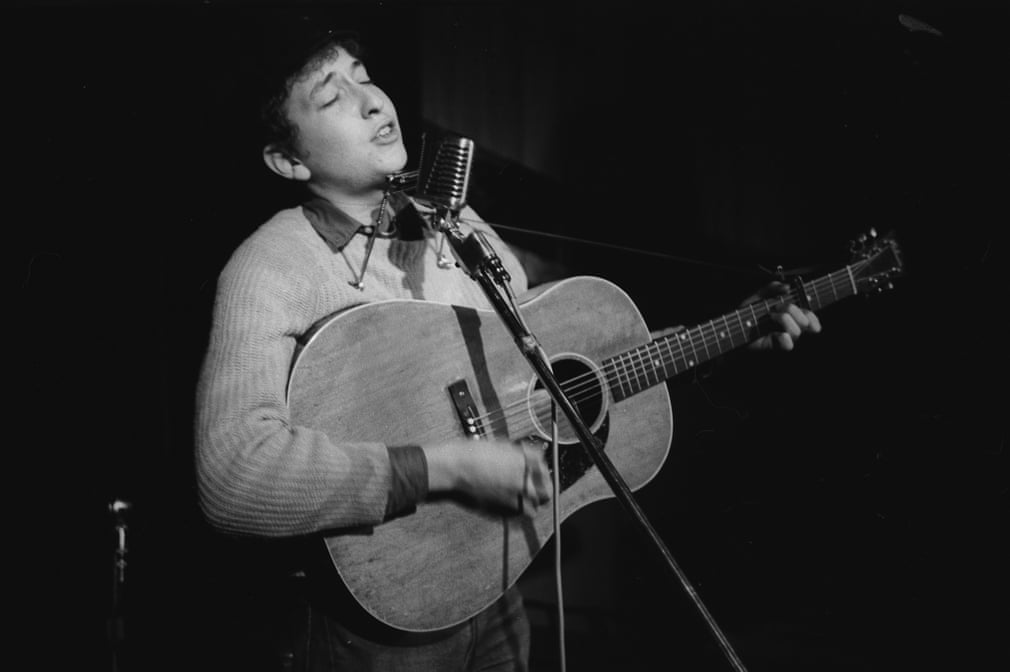
Ted Russell: Iconic photographs of a young Bob Dylan

Dylan performs onstage that same night (Note: at Gerde’s Folk City). Photograph Copyright: Ted Russell

Dylan performs onstage that same night (Note: at Gerde’s Folk City). Photograph Copyright: Ted Russell

I just came across this engrossing set of pictures on “The Guardian”.  They were made by famous photographer Ted Russell who has also earlier published a related book: Bob Dylan: NYC 1961-1964.

“The Guardian” explains:

As Bob Dylan accepts his Nobel prize for literature this weekend, an exhibition of photographs of him on the cusp of international fame is planned to open in New York. The photographer Ted Russell first met Dylan in 1961 and his intimate pictures of Dylan performing, and at home, are the subject of a show at the Steven Kasher Gallery featuring dozens of images never before seen in the city. Bob Dylan NYC 1961–1964 opens on 20 April and will run until 3 June

Source: Portraits of a young Bob Dylan – in pictures | Music | The Guardian

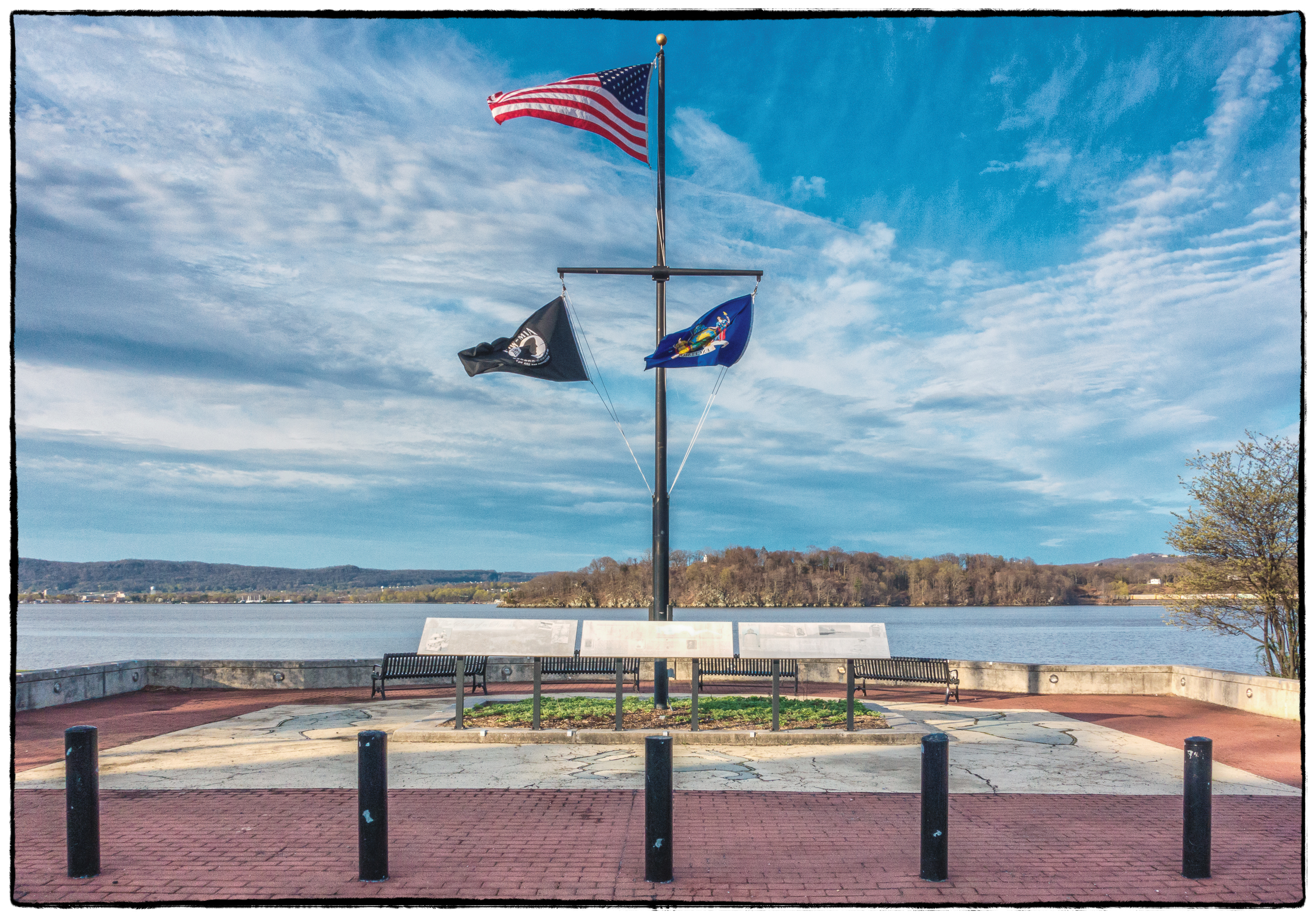
Kings Ferry

It doesn’t look much nowadays, but this somewhat out of the way location was very significant during the Revolutionary War.

According to the ‘A Revolution Day‘ website, which provides one day itineraries for visiting Revolutionary War sites by car (this from the section on Route 9):

Kings Ferry was a major crossing point on the Hudson. It connected Verplanck’s Point on the east side of the Hudson with Stony Point on the west side. Since the British controlled New York City for most of the war, Kings Ferry was the southernmost crossing point for American personnel and supplies for most of the war. It was also a very important communication line between the north and the south. Therefore, Kings Ferry was a very strategic target for the British.

On October 5, 1777, Clinton dispersed the American forces at Verplanck’s Point and landed 3,000 troops to secure the area for an attack up river. On October 6th, they took Stony Point across the river and then moved north to take Fort Montgomery, Fort Clinton and Constitution Island.

On October 8, 1777, George Washington sent a letter to William Livingston. “Sir: I yesterday received certain intelligence, that the enemy had proceeded up Hudson’s River from New York, and landed a body of men at Verplanck’s Point, a few miles below Peekskill. … Should any disaster happen, it is easy to foresee the most unhappy consequences. The loss of the Highland passes would be likely to involve the reduction of the forts. This would open the navigation of the river, and enable the enemy, with facility, to throw their force into Albany, get into the rear of General Gates, and either oblige him to retreat, or put him between two fires.”

On May 30, 1779, the British returned to Kings Ferry. Six thousand troops left New York City, by land and water, and moved north toward Stony Point. On June 1st, while 40 American soldiers were finishing a blockhouse at Stony Point, the first British ships appeared in Haverstraw Bay. The soldiers burned the blockhouse and fled.

Also on June 1st, British forces attacked 70 North Carolina troops stationed at Fort Lafayette at Verplanck’s Point. The American troops surrendered cutting off the important east-west link at King’s Ferry. Also, the victories put the British in control of the gateway to the Hudson, just 12 miles south of West Point.

On the night of July 15-16, 1779, Brigadier General Anthony Wayne of Pennsylvania led the American Light Infantry in a daring midnight assault against the British forces at Stony Point. Two American columns outflanked the front line defenses and captured the garrison. The main assault column waded through the shallow waters of Haverstraw Bay, south of Stony Point. The secondary column approached around the north side of the Peninsula. The American victory at Stony Point was the last major battle in the north.

After the battle, the Americans destroyed the fort, removed the prisoners, and captured supplies and equipment, including 16 pieces of artillery. Two days later, General Washington abandoned the peninsula, having determined that it could not be defended against the combined might of the British army and navy.

When the Americans withdrew, the British returned, and built a second fort with blockhouses surrounded by an abatis, but the war continued to expand. Crown forces were fighting the French and the Spanish, now allied with the Americans. The additional burden on military resources, a decision to move the war to the American south and a lack of reinforcements compelled the British to abandon the forts at Stony Point and Verplanck’s Point in October 1779. Kings Ferry was once again the southernmost crossing point on the Hudson.
In August 1781, Washington made the pivotal decision of the American Revolution. He decided to abandon operations in New York, sneak across the Hudson at Kings Ferry with French troops under the command of General Rochambeau and immediately march to the south to surprise Cornwallis at Yorktown. The American victory at Yorktown was the last major battle of the American Revolution.

In the summer of 1782, the Continental Army took to the field for the last time at Verplanck’s Point. In a show of strength, the combined armies of General Washington and General Rochambeau demonstrated their might to the British bottled-up in New York City. The combined forces totaled 12,000.

The defeat at Yorktown, the assistance of the French and a war that had become unpopular in England forced the British to the peace table. Congress ratified the peace treaty on April 15, 1783 and the British evacuated New York City on November 25, 1783.

Today, a marker and a small park are at the spot where Kings Ferry leaves Verplanck’s Point. Across the Hudson, is the Stony Point Battlefield. On a clear day, you can see the lighthouse at Stony Point.

The small white dot on the opposite side of the river, and to the right of the flagpole, is the lighthouse at Stony Point. Just behind it is the site of the Battle of Stony Point mentioned above.

Through the door of the slave house

Dakar is situated on a peninsular and is the western most part of Africa. Consequently it’s a touch closer to The Americas than anywhere else in Africa. Perhaps this is why it was the main jumping off point for the slave trade. The slave trade was centered on Gorée Island, which is now on the list of World Heritage Sites, where it is described as follows:

The island of Gorée lies off the coast of Senegal, opposite Dakar. From the 15th to the 19th century, it was the largest slave-trading centre on the African coast. Ruled in succession by the Portuguese, Dutch, English and French, its architecture is characterized by the contrast between the grim slave-quarters and the elegant houses of the slave traders. Today it continues to serve as a reminder of human exploitation and as a sanctuary for reconciliation.

The Island of Gorée testifies to an unprecedented human experience in the history of humanity. Indeed, for the universal conscience, this “memory island” is the symbol of the slave trade with its cortege of suffering, tears and death.

The painful memories of the Atlantic slave trade are crystallized in this small island of 28 hectares lying 3.5 km off the coast from Dakar. Gorée owes its singular destiny to the extreme centrality of its geographical position between the North and the South, and to its excellent strategic position offering a safe haven for anchoring ships, hence the name “Good Rade”. Thus, since the 15th century it has been prized by various European nations that have successively used it as a stopover or slave market. First terminus of the “homeoducs” who drained the slaves from the hinterland, Gorée was at the centre of the rivalry between European nations for control of the slave trade. Until the abolition of the trade in the French colonies, the Island was a warehouse consisting of over a dozen slave houses. Amongst the tangible elements that reflect Gorée’s universal value are, notably, the Castle, a rocky plateau covered with fortifications which dominate the Island; the Relais de l’Espadon, former residence of the French governor; etc…

The Island of Gorée is now a pilgrimage destination for the African diaspora, a foyer for contact between the West and Africa, and a space for exchange and dialogue between cultures through the confrontation of ideals of reconciliation and forgiveness.

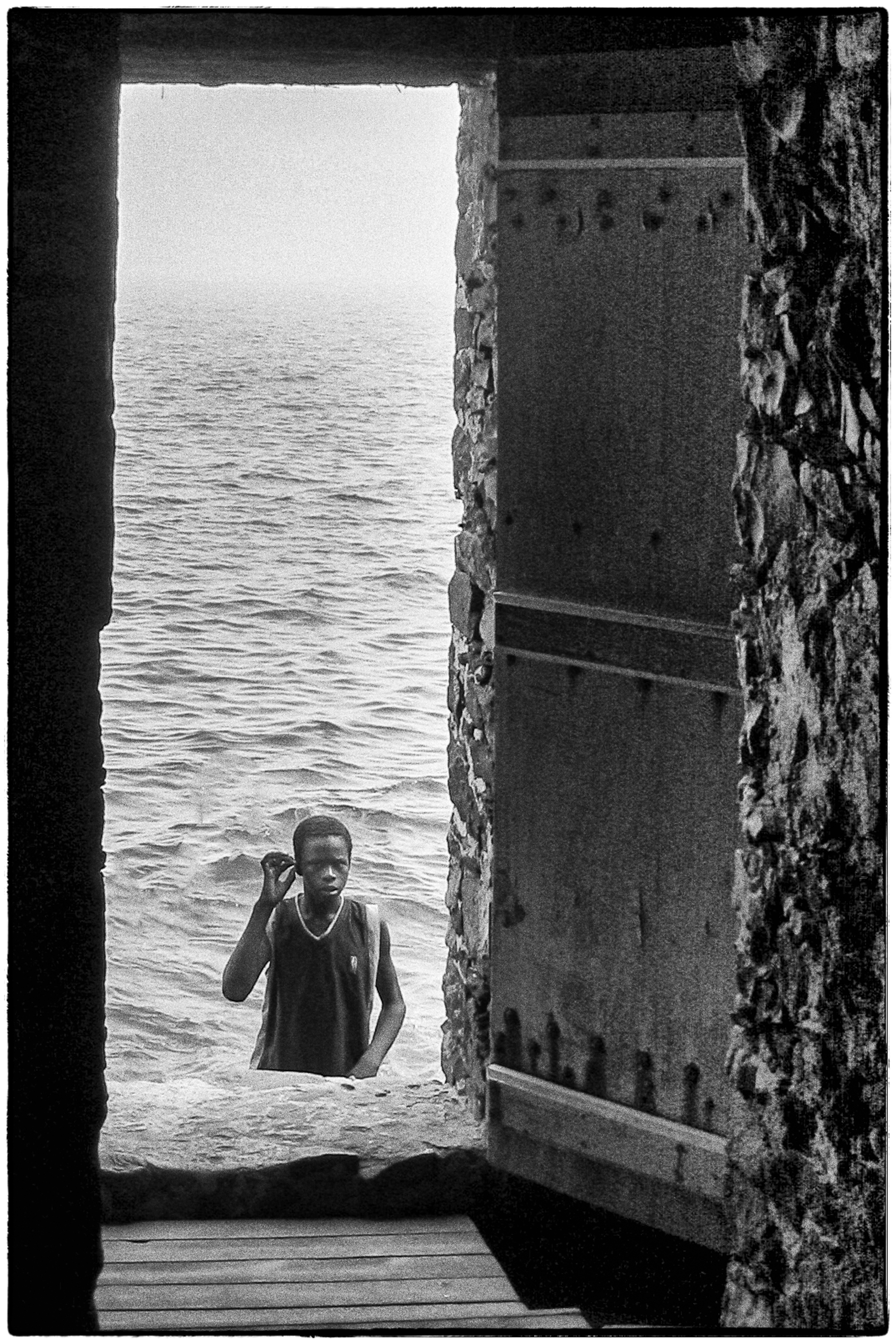
As mentioned above the slave house is indeed “grim”. So disturbing in fact that my colleague could not stand being inside and had to leave. This picture is taken looking through the door – possibly the last thing the slaves saw before boarding a ship for The Americas.

The child standing outside the door was one of a number of children diving for coins thrown by tourists – a different kind of slavery.

Taken with a Canon Powershot S-50.

Sunset, Briarcliff Manor

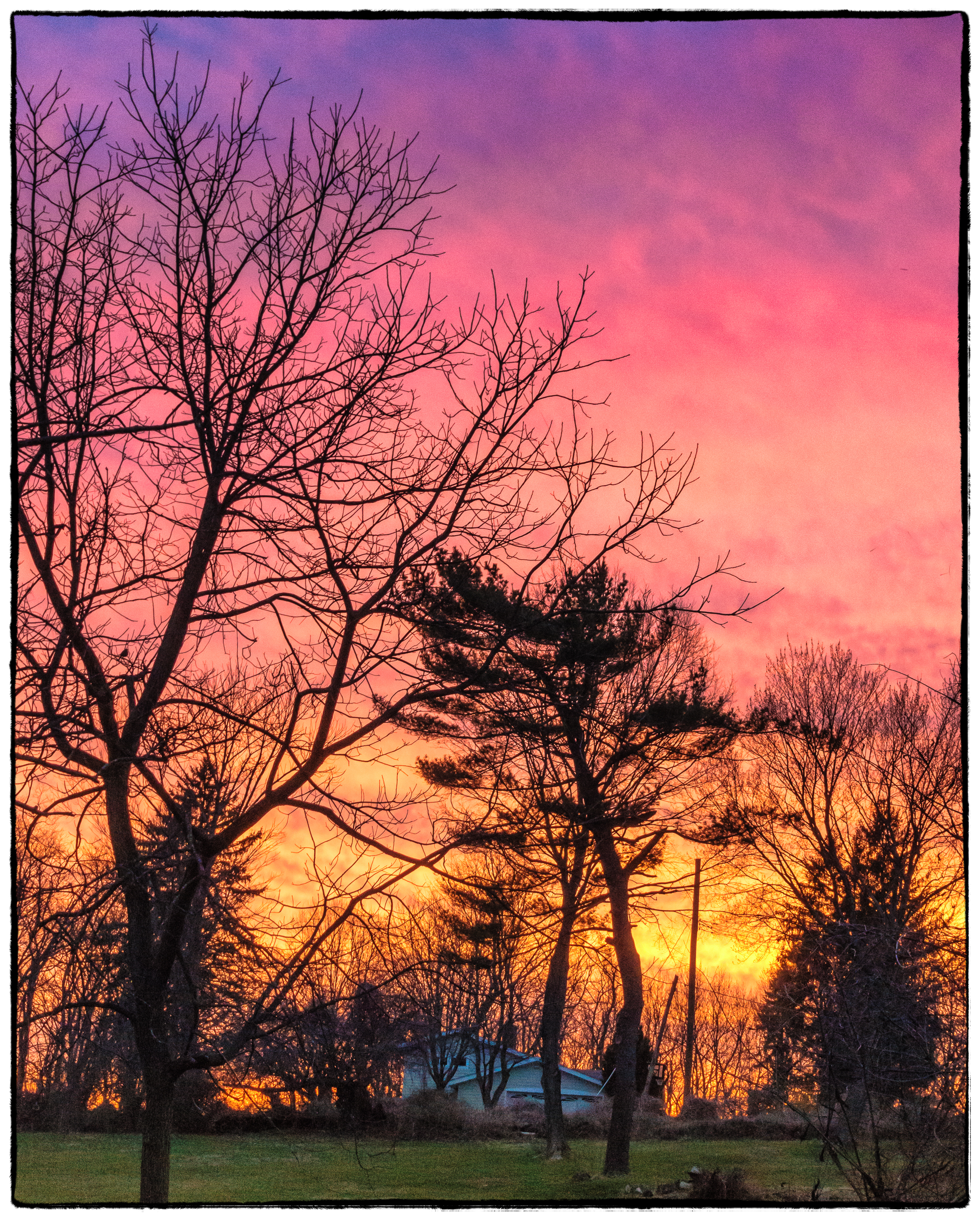
The sun was going down as I was sitting in the kitchen of our house in Briarcliff when I noticed all kinds of colors coming in through the windows. I stepped outside to find this amazing sunset. I know that sunset pictures are supposed to be clichéd, but this one was just so bloody colorful that I couldn’t ignore it. I also wanted to share the picture with our friends who have been in Thailand for the past year. The house in the picture is theirs. Thailand is very colorful and exotic, but we have our moments in the Hudson Valley too.