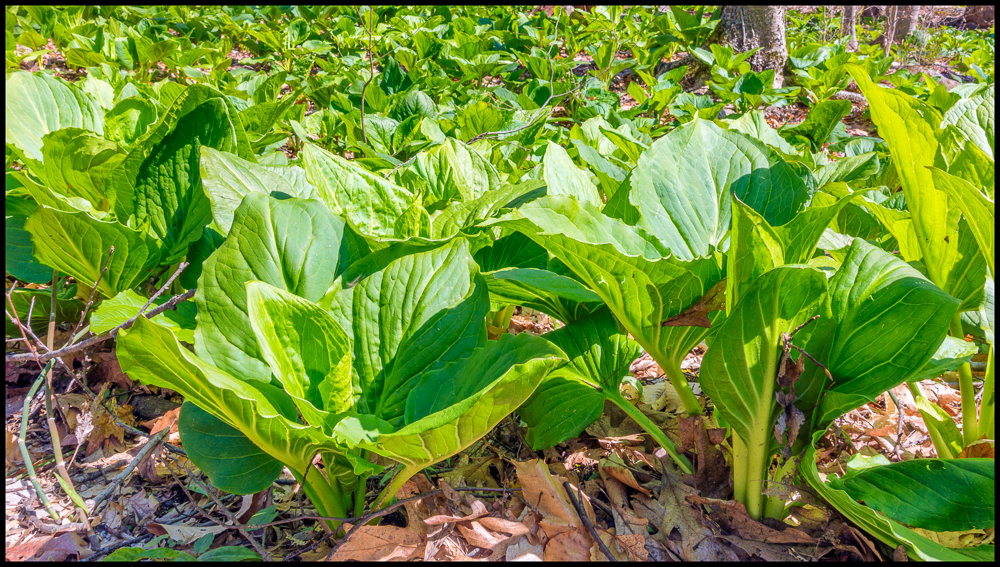
Rockefeller Preserve, Brook Trail – A Field of Bright Green Skunk Cabbage

Or at least that’s what I think it is.

Somehow I never see the the flowers, which come out early in Spring and then disappear leaving only these bright green leaves – quite attractive themselves when massed as in this picture.

According to the National Wildlife Federation:

The skunk cabbage gets its name from the unpleasant odor it emits. This scent is a way for the plant to attract pollinators that are attracted to rotting meat. The scent is especially noticeable when the plant is injured. It travels easily because it is carried on the warm air that constantly rises from the spathe.

I’ve never noticed the smell. This could be because I don’t go during the period where the smell is noticeable or it could be because I have a truly terrible sense smell.

Taken with a Sony RX-100 M3.

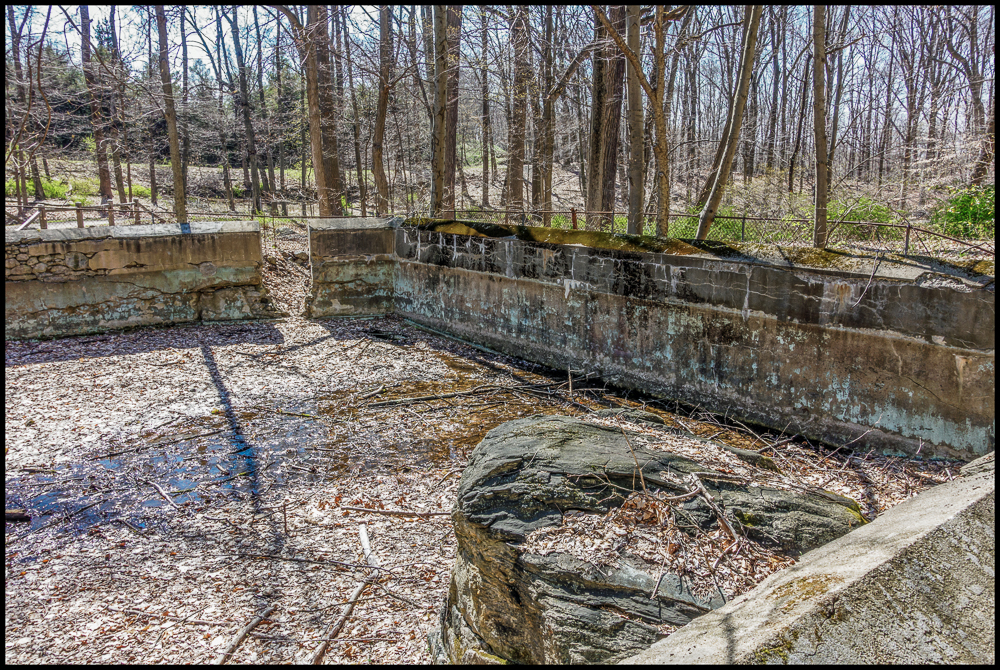
Rockefeller Preserve, Brook Trail – Cistern

I’m not entirely sure what this is. Water runs into it and then out again on the opposite side so it’s obviously something designed to collect water. I read somewhere that some people think it was a swimming pool, but I imagine it could just as easily be a cistern of some kind to collect water for agricultural (e.g. irrigation) purposes.

Taken with a Sony RX-100 M3.

Rockefeller Preserve, Brook Trail – Broken Dams

The brook runs through a series of picturesque, now broken dams on its way down to the lake.

Can you spot the snake basking in the sun? I didn’t even know it was there when I took the picture. After taking it I moved a bit closer to get a different angle and out of the corner of my eye I spotted movement and heard a splash. When I looked I could see the snake swimming off in the brook.

I don’t know much about snakes, but from what I can see in the picture I suspect this is an adult Coluber constrictor or Black Racer.

Taken with a Sony RX-100 M3.

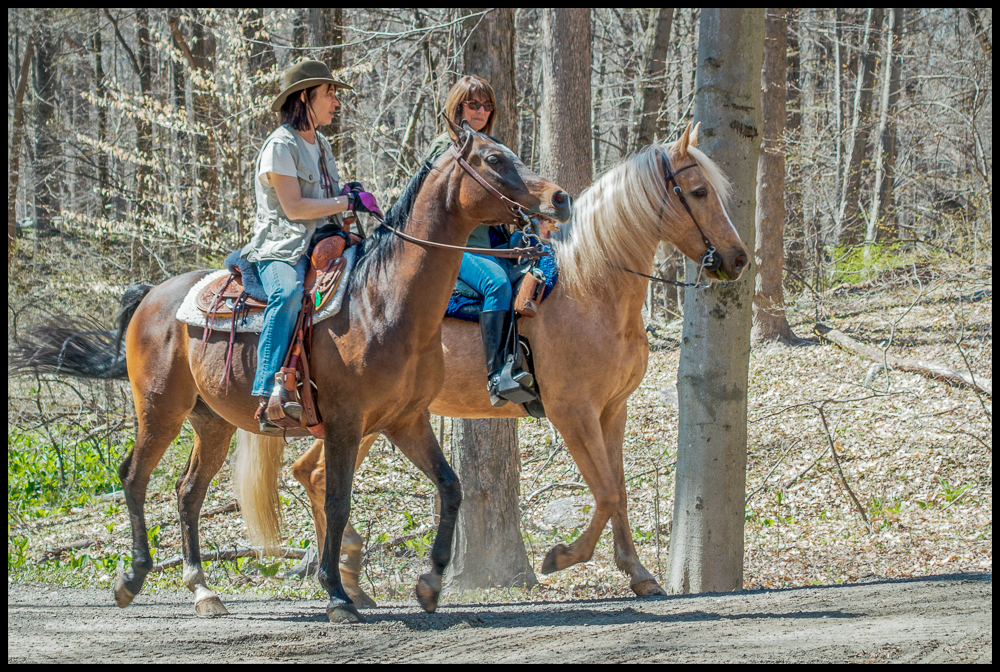
Rockefeller Preserve, Brook Trail – Horses

I recently took the dog for a walk at the nearby Rockefeller Preserve. This time we went along the Brook Trail down to the lake and back. I find the Brook Trail interesting because it’s one of the few parts of the preserve (other than the superb stone bridges) where there are multiple signs of human activity: dams, cisterns, etc.

On this occasion we also bumped into these two riders. Harley always gets very excited when he sees horses. I think he believes they are some kind of deer – his mortal enemies.

Taken with a Sony RX-100 M3.

A spider

I know it’s a terrible picture, but I needed to have something to illustrate the story below.

I was sitting at the computer working on some pictures when I saw this rather small spider crawling across the keyboard. It was a little creepy as it had large eyes and whenever I moved it would re-orient itself so that it was looking at me.

I didn’t have much hope for a picture, but I grabbed a nearby camera and pointed it in the direction of the spider. As I was looking through the viewfinder I noticed that the spider was getting larger and larger. It had jumped across the distance between the computer keyboard and my camera – maybe about six inches or so.

This really threw off my concentration and any slim hope of getting a decent picture went out the window. It should be said that I don’t suffer from Arachnophobia (extreme or irrational fear of spiders). Quite the contrary. Since I was a child I’ve always liked spiders. I find them fascinating creatures and am in awe of their ability to build their webs. However, I’d never seen one that seemed so intelligent and it “creeped me out”.

After I’d calmed down I went onto the internet to see if I could find out what it was. I’ve concluded that it’s a jumping spider (what a shocker). According to Common Spiders of New York:

Jumping spiders are easily identified by their large eyes, squat bodies and sturdy legs. They are very intelligent, colorful spiders with distinct personalities. Jumping spiders have excellent vision and will often turn to look at you as you approach. They hunt during the day, eating insects and other spiders. They get their name from their ability to jump impressive distances while searching in vegetation or catching prey. Before jumping, these spiders will touch their abdomens to the ground to tack down their draglines. That way if they miss their destination, their spinnerets clamp the silk so they only fall a short distance. When jumping spiders see prey that they cannot jump onto directly, they are known to take a detour route through the vegetation to put them into a position above the intended prey. Male jumping spiders court females by moving their brightly colored chelicerae, palps or leg tufts. In autumn, many jumping spiders build silken retreats in goldenrod plants, windowsills, or mailboxes.

I also found a much better picture of one.

Jumping Spider

Jumping Spider.  Source: Common Spiders of New York.