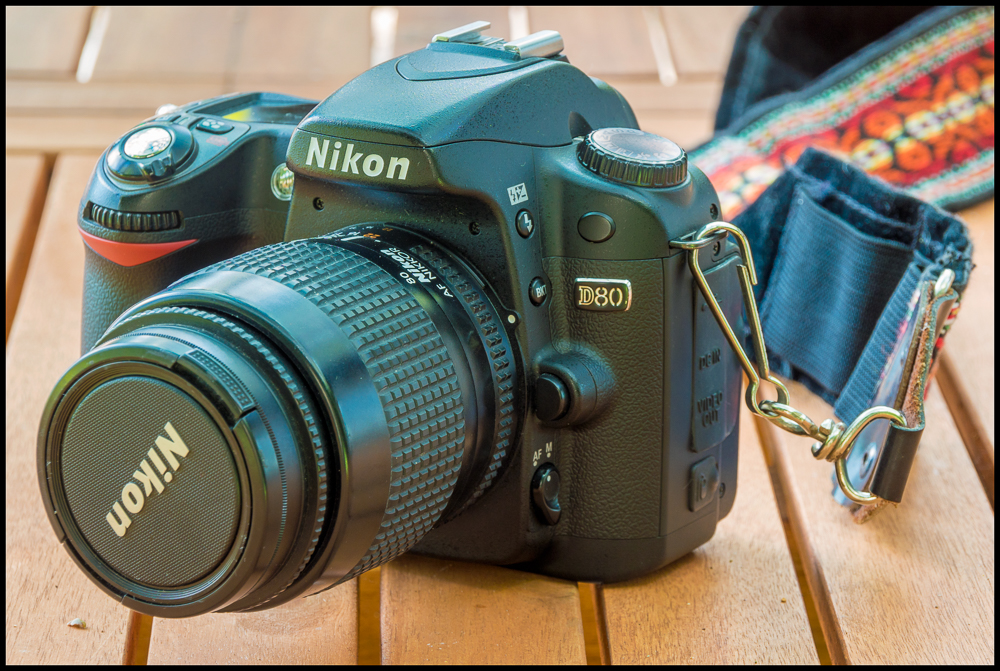
While I fairly frequently purchase old film cameras, I can’t remember ever buying an old digital camera. So why did I buy this one?
Recently I’ve come across a few articles on the internet talking about how cameras have become too complicated – with resolution and functionality that we don’t really need, and that it might be worth taking a look at older cameras to see what they can do. For example: Digital classic: Robin reviews the original Canon 5D in 2018; Why do I still have warm, fuzzy feelings about the old Nikon D700? I guess it’s because the photos I shot with it eight years ago still stand up today. Can’t say that about some other cameras I’ve bought….; Is 4MP Enough In 2018? (Three Part Series – Part 1; Part 2; Part 3.) etc.
So I decided to try to find an older digital camera to see what the experience would be like. The Nikon D700 (example one above) and the Canon 5D Mark I (example two above) were a bit more than I wanted to pay for what after all was pretty much a whim. The cameras in the three part series were all a bit too “low end” for me.
A secondary factor was that my use of digital cameras has been so far limited to Canon compact digital cameras; Panasonic compact digital cameras; and most particularly Minolta/Sony DSLRs. Apart from briefly trying out my son-in-law’s camera I’ve never tried Nikon digital cameras.
In the end I settled on this camera, which met my basic criteria:
- A Nikon DSLR so that I could get familiar with the Nikon digital experience – even if a rather dated one.
- A resolution appropriate for my normal use i.e. posting to this blog, social media sites, and occasional prints up to 8×10 inches.
- Outrageously inexpensive (I already had the 35-80mm lens, which I’d used on some of my film Nikons).
It’s a Nikon D80, which co-incidentally is the same model as the one my son-in-law has.
It came out in August 2006 and according to Nikon it has the following key features:
- 10.2 effective megapixel Nikon DX Format CCD image sensor
- High-speed continuous shooting: 3 frames per second (fps) in bursts of up to 100 consecutive JPEG (FINE M-size or smaller) or 6 RAW (NEF) images
- Advanced high-precision, high-performance imaging processing engine with color-independent pre-conditioning
- 3D-Color Matrix Metering II with 420-pixel RGB sensor delivers consistent and dependable automatic exposure for ideal results in most lighting conditions
- Refined 11-area AF system with new Auto-area AF mode and center sensor that can be switched to wide-frame operation for broader coverage
- ISO AUTO mode automatically adjusts sensitivity between ISO 100 to 1600, maximizing available light to help achieve optimal exposure
- Seven automated Digital Vari-Programs (Auto, Portrait, Landscape, Close Up, Sports, Night Landscape and Night Portrait) optimize white balance, sharpening, tone, color, saturation and hue to match the scene.
User-selectable choice of Normal, Softer, Vivid, More vivid, Portrait, Custom and Black-and-white image optimization options
- Near-instant response with 0.18 sec. power-up and approx. 80-millisecond shutter release time lag promotes fast handling
- Top shutter speed of 1/4,000 second and flash sync speeds up to 1/200 second
- Fast image transfer via USB 2.0 Hi-Speed interface and SD memory card
- Creative in-camera effects and editing functions consolidated under the new Retouch menu, including D-Lighting, Red-eye correction, Trim, Image Overlay, Monochrome settings (Black-and-white, Sepia, Cyanotype) and Filter Effects (Skylight, Warm filter, Color balance)
- Multiple Exposure shooting option automatically produces an effect that resembles multiple exposure techniques used with film
- Large 2.5-inch LCD monitor with ultra-wide 170-degree viewing angle for clear image preview and easy access to settings and information, including RGB Histograms
- Selectable Slideshow function (Standard or Pictmotion)
- SD memory card storage, SDHC compatible
- Lightweight, compact body
- High-energy EN-EL3e rechargeable lithium-ion battery delivers the power to shoot up to 2,700 pictures on a single charge and provides detailed battery status information. (Battery life figure determined by in-house test parameters)
- Built-in Flash with i-TTL flash control and full support for Nikon’s Creative Lighting System
- The D80 supports more than 43 AF NIKKOR lenses in addition to the growing family of DX NIKKOR lenses
- Includes Nikon’s PictureProject software for easy control over image adjustment and management
- Support for Nikon’s new Capture NX software, which provides easier access to powerful and visually intuitive enhancement tools that help tap the full potential of NEF images
While I’ve taken a few pictures with it already I don’t think I’ve used it enough to be able to say much at the present time so I’ll save my thoughts for a future post.