A Visit to Boston – Day Three – Trinity Church

According to the history section of the church’s website:

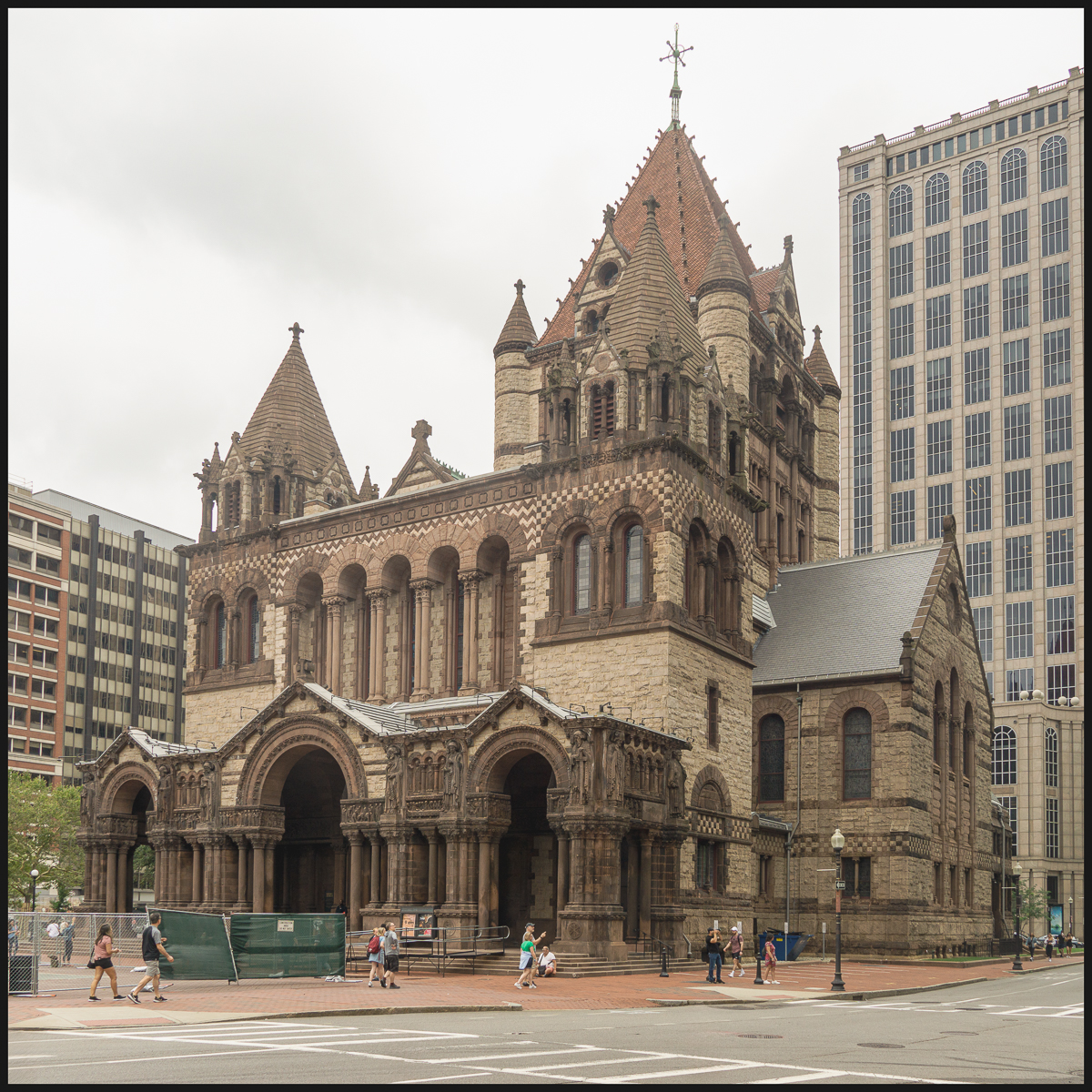
Trinity Church in the City of Boston is recognized for its National Historic Landmark building, considered by members of the American Association of Architects as one of this country’s top 10 buildings. The parish that calls it home was actually founded in 1733, more than 150 years before the current church was built.

TRINITY’S RECTORS
Phillips Brooks, Rector from 1869-1891, is considered the greatest American preacher of the 19th century; his sermons are still read. His Christmas carol, “O Little Town of Bethlehem,” is how most Americans might know him today. Other influential Rectors known for their preaching have included the Rev. Theodore Parker Ferris (1942-1972) and the Rev. Spencer Rice (1982- 1992).

THE BUILDING
The famous Copley Square building is the third home to this parish. The first two were located in what is now the Downtown Crossing area of Boston. After the second church was destroyed by the Great Fire of 1872, Brooks moved the parish to Boston’s new Back Bay neighborhood, a recently land-filled marsh.

The builders of the existing Trinity Church—Phillips Brooks, H. H. Richardson, John La Farge, Robert Treat Paine, Sarah Wyman Whitman and many others—envisioned the new space for worship unlike any other. The stunning result catapulted this new church building into the first rank of American art and architecture.

The needs of the parish have changed over the years. In the late 1990s, under the leadership of its Rector, the Rev. Samuel T. Lloyd, the parish launched another ambitious building project. Much needed common space for programs and ministries—today’s Undercroft—was created by excavating more than 13,000 square feet below the church. The adjoining Parish House was renovated, and Aeolian-Skinner organs repaired. At the same time, innovative, eco-sensitive new technologies were installed for the heating/cooling systems.

MURALS AND STAINED GLASS WINDOWS RESTORATION
Painter John La Farge aimed to create “the feeling that you are walking into a painting” with his murals that cover nearly every inch of Trinity’s church interior. By 2000, the ravages of pollution and natural elements had begun to damage this priceless artwork. Ten stained glass windows were also in need of care. Conservation specialists stabilized and cleaned surfaces in the Central Tower in addition to restoring and preserving priceless murals while stained-glass experts cleaned and releaded ten windows. The rest of the church interior needs similar care.

SERVICE TO THE COMMUNITY
Thriving outreach ministries have been as much a part of Trinity’s DNA as its architecture, preaching, teaching, and pastoral care. With our baptismal vows, we promise to seek and serve Christ in all persons, and to strive for justice, peace, and dignity among all people. These ministries have often reflected the needs of the time—job training and child care for recent immigrants, responding to health crises such as tuberculosis and AIDS, feeding the hungry, and helping to house the elderly and homeless.

Trinity has long been a leader in establishing transformational programs for people in the city. Many of these programs continue as independent entities today. Trinity Church Home for the Aged, founded in 1910, is an offshoot of parish ministry. It now serves the community as Sherrill House, a nonprofit skilled nursing and rehabilitation facility. In the 1980s, AIDS Support Committee’s work led to the founding of Trinity Hospice, and a new residence for HIV-positive clients. In partnership with Pine Street Inn, another Trinity ministry known as Yearwood House that was established in 2007 provides independent housing to previously homeless persons.

Perhaps most notably, in the 1990s Trinity established two programs that have continued to grow and support Boston’s youth. Trinity Education for Excellence Program (TEEP) and Trinity Boston Counseling Center (TBCC), became part of the Trinity Boston Foundation (TBF), which was established in 2007 as an affiliated nonprofit organization to grow these programs with additional support from outside the parish

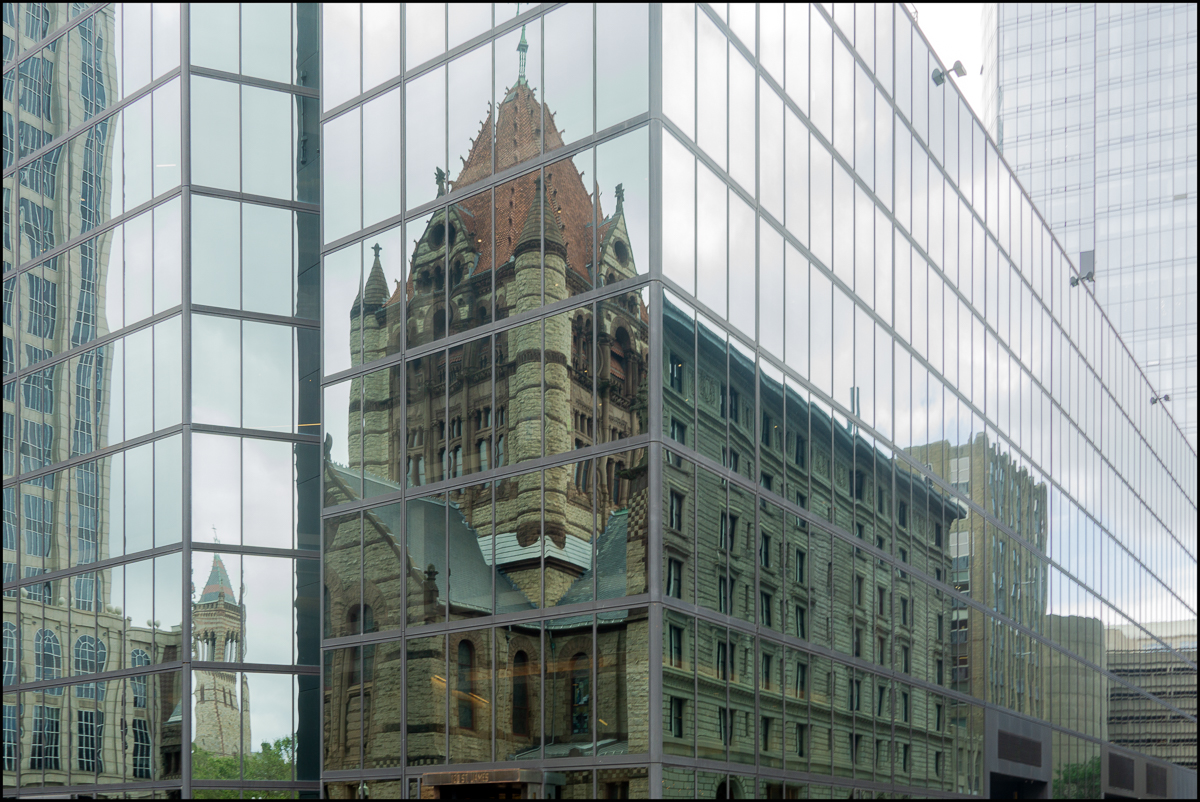
Below: reflection of Trinity Church in a neighboring building.

Taken with a Sony A6000 and 18-135mm f3.5-5.6 OSS

A Visit to Boston – Day Three – Phillips Brooks Statue

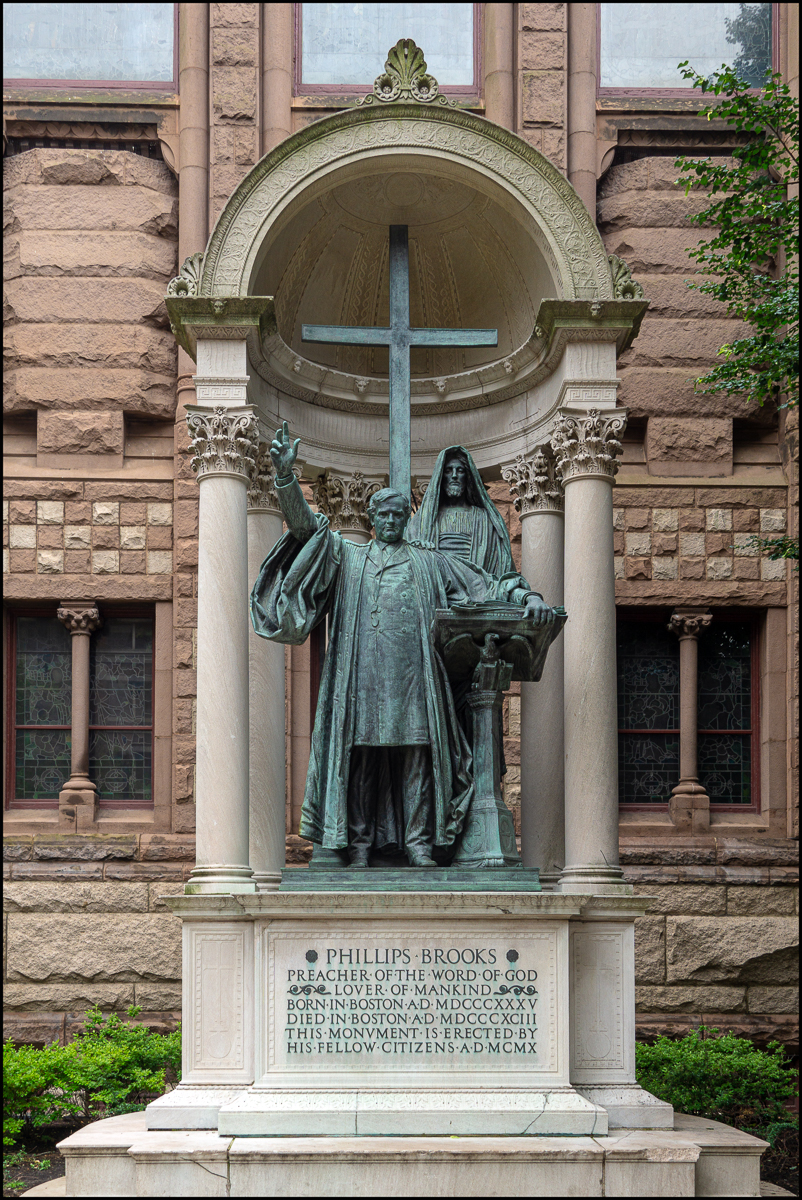
This statue of Phillips Brooks is installed outside the Trinity Church. The memorial is credited to sculptors Augustus Saint-Gaudens, Frances Grimes, and architects Stanford White and Charles Follen McKim. It was commissioned in 1893 by the church congregation for $80,000 and completed from 1907–1910.

The bronze statues of Brooks and Jesus stand in a domed marble niche that measures approximately 17 ft. x 14 ft. 1 in. x 38 in. The figures rest on a granite base that measures approximately 5 x 11 x 9 ft.

An inscription on the front of the base reads in bronze lettering: “PHILLIPS BROOKS / PREACHER OF THE WORD OF GOD / LOVER OF MANKIND / BORN IN BOSTON AD MDCCCXXXV / DIED IN BOSTON AD MDCCCXCIII / THIS MONUMENT IS ERECTED BY / HIS FELLOW CITIZENS AD MCMX”.

Phillips Brooks (December 13, 1835 – January 23, 1893) was an American Episcopal clergyman and author, long the Rector of Boston’s Trinity Church and briefly Bishop of Massachusetts. He wrote the lyrics of the Christmas hymn, “O Little Town of Bethlehem”. He is honored on the Episcopal Church liturgical calendar on January 23.

Taken with a Sony A6000 and 18-135mm f3.5-5.6 OSS

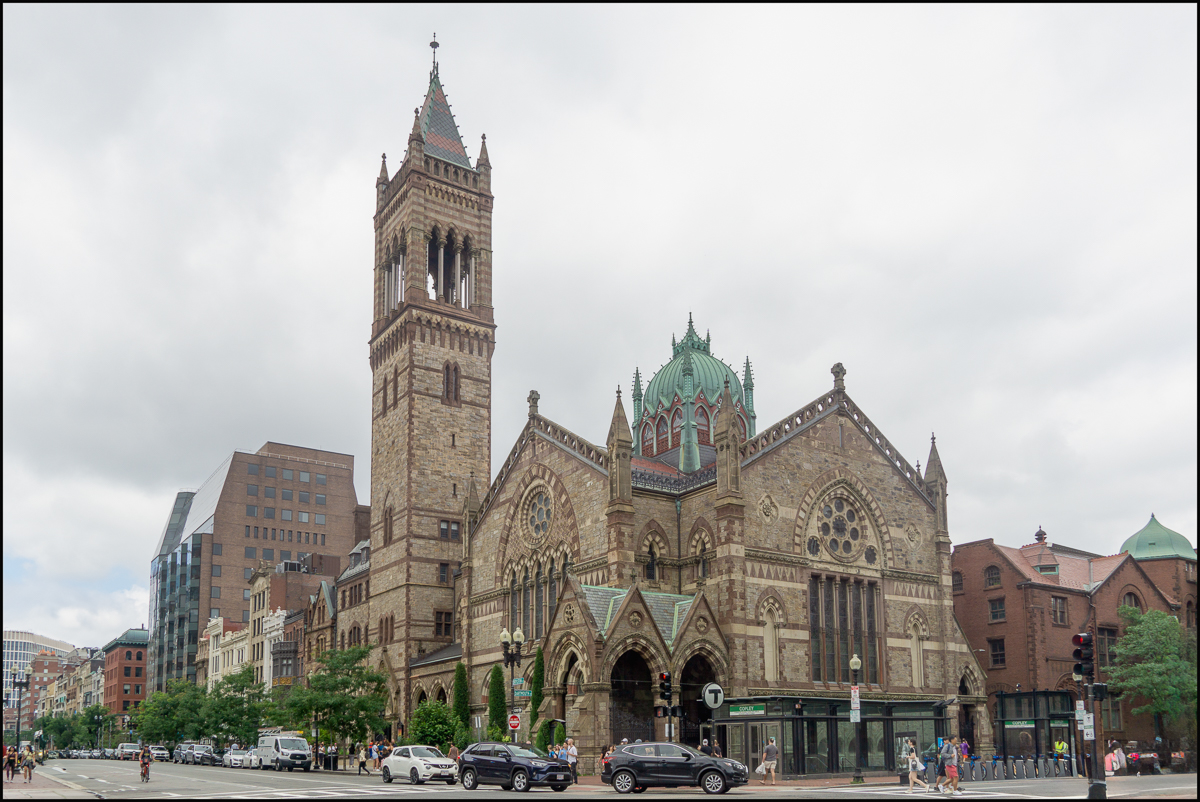
A Visit to Boston – Day Three – Old South Church

“Old South Church in Boston, Massachusetts, also known as New Old South Church or Third Church, is a historic United Church of Christ congregation first organized in 1669. Its present building was designed in the Gothic Revival style by Charles Amos Cummings and Willard T. Sears, completed in 1873, and amplified by the architects Allen & Collens between 1935–1937. The church, which was built on newly filled land in the Back Bay section of Boston, is located at 645 Boylston Street on Copley Square. It was designated a National Historic Landmark in 1970 for its architectural significance as one of the finest High Victorian Gothic churches in New England.[3] It is home to one of the oldest religious communities in the United States.” (Wikipedia, which also provides much more information)

Additional information on the history of the church can also be found on the church’s website.

Again, I would have liked to explore the interior, but didn’t have the time.

Taken with a Sony A6000 and 18-135mm f3.5-5.6 OSS

A Visit to Boston – Day Three – Boston Public Library

As I arrived in Copley Square this was the first building I encountered: The wonderful Boston Public Library.

The library’s website provides the following information:

Established in 1848 by an act of the General Court of Massachusetts, the Boston Public Library (BPL) was the first large free municipal library in the United States. In 1839, French ventriloquist M. Nicholas Marie Alexandre Vattemare became the original advocate for a public library in Boston when he proposed the idea of a book and prints exchange between American and French libraries. The Mayor of the City of Boston, Josiah Quincy, Jr., first president of the Board of Trustees, Edward Everett, and his successor, George Ticknor, were also at the forefront of the library’s establishment.

Boston Public Library’s first building of its own was a former schoolhouse located on Mason Street that opened to the public on March 20, 1854. However, it was obvious from opening day that the quarters were inadequate for the library’s collection of sixteen thousand volumes. In December 1854, library commissioners were authorized to locate a new building on a lot on Boylston Street, which opened in 1858 at 55 Boylston Street with seventy thousand volumes. Twenty years later, as the library outgrew that space, the Trustees asked the state legislature for a plot in the newly filled Back Bay. On April 22, 1880, the state granted the City of Boston a lot at the corner of Dartmouth and Boylston Streets.

Charles Follen McKim of McKim, Meade, and White was appointed the principal architect in 1887 for the new building. The present Central Library in Copley Square has been home to the library and has served as its headquarters since 1895, when Charles Follen McKim completed his “palace for the people.”

In 1986, the National Park Service designated the McKim building a National Historic Landmark, citing it as “the first outstanding example of Renaissance Beaux-Arts Classicism in America.” Within the McKim Building are exquisite murals series by John Singer Sargent, Edwin Austin Abbey, and Pierre Puvis de Chavannes, a peaceful inner courtyard, and additional works of famed sculptors and painters that can be viewed via the library’s daily art and architecture tours. Bates Hall, the iconic reading room located on the second floor of the McKim building, is named in honor of Joshua Bates, a London merchant banker born in Weymouth, MA, who in 1852 donated $50,000 for the library’s establishment and another $50,000 for the purchase of books. He was the first major benefactor of the BPL and initiated that its services be “free to all.”

The McKim building restoration and renovation project began in 1980 with a planning grant from the Massachusetts Historical Commission that enabled the Trustees of the Boston Public Library to undertake an initial feasibility study, and Mayoral and City Council approval was received by 1983. The multiphase project began in 1991 and was completed in 2002 and included renovation of several public services spaces, mechanical, electrical, and telecommunication systems, and historic restoration work including the courtyard. (BPL History)

For much more information see the Wikipedia page on the Boston Public Library.

These two, seated allegorical female figures (two views of each) below represent Science (the first, holding a sphere) and Art (the second, holding a palette and a paintbrush) stand by the entrance to the library. The sculptures were created by Bela Lyon Pratt after his mentor Augustus Saint-Gaudens died, leaving his design for the library incomplete.


Below, a scary looking, spiked light fixture.

Six bronze doors lead from the vestibule to the spectacular lobby and grand staircase (see below. They were designed by Daniel Chester French. Each of the doors weighs 1500 pounds. This one is called “The allegories of truth and romance”.

Each door bears the low-relief image of an allegorical figure holding her attributes along with a quote. The left door quote reads: “Truth is the strength and the kingdom and the power and the majesty of all ages”, and the right: “A romance to rede and to drive the night away for me thought it better play than either at cheese or tables. (I have no idea what these means)”.


Below, Statue of Sir Henry Vane. The plaque reads:

Sir Henry Vane. Governor of the Colony of Massachusetts Bay 1636. Born 1612. Beheaded 1662. An ardent defender of civil liberty and advocate of free thought in religion. He maintained that God’s law and parliament are superior to the king. This statue was placed here at the request of James Freeman Clarke, D.D. an honored citizen of Bost who nobly labored for the abolition of slavery in America.

It appears that, after serving as governor of the Massachusetts Bay Colony at the age of 23 in 1636, Vane later returned to England to be tried for sedition against King Charles I and was beheaded. The royal charge was treason against the crown, but the charge was not made specific.

It seems the the library isn’t just used for reading.


I would have liked to explore the interior, but didn’t have the time.

Taken with a Sony A6000 and 18-135mm f3.5-5.6 OSS