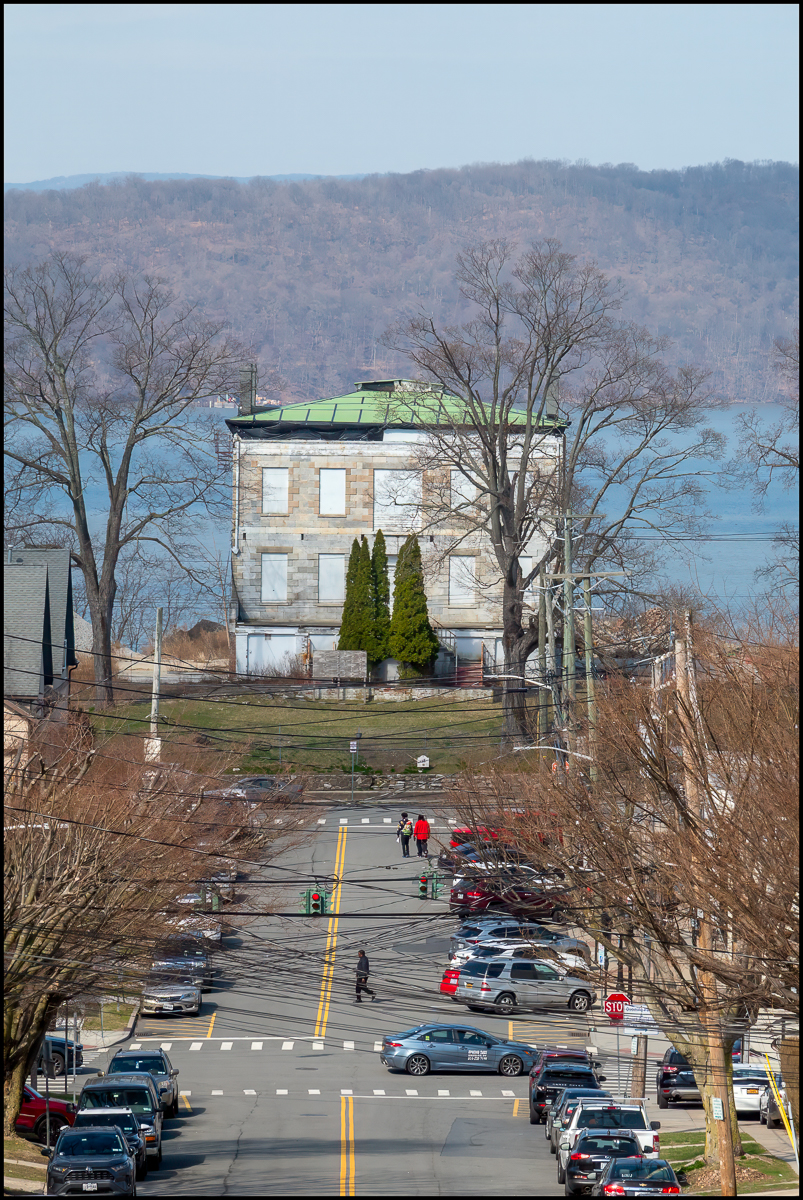
The building at the center of the photograph near the river is the Smith-Robinson house. The Village of Ossining Significant Sites and Structures Guide, Page 108 has this to say about it:
Property Name: Smith-Robinson House
Other Name(s): Printex Building
Street Address: 34 State Street
Section, Block, and Lot: Section 97.07, Block 2, Lot 17
Architect/Builder: Unknown
Date of Construction: circa 1840
Architectural Style: Greek Revival (1825-1860)Greek Revival architecture came to prominence in America during the early 1800s as part of a renewed phase of interest in the architecture and culture of the ancient Mediterranean following a series of archaeological discoveries in the late 18th century. Greek Revival structures are often identifiable by the use of a temple front façade configuration, with a large triangular pediment and columns dominating the main façade. Some examples of the style may utilize the columns without the pediment, while others may have an appearance consisting of a blend of Greek temple features with other early 19th century styles.
The Smith-Robinson House is two stories in height, five bays wide, and five bays deep. A veranda with six one story Doric columns extends along the length of the main façade, along with a second story balustrade and balcony above. A raised basement story is visible below the
veranda, and the original windows on this story of the structure were enclosed at an unknown date. The window configuration on the main façade consists of six over six wood sash double hung windows with stone sills and lintels. The main entryway has a transom window over the door and is flanked by side lights. The house is also architecturally notable for one of the most complete and well-preserved Greek Revival interiors in Westchester County. The building has a flat roof and is built from Sing Sing Marble.Significance: Architectural and Cultural
The Smith-Robinson House is architecturally significant as one of three remaining Greek Revival structures in the Village of Ossining. The others are neighboring James Robinson House (see entry) and the Charles Snowden House, (see entry). It is also culturally significant for its association with James Robinson and James Smith, two wealthy mid 19th century Sing Sing Village landowners.
Narrative:
The Smith Robinson House, located at 34 State Street and built in the 1840’s, was constructed by a local businessman named James Smith as his residence. The original estate on which the house was built once extended east all the way to Highland Avenue and contained several acres worth of orchards. The property was later purchased by James Robinson, another wealthy local landowner who built the residence that bears his name in 1860. The house was used as a wallpaper factory for a time in the 1940s, in 1948 the house served as offices for the Printex Corporation, a now-defunct textile manufacturer. An expansion wing built in a utilitarian style was constructed in 1955, and a dedicated factory facility was built on the south side of the house in 1967. The house has had a series of owners and tenants since then and was used as a meeting space for the Catholic Community Club, Knights of Columbus and other nonprofit organizations for a time. Currently, it is vacant and unused but retains much of its original condition.
I took this photograph from Highland Ave., so everything you see would once have been part of the estate. A friend who’s quite knowledgeable about the history of Ossining (he’s even written a book about it) informs me that Broad Ave. was once the road to the main entrance of the Smith-Robinson House.
As mentioned above the Guide, which was published in April 2010, states “Currently, it is vacant and unused but retains most of its original condition”. This photograph was taken March 29, 2025, and you can see that much still needs to be done.
Taken with a Sony RX100 IV.