Bye bye iPhone 3GS’s. Hello iPhone 5s.

It’s now been raining for seven days in a row and you see what I’ve been reduced to – taking pictures of iPhones!

Anyway the sad tale of my poor old iPhone 3GS has now come to an end. My wife and myself both got one of these phones back in 2009 when they first came out.

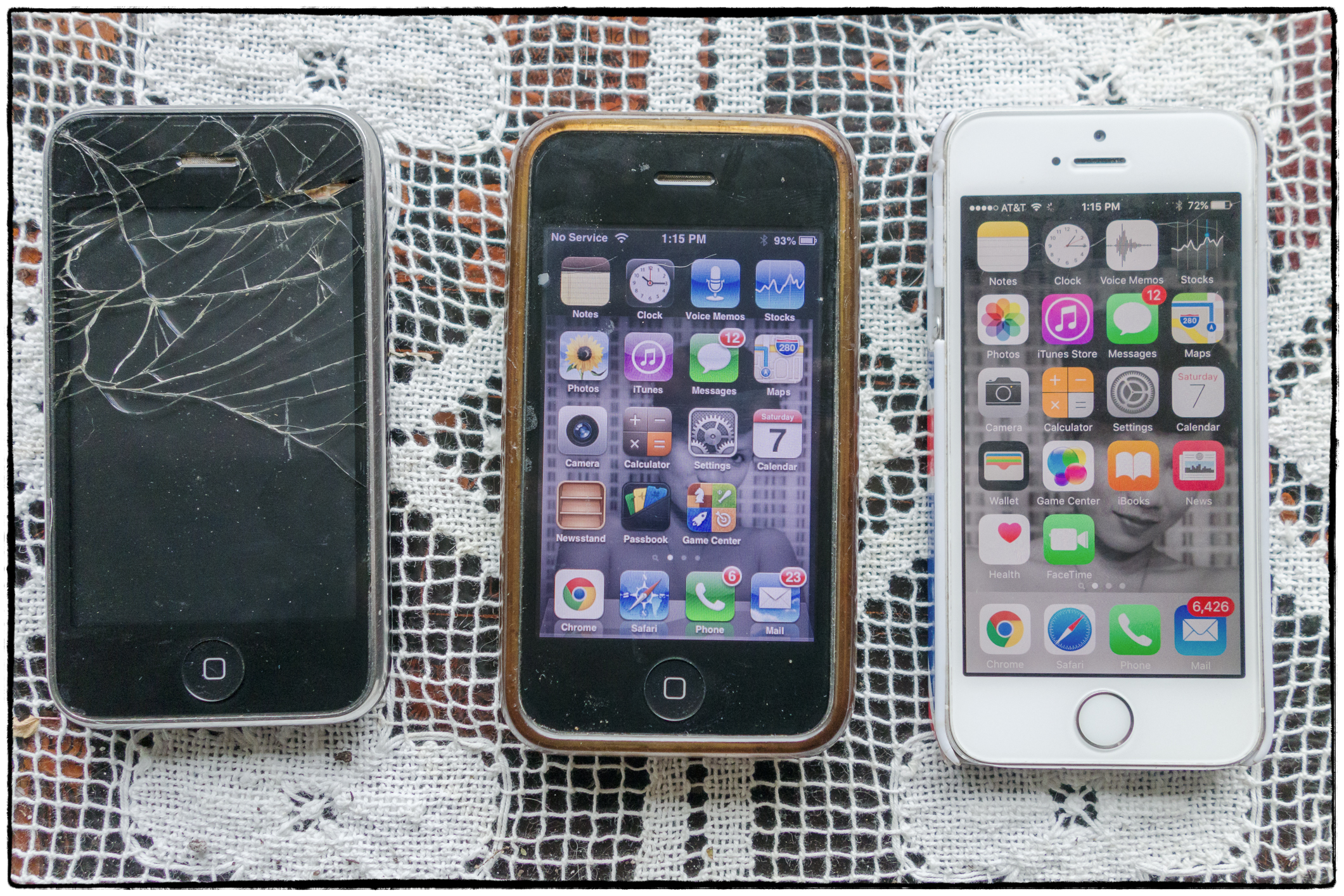
The one on the left was mine. One day I was sitting outside my wife’s fitness club with our old dog, Jackson browsing away on the phone. Something he saw caused him to rush off, pulling my arm with him. The phone flew out, spiralled up into the air and came down with a crash on the concrete paving (he also destroyed two Amazon Kindle’s in the same way before I figured out that it wasn’t a good idea to hold his leash in the same hand as an electronic device). As you see the screen shattered. But it was still working and I could still read the screen – just. So I kept using it.

The one in the middle belonged to my wife. Eventually she got an iPhone 5s. I was getting frustrated with my 3GS – not so much because the screen was broken. I could live with that. But because 1) the battery life was gradually decreasing; and 2) newer versions of apps wouldn’t work on the old operating system (OS3). The latter was particularly important as I read a lot and had come to depend on the Amazon Kindle app, which I had unfortunately accidentally deleted and could no longer replace. Then one day I had a brainwave – how about I use my wife’s old phone. I thought at the time that it was an iPhone 4 (it wasn’t) and so it would be a slight step up. I upgraded the OS to version 6, which I figured would support the Kindle app (it did) and all was well with the world – for a while. I had a phone that didn’t have a broken screen and could run my favored apps. OK, it was a bit slow but it got the job done. Then one day – disaster! While it continued to make and receive calls, the person I was calling couldn’t hear me and I couldn’t hear them. Ah well back to the cracked screen.

Anyway the other day the phone with the cracked screen stopped working altogether. It was probably my fault. I was taking a bath and put the phone on the side of the bath in case my wife called. When I got out of the bath the phone was wet – I must have splashed some water on it. All would probably have been well with an intact phone, but with all those cracks and holes….I switched back to phone number two and lo and behold it worked. I could hear people speaking and they could hear me. Somehow it had miraculously come back to life. But I no longer trusted it. It had stopped working once so it could stop working again. I’d put up with the laughter and sarcasm from my friends for too long. It was time to upgrade.

My wife had been talking about upgrading for a while (she wanted a better camera and a bigger screen). She got an iPhone 6s and I inherited her two year old 5s. So I have a fairly recent iPhone. The screen isn’t cracked and it will run all my apps. It’s not the latest technology, but it’s good enough for me.

Since this is primarily a photo blog, you may well ask what all of this has to do with photography. I love cameras and would never dismiss the camera in the iPhone. It’s revolutionized photography. I imagine more people take pictures today with phone cameras than with regular cameras. You always have it with you and within its limitations it can produce great results. I few years ago we were in the Turks and Caicos Islands. My wife went for a spa treatment and took a few pictures inside with her iPhone 3GS. I took some pictures outside with my regular camera. That day the light was gorgeous. I later did a photobook and you really can’t tell the difference. I’ve asked friends if they can identify the pictures taken with the iPhone and they can’t. I recently did another photobook with just iPhone pictures (because I didn’t have another camera with me) as a souvenir for a friend who may be relocating. It came out fine. I’m pleased that the iPhone 5s has a better camera than the 3GS I had before.

Hopefully I won’t have to worry about upgrading for another seven years.

Confused by the bewildering array of Canonets

In January of 1961, Canon introduced the Canonet, a consumer-friendly 35mm film rangefinder camera aimed at the average person. Over fifty years and fourteen variations later, film photographers still look back on the Canonet as an excellent choice for beginning and experienced photographers alike. Let’s travel back in time to see how it all began and why the Canonet remains popular even today.

Source: A Brief History of the Canon Canonet Rangefinder.

The Canonet QL-17 GIII is one of the best regarded of the fixed lens, compact rangefinder cameras. I have one, but have yet to try it out. However, in browsing around I’ve also noticed that there are many more Canonet models (e.g. original canonet; canonet 28, canonet 25; canonet 17 (no ql); canonet 17 – no GIII. Wikipedia lists no less than 17 different models including four 17’s and four 19’s – only one of which is covered in detail: the QL-17 GIII) I can guess that the number indicates the largest aperture and that the QL indicates that the camera has a “quick load” system. But I’ve no idea what the GIII means (third generation maybe?). I’ve also seen references to something called a “new” canonet. It’s all very confusing. I have a excellent book (Canon Rangefinder Cameras 1933-68 by Peter Dechert) on Canon rangefinder cameras, but it only deals with the older, Leica Thread Mount cameras. There are also multiple models of these – many of which look practically the same (what exactly is the difference between a Canon IV, IVSB, and IVSBII for example?). So the book didn’t help.

So I was excited when I came across this article on Petapixel. After I read it I was still somewhat bewildered, but it certainly helped. Maybe if I read it a few more times it will become clearer.

The photography of Gregory Crewsdon

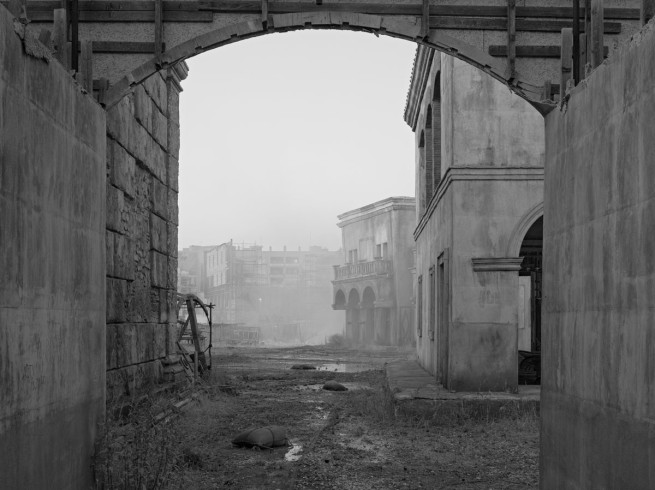
Gregory Crewdson’s photographs almost always project solitude and intimacy, even if his images take a team to organize. The subject of one of his images looks back at the experience. Source: Alone, in a Crowd, With Gregory Crewdson – The New York Times

I’m not quite sure what to think about Gregory Crewsdon’s work and suspect that these large canvases need to be seen in their full glory to really appreciate them. Small images on the web may not do it. The NY Times article mentioned above refers to a recent (Jan-March, 2016) exhibition of his work at the Gagosian Gallery. I meant to go into New York City to see it, but typically for me never found the time to go. Ah well – another time.

Below two reviews, from Australia, of an exhibition of Crewsdon’s work in 2012, the first one negative and the second one positive.

Photographer Gregory Crewdson at The Centre for Contemporary Photography in Fitzroy. Photo: Joe Armao. Source: Sydney Morning Herald

American painters like Edward Hopper and the photorealist Richard Estes in their mysterious stasis.In painting, if you want to make something look brighter or mistier or on fire, you just toss in appropriate colours while building your volumes and edges. But in photography, you have to bring in lights and fog machines and incendiaries; and even then, the effects often look phoney. Crewdson is a master of directorial fakery, creating memorably unnatural-looking photographs that seem wilfully inauthentic.

I wish I could say the images are atmospheric. But the pictures are stilted and airless. You feel that if the wind were to blow, it would only be because someone was instructed to plug in a fan.

The human subjects in Beneath the roses strike me as lifeless, perhaps because of long exposures, during which everyone is ordered to stand still. The scenes mostly have a tragic air with incomplete narratives; but because of the contrived lighting, atmosphere and paralytic acting, they’re enigmatic in a goofy way. By suggesting some profound condition which is only staged as artifice, the work unwittingly strays into the burlesque.

Crewdson’s dramas seem both obvious and obscure. If you only saw one, you’d think it’s very clever and symbolically meaningful. But seeing a dozen weakens the intrigue, because the action in one picture looks more arbitrary than in the last.

Source: In a Lonely Place review, Sydney Morning Herald

© Gregory Crewdson. Courtesy Gagosian Gallery

After the excoriating, unreasonably subjective diatribe by Robert Nelson in The Age newspaper (“Unreal stills, unmoving images” Wednesday October 17 2012) I hope this piece of writing will offer greater insight into the work of this internationally renowned artist. With some reservations, I like Crewsdon’s work, I like it a lot – as do the crowds of people flocking to the Centre for Contemporary Photography, Fitzroy to see the exhibition. Never have I seen so many people at the CCP looking at contemporary photography before and that can only be a good thing.

Source: In a Lonely Place review, Art Blart

VW Beetle

It’s now Friday and it’s rained every day since last Sunday and out of frustration and boredom I’ve taken refuge in taking pictures of objects around the house.

This VW Beetle was a birthday (Last week, April 30) present from our friend Ken. He knew that our old Toyota Camry had given up the ghost a year or so ago and I suppose he found it amusing to provide this as a replacement (to be fair he did give me a bottle of 15 year old Tobermory single malt scotch too). It also came with a challenge. He told me that there is something wrong with the model and left it to me to find out what.

I know very little about cars, but nonetheless I spent a few days browsing the internet and looking at pictures/plans of VW Beetles hoping that inspiration would strike me. I did notice that the rear view mirror and side mirror(s) were missing, but when I mentioned that to Ken he dismissed it as trivial. No, he had discovered something much more serious. I kept looking, but finding nothing, eventually gave up. Ken’s response was:

I can almost feel your pain! And inflicting pain was never my intent! Turn the model over and fix your gaze between the front wheels. There’s a suggestion of an engine and a gear box. Now, what do we/you know about where the engine/gearbox is on a Beetle? At the back!

Wow! Is that what those squiggles were? I’d never have spotted that in a million years.

I took a few pictures of the model today and the one above was the one I preferred. I like the way that almost nothing is in focus and the car seems to just disappear into the background.