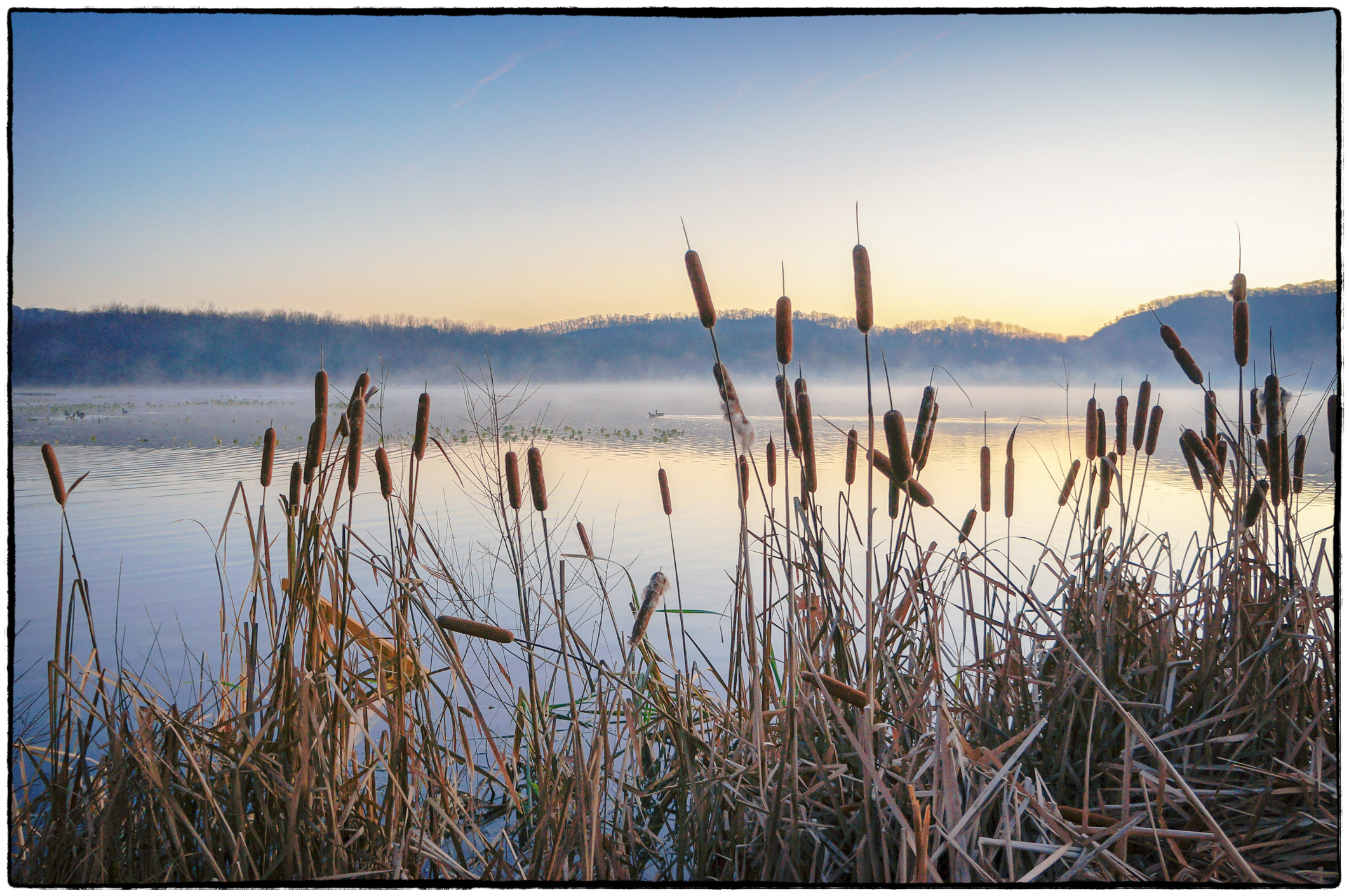
Taken early morning (around 6:45 am) in November, 2011 – one of the relatively few times I’ve been able to get up early enough to get the nice early morning light.
The lake, and the State Park that surrounds it has some interesting history
According to Wikipedia:
Rockland Lake was known as “Quashpeake Pond” to the region’s Native American population, prior to the lake being given its current name, which refers to the county in which it is situated. The adjacent hamlet of Rockland Lake was originally known as “Slaughter’s Landing” before its name was changed to match the lake.
…
Prior to the establishment of the park, Rockland Lake served as an important supplier of ice to New York City after the Knickerbocker Ice Company was established on the lake’s northeastern bank in 1831. Rockland Lake eventually became known as the “Icehouse of New York City”, with a reputation for having the cleanest and purest ice in the area.
During the 1850s, the Knickerbocker Ice Company operated a dozen steamboats, 75 ice barges, and employed 3,000 people. Ice harvests typically began in January, and blocks of ice were stored in large icehouses before being shipped to customers during warmer weather. The icehouses, insulated with sawdust, could store up to 50,000 tons of ice.
The nearby Knickerbocker Fire House was established 1862.
The Knickerbocker Ice Company closed in 1924. In 1926, workers who were demolishing one of the ice houses accidentally set fire to the structure’s sawdust insulation. The fire spread extremely quickly and destroyed much of the village of Rockland Lake. The old foundation of the ice company remains today, marked by a historical plaque and bench.
For an interesting article on the village of Rockland Lake see: “Ghost Town: The Lost Village of Rockland Lake” by John Patrick Schutz in Nyack News and Views. It seems that the fire mentioned by Wikipedia was nowhere near as catastrophic as they make out. The article delves into the history of Rockland Lake both before and after the fire from the perspective of the author, whose family lived there. Well worth reading!