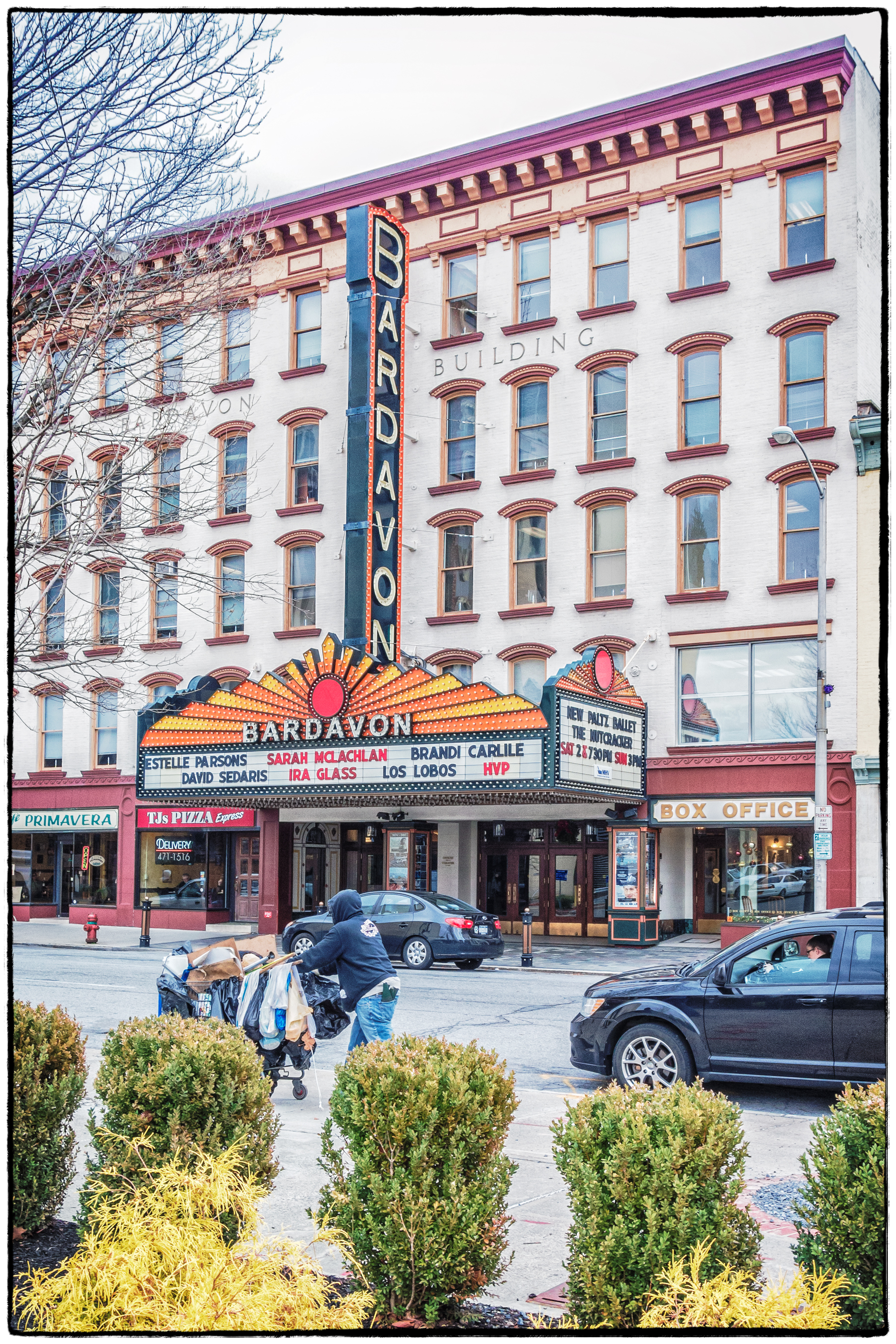
The About the Bardavon – History section of the Bardavon web site provides a short history of the theatre. Some Extracts follow:
The oldest continuously operating theatre in New York State is Poughkeepsie’s Bardavon Opera House. For its first fifty years the theatre was called the Collingwood Opera House. It’s owner was James Collingwood, a coal and lumber merchant. Born in England, Collingwood had become one of Poughkeepsie’s wealthiest men by the time he built the theatre. Construction of the new music hall began in June, 1868 and was completed in eight months. The site was behind an office building Collingwood had built five years earlier. It had been the uptown branch of his coal and lumber yard.
…
In 1943, Paramount’s northeast subsidiary, Netco, purchased the Bardavon Theatre and the office building in front of it. In 1947, the lobbies and marquee were modernized, and today, they look much like they did then. Paramount and its successor, ABC, owned the Bardavon almost until it closed as a movie theater.
During most of its 50 years as a movie house, the Bardavon was paramount’s A house in Poughkeepsie. Important movies opened first at the Bardavon. In 1940, “Gone with the Wind” played for two weeks. Seating for the evening shows was by advance reservation and cost $1.10. Later films included “The Wizard of Oz”, Richard Burton’s, “Hamlet”, “The Sound of Music” and “The Godfather” As more and more movie theaters opened in suburban shopping centers, downtown poughkeepsie movie houses closed.
The Bardavon Theatre was the last to close as a movie house in September, 1975. It was to be torn down and replaced by a parking lot. The Dutchess County Arts Council and Poughkeepsie residents, formed the Concerned Citizens to Save the Bardavon and immediately got the Urban Renewal Plan changed and The Citizens Group then obtained a lease on the theatre. The Bardavon 1869 Opera House a Not-for-profit corporation was formed. Retired IBM engineer, Stephen Dunwell was named chairman of the Board and volunteer General Manager along with, his wife Julia , who became Director of programs and publicity, thus commencing a three year period of revitalization of the theatre as a performing arts center. To help to secure its future, the Bardavon was placed on the National Register of Historic Places in 1978. By 1979 the theatre provided full seasons of community and professional shows. A popular program for school children was in place. Strong support from the city Mayor and community had been developed. It was than possible to purchase the building with city, state and local contributions. In September 1979, a professional Executive Director, Robert Cole was hired and took over operations. Since 1980 more than $2 million dollars has been spent to improve the theater.
Today, the Bardavon is a lively center for the performing arts presenting a variety of professional performances, such as “The Hubbard Street Dancers”. Wynton Marsalis has played as a guest performer with the Hudson Valley philharmonic, and also with “Stars of Lincoln Center Jazz”. There are still a few reminders of the old Collingwood. Backstage, scenery is flown using the hemp system first installed in the opera house, and its crowning jewel – the original 1869 dome – is still in place above the present dome. The Wurlitzer organ designed for the Bardavon has been reinstalled. The spirits of the Collingwood Opera House and the Bardavon Theatre live on in the Bardavon Opera House, enriching it as a performance space and a living history museum.
The list of famous artists who have performed at the Bardavon is extensive and much too long to include here so some examples will have to suffice: Al Pacino, Bob Dylan, Buffalo Bill, Cher, Frank Sinatra, Steve Martin, Liza Minnelli, Wynton Marsalis, and Tony Bennett.