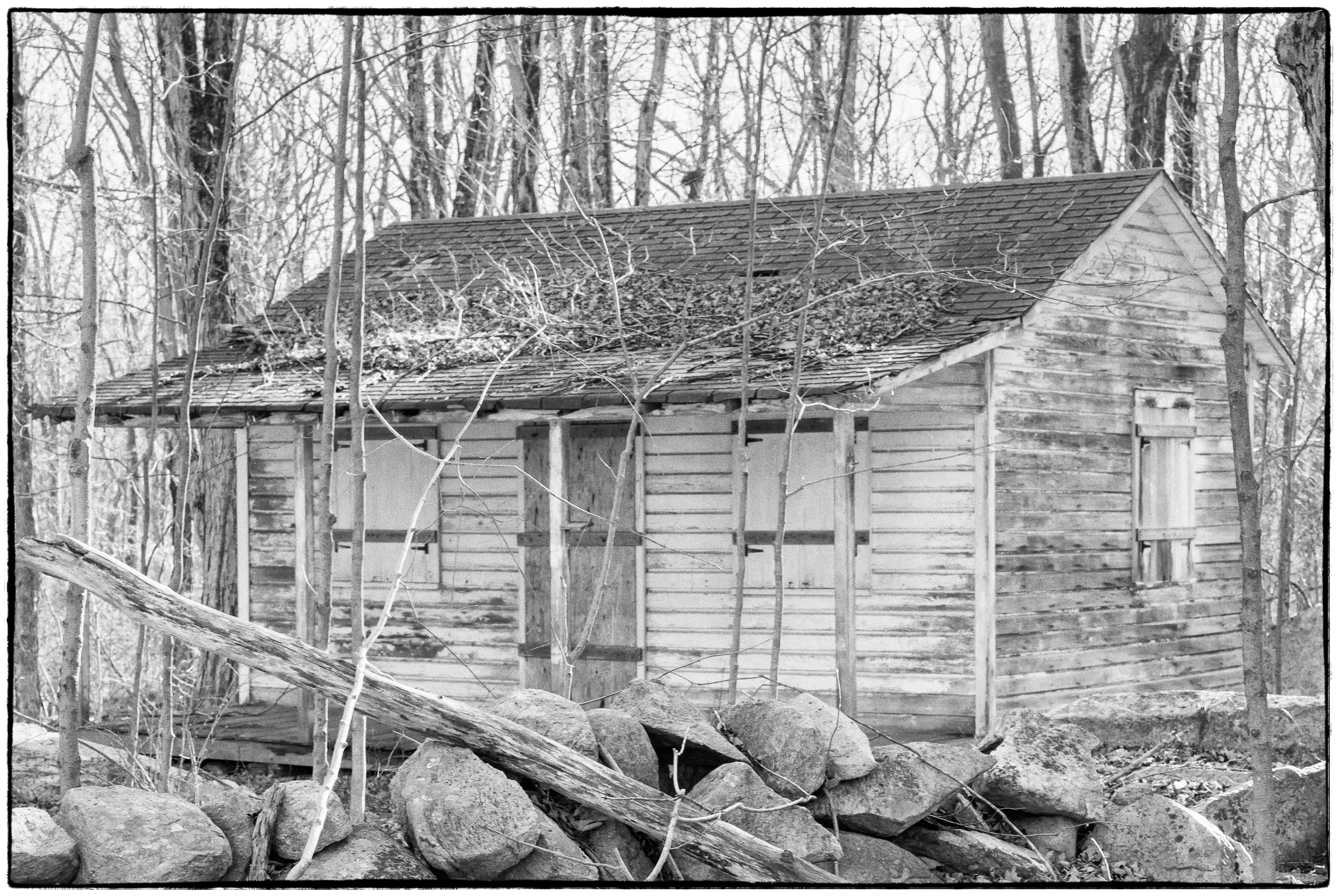
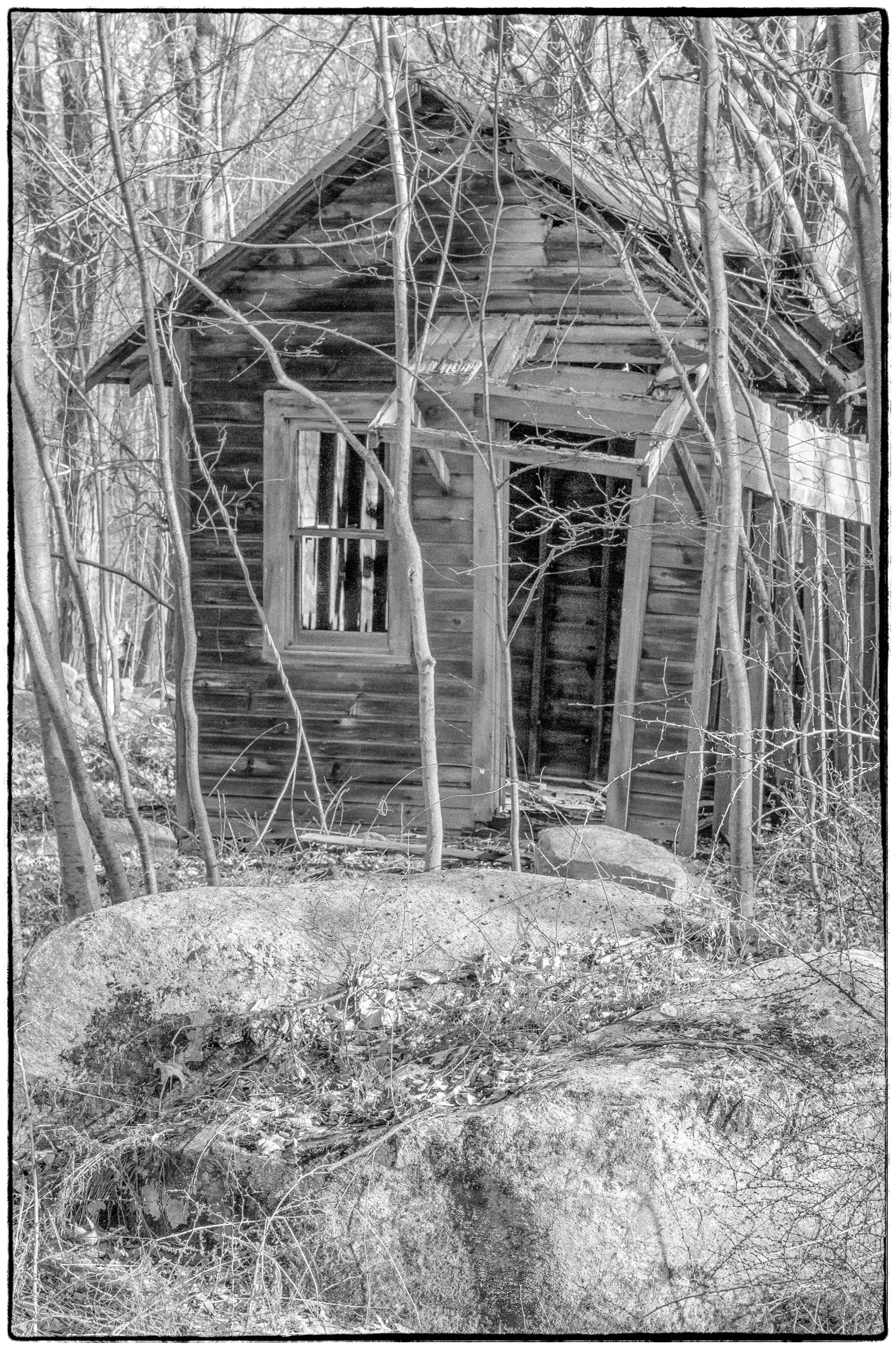
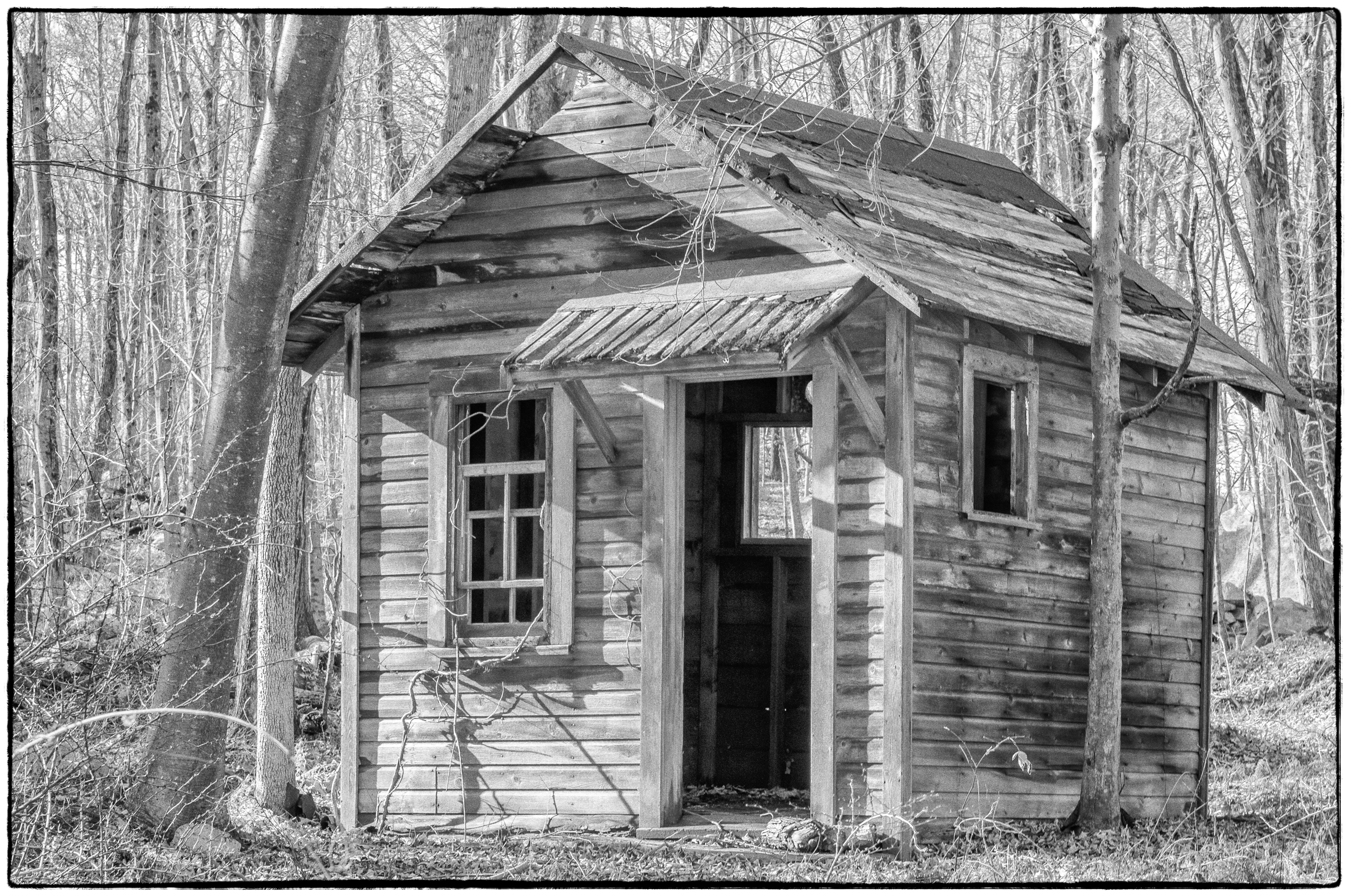
Abandoned shacks

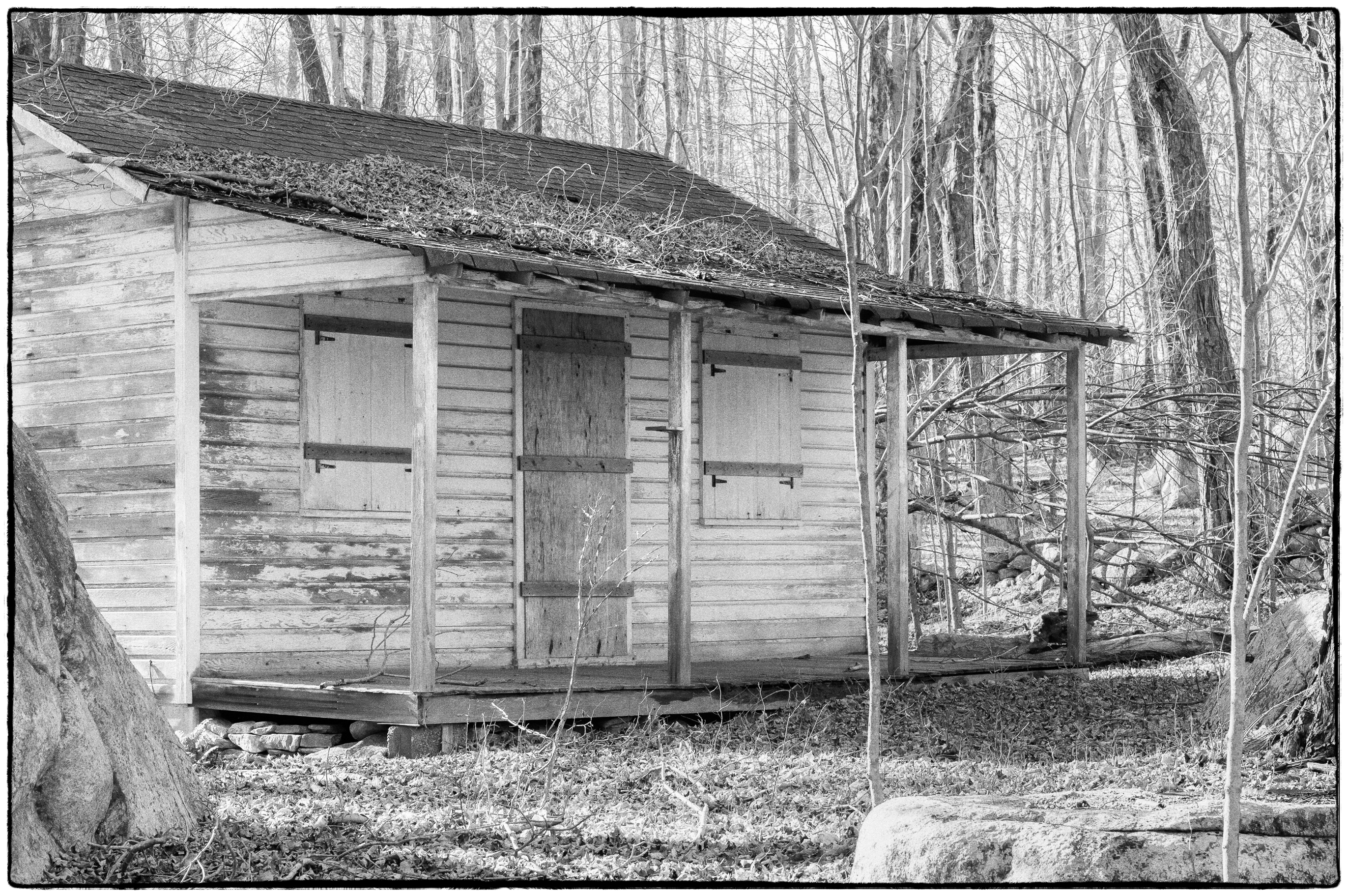
I’ve often noticed these ramshackle wooden shacks just off Route 301 between the Taconic State Parkway and Carmel, NY. I’ve also often thought that we should stop and take some pictures, but until now I haven’t done so.

There are three of them and I don’t know what they are/were or why they’re there. So far haven’t been able to find any additional information.

While taking a picture of the first shack above I decided that I might get a better shot if I was the other side of a stone wall. Unfortunately the only way to get to the other side was to climb over the wall. As I was doing so one of the stones turned under my foot. Luckily it didn’t fall on any part of my anatomy as it was a rather large stone. It did, however, twist my toe, which made walking painful for about a week and rather curtailed my photographic activities.

The view from the other side with the offending wall in the foreground. Unfortunately the picture is not too sharp. I was using an old Minolta manual focus lens and since I was in a fair bit of pain at the time I guess I wasn’t concentrating enough on getting the focus right.

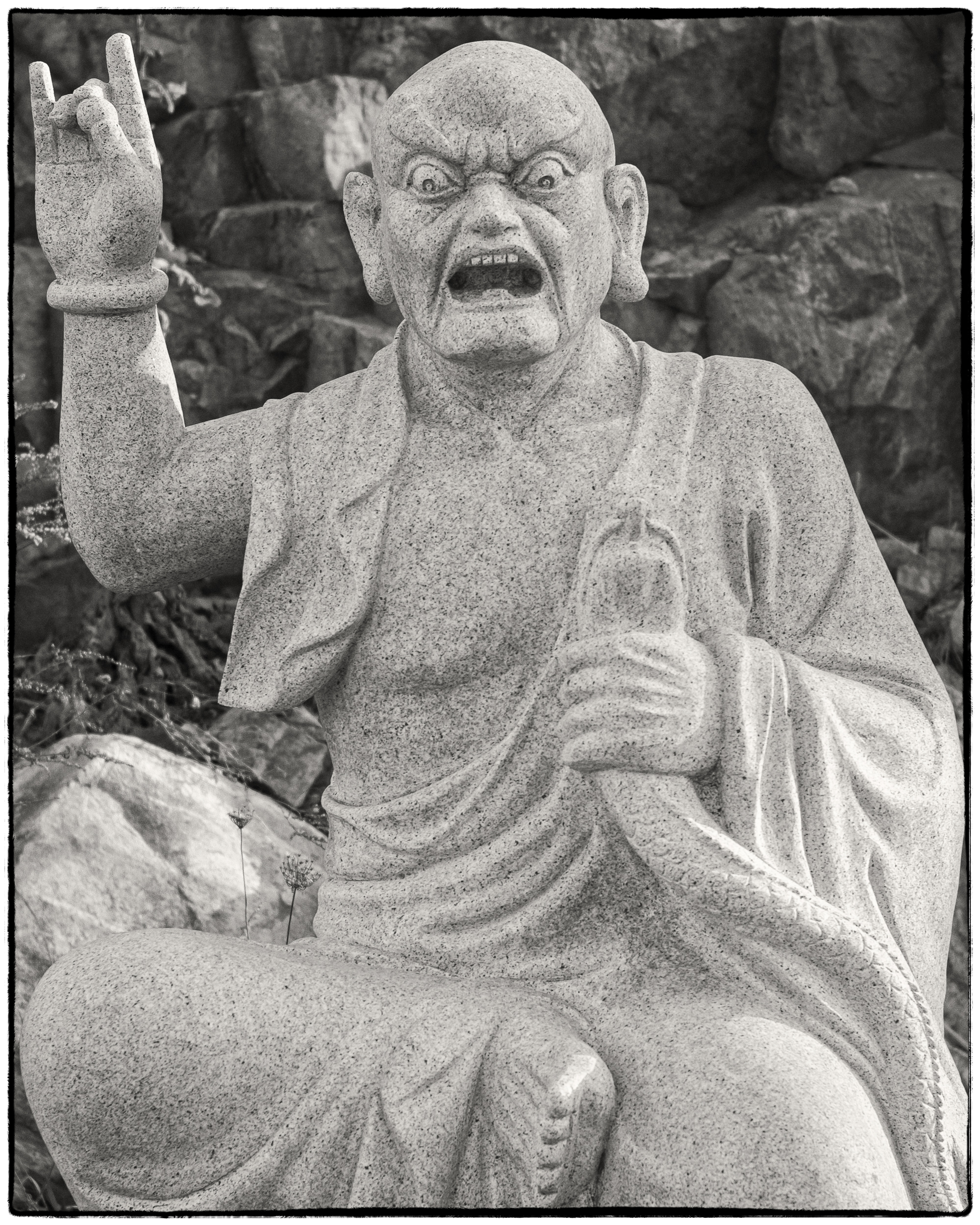
Eighteen Arhats: My personal favorite – Mahakappina Thera

I thought I’d include one of the pictures at a larger size. This one is my personal favorite (which is a pity because it’s also the least sharp. Either I missed the focus or there’s a little camera shake. I’ll have to go back and try again, but probably not before next year as the monastery closes between January 1 and March 31):

Mahakappina Thera. The Buddha declared Mahakappina was the ablest in admonishing monks. He was a king prior to set out to seek the Buddha’s teaching. He who was older than the Buddha often dwelled in the bliss of jhana, and was skillful to instruct others by his preaching.

Whoever produced this statue certainly caught the ‘admonishing’ part. You’ve got to love the facial expression and the raised finger.

The Dhammapada: Verses and Stories provides additional detail on the story of Mahakappina:

The Story of Thera Mahakappina

While residing at the Jetavana monastery, the Buddha uttered Verse (79) of this book, with reference to Thera Mahakappina.

Mahakappina was king of Kukkutavati. He had a queen named Anoja; he also had one thousand ministers to help him rule the country. One day, the king accompanied by those one thousand ministers, was out in the park. There, they met some merchants from Savatthi. On learning about the Buddha, the Dhamma, and the Samgha from these merchants the king and his ministers immediately set out for Savatthi.

On that day, when the Buddha surveyed the world with his supernormal power, he saw in his vision, Mahakappina and his ministers coming towards Savatthi. He also knew that they were due for arahatship. The Buddha went to a place one hundred and twenty yojanas away from Savatthi to meet them. There, he waited for them under a banyan tree on the bank of the river Candabhaga. King Mahakappina and his ministers came to the place where the Buddha was waiting for them. When they saw the Buddha, with six-coloured rays radiating from his body, they approached the Buddha and paid homage to him. The Buddha then delivered a discourse to them. After listening to the discourse the king and all his ministers attained Sotapatti Fruition, and they asked the Buddha to permit them to join the Order. The Buddha, reflecting on their past and finding that they had made offerings of yellow robes in a past existence, said to them, “Ehi bhikkhu”, and they all became bhikkhus.

Meanwhile, Queen Anoja, learning about the king’s departure for Savatthi, sent for the wives of the one thousand ministers, and together with them followed the king’s trail. They too came to the place where the Buddha was and seeing the Buddha with a halo of six colours, paid homage to him. All this time, the Buddha by exercising his supernormal power had made the king and his ministers invisible so that their wives did not see them. The queen therefore enquired where the king and his ministers were. The Buddha told the queen and her party to wait for a while and that the king would soon come with his ministers. The Buddha then delivered another discourse; at the end of this discourse the king and his ministers attained arahatship; the queen and the wives of the ministers attained Sotapatti Fruition. At that instant, the queen and her party saw the newly admitted bhikkhus and recognized them as their former husbands.

The ladies also asked permission from the Buddha to enter the Order of Bhikkhunis; so they were directed to go ahead to Savatthi. There they entered the Order and very soon they also attained arahatship. The Buddha then returned to the Jetavana monastery accompanied by one thousand bhikkhus.

At the Jetavana monastery, Thera Mahakappina while resting during the night or during the day would often say, “Oh, what happiness!” (Aho Sukham). The bhikkhus, hearing him saying this so many times a day told the Buddha about it. To them the Buddha replied, “My son Kappina having had the taste of the Dhamma lives happily with a serene mind; he is saying these words of exultation repeatedly with reference to Nibbana.”

Then the Buddha spoke in verse as follows:

Verse 79: He who drinks in the Dhamma lives happily with a serene mind; the wise man always takes delight in the Dhamma (Bodhipakkhiya Dhamma) expounded by the Noble Ones (ariyas).

Eighteen Arhats: Right Side

The second (and final) grouping: statues from the right side of the walkway.

10. Culapanthaka Thera. Culapanthaka was skilled in liberation from mind. He was born a dull person, could not even recite one verse of the teaching He got rid of the impurities of lust and other defilements and attained arahantship after wiping his face with a piece of cloth.

11. Mahakotthita Thera. Mahakotthita ranked the foremost in the logical analysis. Being born in a rich family, after hearing the Buddha’s sermon he was ordained to be a bhikkhu (monk). He who often explained the Dhamma appeared in many sutras.

12. Mahakappina Thera. The Buddha declared Mahakappina was the ablest in admonishing monks. He was a king prior to set out to seek the Buddha’s teaching. He who was older than the Buddha often dwelled in the bliss of jhana, and was skillful to instruct others by his preaching.

13. Kaludayi Thera. Kaludayi was declared pre-eminent among those who gladdened the clans. Being the Buddha’s former playmate he requested the father of the Buddha, King Suddhodana’s invitation of the Buddha back to his home country.

14. Nanda Thera. Nanda, a half brother of the Buddha, was pre-eminent for subduring the five senses. Upon hearing the teaching of the Buddha first he practiced for being with nymphs in heaven but later renounces his desires and attained arahantship.

15. Sariputta Thera. Sariputta, one of the two chief disciples of the Buddha was foremost in wisdom. He not only excelled in comprehending the Dhamma, but also in expounding it. He was called “General of the Dhamma” by the Buddha and greatly contributed to the Abhidhamma

16. Moggallana Thera. Moggallana was one of the two chief disciples of the Buddha, along was foremost in supernatural power. He was well known for his ability to use his power of mind reading to provide proper advice to his students. Moggallana along with Sariputta were declared to be the ideal disciples.

17. Mahakaccana Thera. Mahakaccana, a sone of a highly respected chaplain was praised by the Buddha as the master of doctrinal exposition. By the end of hearing a sermon given by the Buddha he attained arahantship.

18. Kondanna Thera. Kondanna, the first arahant, once was a renowned royal scholar who unequivocally predicted upon the birth of Prince Siddhartha that the prince would become an enlightened Buddha. he was the first to comprehend the Dhamma in the first sermon.

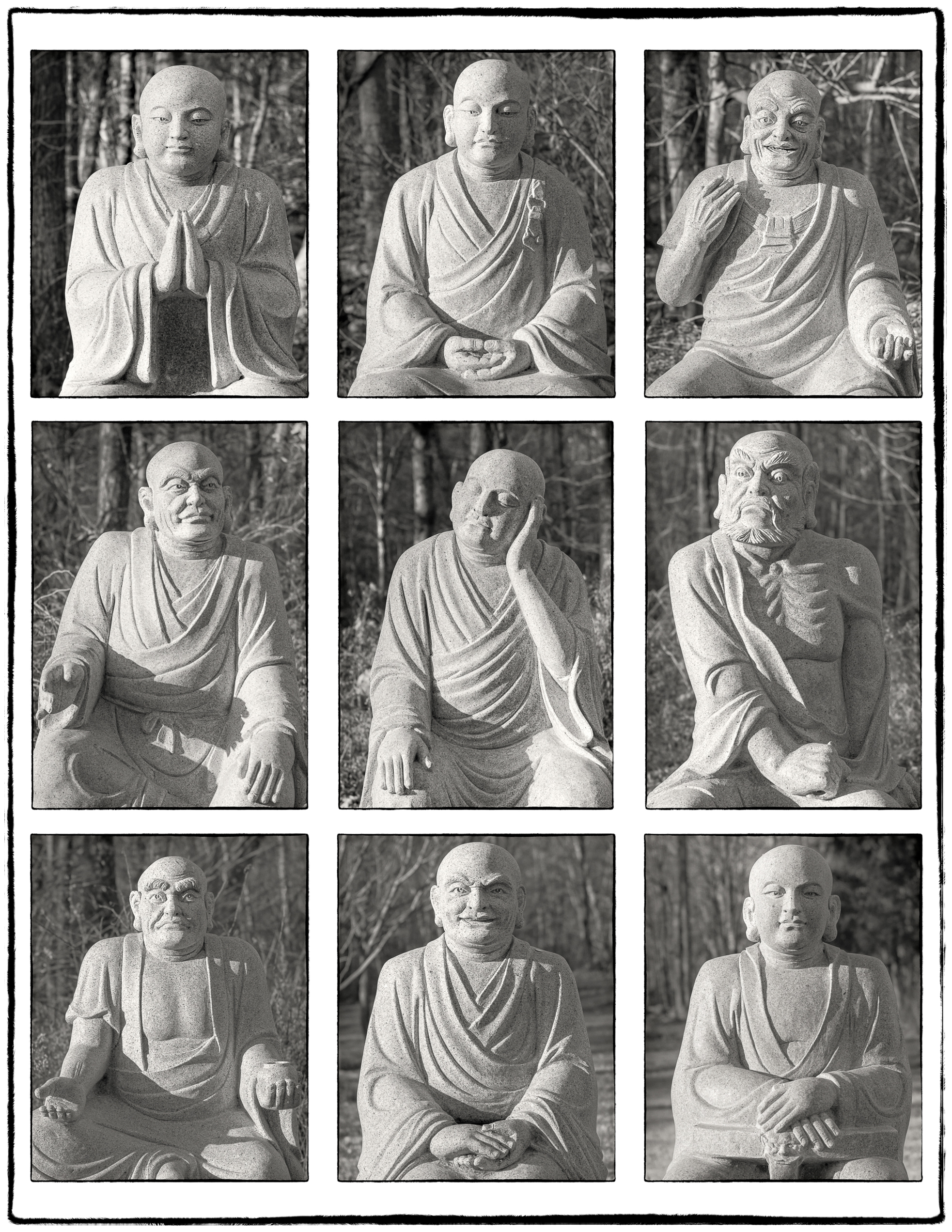
Eighteen Arhats: Left Side

As mentioned in an earlier post (see: Eighteen Arhats: Overview) I took pictures of each of the eighteen statues beside the walkway to the Great Buddha hall at Chuang Yen monastery.

Now I have eighteen pictures. How do I present them in this blog? Clearly one post with 18 pictures would be too much. The statues are conveniently organized into two groups: a group of 9 statues on each side of the walkway. Still too much for one post! Maybe I should break it into groups of three statues per post: 6 posts in all. I didn’t like this idea much. It seemed to break the groupings unnaturally.

I finally came to the image you see above: a single image containing all of the statues from one side of the walkway. This is not ideal as each of the individual pictures is rather small. Maybe one day (when I’ve figured out how to do it and have the energy) I’ll treat each of the images as a thumbnail with a link to the larger image.

The text below provides the descriptions from the plaques at the base of each statue (tortured English and all). Read left to right, top to bottom.

1. Pindola Bharadvaja Thera. Pindola Bharadvaja, a son of the chaplain for a royal family was declared by the Buddha as chief of the ‘lion roarers’. He indulged himself with gastronomic pleasure before attaining the arahantship by conquering his intemperance in diet.

2. Rahula Thera. Rahula, the son of the Prince Siddhartha, respected as the foremost in inconspicuous practice. He became a novice monk at age seven under the guidance of Sariputta and Moggallana, and attained arahantship at the age of eighteen.

3. Gavampati Thera. Gavampati, a son of renowned family joined the community at age of seven. When the Buddha visited where he lived, a river rose at night and there was great dismay. He stemmed the flood by his supernatural power.

4. Punna Mantaniputta Thera. Punna Mantaniputta excelled in expounding the Dhamma and was an excellent example with a mission and desire to serve others. In spite of the fierce and rough environment he went back to his native land and propagated the Dhamma to his people.

5. Anuruddha Thera. Anuruddha, a cousin of the Buddha and one of the five head disciples of the Buddha. He ranked foremost amongst those who had obtained the divine eyes. Being an affectionate and loyal monk he was foremost in consoling the monks with divine eyes.

6. Bakkula Thera. Bakkula was freed from disease and the foremost in good health. As a descendant of a prominent governmental administrator he enjoyed a prosperous life before he heard of the Buddha sermon, renounced the world and attained arahantship at the age of eighty.

7. Upali Thera. Upali was declared by the Buddha to be the most proficient of those who were learned in the Vinaya (Discipline Code). Being born as an outcaste he was a barber who once cut the Buddha’s hair. He also showed every concern for the sick of the monks in the community.

8. Revata Thera. The Buddha declared Revata, the younger brother of Sariputta, to be the foremost among forest dwellers, and pre-eminent in concentration state (jhana). He renounced the worldly life by realizing the impermanence of human body.

9. Subhuti Thera. The Buddha praised Subhuti as the foremost in realizing the nature of emptiness (Sunnata) and pre-eminent in compassion. He appears in most of the Mahayana sutras explaining the concept of the perfection of wisdom.

Eighteen Arhats: Overview

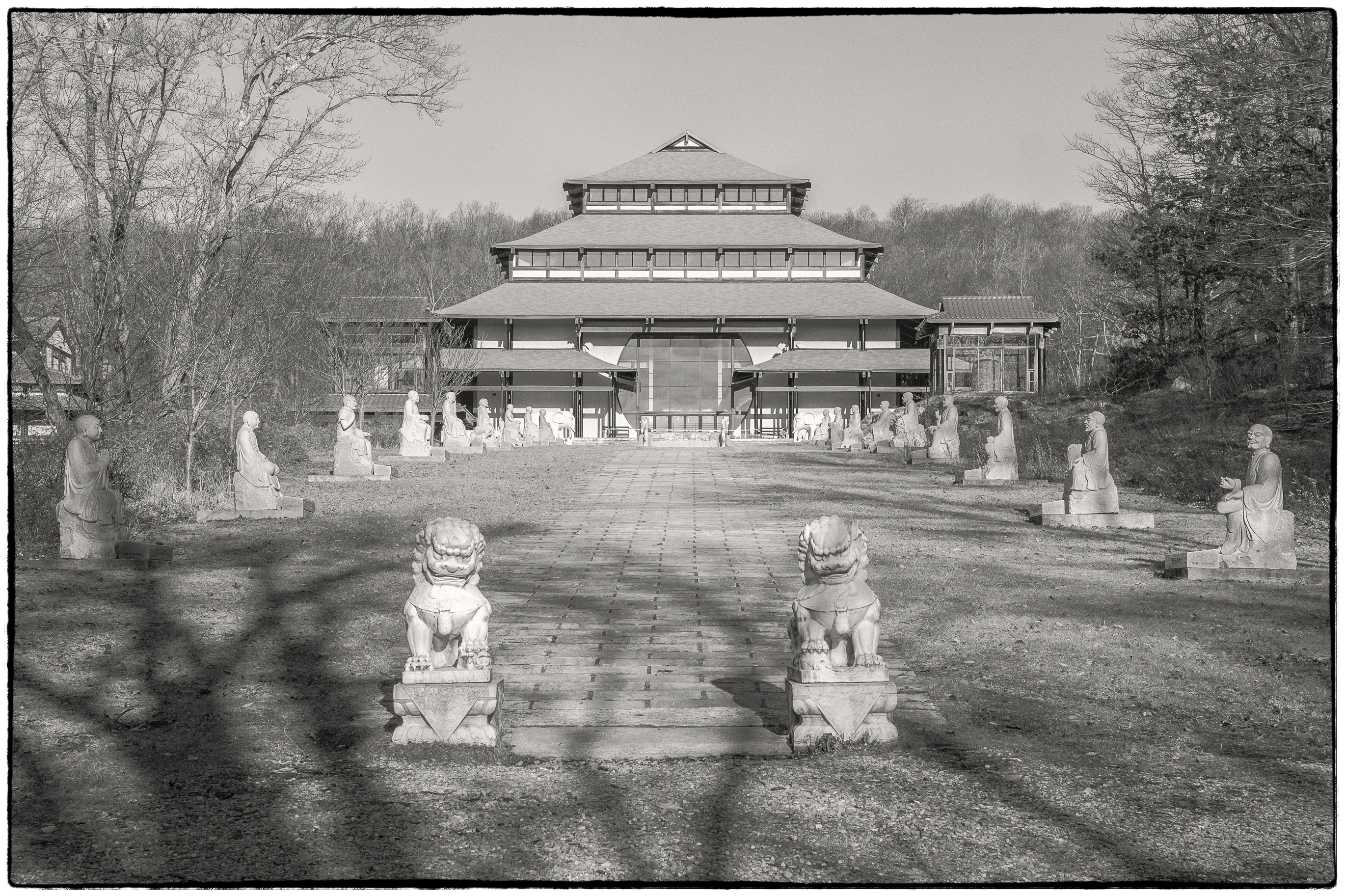
We recently took our elder daughter to nearby Chuang Yen monastery. As we were walking up from the car park to the Great Buddha hall we were looking at the statues on both sides of the walkway. I had previously taken pictures of a couple of them and now it occurred to me that it might be a nice little project to take a picture of each of them – eighteen in all.

I was originally going to call this ‘Eighteen Buddhas’, thinking that each of the statues was of the Buddha, but in a different pose. Then my wife remarked that the number eighteen must have some significance so I looked it up and found that it did.

As Wikipedia says:

The Eighteen Arhats are depicted in Mahayana Buddhism as the original followers of the Buddha who have followed the Eightfold Path and attained the Four Stages of Enlightenment. They have reached the state of Nirvana and are free of worldly cravings. They are charged to protect the Buddhist faith and to await on earth for the coming of Maitreya, a prophesied enlightened Buddha to arrive on earth many millennia after Gautama Buddha’s death and nirvana. In China, the eighteen arhats are also a popular subject in Buddhist art, such as the famous Chinese group of glazed pottery luohans from Yixian of about 1000.

And, indeed, each of the statues had, at its base, a stone plaque describing the follower to which it referred. In subsequent posts I’ve used these descriptions – broken English and all.

And I changed the post title to “Eighteen Arhats”