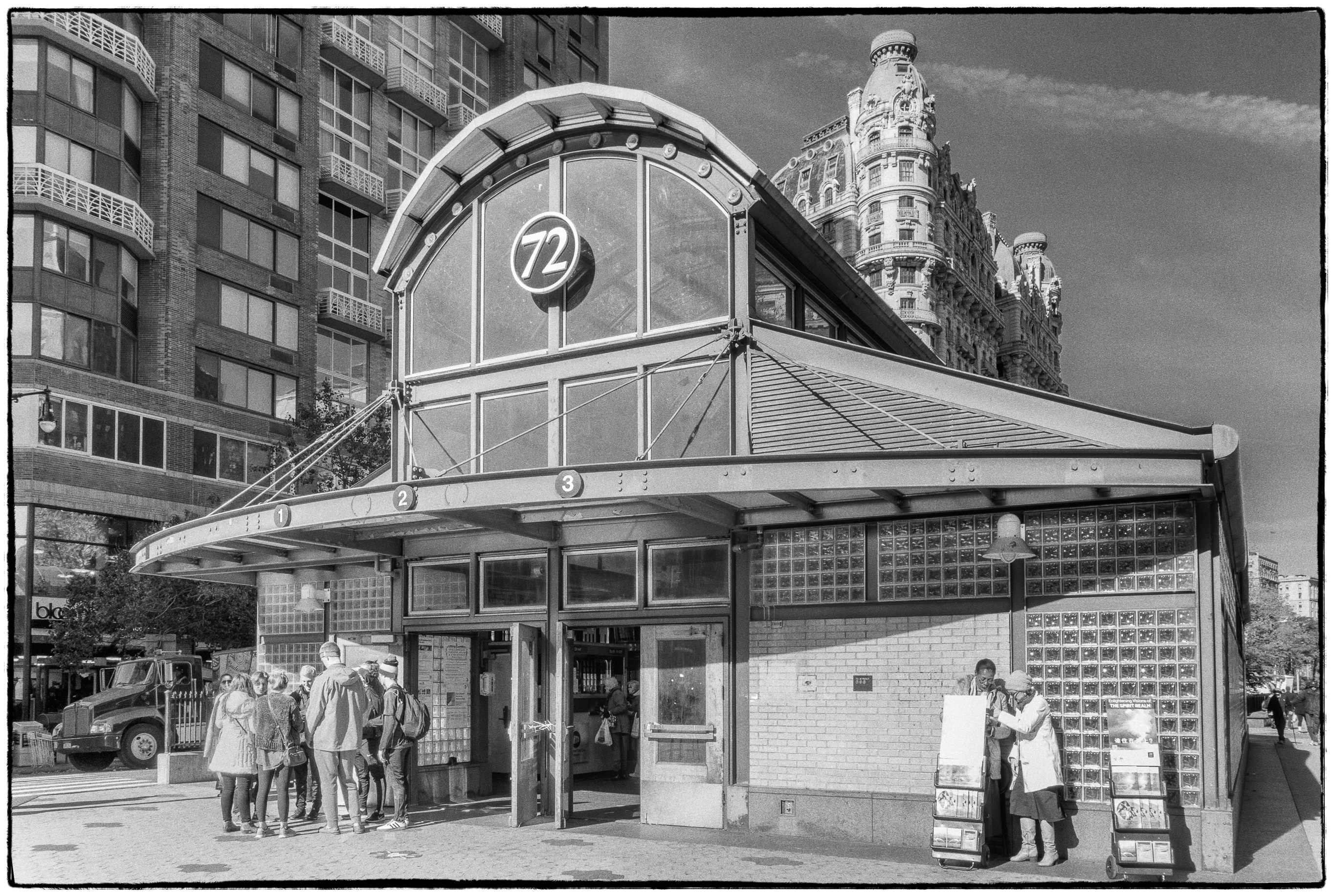
Subway station on 72nd Street and Amsterdam Avenue, New York City

A different kind of New York City subway station.

According to Wikipedia:

The 72nd Street station opened on October 27, 1904, as part of the original subway, with trains running from Brooklyn Bridge to 145th Street. The original configuration of the station was inadequate by IRT standards. It had just one entrance (the control house on the traffic island between 71st and 72nd Streets, now listed on the National Register of Historic Places), and the platforms and stairways were unusually narrow. There were no crossovers or crossunders as the control house had separate turnstile banks and token booths for each side. Express trains ran on the innermost two tracks, while local trains ran on the outer pair.

During the 1950s, the New York City Transit Authority (now the Metropolitan Transportation Authority, or MTA) considered converting the station to a local station by walling off the express tracks from the platforms. This would have coincided with 59th Street–Columbus Circle, which is a major transfer point to the IND Eighth Avenue Line, becoming an express stop.

A substantial renovation was completed on October 29, 2002, providing a new, larger control house on the traffic island between 72nd and 73rd Streets and slightly wider platforms at the north end of the station. This control house has two staircases and one elevator from each platform going up to a crossover, where on either side a turnstile bank leads to either 72nd or 73rd Streets. Only the southern turnstile bank has a staffed token booth and the elevators make this station ADA-accessible. This control house has an artwork, Laced Canopy by Robert Hickman, which consists of a mosaic pattern on the central skylight; if looked at in the right way, the knots within the pattern make up the notation for an excerpt of Verdi’s Rigoletto. The original control house was renovated and now has a total of five staircases: two to the southbound platform and three to the northbound platform. These staircases go up to a crossover, where on the north side, an unstaffed turnstile bank leads to 72nd Street and on the south side, three High Entry/Exit Turnstiles lead to 71st Street. This control house has artful wrought iron pillars, dating back to the days of the original subway system, as well as decorated ceiling beams.

The is the new control house. The old control house is across the street.
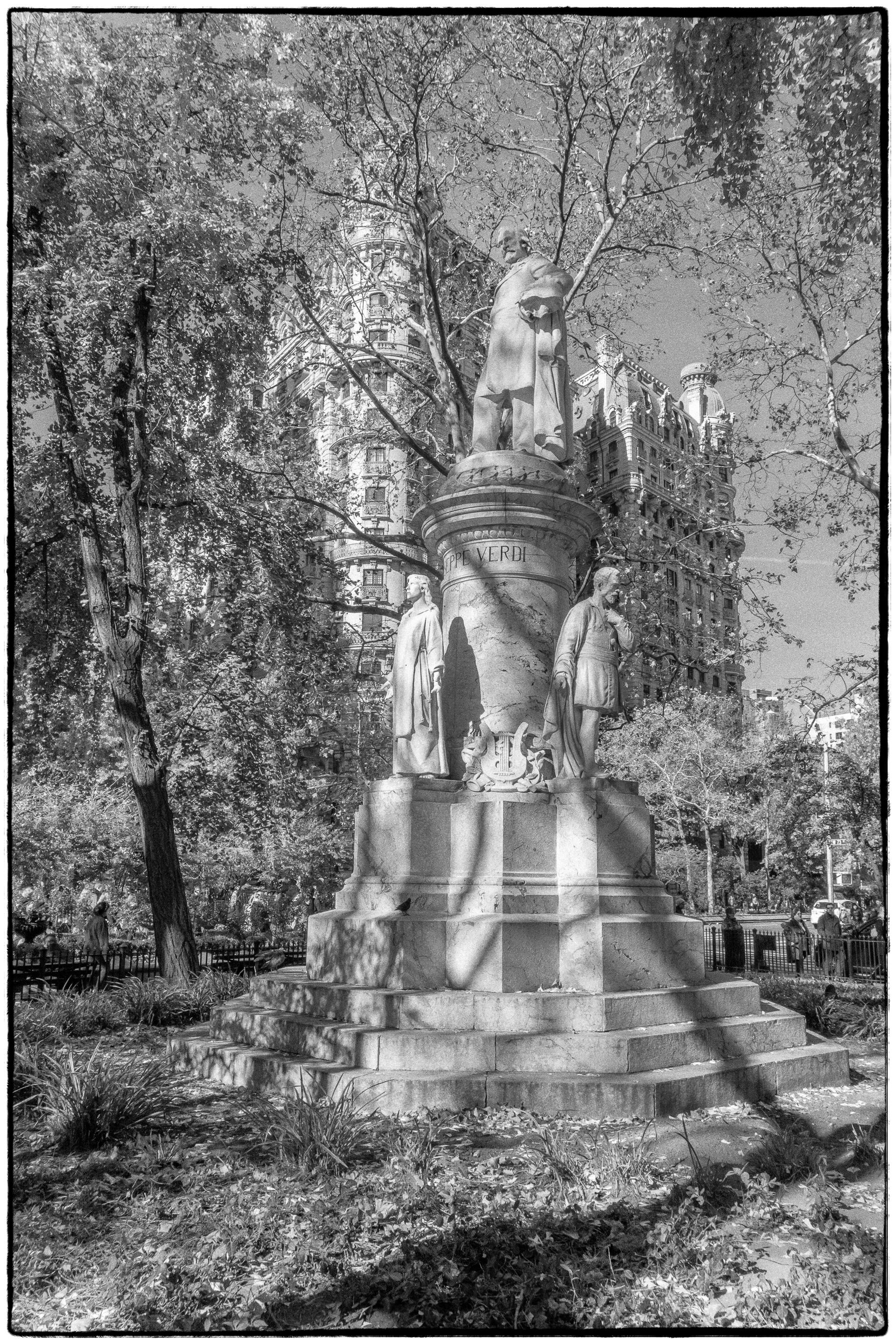
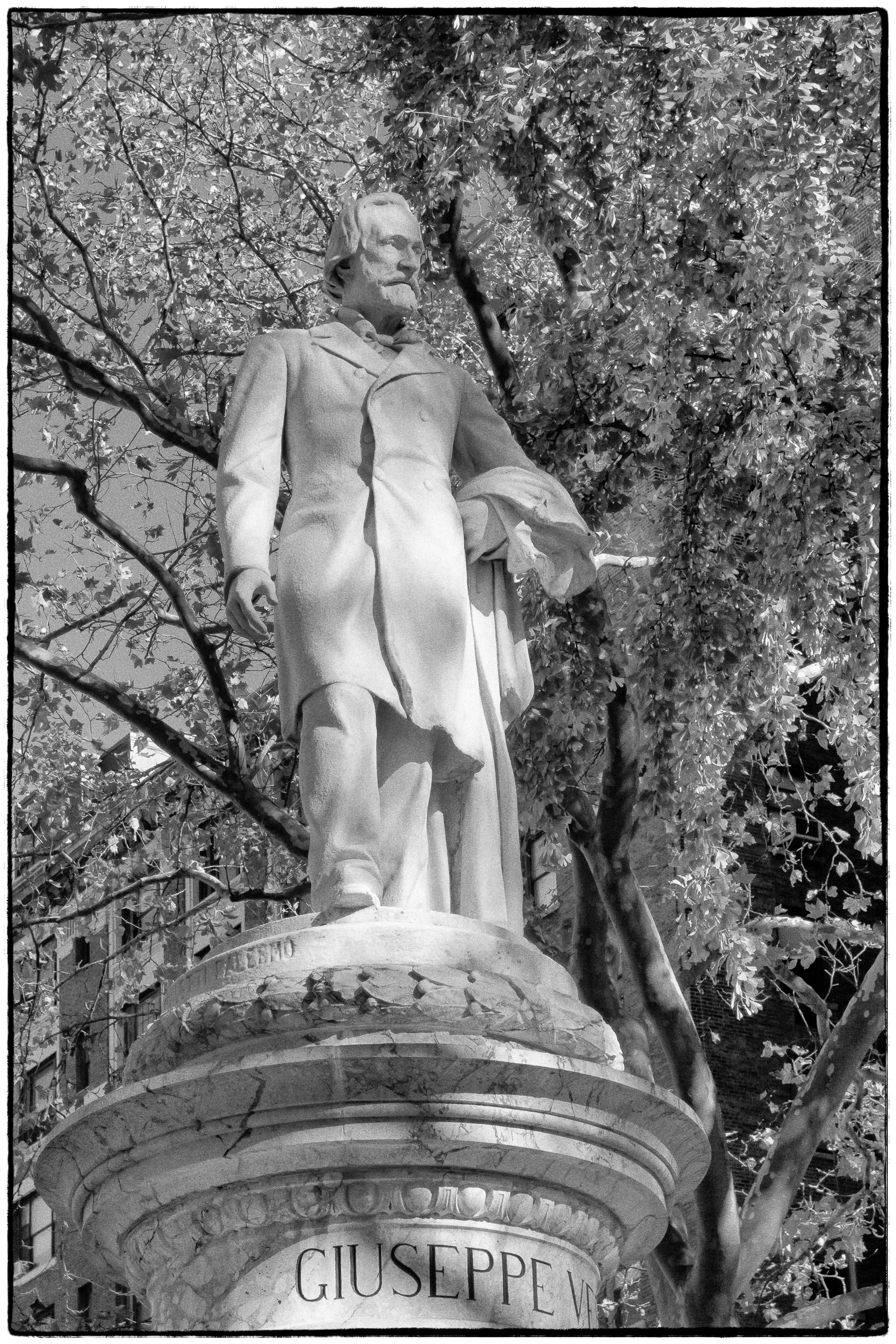
Verdi statue

This statue stands in Verdi Park on West 72nd street and Amsterdam Avenue in Manhattan. Our friend had driven us (myself, my wife, and our friend’s mother) into the city to see Spamilton. She had another stop to make and so dropped us off near the theatre. We had some time to kill and it turned out that we were right outside a Bloomingdales Outlet so the ladies went in to look around while I wandered around taking pictures.

According to the New York City Parks site:

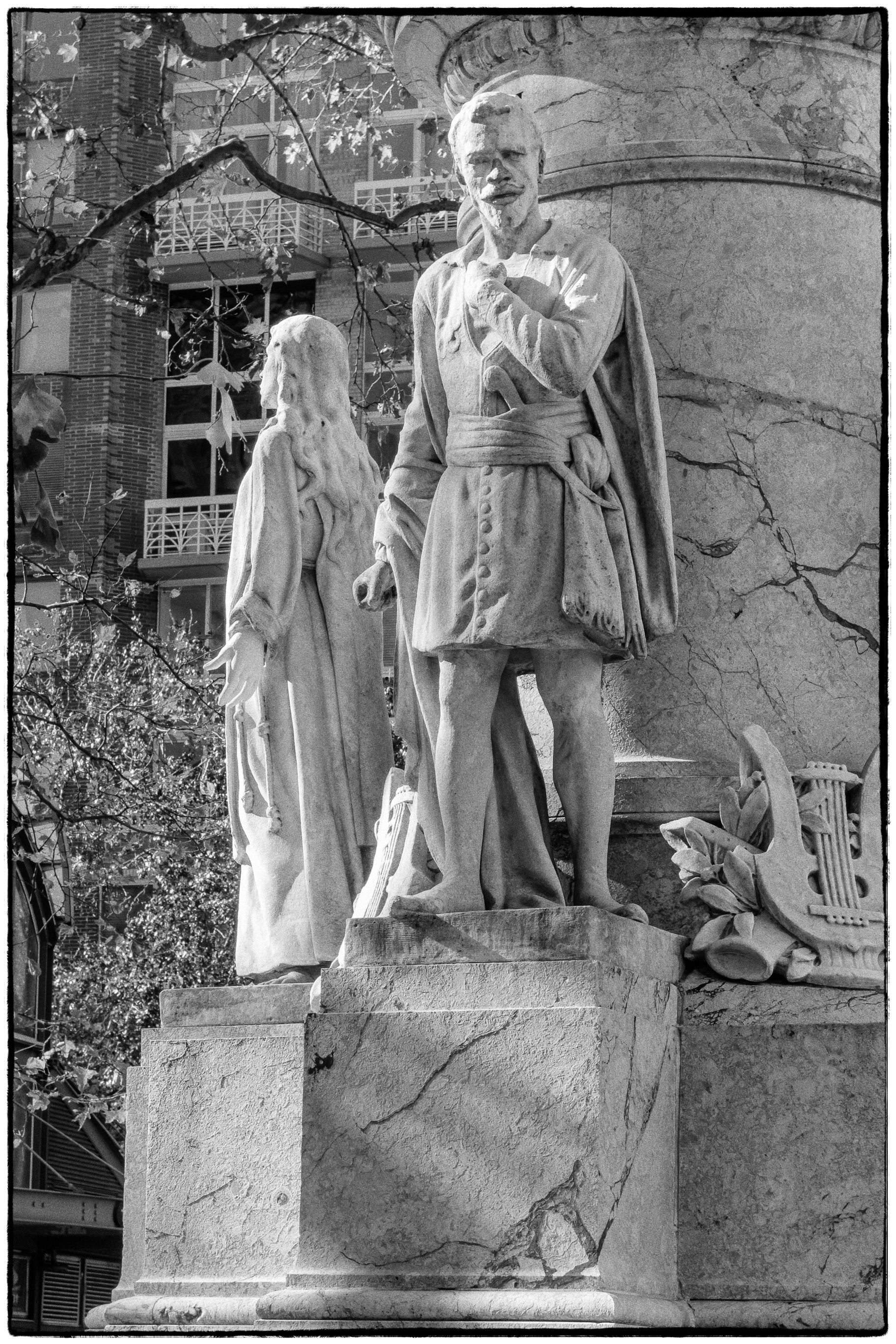
Giuseppe Fortunino Francesco Verdi (1813–1901), one of the world’s most renowned composers, is immortalized by such operas as Aida, La Traviata, Otello, and Rigoletto, which are still performed regularly to great acclaim. This legacy is also captured in the Verdi Monument, created by Sicilian sculptor Pasquale Civiletti (1858–1952) in 1906. Made of Carrara marble and Montechiaro limestone, this statue depicts Verdi flanked by four of his most popular characters: Falstaff, Leonora of La Forza del Destino, Aida, and Otello.

The president of the Verdi Monument Committee, Carlo Barsotti (1850–1927), championed public recognition of pre-eminent Italians as a source of inspiration for New York’s large Italian-American community. As founder and editor of Il Progresso Italo Americano, he used his newspaper to raise funds for this project by public subscription. Barsotti was instrumental in erecting this monument as well as those honoring Christopher Columbus (1892) in Columbus Circle, Giuseppe Garibaldi (1888) in Washington Square Park, Giovanni da Verazzano (1909) and Dante Alighieri (1921) in Dante Square.

The Verdi monument was unveiled on October 12, 1906, the 414th anniversary of Columbus’s discovery of America. The day began with a march of Italian societies from Washington Square to the site at Broadway and West 72nd Street. Over 10,000 people attended the unveiling, attesting to the significance of the occasion in uniting Italian-Americans in celebration of their cultural and artistic heritage. The sculptures were unveiled by Barsotti’s grandchild who pulled a string that released a helium balloon, lifting the monument’s red, white and green shroud (the colors of the Italian flag). As it peeled away, a dozen doves – concealed in its folds – were released into the air, and flowers cascaded from the veil upon the participants.

By the 1930s the monument had suffered from the effects of weathering, pollution and vandalism, and underwent restoration, including the replacement of sculptural features. In 1974, Verdi Square was designated a Scenic Landmark by the Landmarks Preservation Commission, one of only eight public parks to receive this distinction. In 1996-97, the monument was again extensively conserved with funding from the Broadway/72nd Street Associates.

A permanent monument maintenance endowment has been established by Bertolli USA, Inc. Additional funds for landscaping designed by Lynden Miller have been donated by Harry B. Fleetwood, and the Verdi Square landscape has been endowed in memory of musician James H. Fleetwood.

The man himself.

I believe the two figures are Leonora (from La Forza del Destino) and Otello (from the opera of the same name).

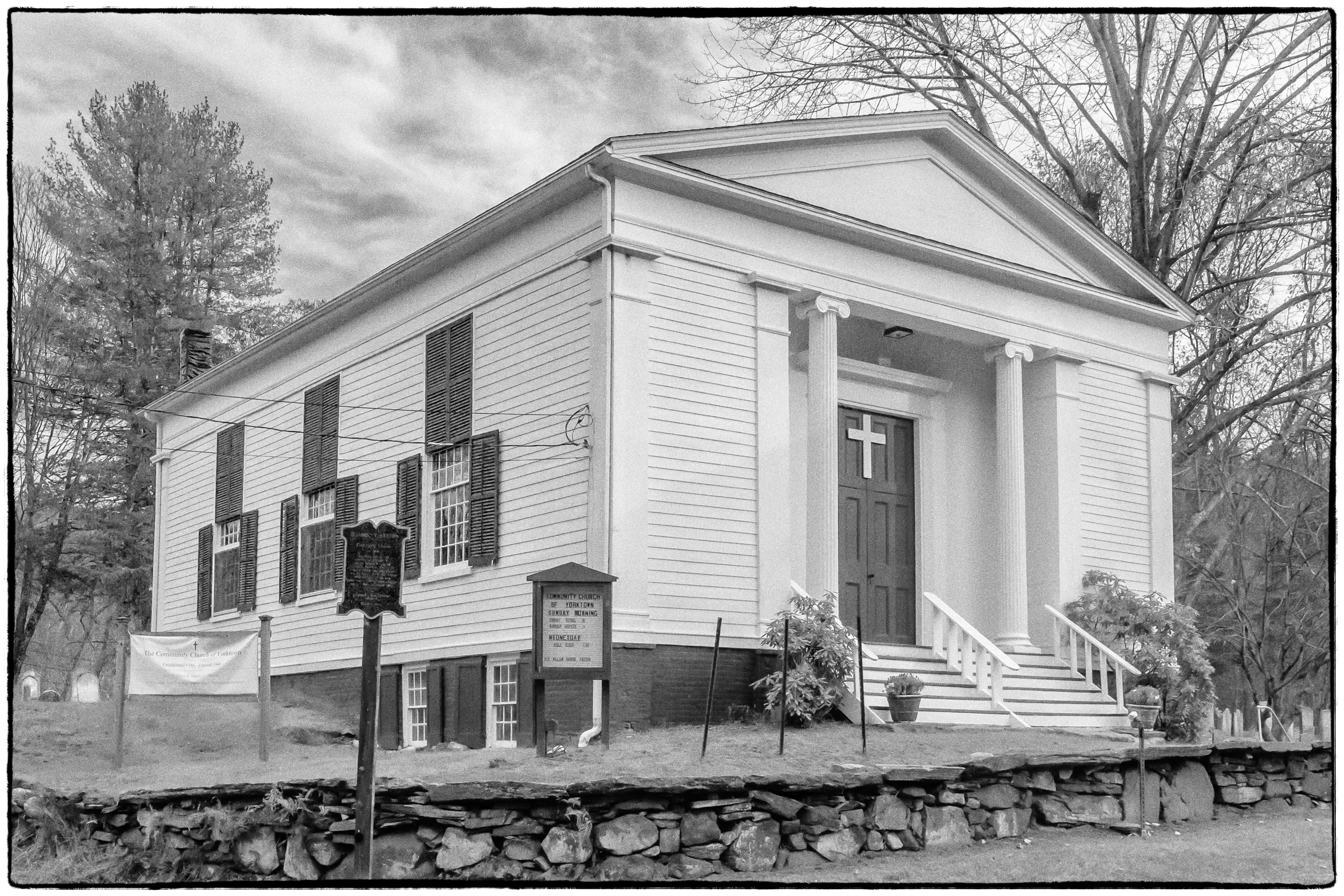
Community Church of Yorktown

The Church’s website provides the following history:

My friend George took me for a drive to a couple of Yorktown cemeteries, familiar to him, but unknown to me. The first is right next to this church.

Our church history goes back to 1785 when the Yorktown Baptist Society, a branch of the Stamford Baptist Church, was organized. In 1788 the Yorktown Baptist Church was officially constituted, with Elder Reuben Garrison as the first pastor. Services were held in homes until the first Baptist meeting house was built in 1802, during the pastorate of Elder Isaac Rhodes. This original building, which was later moved to the corner of Baptist Church and Hunterbrook Roads and remodeled, has at times served as a parsonage. In recent years it has provided housing for the church caretakers.

In 1848 the present Greek Revival-style building, larger than the first building, was constructed and dedicated to the Lord. Services were held under various pastors and visiting preachers until 1890, after which the church was mostly closed for 27 years. In 1917 Rev. Harry B. Roberts, pastor of the Yorktown Presbyterian Church, began holding Sunday afternoon services in the Baptist Church building. In the following years a movement was begun to buy the building from the Baptist Society. The purchase was completed in 1924 and a non-sectarian Community Church, complete with constitution and by-laws, was organized. In 1933 Rev. Roberts became permanent pastor of Community Church and that year conducted the first of our continuous Christmas Eve candlelight services.

In 1940, under the leadership of Rev. F. Gordon Ham, the church was incorporated as The Community Church of Yorktown under the religious corporation laws of the State of New York. Fellowship Hall and our Sunday School classrooms were added to the building in the early 1970s, while Malcolm Foster was pastor.

And now, after several years of repairing and improving the property, we are rededicating the building to God, desiring that for years to come the message of peace through our Lord Jesus Christ will be heard in this place. To God be the glory! Amen. (Oct. 1998)

The historic marker on the property adds:

This Greek revival style church was originally the Baptist Church serving the community known as Huntersville. Most of Huntersville disappeared when the waters of the New Croton Dam put most of the area under water. The adjacent cemetery contains many pre-revolutionary war graves.

Happy Birthday, M. Daguerre

Louis-Jacques-Mandé Daguerre was born on 18 November 1787 in Cormeilles-en-Parisis, Val-d’Oise, France. Best known as one of the first pioneers of photography he was also an accomplished painter, businessman and advocate of the diorama.

His positive daguerrotype process for a while dominated photography until ultimately supplanted by William Henry Fox Talbot‘s, negative calotype process.