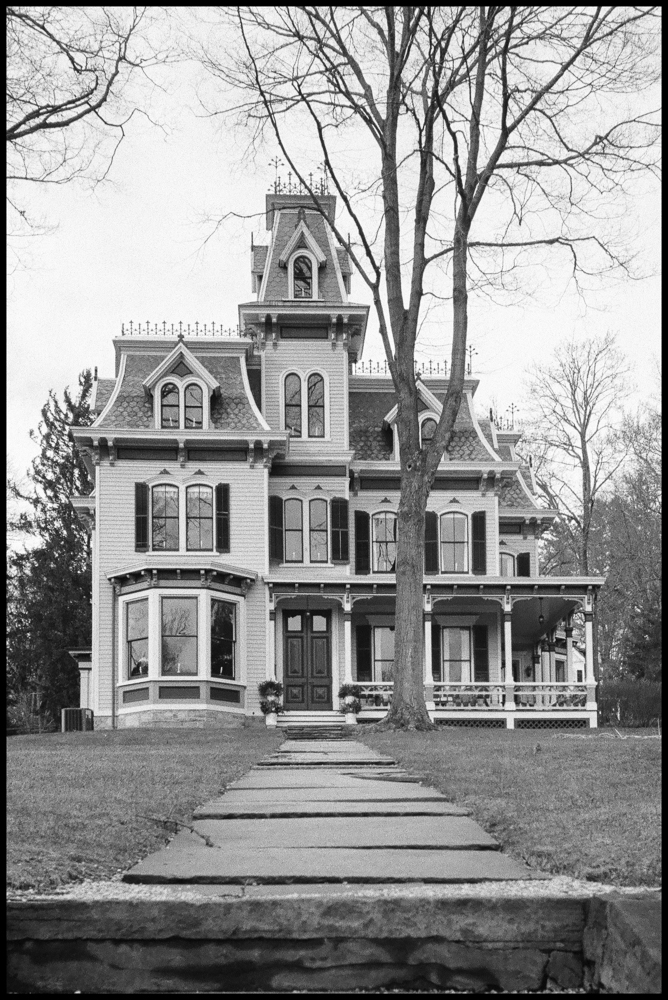
A walk around Mount Kisco – A lovely old victorian

According to Captivating Houses:

About This 1877 Theodore Carpenter House In New York.

The Theodore Carpenter House stands today as one of the finest examples of a Second Empire Victorian. Built in 1877 for a prominent Mt. Kisco merchant, the house served as a principal location for the filming of the E.L Doctorow classic novel “Ragtime.” Wonderfully authentic, the house is restored and in beautiful condition. Matching pairs of double doors lead through the front vestibule to a center hallway.

The parlor, living room and dining room are each flooded with natural light from oversized windows. Eleven feet ceilings are handsomely detailed with crown and plaster moldings. The kitchen is tastefully renovated-blending perfectly with the original character. Four generously sized bedrooms include a master suite with private bath, office and walk-in closet. A period carriage barn includes garaging and a two story, 2 bedroom accessory apartment. Admired by many for generations and much loved by its owners for over 20 years, the house known as “Ragtime” begins its next chapter.

Please bear in mind that the information above comes from a real estate site and suffers from the usual hyperbole.

Taken with an Olympus Stylus Epic/Mju II and Kodak Tri-X 400.

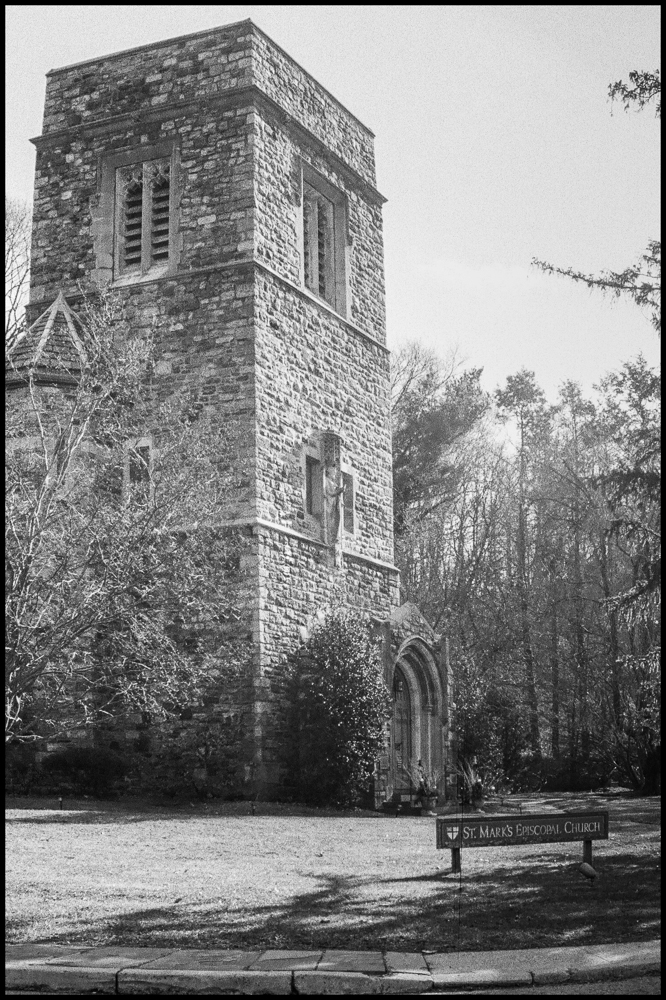
A walk around Mount Kisco – St. Marks Episcopal Church

According to the church’s website:

Saint Mark’s has provided a history of continuous Anglican worship dating back to 1761. In that year a mission church then called Saint George’s, was established on a plot of ground across the street from the current Friendly’s Restaurant on East Main Street, just south of the Northern Westchester Hospital complex. (The area was then referred to as North Castle, explaining early references to “Saint Mark’s North Castle” as opposed to “Saint Mark’s Mount Kisco.”)

St. Mark’s was formally recognized as a religious corporation in New Castle in 1850, largely through the efforts of the Reverend R. M. Harris, rector of Grace Church, White Plains.

A new church was built on the site of the earlier Saint George’s which was sold in 1819 due to extensive damage from Revolutionary War battles. According to records, the new building was a “model for a country church, 50 by 30 feet with a tower projecting 8 feet in front.” Exclusive of stained glass and the furniture, it cost $2,050. The burying ground, which was in back of Saint George’s and then St. Mark’s, remains to this day. It contains graves dating back to the Revolutionary War.

With the coming of the railroad, the community around the Mount Kisco station began to grow. In order to serve the new people, it became necessary in the early 1880’s to hold missionary services at the Town Hall. In time, it was felt that the church should be nearer to the new community, so the Rector, the Reverend Egisto F. Chauncey, bought a lot for $420, upon which the present church stands. In 1910 Mr. Chauncey engaged the firm of Cram, Goodhue and Ferguson to build a new church. Mr. Bertram G. Goodhue undertook the work, the cost to be $60,000.

The cornerstone was laid in 1910, and is inscribed with these words in Latin: ‘Where there is no vision the people perish'” (Proverbs 29:18). On St. Mark’s Day, 1917, the new church was consecrated by the Right Reverend David Hummel Greer, Bishop of New York. In 1921 the Peace Tower was dedicated, and in 1929 the south aisle and the Parish House were added. In 1954 the Parish House was remodeled to provide classrooms for a growing Church School. The most recent addition was the Columbarium which was added to the south of the Church, in 1961.

Taken with an Olympus Stylus Epic/MjuII and Kodak Tri-X 400.

A walk around Mount Kisco – Native American Statue

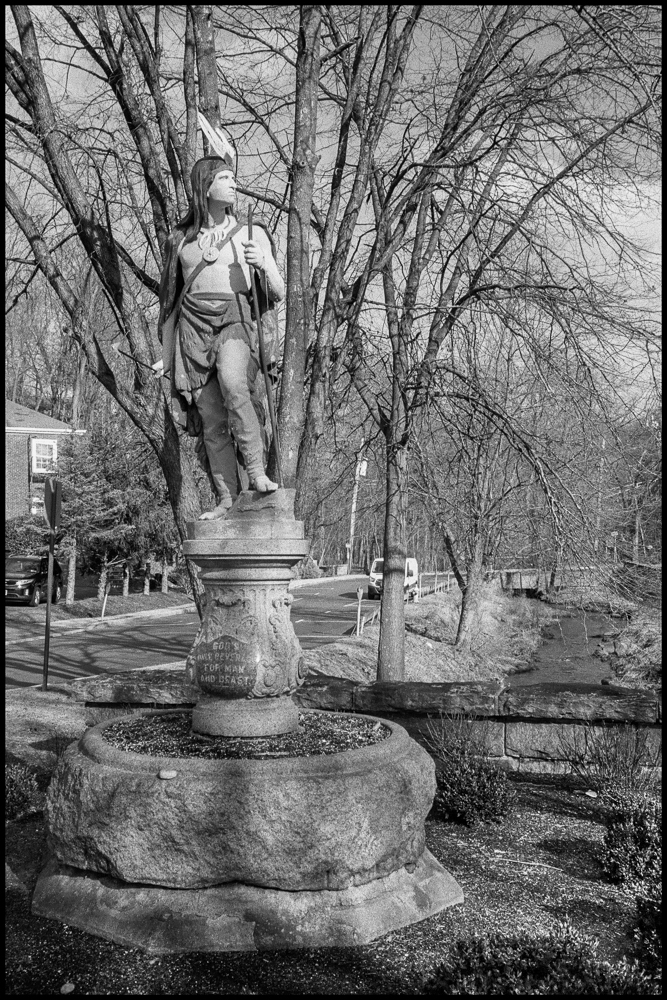
One of the first things I came across was this interesting looking statue.

According to the Village’s website:

There is a statue named “Chief Kisco” in Mount Kisco. There never was a real person with that name. David F. Gorham gave the statue to Mount Kisco in 1907 as a decorative top to a water fountain. On the base of the pedestal are the words “God’s Only Beverage For Man and Beast.” Chief Kisco rules over the village from his perch at the intersection of Routes 133 and 117.

Taken with an Olympus Stylus Epic/Mju II and Kodak Tri-X 400.

A walk around Mount Kisco – Overview

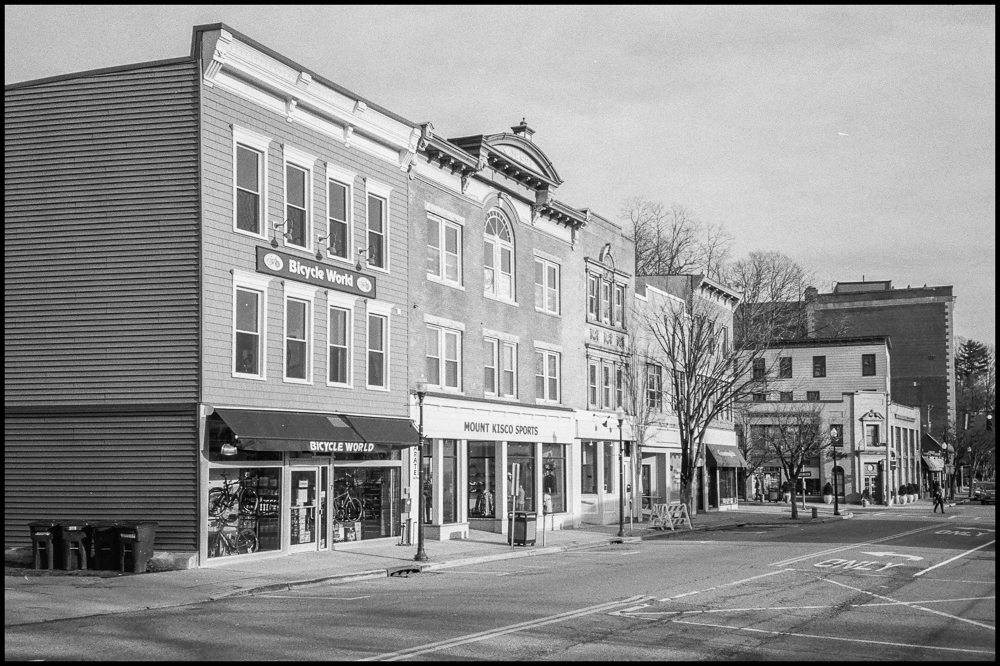
My wife was having lunch in Mount Kisco with some friends. I’d been there a number of times, but had never really walked around. I decided to go along and try out my newly acquired Olympus Stylus Epic/Mju II. Above a view down West Main Street.

According to the village’s website:

Mount Kisco is one of Westchester’s most vibrant communities. Approximately 3 square miles, it is geographically small, but it delivers big. Located 43 miles from New York City, it is easily commutable by train or car, though there is little need to ever leave as Mount Kisco is known as a premier destination for shopping, fine dining, entertainment, and award-winning medical care. Boutiques, bistros, and a movie theater line the walkable downtown urban village, while a variety of residential neighborhoods featuring some sprawling lawns and historic homes fan around it. Part of the highly regarded Bedford Central School District, Mount Kisco is a village of varied faiths, backgrounds, and income levels. Residents and visitors value this tight-knit community, considering it a little village with a big heart.

History:

Mount Kisco was founded in 1850 shortly after the arrival of the railroad. It included two small settlements called Kirbyville and New Castle Corners. Kisco is derived from an Indian word –either kiskamenahook meaning “settlement near a brook” or cisqua meaning “a muddy place.” Mount comes from the 623-foot hill northwest of town.

Since 1875, Mount Kisco has been an incorporated Village under the Village Law of the State of New York. One half of the Village laid in the Town of Bedford, and on half laid in the Town of New Castle. In the mid-seventies, the administrations of the two Towns agreed to support the Village’s effort to “secede” from the Towns. Mount Kisco emerged from the Town of Bedford and the Town of New Castle as a coterminous and independent Village/Town of Mount Kisco effective January 1, 1978.

Mount Kisco comprises 3.1 square miles, has a population of 10,877, and includes 4,289 households according to the 2010 U.S. Census.

Taken with an Olympus Stylus Epic/MjuII and Kodak Tri-X 400.

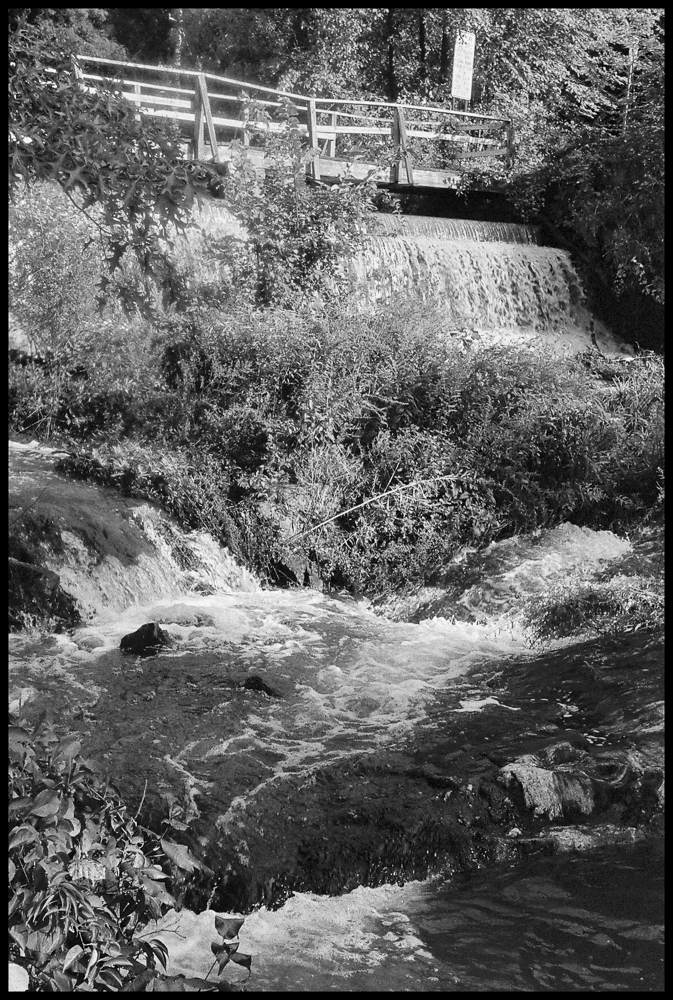
Waterfall at Tarrytown Lakes Park

We used to take the dog for walks here. It’s a short, paved, relatively flat and easy walk alongside the reservoir. My wife is particularly fond of this type of walk. I tend to prefer longer, more remote, more rugged walks in the woods. When I was working she used to walk the dog here. However, since I retired I seem to have taken sole responsibility for dog walking. Consequently I haven’t been here much of late.

For a bit of history see: On the Water: Secret history of Tarrytown Lakes on Lohud.com.

The story of the Tarrytown Lakes begins in a raging fire. On Feb. 23, 1876, a blaze on Lower Main Street in Tarrytown devoured 19 buildings and caused $150,000 in damage. Hampered by an unreliable water supply and insufficient water pressure, firefighters struggled to douse the flames.

Alarmed, village leaders decided to act. In 1887, Tarrytowners approved construction of a new reservoir in a valley behind the hills that rose up from the central village. Railroad magnate Jay Gould, whose Lyndhurst estate remains a historic riverfront landmark, contributed $100,000 for the project.

When completed in 1897, the two lakes had the capacity to hold up to 200 million gallons of water. A pump station was built on the eastern shore of the larger lake, known as the Lower Lake. Two wells stood on small islands near the edge of the lake, one of them still there today.

The new lakes weren’t the only landmark in the valley.

The New York & Putnam Railroad had been established in 1880, with a single rail line that connected Brewster to the Bronx. During its lifetime the railroad had stops in White Plains, Elmsford, Pocantico Hills, Carmel and Brewster. Also along the route were stops at Tarrytown Heights, at the southernmost tip of the reservoir near the present-day intersection of Neperan Road at Sunnyside Avenue, and at Eastview.

The railroad’s initial path in the area went over a wobbly 80-foot-high trestle bridge at Eastview, which so frightened passengers that a portion of the rail line was relocated closer to Rockefeller’s estate in Pocantico Hills.

Remnants of the park’s history remain. The popular biking and hiking trail along the southern end of the lakes follows the path of the old rails. A small rail bridge can still be seen along the southern end of the park, behind the Marymount convent and not far from the site of the old Tarrytown Heights station (See: Tarrytown Heights to Tower Hill – Old Putnam Line). Among the structures near that spot is an aging wooden building known to locals as “the skate shack,” used in past years when ice skating was common on the smaller lake. Village officials said the lake has not frozen over enough in recent years to allow skating.

In addition to the hiking and biking opportunities, Hudson River Recreation added kayaking on the lakes during summer weekends in recent years. Fishing requires both a state license and a Tarrytown village permit reserved for residents — 155 of which were issued in 2016.

Taken with a Zorki 4 and FED 50mm f3.5.