
Yesterday I took the dog for a walk to North Beach, one of the five beaches around our lake.
Taken with a Sony RX100 M3.
Photographs and thoughts on photography and camera collecting

Yesterday I took the dog for a walk to North Beach, one of the five beaches around our lake.
Taken with a Sony RX100 M3.

Yesterday was the first full day of Spring 2018 and it brought with it yet another Non’Easter – the fourth in three weeks. Despite predictions that we would get upwards of a foot and a half of snow the reality turned out to be somewhat different. I went out to measure the snow early in morning at our house in Briarcliff Manor and we had about two inches on our driveway and a bit more on grassy surfaces. Then the temperatures went up almost to 50F and by the end of the afternoon it had almost all melted. Up at the lake we had about five inches.
Down in New York City things were much worse, a foot of more of snow and out on Long Island still worse again with amounts up to 20 inches or more.
Taken in the meadow in front of our house with a Sony RX100 M3.
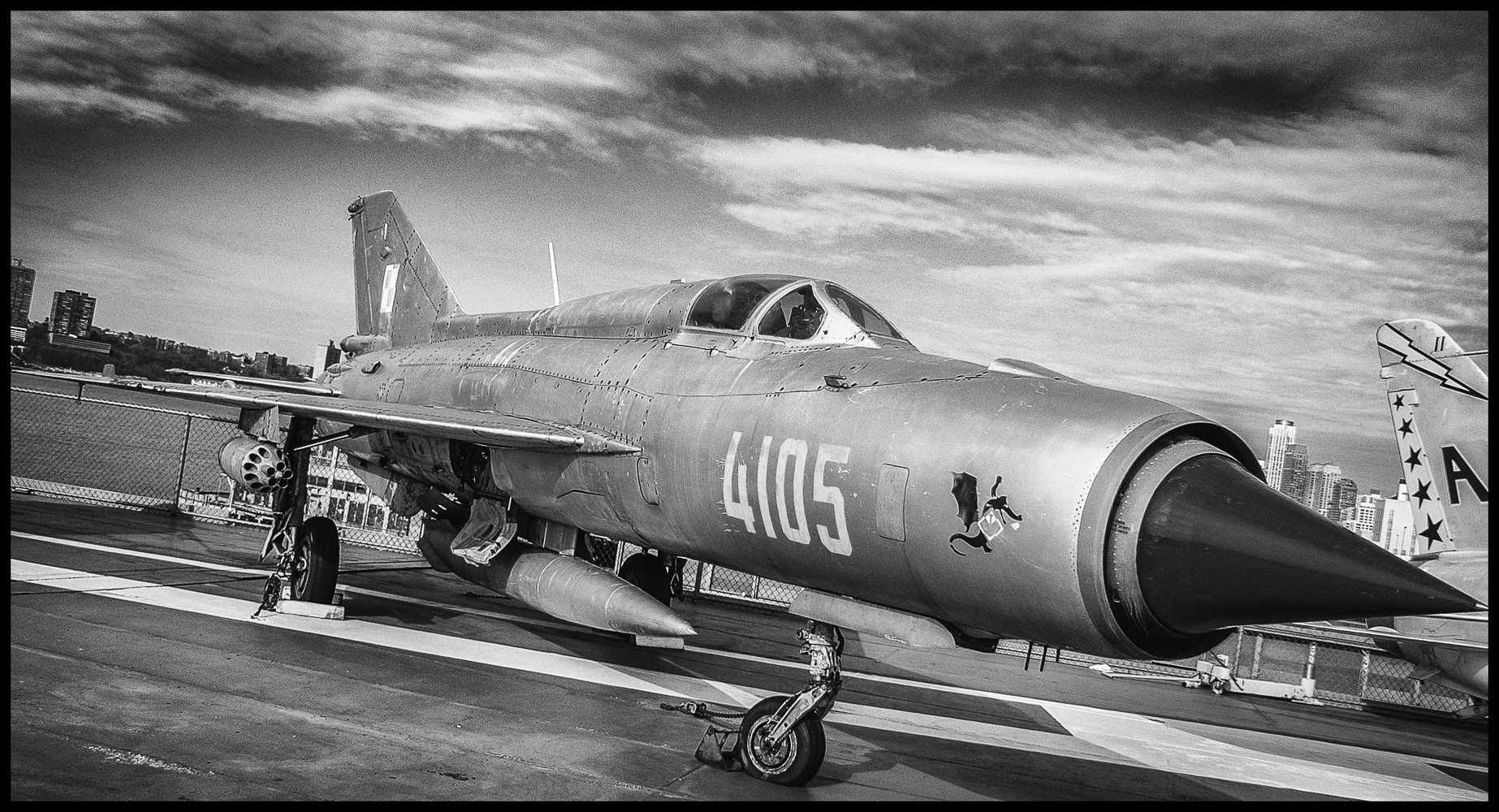
According to Military Today:
The most widely produced supersonic jet fighter of all time, the MiG-21 (Western designation: Fishbed) is an incredibly prolific aircraft. Dated but nimble, it has allowed skilled pilots in past decades to defeat more advanced aircraft. However, its days appear to be numbered as the majority of air forces switch to newer fighters.
The Mikoyan design bureau began development of the MiG-21 in the 1950s, in order to replace the crash-prone MiG-19s. Its first flight was in 1956. Production began in 1959, and it entered service soon after. Although no longer in production, after over 50 years (counting Chinese production), more than 10 000 units were produced, serving in 50 countries. It holds the record for the most-produced jet aircraft. The MiG-21 continues to serve in around 20 countries to this very day.
The MiG-21 was nothing radical—it was a continuation of the existing MiGs (the 17 and the 19). Compared to its predecessor, MiG-19, the Fishbed’s main design difference is its triangular delta wings (as opposed to the swept wings on the MiG-19). Its primary improvements were its speed, better design, and greater capacity for armament. The MiG-21 was relatively simple in design and technology. This allowed to produce these aircraft in large numbers.
The MiG-21 could carry a fair amount of armament. Located to the left of the cockpit, the twin-barreled GSh-23 23 millimeter cannon was standard with 420 rounds carried. Optional were a variety of guided air-to-air missiles (the K-13, K-13M, and R-60, for later models) and unguided bombs or rockets. A total of 2 000 kilograms of ordinance could be carried.
The MiG-21 was highly maneuverable for its time, although even this feature is now outdated compared to fly-by-wire aircraft. In its day (the 60s and 70s), it posed a considerable threat in the hands of a good pilot to more modern western aircraft such as the F-4. One U.S. Air Force pilot said, “Perhaps the most important lesson on fighting the MiG-21 was that it was very maneuverable and that it was better to take care of it before you got into a tussle with it”.
In its many years of service, the MiG-21 has generated an excellent combat record, for the most part. Against Pakistani F-86s, F-104s, and MiG-19s it performed respectably, taking down several while suffering a few losses itself. Against well-trained Israeli pilots and their Mirage IIIs and F-4s, the MiG-21 and its mediocre pilots performed poorly with many shot down. In Vietnam, the MiG-21 showed its true capabilities, shooting down dozens of American F-4s or F-105s, mostly in close-range dogfights, where its maneuverability and lower speed gave it the edge. Overall, the MiG-21 has proved a highly successful fighter with a low price but much agility.
After over fifty years of service, the MiG-21 appears to still be going strong, although it is gradually leaving the scene of active service. Despite the advance of newer Russian fighters like the MiG-23 or the still more advanced MiG-29, the Fishbed has yet to be entirely ousted. Many low-budget countries continue to use it, for lack of something better. China and some other countries retain upgraded versions of this fighter aircraft.
Taken with a Konica Minolta Maxxum 5D on the USS Intrepid.
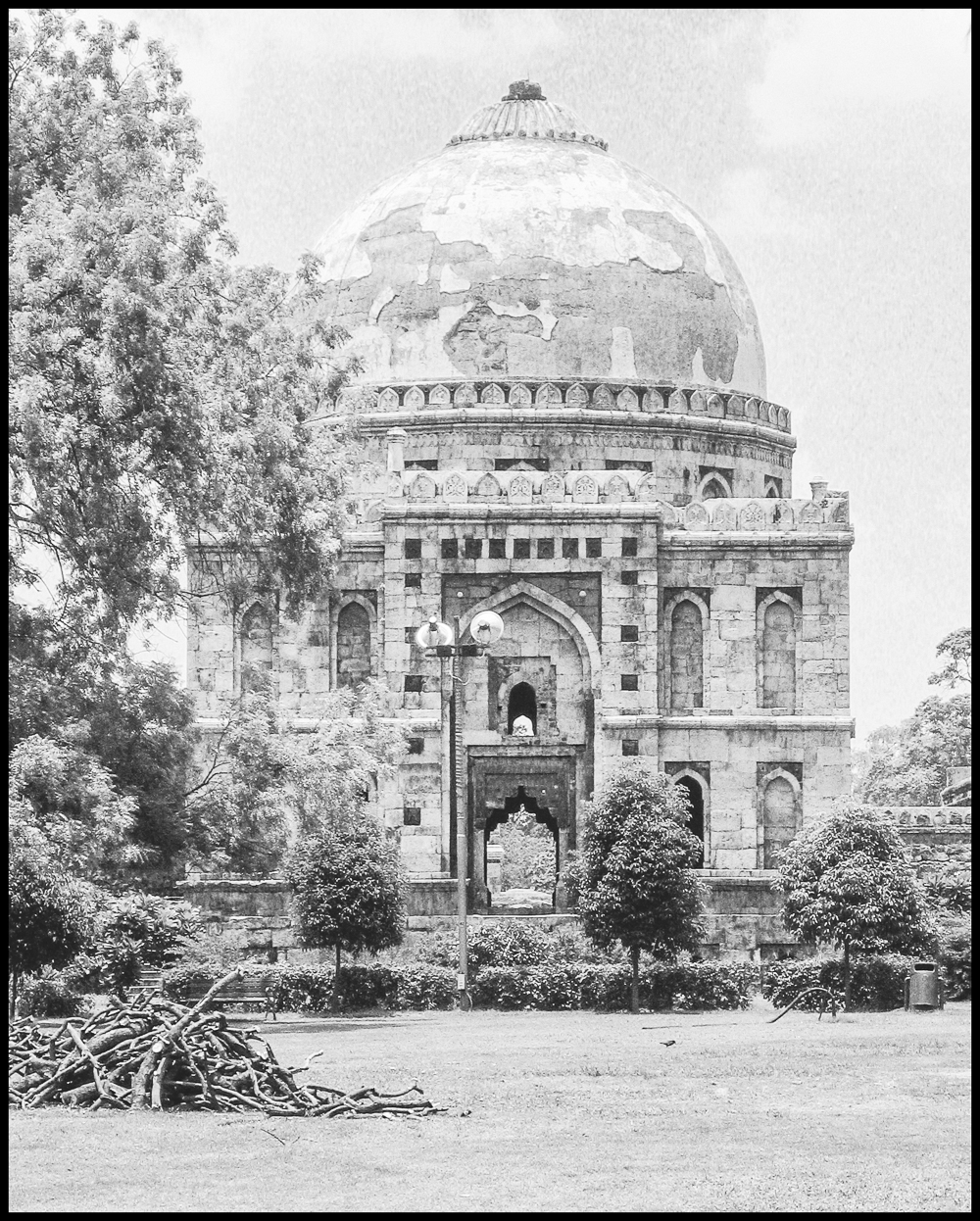
I took this picture in New Delhi in 2006. The building where I was working is located in Lodhi Gardens and I went out for lunch with a colleague. We walked for about 5-10 minutes in the garden on our way to a restaurant and along the way passed this building. I had no idea what it was, but it looked interesting so I took a picture.
In browsing through my photographic archives today I came across the picture again and decided to see if I could find out what it is. So I put the address of the UNICEF Office into Google Maps and then browsed around in ‘satellite’ view until I came across a building, which looked like the one in the photograph.
It turns out that it’s called the ‘Bara Gumbad‘ and according to Wikipedia:
Bara Gumbad (literally “big dome”) is an ancient monument located in Lodhi Gardens in Delhi, India. It is part of a group of monuments that include a Friday mosque (Jama Masjid) and the “mehman khana” (guest house) of Sikandar Lodhi, the ruler of the Delhi Sultanate. The Bara Gumbad was constructed in 1490 CE, during the reign of the Lodhi dynasty. Its construction is generally attributed to Sikandar Lodhi, and it is believed to have the earliest constructed full dome of any building in Delhi.
The monument is situated near the Tomb of Sikandar Lodhi and Shisha Gumbad. Although the three structures, which share a common raised platform, were all built during the Lodhi reign, they were not constructed at the same time. The intended purpose of the builders of Bara Gumbad is unclear: it may have been intended as a free-standing tomb, but no tombstone has been identified. The area in which Bara Gumbad is situated was formally called Khairpur village.
Bada Gumbad was constructed in 1490 CE, and is believed to have the earliest constructed full dome of any building in Delhi. Its construction is generally attributed to Sikandar Lodhi. A mihrab (prayer niche) in the Friday mosque (Jama Masjid) of the Bara Gumbad gives the date of construction as 900 AH (Anno Hegirae) of the Islamic lunar calendar.
Including the Bada Gumbad, there are four monuments in the Lodhi Gardens; the other three being Tomb of Sikandar Lodhi, Shisha Gumbad and the tomb of Muhammad Shah (who belonged to the Sayyid dynasty). The Bada Gumbad is situated approximately 400 metres (1,300 ft) southwest of the tomb and 75 metres (246 ft) south of Shisha Gumbad. During the rule of Sikander Lodhi, the Bara Gumbad, the adjacent mosque and the “mehman khana” (guest house) were constructed. The Bara Gumbad is speculated to serve as a gateway to the Friday mosque. However owing to the constitutions date, placement and stylistic differences the theory of gateway is not supported. The purpose and significance of the Bara Gumbad is unknown and to date remains a mystery. The Friday mosque was constructed in 1494 CE. It was the first mosque to be built in a style that first appeared during the Lodhi Dynasty.
Some historians suggest that the Bara Gumbad was built by an unidentified noble in 1490 CE, before being appropriated by Sikander Lodhi in 1494 CE, to provide an entryway to his mosque. Initially, all the monuments were built independently, and were not in one confine. In the early twentieth century, a park was developed, bringing the four monuments in one confine. The park was inaugurated on 9 April 1936 by Lady Willingdon, the wife of Viceroy Lord Willingdon. The park was originally called the Lady Willingdon Park after her, but was renamed to Lodhi Gardens after independence of India in 1947.
Taken with a Canon Powershot S50.
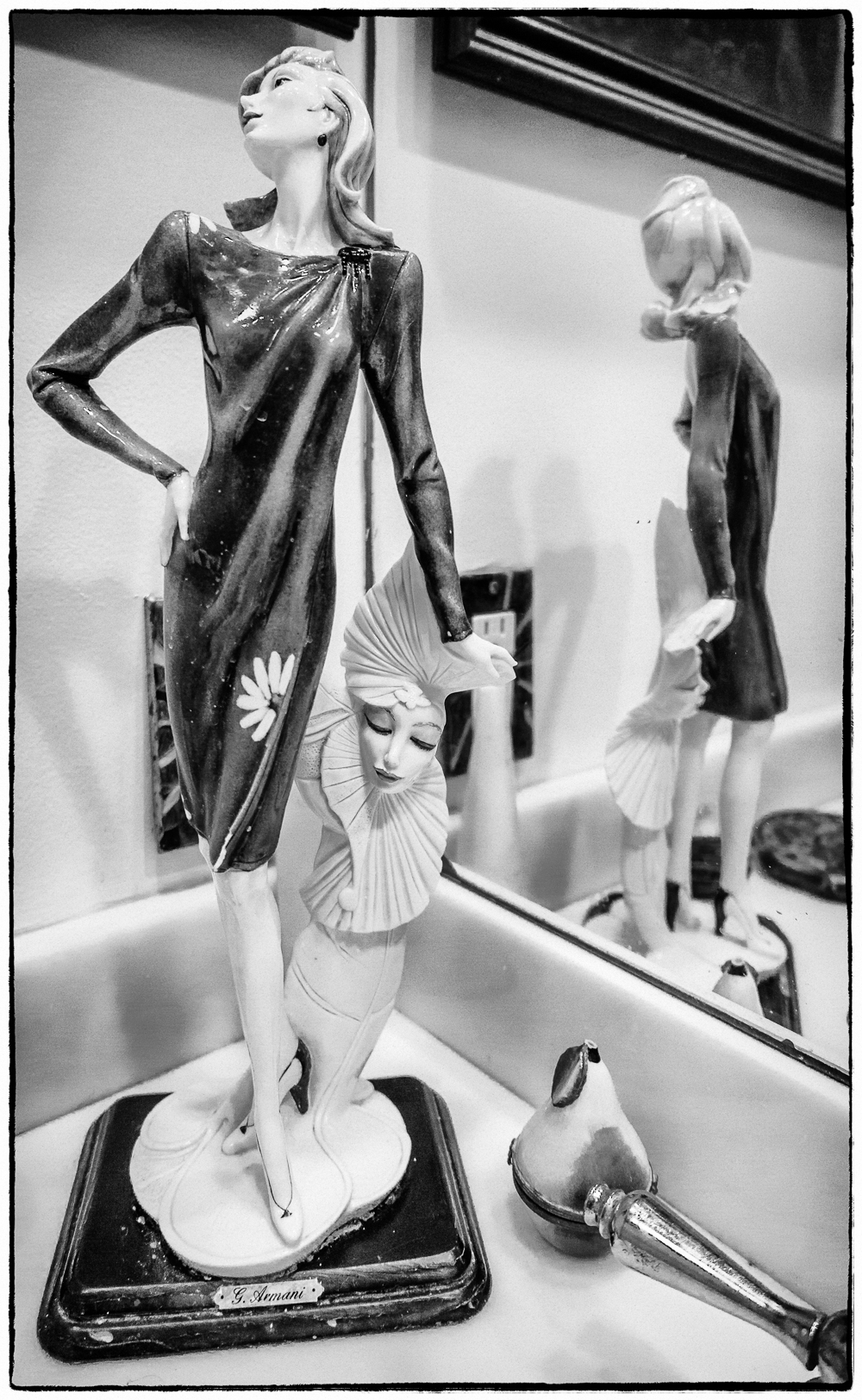
Judging from the plate on the base it’s by Giuseppe Armani (I don’t think he’s related to the more famous Giorgio Armani). According to the La Galerie site:
From the moment young Giuseppe could pick up a pencil, he drew. He drew everything he saw. He drew everyone he knew. He drew all day long. And it wasn’t long before his parents and teachers saw he had The Gift. Young Armani was already enrolled in the Academy of Fine Arts in Florence when his father unexpectedly died.
Because the family now needed Giuseppe, art school was forgotten. Art, however, was not. When Giuseppe’s Parish Priest organized an exhibition for the young artists he knew, he entered Giuseppe’s sculpture of a classically inspired male torso. The work was greatly admired for its extraordinary anatomical precision. When the torso was taken to the Art Gallery in Pisa –Giuseppe Armani’s talent was rewarded with the offer of a permanent job in the Art Gallery adjacent to Pisa’s famous Leaning Tower.
It was there in Pisa that Armani’s dream of studying art was finally realized. While in Pisa he often traveled to Siena and Florence where he immersed himself in the great masterpieces of the Renaissance. His distinction was and remains in his ability to infuse life, character and soul into his sculpture. Giuseppe experimented in wood, clay, alabaster and marble.
His reputation grew with each breathtaking creation. Soon art enthusiasts from around the world started to flock to the Art Gallery just to see Giuseppe Armani’s latest creations. In 1975, Florence Sculture d’Arte, recognizing Armani’s genius, offered him the opportunity to work exclusively for them. He was encouraged to give free rein to his artistic muse.
For more than 25 years Armani has created masterpieces ranging from the traditional Capodimonte style to the more daring, contemporary and whimsical sculptures. Always and remarkably, Giuseppe Armani’s figurines have the spark of life, and his breathtaking realism continues to amaze his many admirers the world over.
Giuseppe Armani described his credo this way: “Although I consider myself a direct descendant of the Renaissance heritage, I believe that an artist has to follow his own evolution and not be solely a remnant of the past, as glorious as the past may have been. I am continually compelled to discover new and better means of expression.”
Sadly Giuseppe Armani passed away suddenly on Saturday, the 28th of October 2006, in consequense of a massive stroke. We all have lost a great Master, but we have also lost a friend, who with his simple attitude has filled our lives with enthusiasm and has transferred to all of us his immense love for Art.
He will be with us always, even if our world will miss his physical prsence. He will live on through his art, and all the colectors and art lovers all over the world, will share a part of his wonderful personality just looking at the timeless works of art he created for them.


Taken with a Sony RX-100 M3