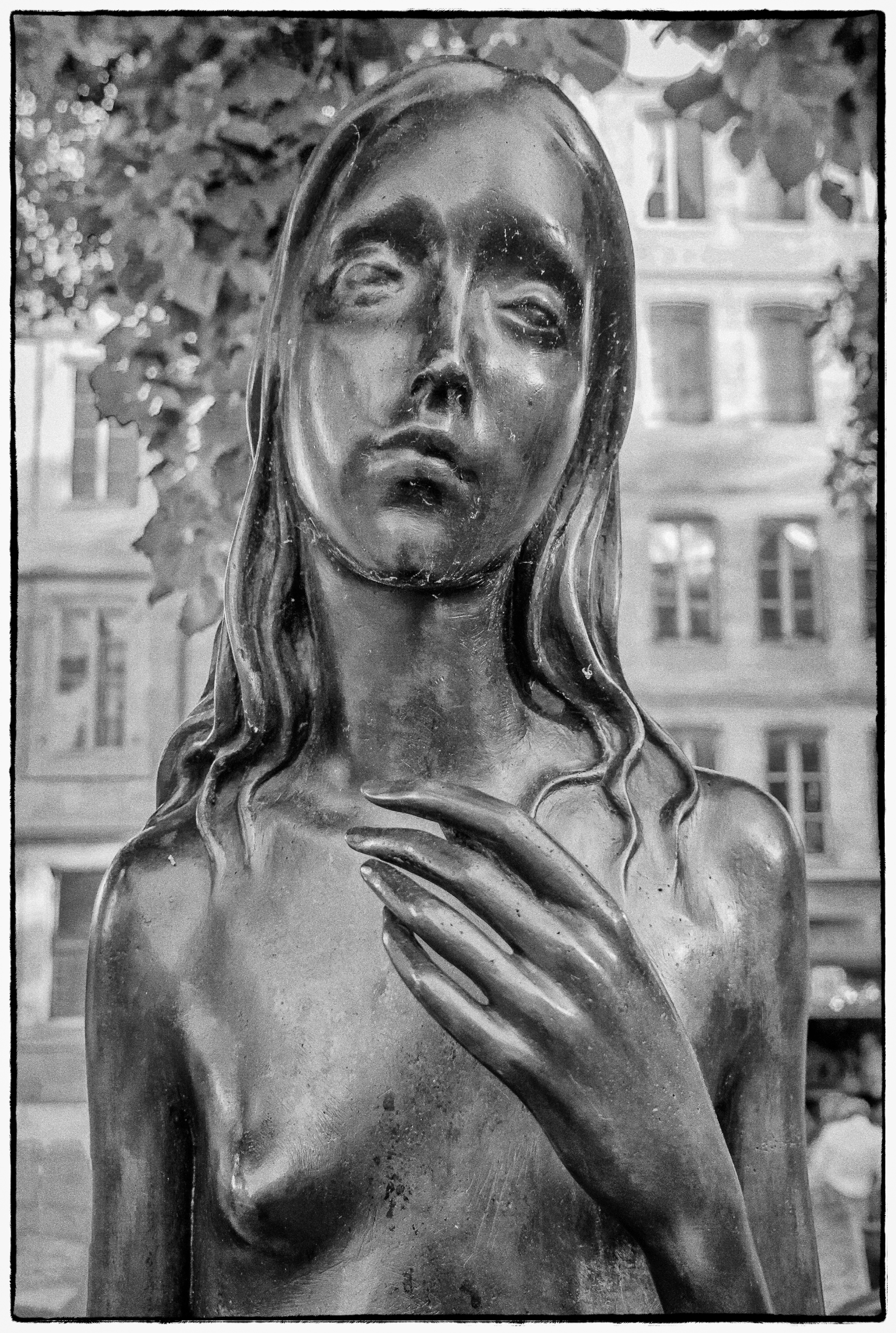
Geneva – Old Town, Clementine Statue

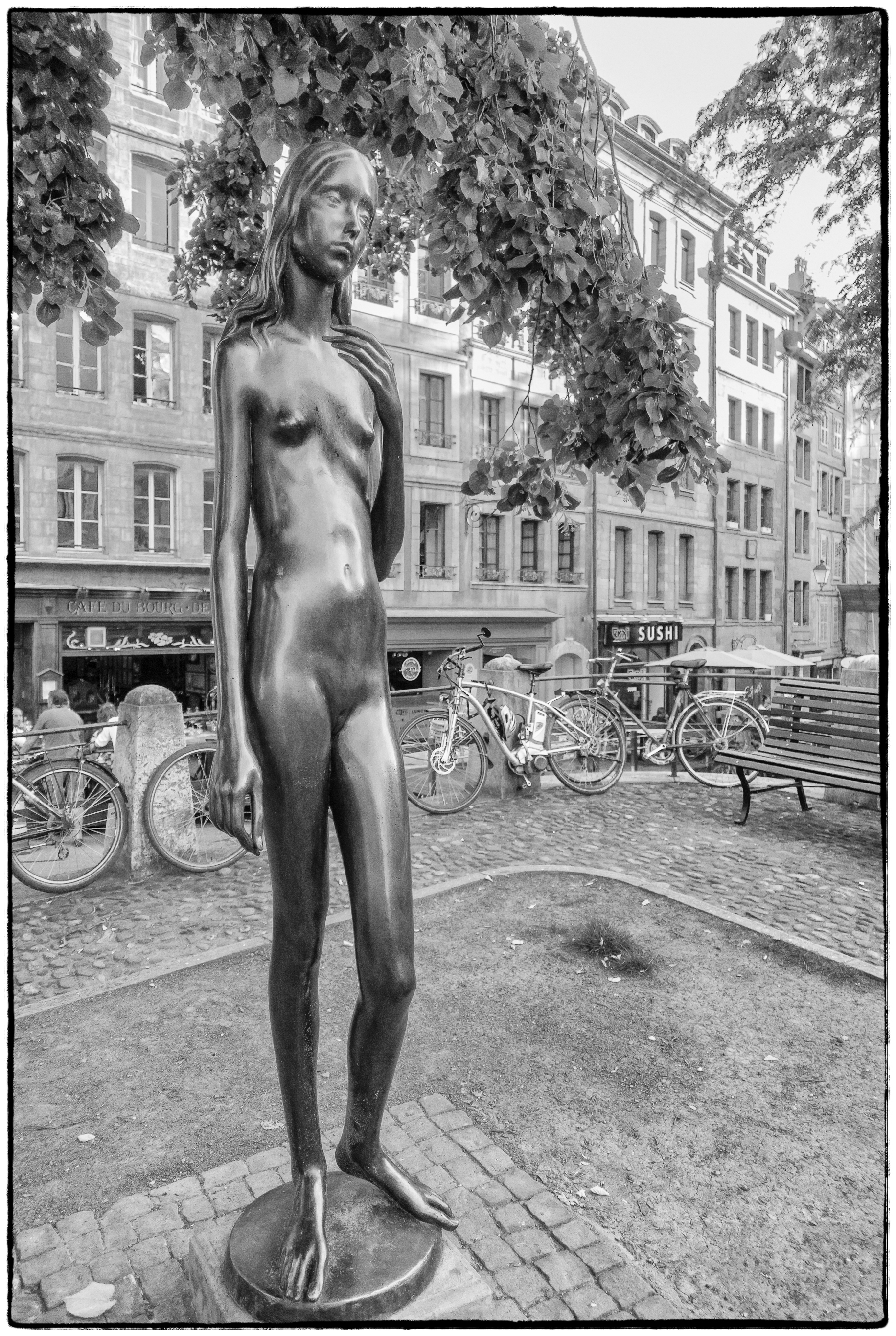
I first photographed this mesmerizing statue sometime in the mid 1990s with a film camera. I’ve even posted about it before (see Statue in the Old Town). The main difference between these two pictures and the earlier one is that in the latter the girl is holding a flower in her hand. Apparently visitors often either place flowers in the girl’s hand(s) or leave them at the base. I didn’t know at the time who had created this statue. I’ve since discovered more about its creator and his intent.

According to the Official Site of the Town of Geneva (translated from the original French):

In the heart of the old town stands a teenage girl with a thin silhouette. This bronze statue by the Swiss artist Heinz Schwarz is part of the collection of the Fonds d’art contemporain of the City of Geneva (FMAC).

The delicate young girl who stands naked on Place du Bourg-de-Four is one of the most popular Geneva statues. She was baptized Clementine by the inhabitants of the district, probably because the statue almost opposite the cafe of La Clémence.

Harmonious forms of adolescence. Adolescence is one of Heinz Schwarz’s favorite subjects. He aims to capture this transitional moment between childhood and adulthood. According to him, this is the period of age when young girls have the purest forms.

A long limbed figure somewhere between energy and weakness. The teenager, with delicate curves and natural calm, amazingly combines energy and weakness: while her body measures more than a meter eighty, it seems to threaten to collapse due to its leanness. This extreme refinement of the body, proposed in several statues of the artist, is difficult to perform technically, for it is less voluminous than statues of more classical proportions.

A statue that denounces injustice. Many have become attached to this statue, which has come to symbolize issues related to female exploitation and child maltreatment.

Factsheet
Title: Clementine
Artist: Heinz Schwarz (Arbon / Switzerland, 1920 – Satigny / Switzerland, 1994)
Date of creation: 1974 (mold), 1975 (cast iron)
Description: sculpture in public space, statue
Technique and materials: bronze
Dimensions: 183x40x40 cm
The Talking Beautiful Stuff site has this to say about the statue in a post entitled: “The adolescent tragedies of Heinz Schwarz“:

From the lake edge, take yourself up to Place Bourg de Four in the old town. Prepare to have your heart-strings pulled!

Schwarz’s “Clementine” is much more than an exquisite statue. She is a symbol of solidarity for women and girls – especially those forced into prostitution – all over the world: the reason why there are often floral tributes strewn at her feet. Clementine is overpoweringly sad and beautiful in her budding adolescence. She is unspeakably delicate and stands fully and unashamedly naked. She is quiet but her vulnerability screams out. You can only weep for her innocence that has been or is soon to be brutalised. And Schwarz has evoked all this in bronze! Genius!

I have to wait to take my photograph because an obese man – to the amusement of his tourist friends – drapes an arm around Clementine’s shoulder and fingers her right breast. Digital shutters click amid giggles. My disgust wells inside. Clementine doesn’t flinch. She’s seen and felt it all before.

It’s ironic that a statue, which has come to symbolize the fight against female exploitation can itself be exploited in such vile ways by the moron mentioned above.
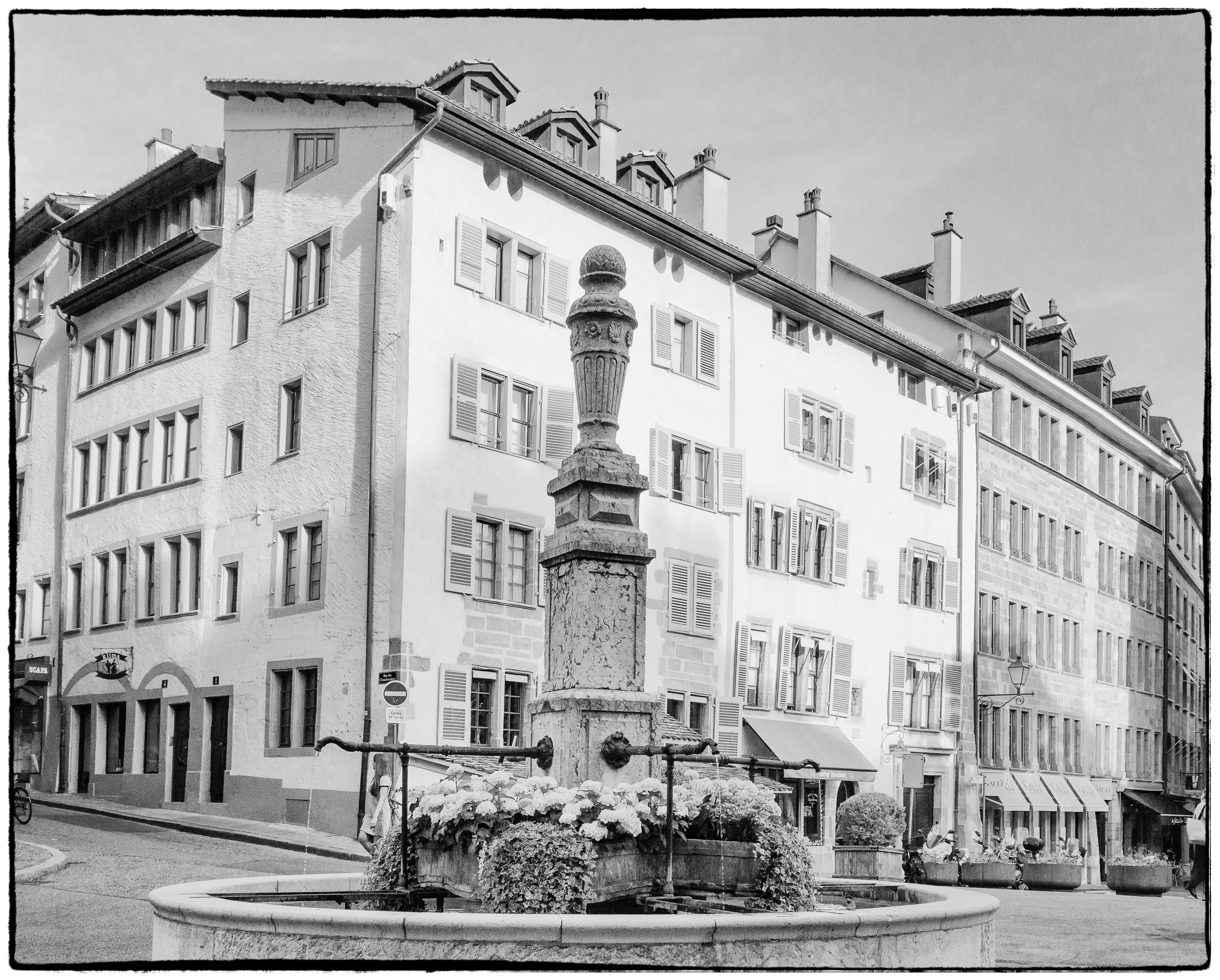
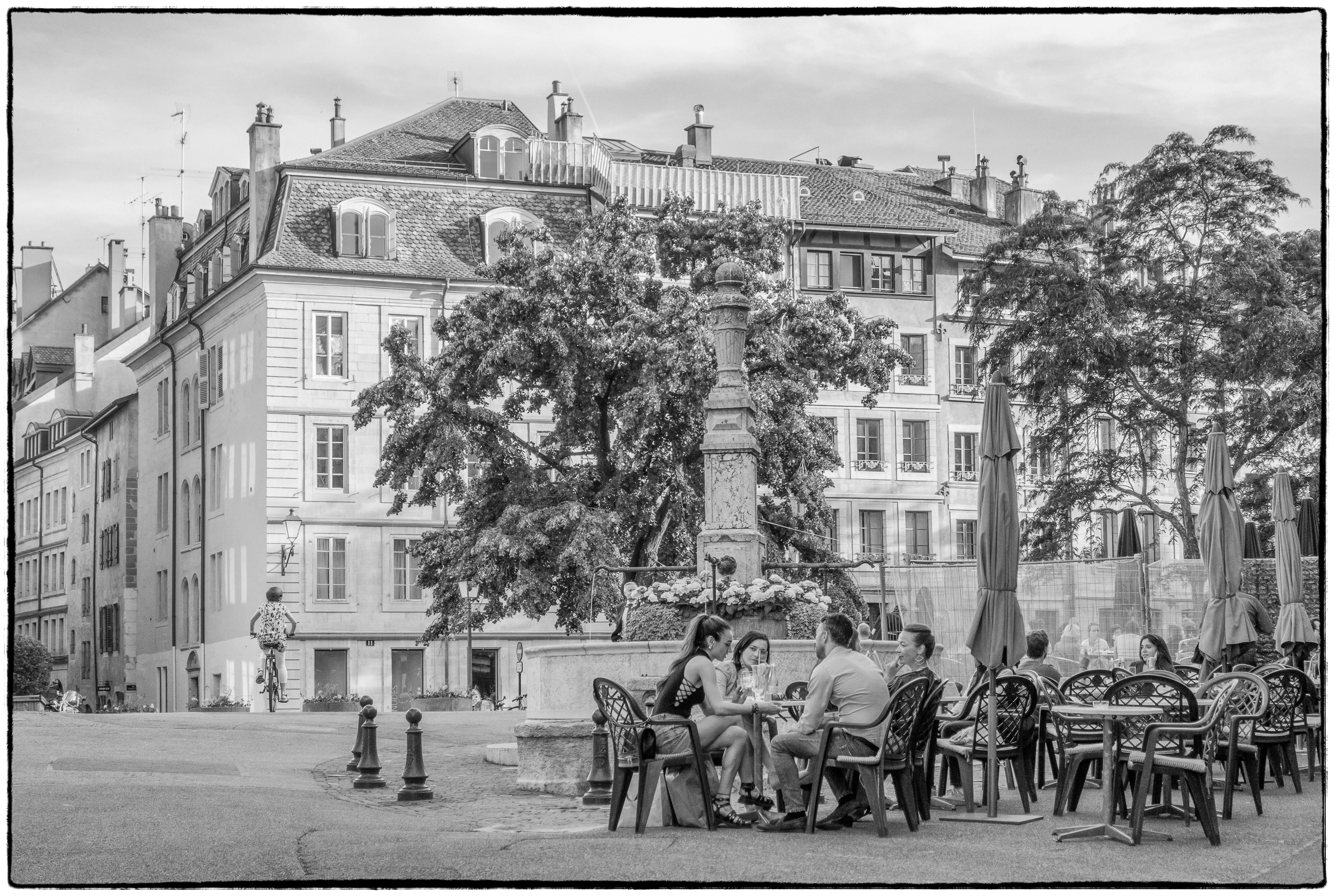
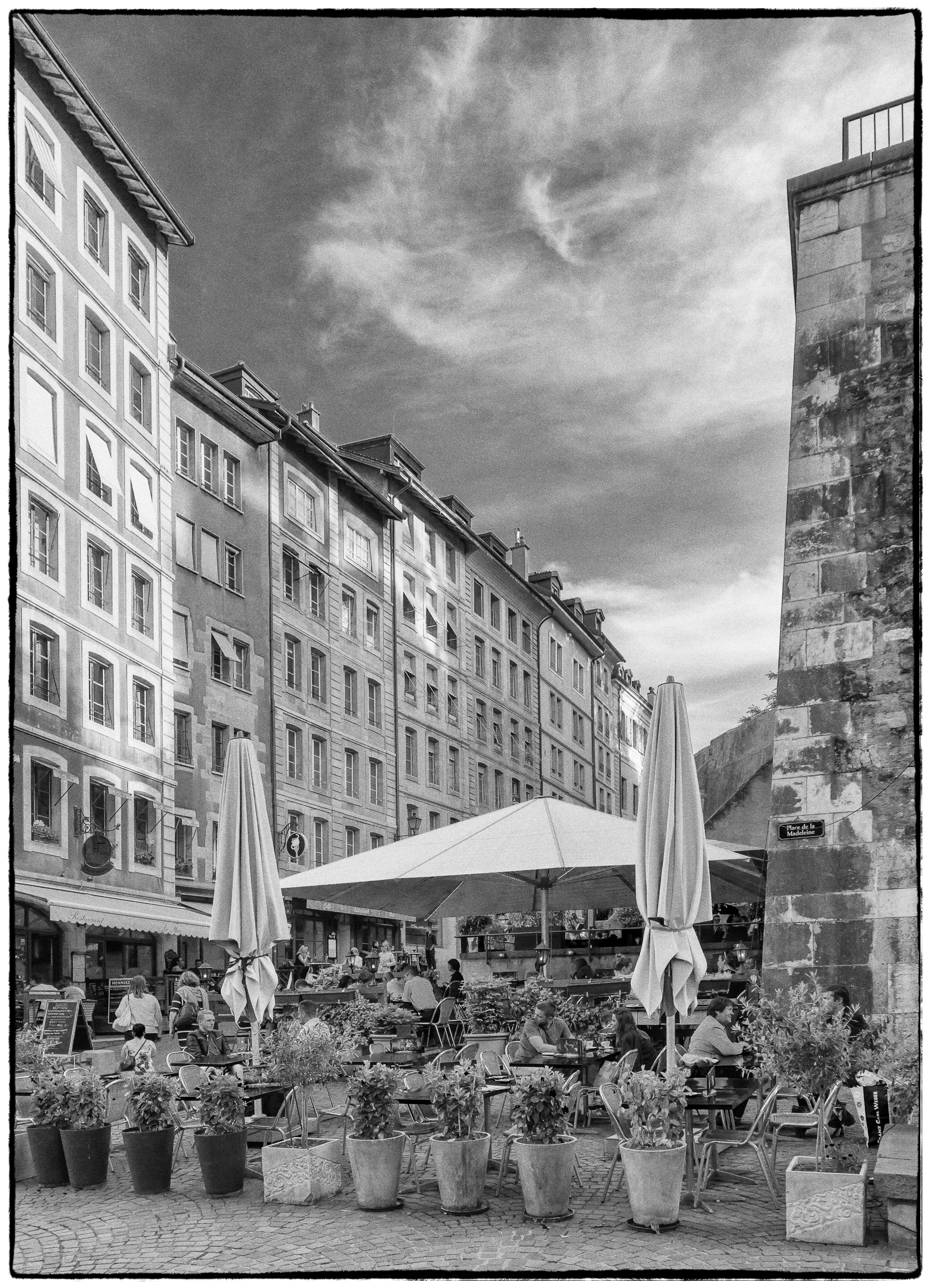
Geneva – Old Town, Place du Bourg-de-Four

One of my favorite places in Geneva. I’ve spent many pleasant hours sitting here, including during this recent visit were I met up with an old friend for a few beers at “La Clemence” mentioned below.

According to the Just Landed site:

One thing has not changed a bit in the Place du Bourg-de-Four since Roman times. It is still a center for commerce and a meeting place for the Genevois. Remnants of the ancient roads that led south to Annecy and Lyon and east to Italy and the Chablais are found buried in this deep within the square. At one time the Place served as a Roman forum and cattle market, then later a medieval town square. It also served as a safe haven for masses of Protestant refugees fleeing persecution in the 16th century.

The building of the Palais de Justice on the Place was constructed in 1707. It later sheltered the convent of the Order of St. Clare and also a hospital until 1857. In 1860, it began housing the courts of law behind its 18th century restructured frontage. This explains there are many intricate varieties of architectural styles on the Place, all blended in their display and ranging from medieval modern in their charm.

This crossroad in the heart of the Old Town is a treasure of magnificent collections of 16th century architecture, as well as handsome constructions of the 17th and 18th centuries. It is an established place of history, but with its heart beating and intent on the future. Still today, hosts of Genevois gather around the18th century flowered fountain of the Place du Bourg-de-Four. Locals gather to sit and sip cafés, take a leisurely walk, or soak up the ambiance in the busy bistrot terraces around the square.

Nightlife in the Place du Bourg-de-Four is just another example of the quintessential Genevois crossroad. Among the antiquaries’ shops, art galleries, book and tourist shops, people of all ages and backgrounds gather to meet for drinks and begin their evening in one of the many friendly cafés, bistrots, or bars. One of the best-known starting points is La Clémence with its large terrace accommodating bohemians, bourgeoisie, and the cultured elite alike. Everyone is welcome and finds their place in the Place du Bourg-de-Four.

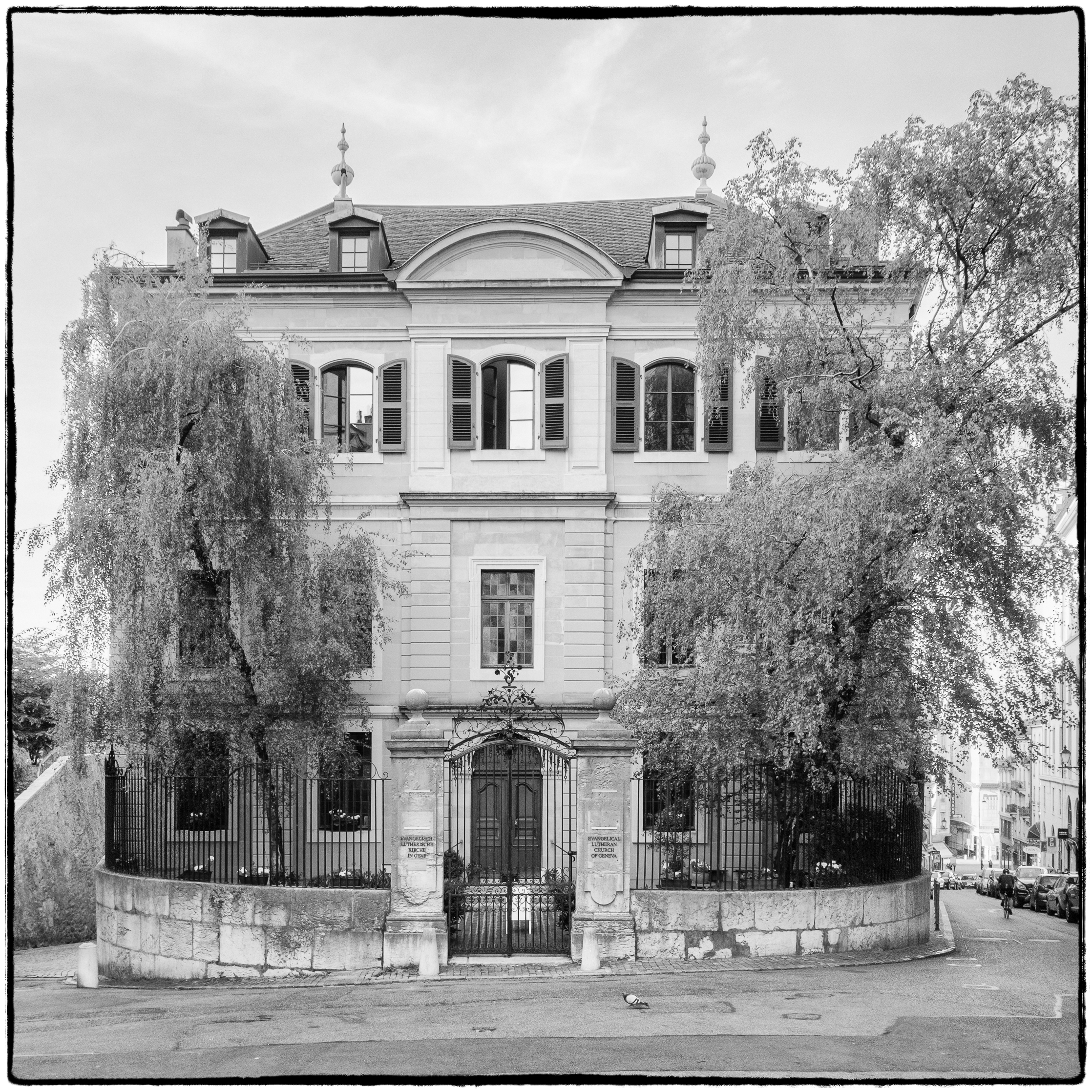
Geneva – Old Town, Evangelical Lutheran Church of Geneva

This building stands at the intersection of Rue de la Fontaine and Rue Verdaine. When I took the picture I didn’t know what it was. I just liked the way it looked: the old building with its two trees, ornate wrought iron gate and fence. When I got back home and examined the photograph more closely I noticed that there was lettering on the two pillars on either side of the gate. The English version (the other one was in German) read “Evangelical Lutheran Church of Geneva“.

After a bit of research I came across this History of the Evangelical Lutheran Church of Geneva – an overview. I found this sentence to be particularly interesting:

1762. With the help of donations from German principalities, the congregation acquires the dilapidated Château de Coudré; tears down the building (maintaining the original basement and foundation); and constructs the new church building (which, according to the regulations may not be recognisable as a church)

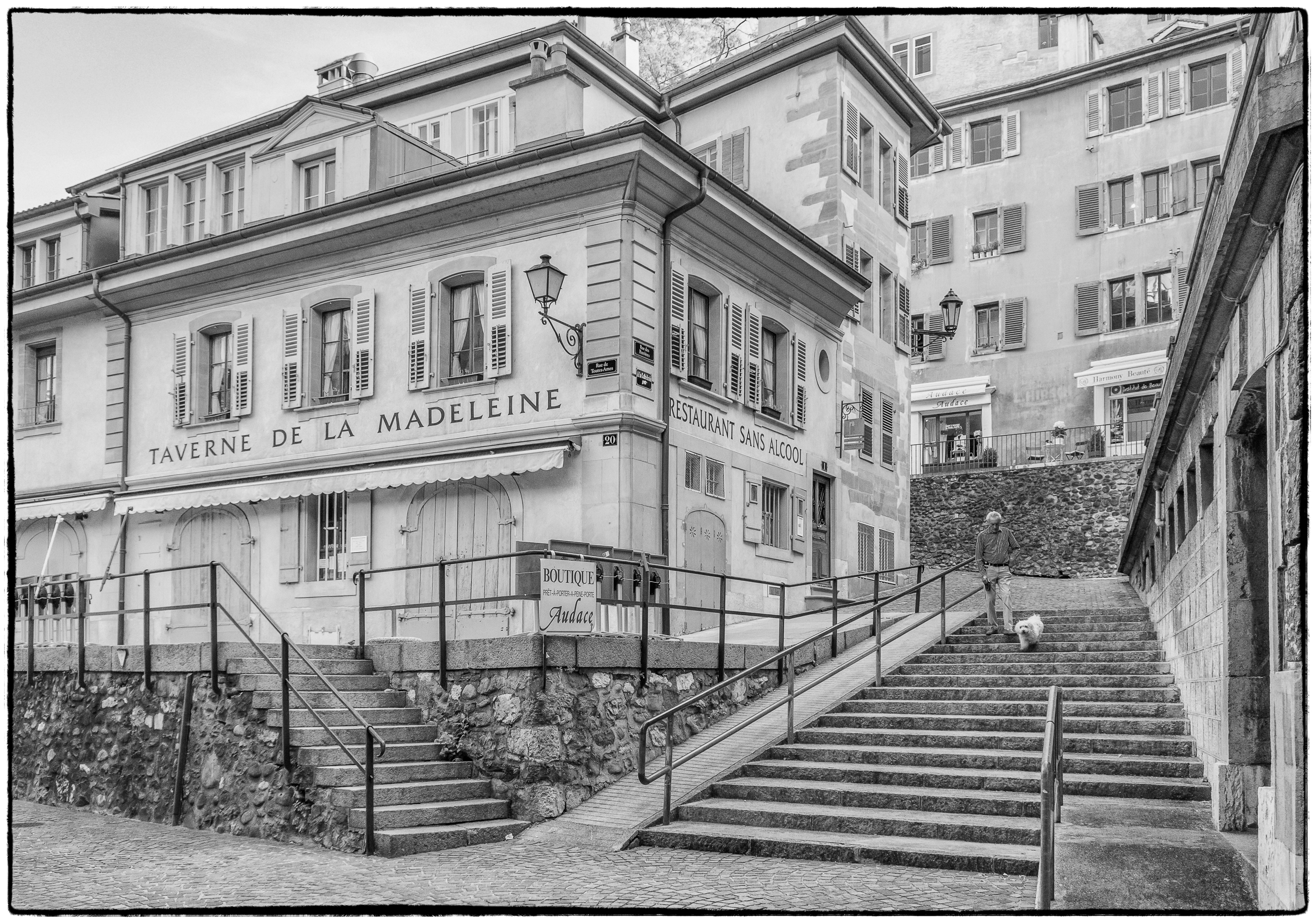
Geneva – Old Town, Place de la Madeleine

If you head from the Place de Longemalle away from the lake, you cross the tram lines and find yourself in the Place de la Madeleine, the northern gateway into the old town. There’s an old church (the Temple de la Madeleine, one of the oldest in Geneva with some impressive modern stained glass) and even a nice carousel (not seen in either of the pictures here, but just visible in the background in the top picture in the preceding post).

The picture above shows the “Taverne de la Madeleine“, a great place to eat (we’ve eaten there many times). The food is good, but unfortunately (at least for me) they haven’t served alcohol since 1920. As the sign on the side wall proclaims: “Restaurant sans Alcool”. If you really feel the need for a beer of a glass of wine there are lots of other places that do serve alcohol including the “Le Flore” seen in the picture below with the Rue de la Fontaine ascending towards the old town.

Taken with a Sony RX100 M3

Geneva – Place de Longemalle, Two statues

As I walked around the Place de Longemalle I noticed a couple of statues that hadn’t been there the last time I’d visited. They stand outside the Opera Gallery and a sign indicates that they are the work of Andy Denzler. According to Wikipedia:

Andy Denzler trained at the Kunstgewerbeschule and the F&F Schule für Gestaltung in Zurich, both schools of applied arts, as well as at the University of California, Los Angeles, and the Art Center College of Design, Pasadena. In 2006 he graduated as Master of Fine Arts from London’s Chelsea College of Art and Design. Andy Denzler lives in Zurich.

Denzler’s works have been exhibited in one person shows and group shows in Europe and America, since 2010 also in Russia. In 2007, he was included in the exhibition “Kindheit” (Childhood) at the Museum Rohnerhaus in Lauterach, Austria. Works of his are owned, among others, by the Museum of Modern Art, Moscow, the White House in Washington DC, the Museum Würth in Schwäbisch Hall, the Burger Collection in Hong Kong, the White Cube Collection in London and the KunstWerk – Sammlung Klein in Eberdingen/Stuttgart.

Andy Denzler’s works move between abstraction and reality. With the classic means of oil painting, the artist endeavors to fathom the borderlines between fiction and reality. He presents his own perception of the world in his pictures. They are snap-shots of events that take place, blurred, distorted movements, Freeze Frames that stylistically move between Photorealism and Abstract Expressionism. In his paintings Denzler frequently alludes to other media. Titles and subject matter refer to films, as for instance in One Flew Over the Cuckoo’s Nest or Viktoria in The Birds. His “Motion Paintings” are divided into four groups of works: “Portraits”, “History Paintings”, “Figures & Landscapes” and “Urban Figures”. Andy Denzler translates them into painting, sculpture and drawing.

The bronze statues date to 2016. The one above is called “Liquid Walking Woman” and the one below, “Selfie”

Talking Beautiful Stuff provides a nice description in a post entitled Its Her Day:

I stroll through down-town Geneva. It is hot. Very hot. Every-language tourists swarm the luxury shrines to chocolate and watches. A stunning new bronze sculpture in Place de Longemalle stops me in my tracks. It is a young woman in hoody, cut-off denim shorts and trainers walking with confidence. She holds a smartphone. Like her living counterparts, she seems unaware of her allure or the conveniences brought by smartphone culture. She is constructed of horizontal segments re-stacked. The texture contrasts effectively with the smooth skin of the presumed model. Somehow, this sculpture captures the young woman of today. It is very beautiful and very gratifying.

I look around for the plaque that names the genius behind this work. Instead, I spot the same young woman only forty metres away. She has both feet firmly planted and her smartphone held up towards her other self striding to meet her. She has that small-screen look of concentration. Is she photographing her twin, taking a selfie, recording the street scene or checking her make-up? I am captivated by these works individually and as a pair. Finding them makes my day

I did not grow up in the internet era nor even with a mobile phone. Denzler’s subject cannot possibly know existence without a smartphone. It is also her camera, her street map, her address book, her pen and paper, her mirror, her compass, her library, her photo album, her stereo, her shopping mall, her magazines, her cinema and much more besides. Her friends and friends’ friends, real and virtual, are connected, categorized and communicated with by Facebook, Twitter, Snapchat, Whatsapp and Instagram. As for all of my generation, what mobile technologies bring to humanity is both fascinating and intimidating. Were I to find myself in conversation with Denzler’s young woman, I’d be interested to know whether she could conceive of life before smartphones. And if I said something stupid like “Well, in my day, we didn’t have such technology.” I am certain she would simply look up from the screen for a second or two, look my squarely in the eye and say politely “But it’s not your day!”