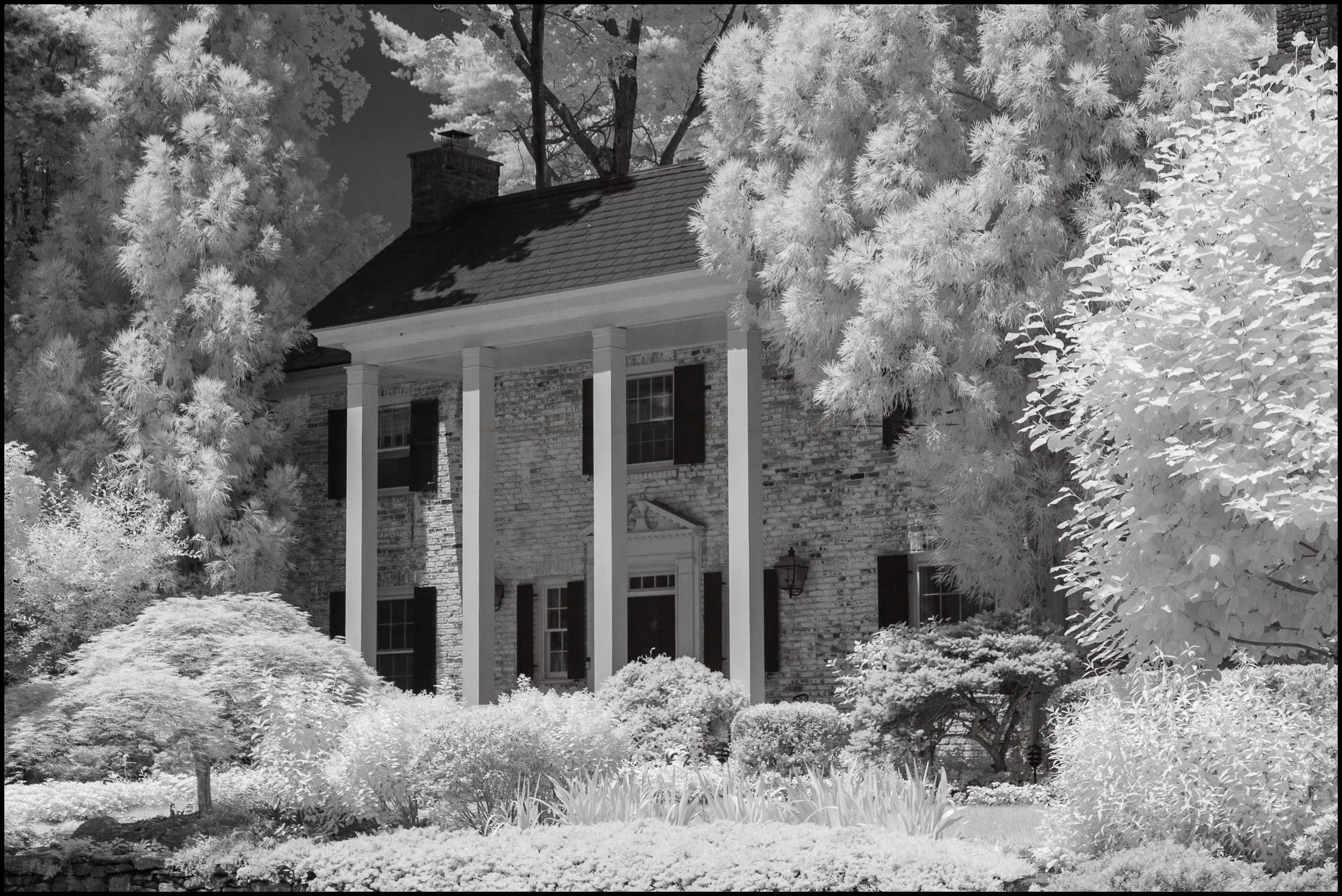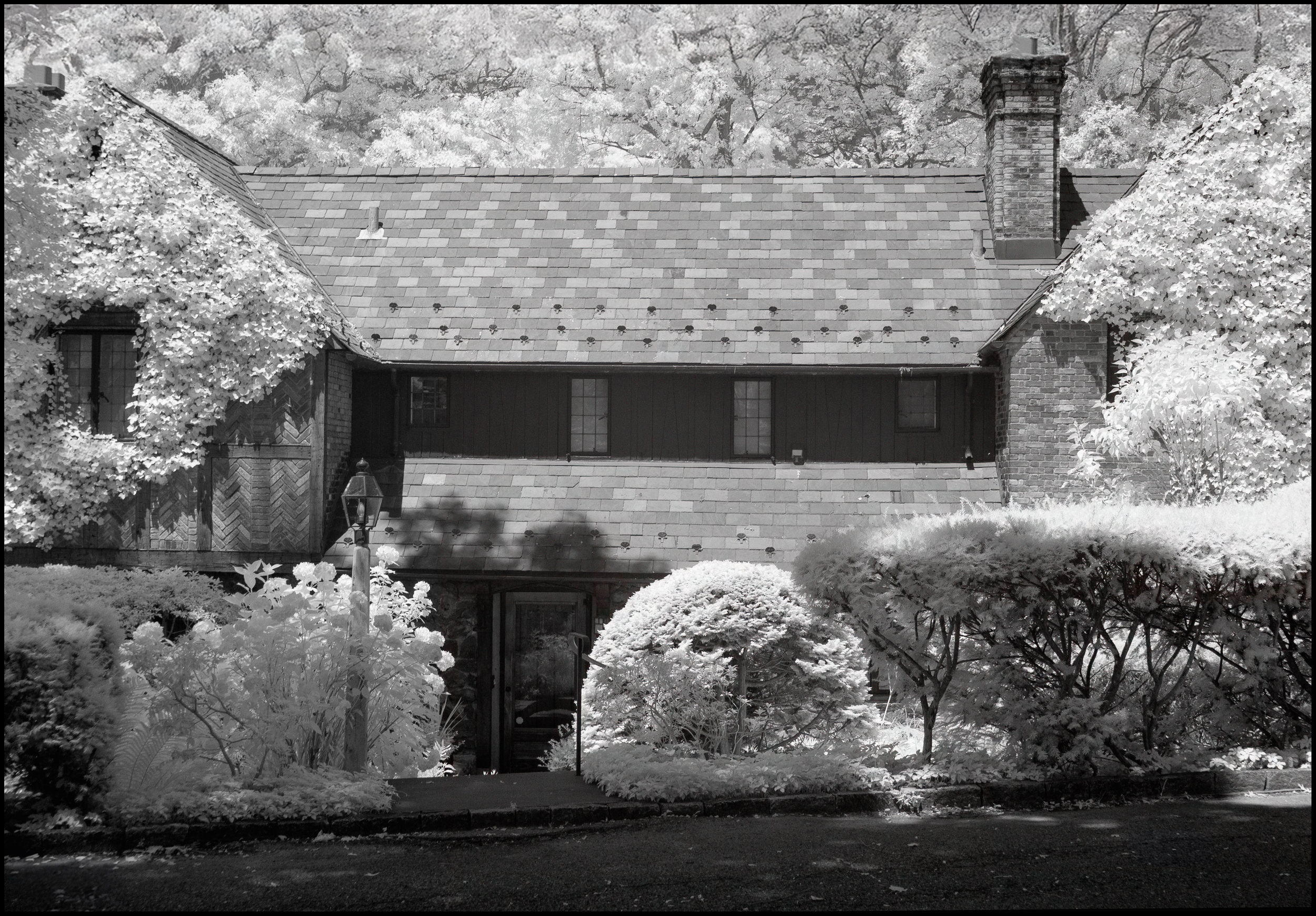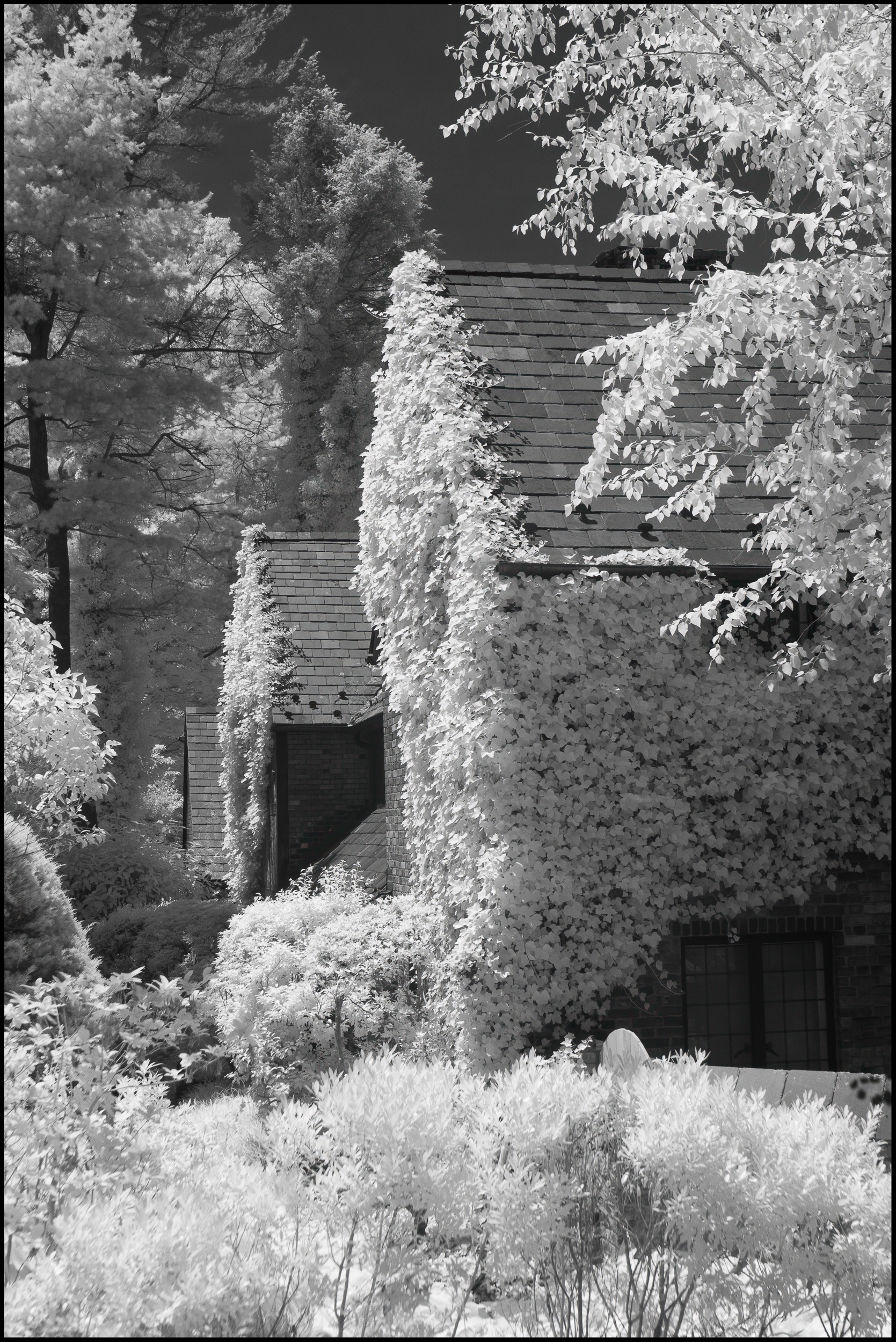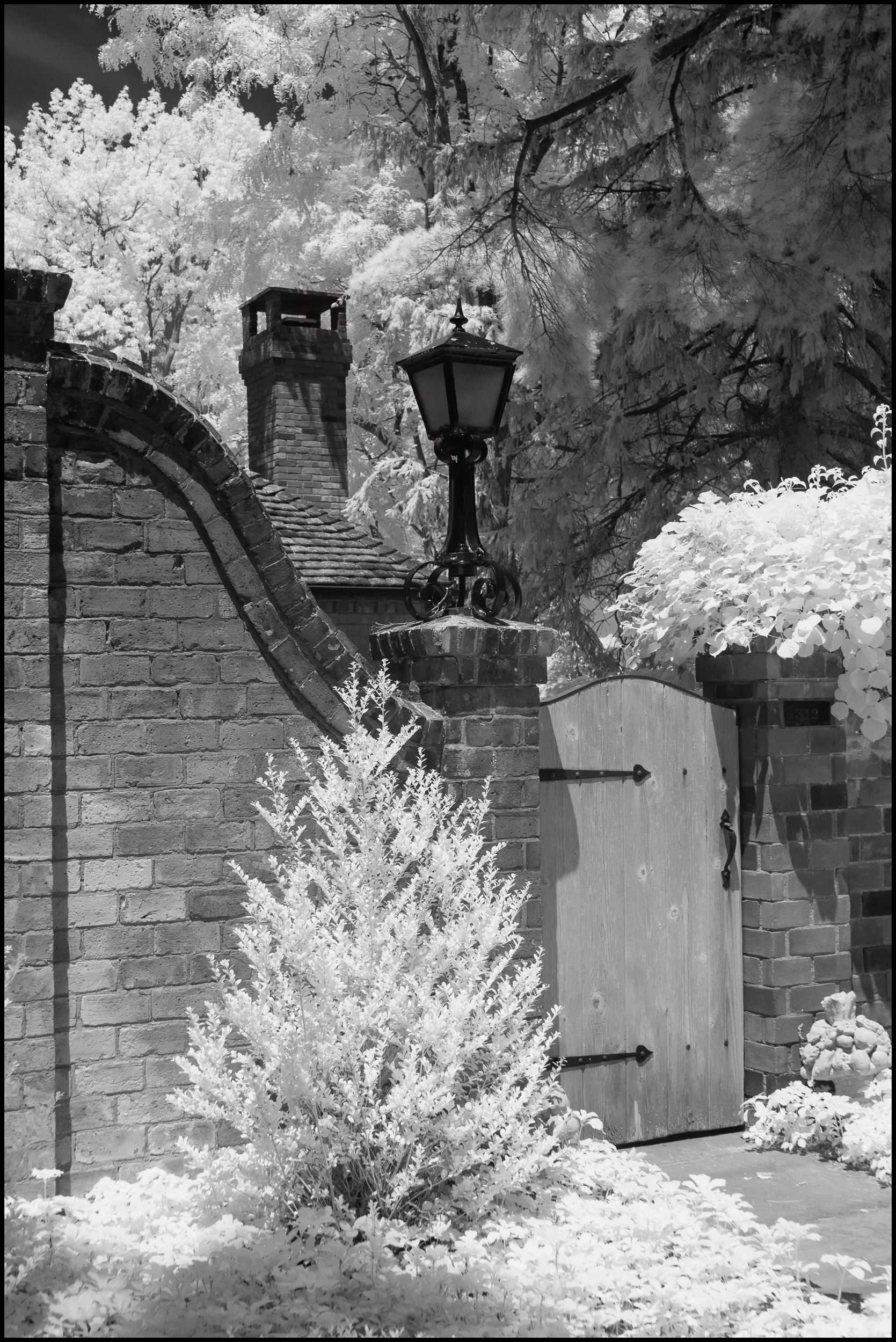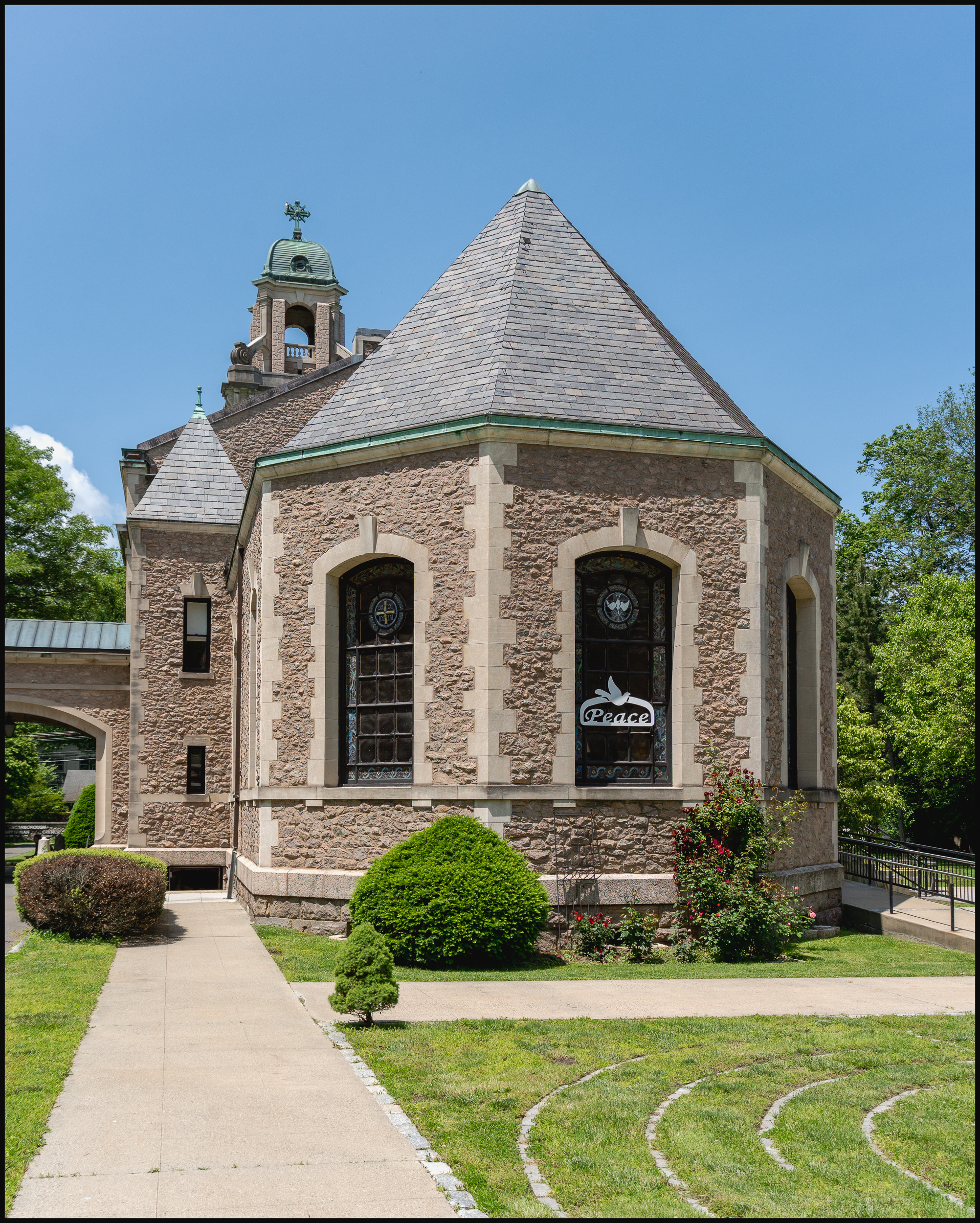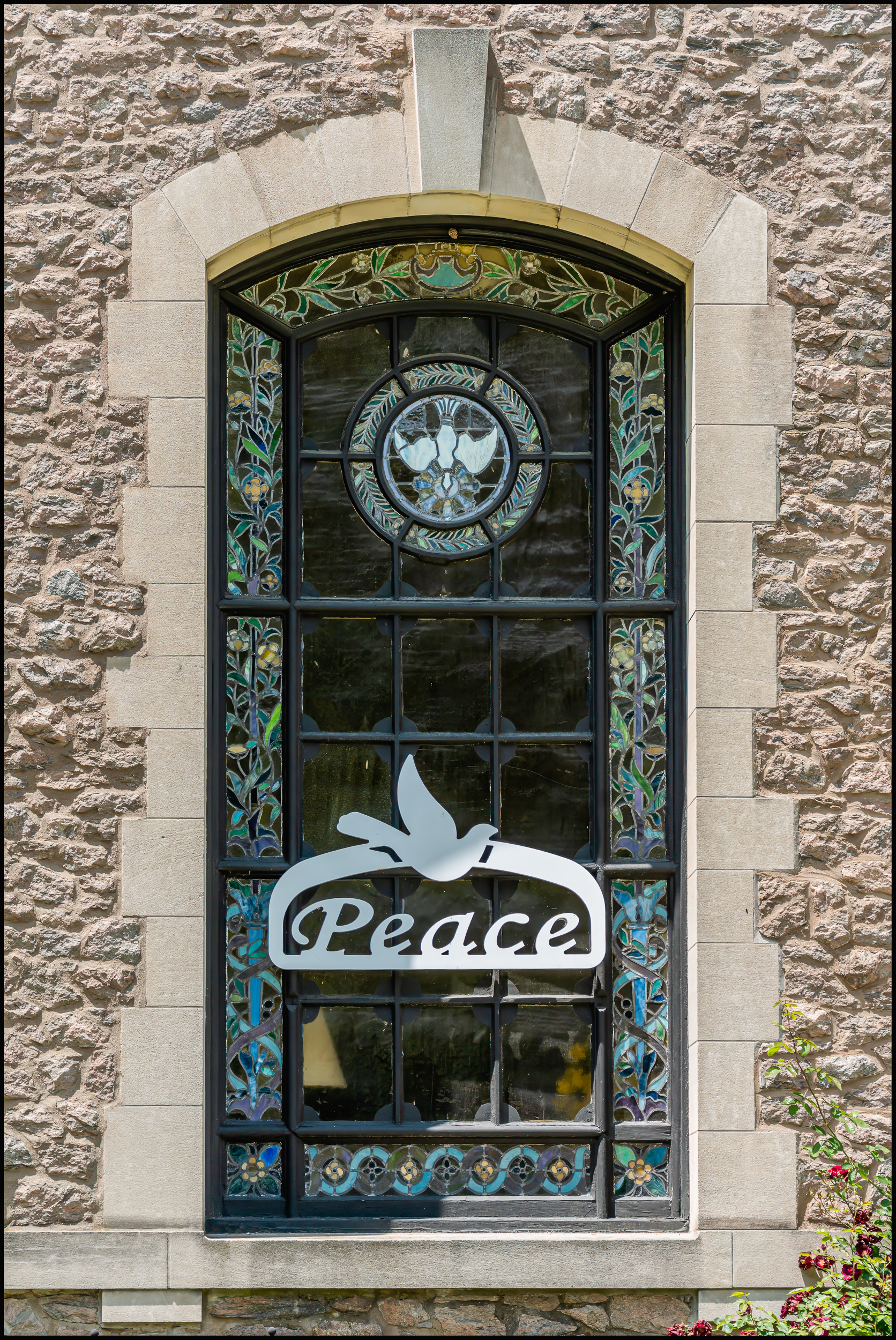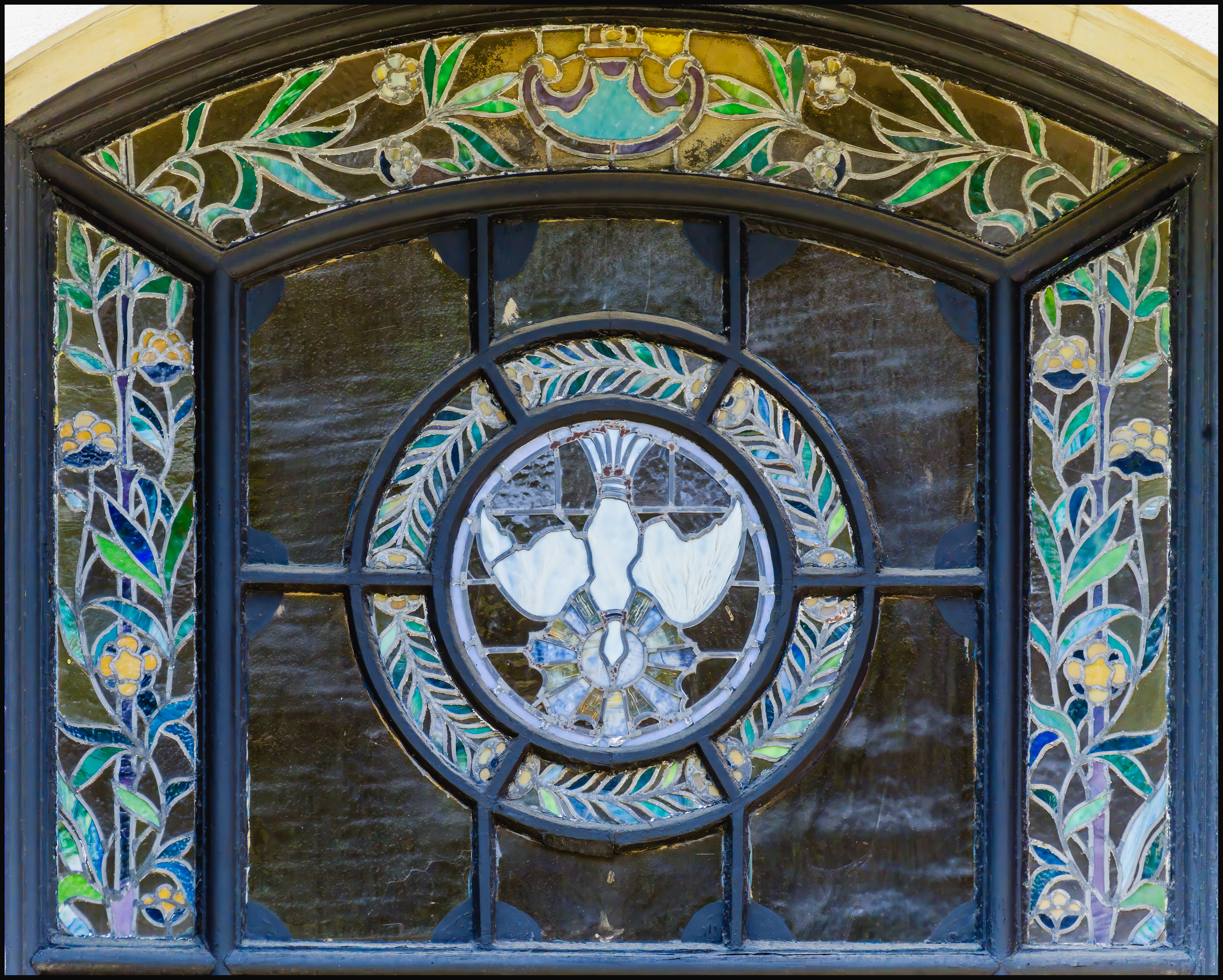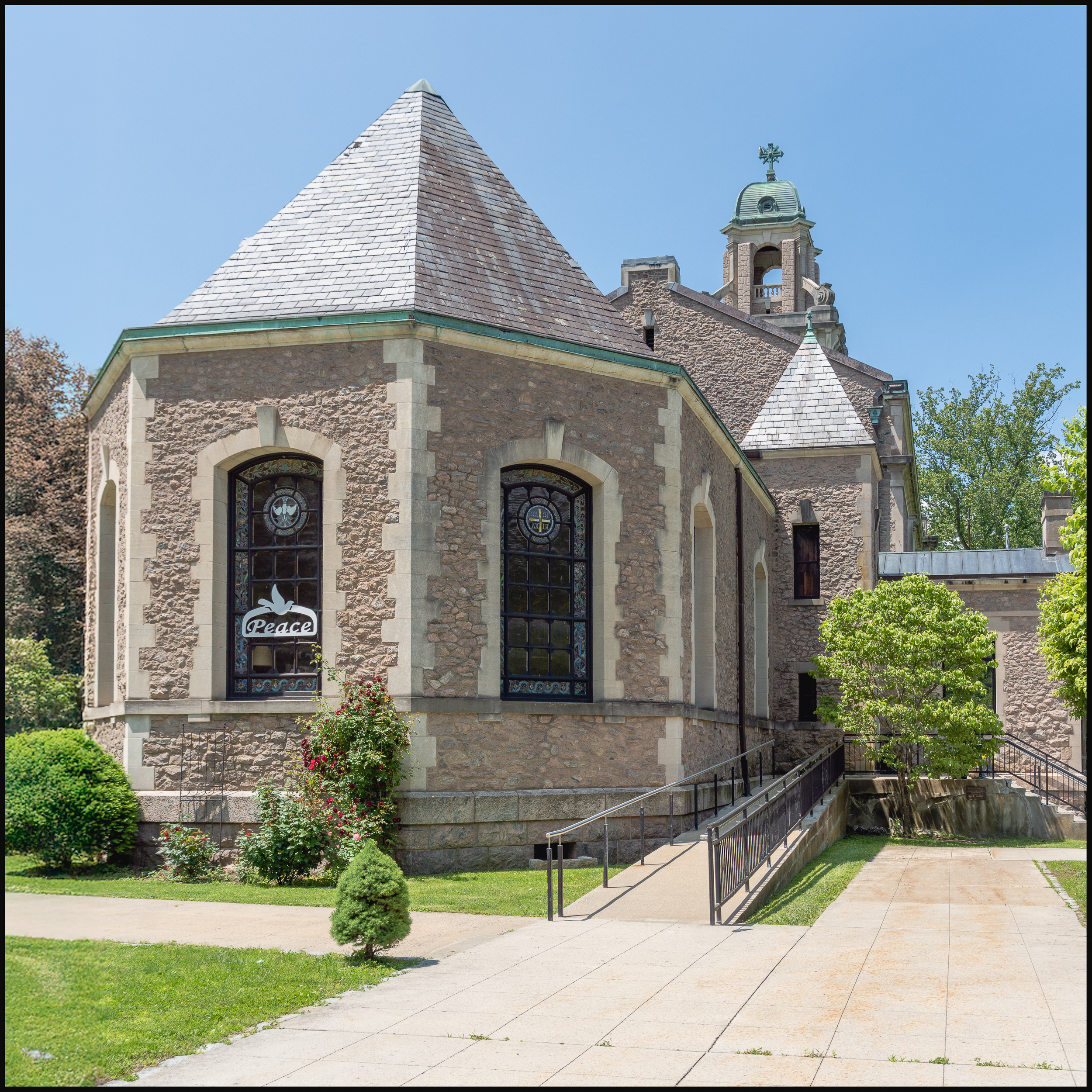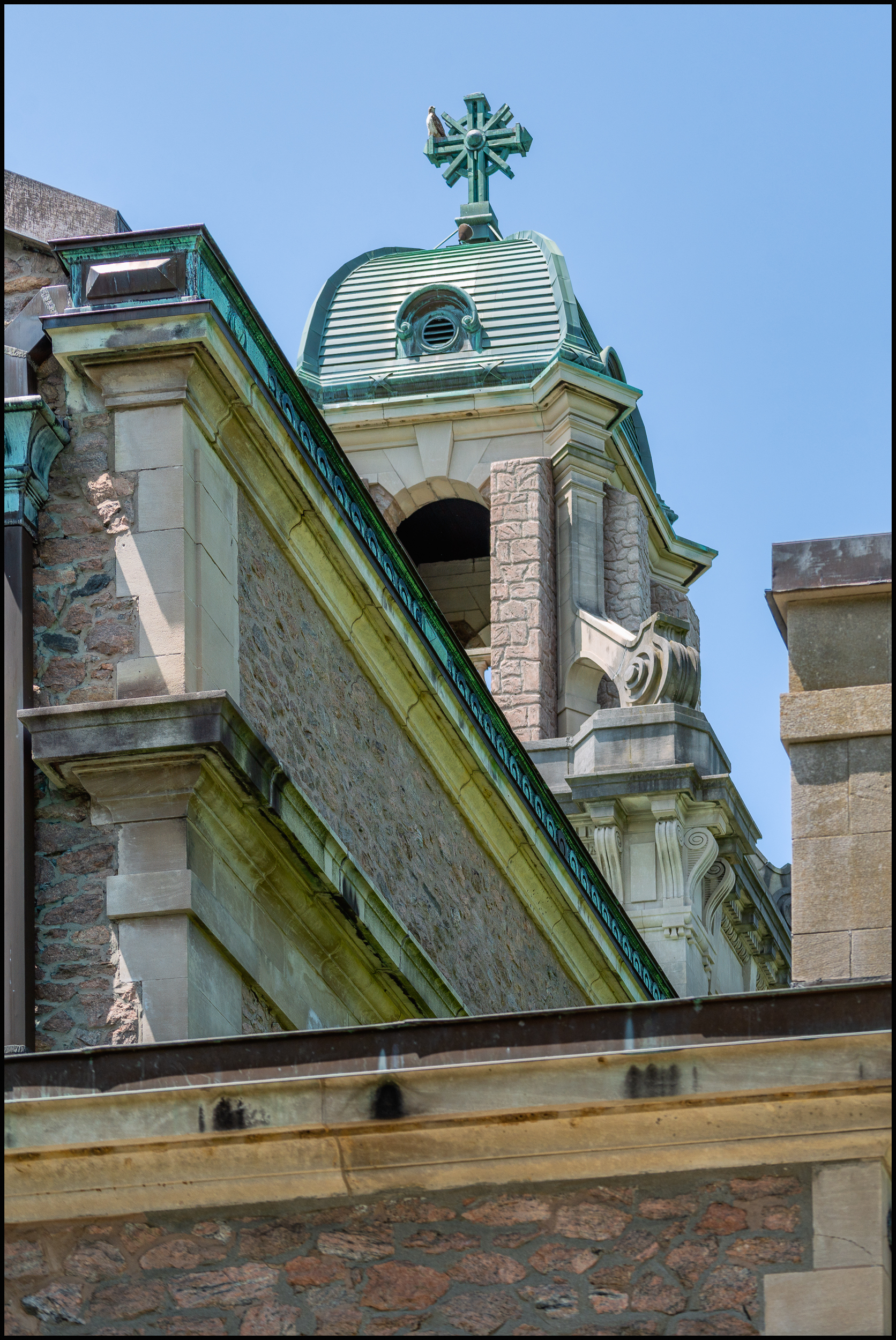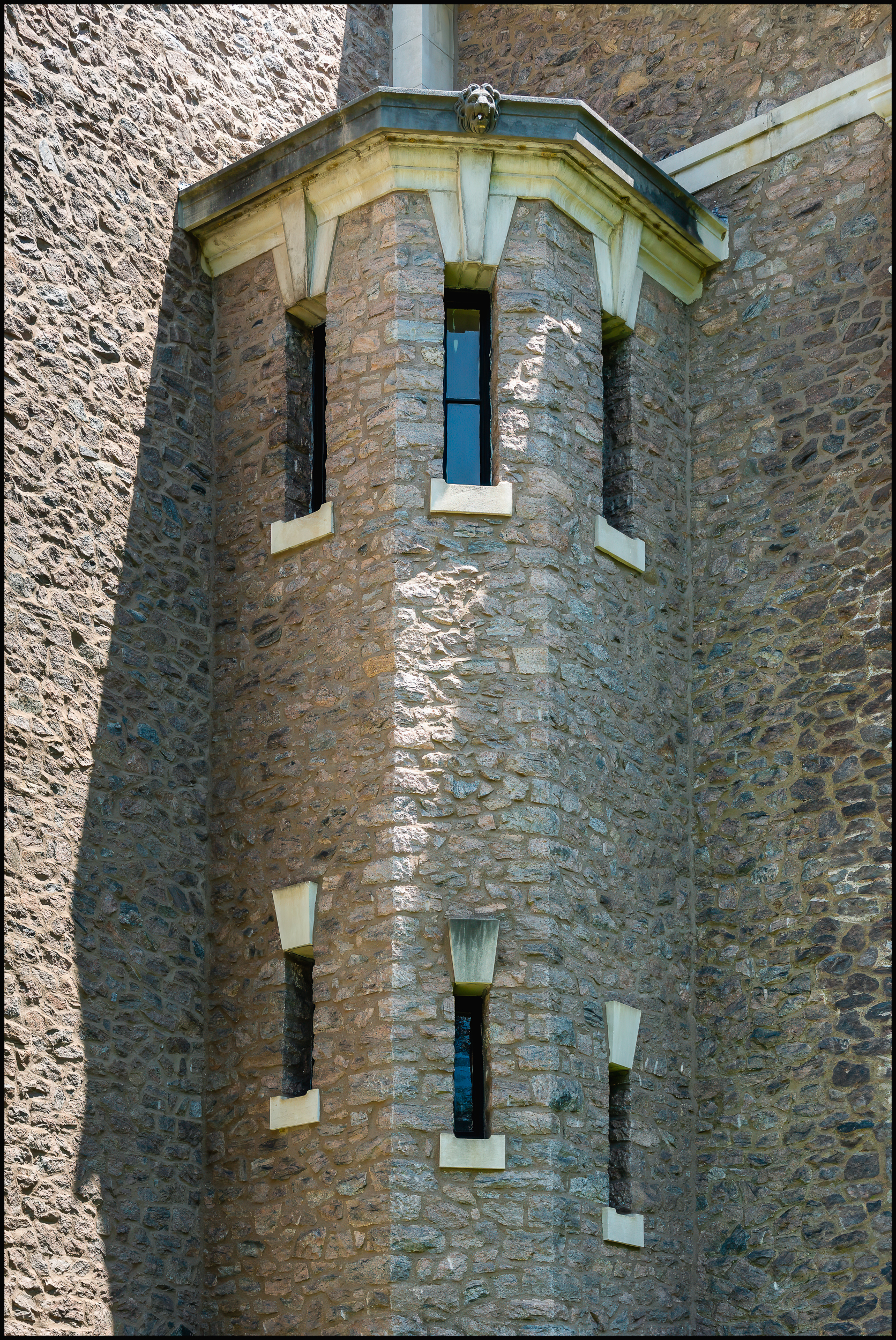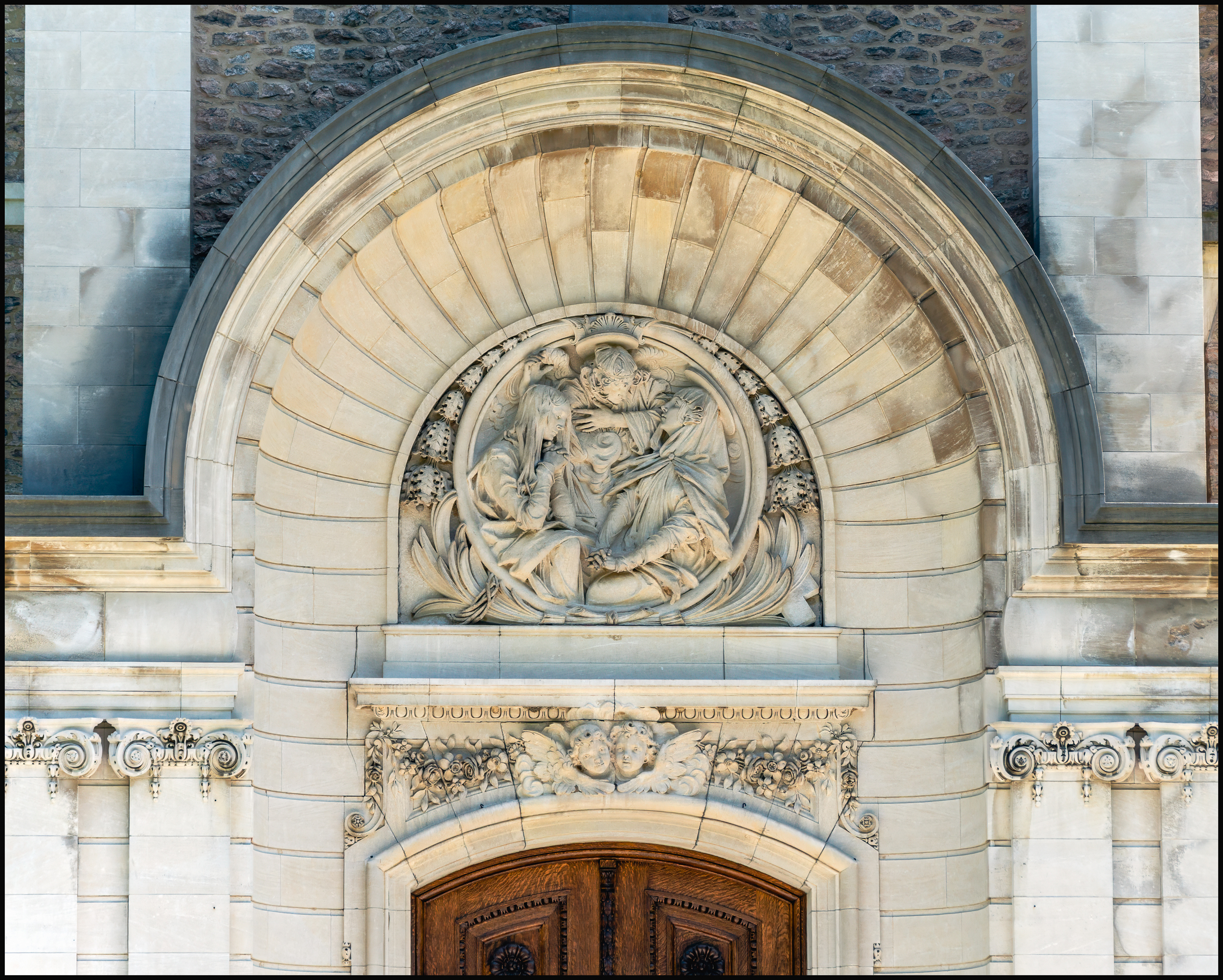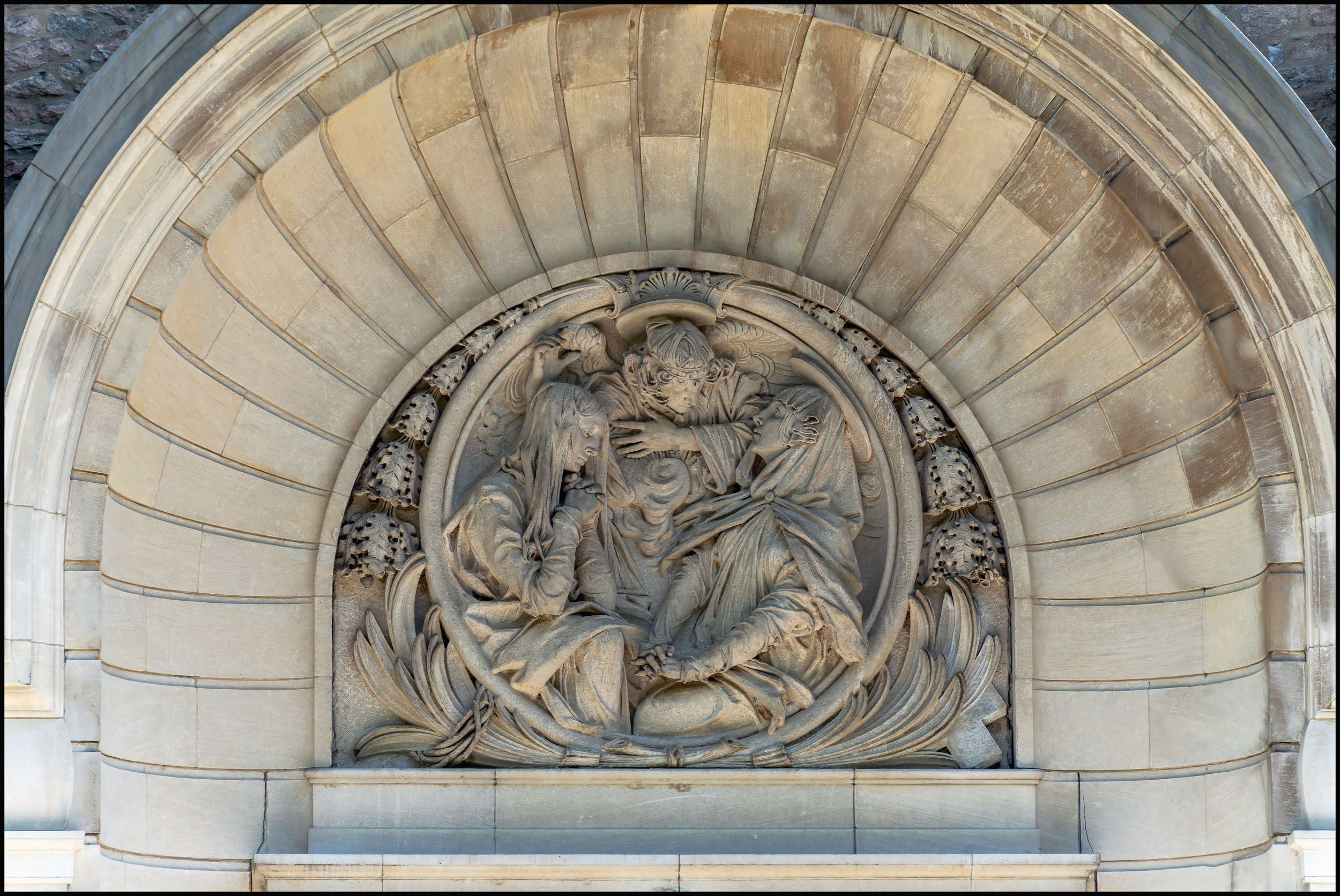
Could use a coat of paint

It seems that the church administration has the same idea (see image below)

As indicated in the sign, this is the First Baptist Church of Ossining:

High Victorian Gothic architecture, which evolved from the older Gothic Revival style, differs from that style in its use of contrasting polychromatic bands on the exterior wall surfaces and more elaborate decorative elements. This style was usually reserved for public buildings such as schools or churches. As it is related to the Gothic Revival style, structures in this style also contain such elements as steeply pitched rooflines, elaborate ornamentation, and a predominantly vertical orientation.

The First Baptist Church consists of two sections: a rectangular main section and a smaller, perpendicular northern section. The main section’s 100-foot-tall spire, which is surrounded by 16 pinnacles, was added in 1894. Older photographs show that the building originally had an
ornamental roof cresting that was subsequently removed at an unknown date. The structure is capped with a gray slate gable roof with four gabled dormers. Each contains a large, pointed arch window and elaborate decorative exterior woodwork around the gables. The pointed arch-shaped double front doors at the main entryway facing Church Street are surrounded with polychrome brick trim and a decorative fanlight above the door. Eight stained glass windows located around the perimeter of the structure illustrate scenes from the Bible. The church is constructed with brick and limestone.

Significance: Architectural and Cultural

The First Baptist Church was added to the National Register of Historic Places in 1973 as architecturally significant for its status as the best example of High Victorian Gothic architecture in the Village. Other examples include the First Presbyterian Church (see entry) and the First Baptist Church (see entry). The nomination took place prior to the 1989 designation of the Downtown Ossining Historic District in which the Church is located and listed as a contributing structure. The Church is also culturally significant for its association with its founder, Captain Elijah Hunter (1749-1815), a Sing Sing-based landowner and businessman who later served as the first Supervisor for the Town of Mount Pleasant prior to the formal incorporation of Sing Sing Village in 1813; the Sing Sing Baptist Congregation, founded in 1786; and for its overall role in the cultural life of the Village since its construction in 1874.

The First Baptist Church, completed in 1874, is actually the second structure to occupy the site at 1 Church St; the first was constructed in the early 19th Century to house the Sing Sing Baptist Congregation. This congregation was founded in April of 1786 by Captain Elijah Hunter, a Revolutionary War spy who was the founder of the hamlet Hunter’s Landing, an early waterfront settlement located near the current-day train station which grew to later become part of Sing Sing Village. Hunter chose a triangular-shaped site at the center of the Village near the convergence of the Albany Post Road (known today as Highland Avenue or Route 9), Croton Avenue, and Main Street in order to maximize its visibility and emphasize its central importance to Ossining’s religious life. The original First Baptist Church was a place where blacks and whites would worship side by side in a setting that permitted a degree of equality that did not exist elsewhere, a tradition that continued with the construction of the current structure. The original church building was demolished once the size of the congregation grew too large, and the present structure was built on the same site. The church was designed by J. Walsh, a Brooklyn-based architect, and was built for a cost of $75,000 in 1874 dollars.

Documented Sources of Information:

1. First Baptist Church “Historic First Baptist Church: History.” http://historicfirstbaptist.org/history.html (accessed April 17th, 2009).
2. Nomination Application for National Register of Historic Places, “First Baptist Church”, 1973, Ossining Historical Society Archives.
3. Ossining Historical Society, “Images of America: Ossining Remembered”, (Charleston, SC: 1999), 98.
4. Scharf, Thomas, J. “History of Westchester County, NY”, (Philadelphia, PA: 1886), 338.
5. Williams, Gray. “Picturing Our Past: National Register Sites in Westchester County”, Westchester County Historical Society, (Canada: 2003), 274-275.

Village of Ossining Significant Sites and Structures Guide, page 192.

Taken with a Sony RX10 IV

Mount Pleasant Military Academy Library

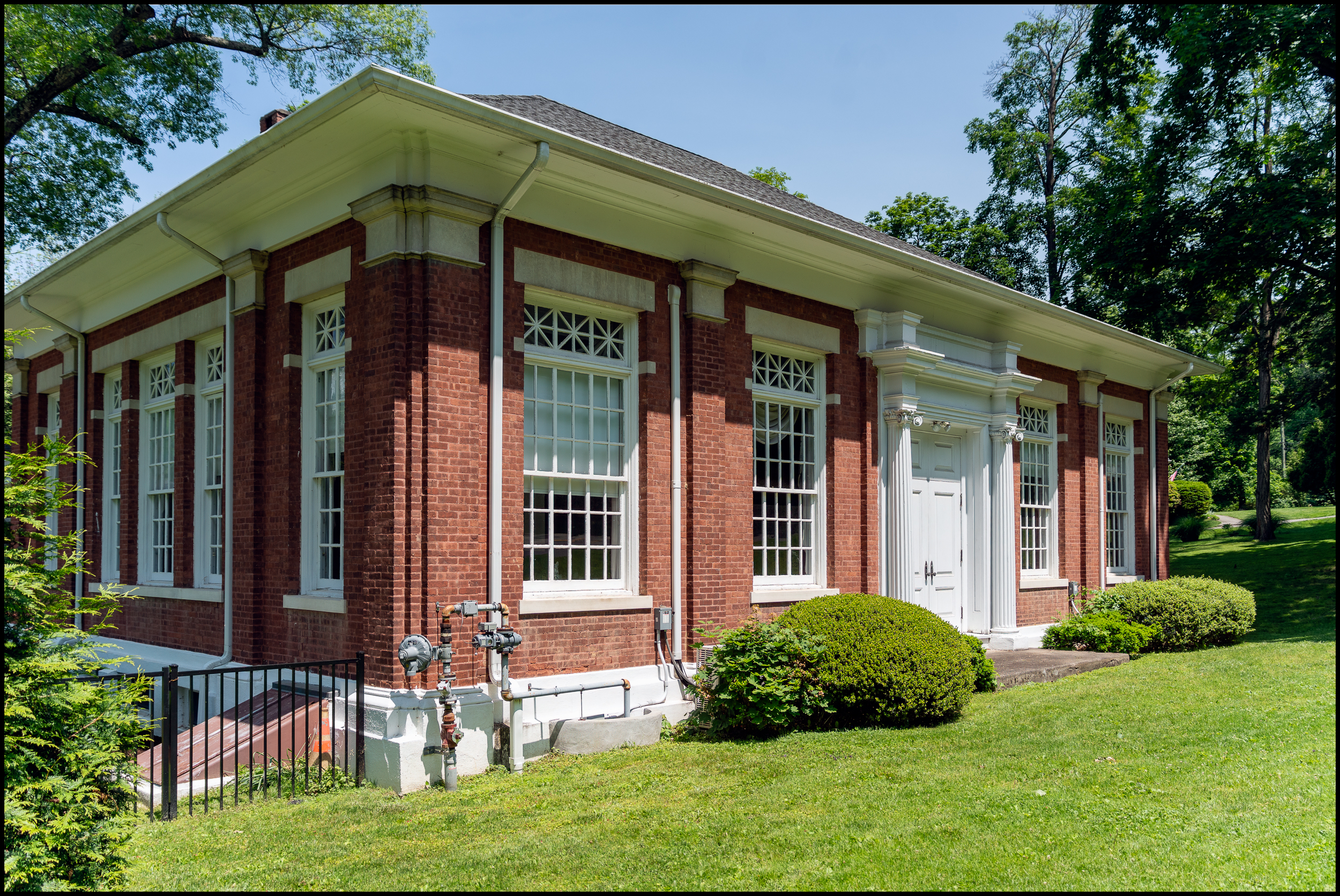
I’ve walked past this building in Ossining many times. I like the way it looks and always felt that it would make a nice photograph. Unfortunately, on previous visits car park was always filled with cars, which obstructed the front of the building. The left side was lined with a lot of garbage containers, which didn’t make an attractive photograph. However, on this occasion I was able to find a different angle, which I feel allowed a decent photograph. Not my ideal angle, which would have been looking down the left side of the building, but it will do for now.

As the title of this posts suggests it’s the former Mount Pleasant Military Academy Library, which struck me as odd, because it’s in Ossining, not Mount Pleasant. The wonderful, Village of Ossining Significant Sites and Structures Guide describes it as follows:

Property Name: Mount Pleasant Military Academy Library
Street Address: 23 State Street
Section, Block, and Lot: Section 97.07, Block 3, Lot 86
Architect/Builder: Unknown
Date of Construction: circa 1870
Architectural Style: High Victorian Gothic (1860s-1890s)

High Victorian Gothic architecture, which evolved from the older Gothic Revival style, differs from that style in its use of contrasting polychromatic bands on the exterior wall surfaces and more elaborate decorative elements. This style was usually reserved for public buildings such as schools or churches. As it is related to the Gothic Revival architecture, structures in this style also contain such elements as steeply pitched rooflines, elaborate ornamentation, and a predominantly vertical orientation.

The Mount Pleasant Military Academy Library is one- and one-half stories in height and has a roughly square configuration. All four elevations feature a very similar appearance, with a red brick first floor and an upper floor clad in slate shingles. The dominant feature of each facing is a steeply pitched gable with a large arched window. Three bands of black and yellow brick extend horizontally along each elevation, with small crosses made of black brick featured in the center band. The main entryway facing State Street contains an arched opening with a marble keystone and springers (the stone at the apex and the lowest on each side) along the arch. The arched window on the main façade’s second story features elaborate decorative ironwork connecting the window frame to the roof gable.

Significance: Architectural and Historical

The Mount Pleasant Military Academy Library is architecturally significant as an intact and well preserved example of High Victorian Gothic style architecture utilized in an institutional context. It is also historically significant as the last remaining structure of the Mount Pleasant Military Academy campus, which occupied this site from 1814 until the 1920s.

The Mount Pleasant Military Academy Library, built to serve as the campus repository for the Academy’s 12,000 books, is the last structure still standing from the original school campus. Originally known as the Mount Pleasant Academy at the time of its founding in 1814, this
institution was created to serve as a private college preparatory school for young men of high school age living in the Westchester and lower Hudson Valley region. The school’s establishment was funded by local philanthropists, who also donated the two acre parcel on State Street on which the Academy was sited.

The Academy began operation as a normal day high school in 1820. In 1842, a wing of the school was established for the education of female students, but the arrival of new principal C.F. Maurice in 1845 led to the disbandment of this part of the school in 1846. Maurice, who admired nearby West Point and other military schools, sought to transform the Academy into a military-style boarding school for young men. He remodeled the composition of the student body into a corps of cadets divided into four companies, with each company containing several dozen cadets who were led by a cadre of cadet officers overseen by a faculty containing a mix of civilian academics and retired military officers. This transformation was complete by 1848 and the school’s name was changed to Mount Pleasant Military Academy to reflect the new orientation.

The cadets who attended the school lived on campus and were taught military tactics and drill in addition to their regular studies. A separate wing of the school called Mount Pleasant Hall was established for boys under the age of 13, whom it was hoped would continue their studies within the corps of cadets once they reached the appropriate age. The academy remained in operation until the 1920s, when it ceased operations due to declining enrollments and closed down. Over time, the buildings on the campus were demolished as the site was subdivided and redeveloped for other purposes. The last remaining structure on the campus is the library, which has been adapted for use as a business office while retaining its original appearance.

According to the plaque on the building, it now seems to known as the Doris E. Buffett Building for Higher Education in Prison, which the Hudson Link for Higher Education in Prison describes on its About Page as follows:

Hudson Link for Higher Education in Prison provides college education, life skills, and reentry support to currently and formerly incarcerated people so they can make a positive impact on their own lives, their families, and communities, resulting in lower rates of recidivism and higher rates of employment, community regeneration, cohesiveness, and reciprocity. We provide post-secondary educational opportunities for incarcerated students enrolled in programs at six correctional facilities in the greater New York area.

Partnering with accredited New York State colleges, we deliver quality undergraduate education that is cost-effective. Nationally, over 67% of formerly incarcerated people return to prison within three years of their initial release date. However, less than 2% of Hudson Link graduates return to prison for a new crime within this three-year period. Educating a full-time undergraduate student is estimated to cost $5,000 annually, significantly less than the $60,000 a year it takes to incarcerate a person in New York State.

Taken with a Sony RX10 IV

Meeting Alexander in New York City for dinner – The Vanderbilt YMCA

Located at 224 E 47th St (between 2nd and 3rd), its website describes its history as follows:

Bearing the name of one of the YMCA of Greater New York’s most benevolent families, the Vanderbilt YMCA Branch opened in its current location in 1932 and was then known as the “Railroad YMCA.” Now focused on meeting the needs of nearby residents, office workers, and members of the United Nations community, the branch was originally established in 1875 to provide housing for the nation’s railroad men. One of many “Railroad YMCAs” throughout New York City and across the country, the forerunner of the Vanderbilt YMCA was housed in the basement of the New York Rail Station on the site of today’s Grand Central Terminal. These railroad workers found clean overnight accommodations, affordable meals, and an array of programs to occupy and enrich their time between journeys. The branch and its extensions moved multiple times over the decades, and once occupied sites where today’s Roosevelt and Waldorf-Astoria hotels now stand.

The “Railroad YMCA” was renamed the “Vanderbilt YMCA” in 1972 in recognition of the significant role that railroad magnate Cornelius Vanderbilt, and his heirs played in its history. Today, the Vanderbilt YMCA serves its neighbors in many ways, including through extensive youth programs, a health and wellness facility, guest rooms, and more than 125 different classes per week for adults, seniors, families, teens, children, and tourists. The branch also opened a fully equipped early childhood center in 1990.

I stayed there for a couple of nights way back in 1974. I can’t say I cared for it very much. It’s also associated with a significant period in my life. But, once again I’m not inclined to talk about it here.

Taken with a Sony RX10IV.

Meeting Alexander in New York City for dinner – An impressive building

As I was walking down Sutton Place, I came across this impressive building. The building seemed to have its own police box! It seemed to me that people of significance must live there.

However, I didn’t know what it was until I was able to get home and do some searching.

Apparently, it’s One Sutton Place South. Wikipedia describes it as follows:

One Sutton Place South is a 14-story, 42-unit cooperative apartment house in the East Midtown neighborhood of Manhattan, New York City, overlooking the East River on Sutton Place between 56th and 57th Streets. One Sutton Place South contains the residences of diplomats, titans of industry, and media executives.

The building was designed and completed in 1927 by Rosario Candela and Cross and Cross for the Phipps family.

The building is topped by a penthouse, a 17-room unit that has 5,000 square feet (460 m2) of interior space and 6,000 square feet (560 m2) of terraces that wrap entirely around it; the penthouse was created originally for Amy Phipps as a duplex. When her son, Winston Guest, the polo player and husband of garden columnist C. Z. Guest, took the apartment over, the lower floor was subdivided into three separate apartments, one of which was occupied by designer Bill Blass. The Guests lived on one side of the penthouse and one of their sons, Alexander, lived on the other side for several years. The Guests sold the apartment in 1963 about the time that their daughter, socialite Cornelia Guest, was born. The apartment was then acquired by Janet Annenberg Hooker, the philanthropist who died in late 1997 and was a sister of Walter Annenberg, the communications magnate and art collector. The apartment was put on the market in early 1998.

A portion of the property behind One Sutton Place South was the subject of a dispute between the building’s owners and the New York City Department of Parks and Recreation. Like the adjacent park, part of the rear garden at One Sutton Place South is cantilevered over the FDR Drive, a busy expressway at Manhattan’s eastern edge that is not visible from most of Sutton Place. In 1939, city authorities took ownership of the property behind One Sutton Place South by condemnation in connection with the construction of the FDR Drive, then leased it back to the building. The building’s lease for its backyard expired in 1990. The co-op tried unsuccessfully to extend the lease, and later made prospective apartment-buyers review the legal status of the backyard and sign a confidentiality agreement. The question of ownership came to a head in 2003 when the state’s Department of Transportation began rehabilitation of FDR Drive between 54th and 63rd Streets and threatened to tear up the garden to fix the deck. In June 2007, the co-op sued the city in an attempt the keep the land, and on November 1, 2011, the co-op and the city reached an agreement in which the co-op ended its ownership claim to a smaller section of land sitting atop the deck only, with each side contributing $1 million toward the creation of a public park on the disputed portion.

Taken with a Sony RX10 IV.

Meeting Alexander in New York City for dinner – Sutton Place Park

At the end of 57th Street there’s a tiny park called the “Sutton Place Park”. It’s a nice place to sit for a while and has a great view of the East River and the Queensboro (59th) Street Bridge.

It also has a fascinating statue of a Wild Boar. It’s cast in bronze and sits on a granite pedestal decorated with snakes, crabs, salamanders, and other creatures and it looked very familiar. Once upon a time, when I was working in Geneva, Switzerland I had to periodically go down to our office in Florence, Italy – I know its I hard life, but someone has to do it. I’d often walked past Pietro Tacca’s bronze Porcellino (“piglet”) statue, located in the heart of the city and more precisely near the Loggia del Mercato Nuovo, not far from Ponte Vecchio and Piazza della Signoria. Based on an ancient Greek marble original discovered in Rome in the 16th century, tourists like to rub its snout – it’s supposed to bring good luck.

The boar in Sutton Place Park is a copy of that replica, installed in 1972 was a gift from neighborhood philanthropist, Hugh Trumbull Adams, a descendent of the colonial governor of Connecticut Jonathan Trumbull. Mr. Adams donated many public works of art to the city including the Armillary Sphere located at the pocket park further south on 54th Street and the bronze Peter Pan statue at Carl Schurz Park, about 30 blocks north along the East River.

If you follow the link above, you’ll see that there’s startling wrinkle to this story:

In August 1999, Peter Pan disappeared. In a widely reported act of vandalism, the statue was dislodged from its base, to be subsequently recovered by the New York Police Department from the bottom of the East River. There were no suspects, indeed, as Parks Commissioner Stern said at the time, “We thought his only enemy was Captain Hook.” Celia Lipton Farris, a British actress who had played Peter Pan on the stage, contributed funds toward the restoration and more secure reinstallation of the sculpture in 1999.

Taken with a Sony RX10 IV.