New Addition to the Camera Collection – Kodak EK4

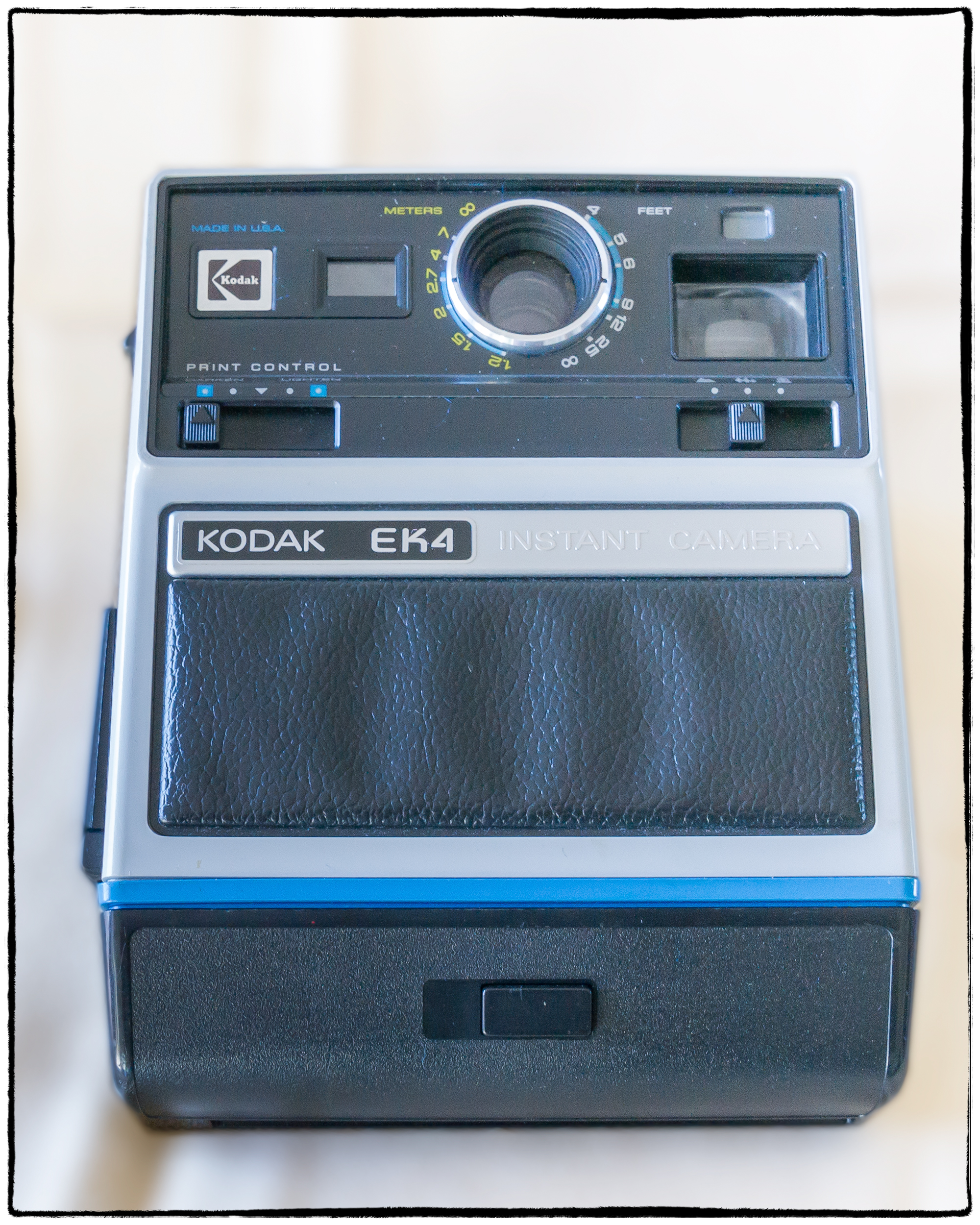
I picked up this old Kodak Instant camera (i.e. as in Polaroid not Instamatic) because of the interesting story behind it. I don’t ever expect to take pictures with it. Kodak stopped making the film almost 30 years ago. It was apparently possible to modify the camera to use Fujifilm FI-800GT film until as recently as 2010 when Fuji discontinued this film. The camera cost practically nothing so even if I could find some leftover Fuji film I wouldn’t be inclined to undertake the modification, and the film was apparently quite expensive.

The story is interesting though. In the 1960s Kodak had manufactured film for Polaroid’s cameras. However, in the 1970s they decided to introduce their own instant cameras. Although Kodak’s design differed from Polaroid’s, Polaroid immediately filed suit for infringement of its patents. The lawsuit dragged on for decades with Polaroid eventually claiming that during the 10 years Kodak had made these cameras Polaroid had lost $12 billion. The lawsuit was finally settled in 1990 with Kodak being found guilty on 7 of the 12 patent infringements.

Polaroid did not get the $12 billion it was asking for, but it did get about $1 billion. Furthemore, Kodak also had to compensate those who had bought any of their instant cameras between 1976 and 1986. Owners were asked to call and register for a compensation package, which would alow them to receive a rebate check for the cameras they had bought. So essentially Kodak had to “buy back” the cameras they had sold.

Kodak was forced out of the instant camera business entirely and never returned.

Kodak made 26 models of their instant cameras (as well as seven types of film) between 1976 and 1986. This is the first of them: the EK4. According to CameraWiki:

The EK4 is a very early model in the Kodak Instant line of cameras released in 1976. It’s features were very basic. It lack an electronic motor for film ejection and requires a hand crank. The nearly identical model EK6 was also available but had motorized ejection. Flip flash socket is on top of the camera. The lens has markings surrounding the lens in both meter and feet. Exposure and focus control is with sliders on the face of the camera. Sliding the focus control rotates the lens indicator to the corresponding distance markers. It used PR10 (PR144) film. It is powered by a 6V flat J sized battery.

Kodak House Museum Video Illustrating the History of Photography

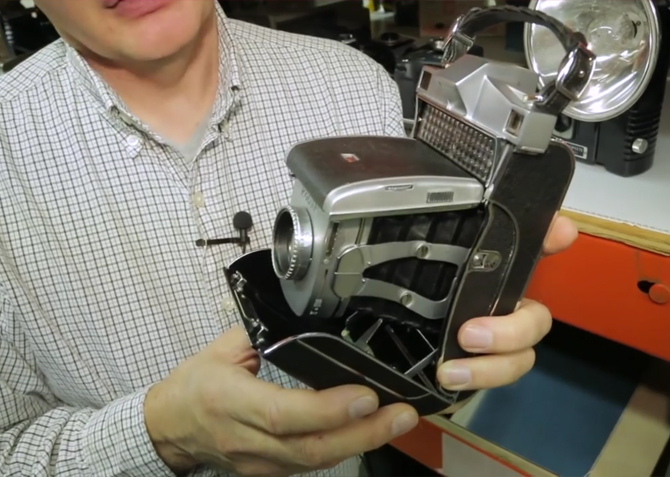
Kodak Super Six-20: the first camera with automatic exposure, introduced by Kodak in 1938.

If you’re really into old cameras (as I am) you’ll probably love this. If not you’ll probably find it boring. It’s essentially a conversation between Chris Marquardt and Todd Gustavson (from the Kodak Museum) regarding the history of cameras. It’s quite long (over one hour) and at times a bit rambling. I’m not sure that Mr. Marquardt adds much: he interjects a few words here and there, but Mr. Gustavson does most of the talking. I suspect that I would have enjoyed the video more if it has just been Mr. Gustavson talking. I found Mr. Marquardt’s interjections somewhat distracting I’m afraid. I would congratulate him on initiating the video though, which I found quite engrossing.

I have books on the history of cameras, but Todd Gustavson really brought the story to life. I found a number of items particularly interesting: the first zoom lens (the Voigtlander Zoomar); the first auto exposure camera, the Kodak Super 620 (I didn’t realize it was so big); the first flash bulb, the vacublitz (a glass tube filled with magnesium foil – it was absolutely enormous). It also reminded me how recent digital photography is. The first digital cameras (made by Kodak, using Kodak sensors and at various times Canon and Nikon bodies) came out in the early 1990s: only about 25 years ago. Interestingly they cost $25,000.

One word of warning though. My brother-in-law lives in Rochester, and during a visit we went to the Kodak Museum (formerly the Kodak House). While it was somewhat interesting I was a little disappointed. If you go don’t expect to see these vaults. They’re not accessible to the public (although a docent told me that if you give them advanced notice and indicate which areas you’re interested in it is possible to arrange a visit. I don’t know if he was correct). A small room with a limited collection of important historical cameras is open to the public, but this collection is much smaller than I thought it would be.

I can also recommend Mr. Gustavson’s book: Camera: A History of Photography from Daguerreotype to Digital.

From a complicated, time-consuming and expensive process to the simple press of a button, photography has come a very long way since the first cameras came along in the early 1800’s.The vast majority of this fascinating evolution can be seen in this video where Chris Marquardt went on a private tour of Kodak’s technology vault.Think you’ve got an impressive camera collection? Wait until you see this 8,500-strong collection of almost every significant camera invented in the last 200 years.

Source: A Journey Through The History of Photography in Kodak’s Technology Vault – DIY Photography

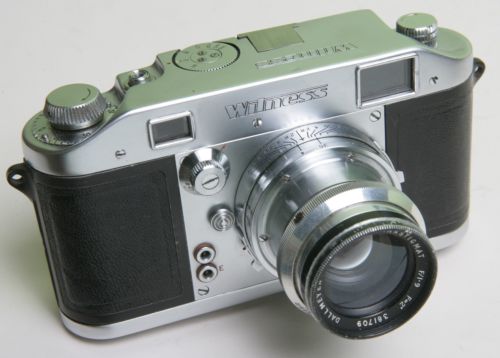
Rare Ilford Witness – You’ll just have to see this…

The title above relates to a post on Rangefinder Forum: Rare Ilford Witness – You’ll just have to see this…

It refers to an Ilford Witness camera that sold for US $18,262.96 with shipping costs of about $700.

Collectiblend (a site which provides values for vintage cameras provides the following estimates:

Average condition $3,200-3,400 body only; $11,500-$12000 with lens

Very good condition $4,000-4,600 body only; $16,000-17,000

Mint condition $7,500-8,000 body only; $25,000-26,000 with lens

They also provide examples of prior auction sales (the first three are from Westlicht and the fourth from Everard & Company Auction): 2014-03-25, “A-” Condition: $18,084; 2013-05-25, “B-” Condition: $18,576; 2012-11-24, “B-” Condition: $19,094; 2011-10-09, “B+” Condition: $13780.

Reading the thread what struck me was the overall tone: amusement, shock, incredulity as if the posters just could not believe the cost of this item. Yet from the information on Collectiblend it seems that this is not an aberration. This is what this camera, with this lens (and it seems as if the lens makes up the bulk of the value) goes for. It’s not as if this is the only camera that fetches large sums of money. Leica “null series” cameras typically fetch in the millions. Collectiblend estimates that a Nikon SP with lens will fetch between $5,600 and $14,000 depending on condition. Collictiblend also provides a list of the 100 most valuable cameras. None of them are below $60,000. Needless to say the Ilford doesn’t come close to making the list.

So are these cameras worth the money they command. To me they aren’t, but obviously they are to the people who buy them. Who knows maybe if I had the kind of money that would allow me to drop $60,000 plus on a camera I might buy one too. I just don’t understand the amusement, shock, incredulity etc. Maybe it’s because the Ilford is an interloper i.e. a valuable camera that isn’t a Leica? If I counted correctly Leicas make up 65 of the 100 most valuable cameras on Collectiblend’s lists.

Great resource for camera collectors


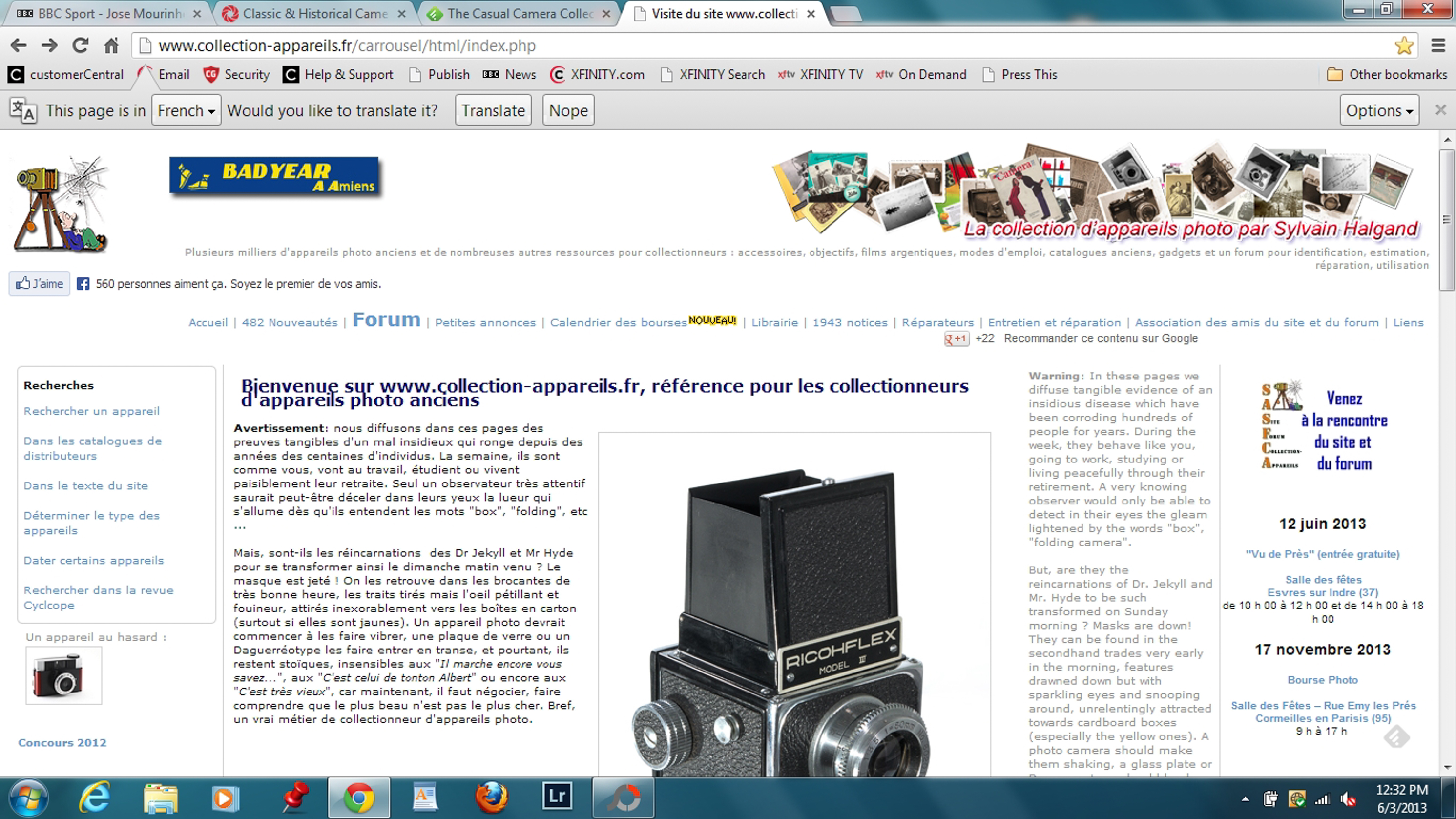
If you collect classic cameras or just like to read about old cameras this site will interest you. It’s he most comprehensive site on classic cameras that I’ve come across. It’s not the best designed site I’ve ever come across, but the coverage is astonishing. Unfortunately it’s in French. Many of the pages have fairly rough English translations though and there’s always Google’s translation capabilities.Here’s what the introduction says (in French and then in the English translation – which actually says more than the French).

Avertissement: nous diffusons dans ces pages des preuves tangibles d’un mal insidieux qui ronge depuis des années des centaines d’individus. La semaine, ils sont comme vous, vont au travail, étudient ou vivent paisiblement leur retraite. Seul un observateur très attentif saurait peut-être déceler dans leurs yeux la lueur qui s’allume dès qu’ils entendent les mots “box”, “folding”, etc …

Mais, sont-ils les réincarnations des Dr Jekyll et Mr Hyde pour se transformer ainsi le dimanche matin venu ? Le masque est jeté ! On les retrouve dans les brocantes de très bonne heure, les traits tirés mais l’oeil pétillant et fouineur, attirés inexorablement vers les boîtes en carton (surtout si elles sont jaunes). Un appareil photo devrait commencer à les faire vibrer, une plaque de verre ou un Daguerréotype les faire entrer en transe, et pourtant, ils restent stoïques, insensibles aux “Il marche encore vous savez…”, aux “C’est celui de tonton Albert” ou encore aux “C’est très vieux”, car maintenant, il faut négocier, faire comprendre que le plus beau n’est pas le plus cher. Bref, un vrai métier de collectionneur d’appareils photo.

Confession: depuis 1992, je pèche souvent le dimanche matin, quelquefois plusieurs fois de suite. C’est toujours le dimanche le matin venu que c’est le meilleur, au milieu de la foule des premières heures, mais je suis tellement atteint que même en pleine semaine, parfois je pratique mon vice dans des lieux réservés à cet effet. Les fruits de mes péchés sont un peu plus nombreux, année après année. Ce n’est pas aux plus beaux que je tiens le plus, bien au contraire.

Warning: In these pages we diffuse tangible evidence of an insidious disease which have been corroding hundreds of people for years. During the week, they behave like you, going to work, studying or living peacefully through their retirement. A very knowing observer would only be able to detect in their eyes the gleam lightened by the words “box”, “folding camera”.

But, are they the reincarnations of Dr. Jekyll and Mr. Hyde to be such transformed on Sunday morning ? Masks are down! They can be found in the secondhand trades very early in the morning, features drawned down but with sparkling eyes and snooping around, unrelentingly attracted towards cardboard boxes (especially the yellow ones). A photo camera should make them shaking, a glass plate or Daguerreotype should lead them close to madness, and yet, they remain stoical, impassivly earing the ” It still works you know…”,the ” It is uncle Albert’s” or ” It’s so old”, because now, it is time to negotiate, making plain that the most beautiful is not the more expensive. In short, a real photo cameras collector professionnal.

A confession: Since 1992, I have often sinned on Sunday mornings, at times, several times in a row. It is always Sunday morning which is the best, in the middle of the early morning crowd, yet I am so afflicted that sometimes even in mid-week I practice my vice in the locations reserved for this practice. The fruits of my sins have increased somewhat more each year. Yet it is not with the most beautiful that I have more; quite the contrary.