January film camera – Fuji GS645S

I started to collect cameras about five years ago and over the years I’ve acquired quite a lot. However, looking back over my collection I realize that I’ve only actually used a few of them.

So I’ve made a couple of New Year’s resolutions.

The first is to limit new acquisitions. Notice that I said ‘limit’ and not ‘stop’. I reserve the right to acquire cameras if a) they’re on my list of cameras I really, really want; b) they’re especially inexpensive. If I see something that takes my fancy and it will cost me less than I would usually spend for lunch then why not? The point of this is to limit additional cameras so I can try to use more of those I already have, which leads me to my second resolution.

Second. Most of my camera collection consists of old film cameras so I’m going to try to use a different one each month for the foreseeable future.

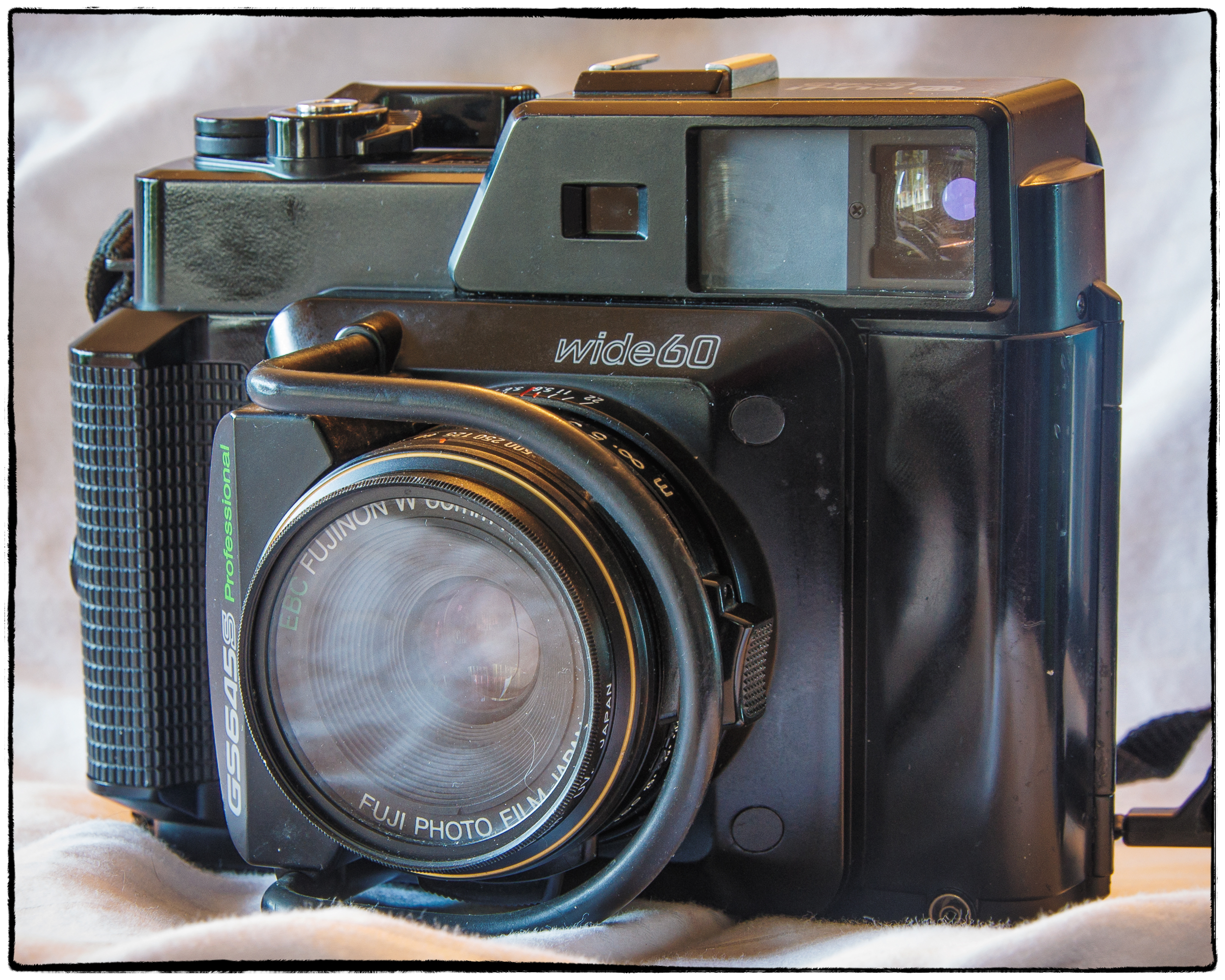
January 2017’s camera is the Fuji GS45S, which I acquired a few years ago and have never used. It’s a medium format film camera, first produced in 1984. It uses 120 roll film (15 6cm x 4.5cm exposures per roll) and 220 roll film. It’s a manual (rangefinder) focus camera that uses batteries only to power the center-weighted meter, which displays correct, over and under markings in the viewfinder. One quirk: when you look through the viewfinder the image you see is portrait format. To get a landscape (i.e. horizontal) format the camera must be turned on its side. It has a 60mm (35mm equivalent of 35mm) f4 Fujinon lens with focus, aperture (f4-f22), and shutter speed (1/15 – 1/500) settings on the lens barrel. ISO settings are from 25 to 1600. Another prominent feature is the ‘bumper’ around the lens barrel. Apparently the lens mount is quite fragile and the bumper is needed to stop it from shearing off. Looks like I’ll have to be particularly careful with this one.

A couple of reviews provide additional information:

Fuji GS645S Review by H W Kately on Film Shooters Collective.
Camera review: Fuji GS645s by Roy on Printer Attic.

For a medium format camera it’s not so large (about the same size as a large 35mm SLR) and it’s comfortable to hold. Despite the complaints about the fragility of the lens mount (which I’m convinced are valid) it otherwise feels quite solid. The meter worked well. My only real complaint relates to the rangefinder: the spot is quite small and somewhat difficult to see, particularly when the camera is held on its side for a horizontal shot. I found that I had to check the focus in the vertical position and then turn the camera sideways afterwards. I read somewhere that you can make the rangefinder spot brighter by placing a small piece of tape on the front of the viewfinder (see Resurrect Your Dim Rangefinder by Rick Olson). I may try this. Turning the camera sideways for a horizontal picture is, in any case, a little uncomfortable so if the majority of your pictures are horizontal this camera may not be for you.

I enjoyed using it, but since it was my first time I allowed for possible problems by framing wider than I usually would so that I could crop later if need be. This turned out to be a good idea because the camera had a light leak – fortunately fairly small and on the edge of the negative where it was easy to crop out. The leak is probably caused by old, decaying light seals and if I find I’m using the camera a lot I’ll consider having them replaced. If, as seems more likely, I use it infrequently I’ll probably just cover the offending area (I’m pretty sure I know where it is) with tape.

For some pictures taken with this camera see: Amawalk Friends Meeting House.
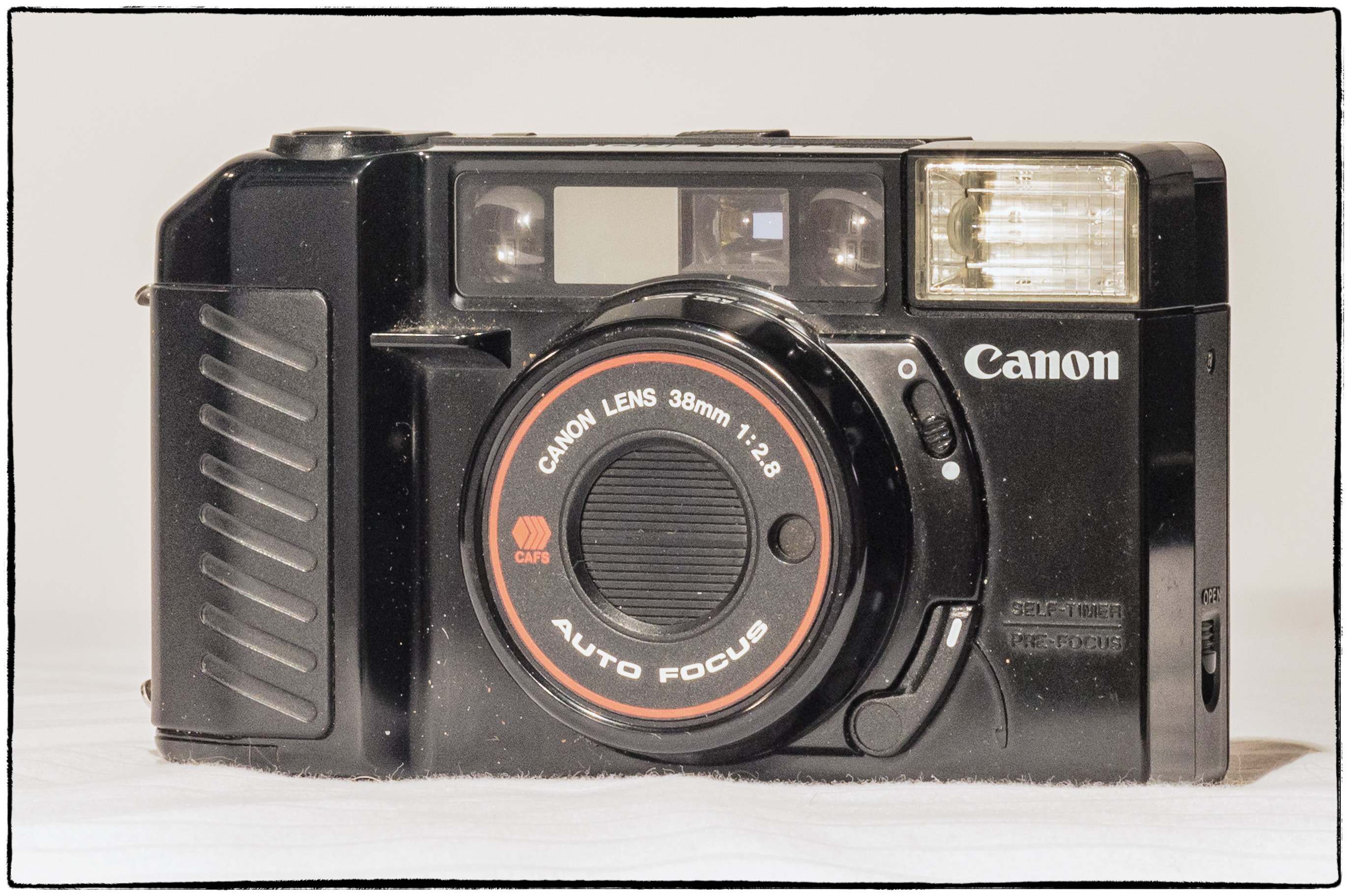
Thrift store find – Canon AF35M

I came across this camera in a nearby thrift store (Goodwill). It seemed to be in pretty good shape and had a solid feel to it. Although I’d already read about this camera before I’d forgotten about it. So I left it. After returning home I looked it up and discovered that it might have some historical significance. The Konica C35 AF (which I also have) was the first autofocus camera, but it apparently had a not particularly impressive passive autofocus system. The Canon AF35M introduced a better active autofocus system, which I believe has formed the basis for camera autofocus ever since.

According to a post (Canon AF 35M), which also provides a detailed review of the camera on Mike Eckman’s excellent site:

In terms of historical significance, the AF35M was the first camera in the world to offer a modern automatic focusing system. The reason I threw the word “modern” in that previous sentence is because its actually the second auto-focus camera released in the late 70s. The first was the Konica C35 AF which came out two years earlier in November 1977. Many people do not consider the Konica C35 AF to be a truly automatic focus camera because Konica “cheated” somewhat in how they accomplished automatic focus.

An ad from 1980 for the AF35M hyped the frustration free simplicity of the camera. Konica employed the use of the Visitronic AF system that was created and produced by Honeywell. This system was a passive auto-focus design which used a traditional two window rangefinder to compare the light entering each window, and through the use of a primitive CPU, it would estimate range and then adjust the focus of the lens to achieve proper focus. Canon’s CAFS (Canon Auto Focus System) from the AF35M used a scanning infra-red light beam that would triangulate distance by reflected light bouncing back to the camera. Konica’s system was easily tricked and could not handle moving or very small objects very well. Canon’s CAFS system was far from fool-proof, but it handled a variety of scenes, including low light situations, much more reliably.

I also discovered that the camera is capable of taking impressive pictures (see A Canon in A Minor – the AF35M on Random Camera Blog).

I had to go back to the same area the following day and I decided that, if the camera was still there, and if the price was less than $10 I’d get it (the camera had no price sticker on it). As it turned out the price was $5 so I got it.

Surprisingly the camera had functioning batteries in it and fired up immediately when I turned it on. Everything else seemed to be working fine too.

I did a bit more research and discovered that this particular model was not the first in the series though. There are a large number of different models from the first in 1979 to the last in 2005. I’m most interested in the early models. The first three models were (the names represent the way the camera was designated in the USA, Europe and Japan):

Canon Sure Shot/AF35M/Autoboy (1979)
Canon Super Sure Shot/AF35ML/Autoboy Super (1981)
Canon (New) Sure Shot/AF35M II/Autoboy 2 (1983)

The one I had was the third: (New) Sure Shot, AF35 M II, Autoboy 2. The problem arises because the first and third US models are both labeled on the top plate as simply ‘Sure Shot’. Of course I decided that I had to have the first. I found one on ebay and hope to receive it soon. Then I’ll have decide if I want the Super Sure Shot with its faster lens (f1.9 instead of f2.8). A quick look at ebay tells me that this model is somewhat more expensive so maybe I’ll just wait and see if I bump into one in a thrift store of flea market.

For those Twin Lens Reflex (TLR) aficionados out there

If you’re into Twin Lens Reflex (TLR) cameras you’ll love this site. It has a very simple name: TLR Cameras Website and it’s not all that attractively presented. It has a very ‘old style’ look to it, but it’s packed with information about TLRs of all kinds. The section on his collection (one of eight sections in all) contains sub-sections on:

  • American TLRs (mostly – some are rebadged Japanese)
  • British TLRs (not very extensive, just MPP from Kingston)
  • Chinese and Hong Kong TLRs
  • Czechoslovak TLRs – some of the nicest made
  • French TLRs (surprisingly many)
  • German – this button takes you to a sub-index
  • Japanese TLRs – this button takes you to another sub-index
  • Polish TLRs – all from WZFO’s factory
  • Russian TLRs – not just Lyubitels!
  • Other sections include:

  • Links to other sites with strong TLR content
  • A very abbreviated history of the TLR
  • Other bits and pieces of TLR history
  • Items for sale – surplus collectables
  • Key reference sources used for this site
  • Cameras I’d like to buy!
  • It’s a veritable treasure trove of information on TLRs. I never knew that there were so many different models of TLRs, from so many different manufacturers.

    The copyright notice on the site extends only as far as 2013, which makes me wonder if the site is still being maintained. A contact link provides a mechanism for getting in touch with the site creator.

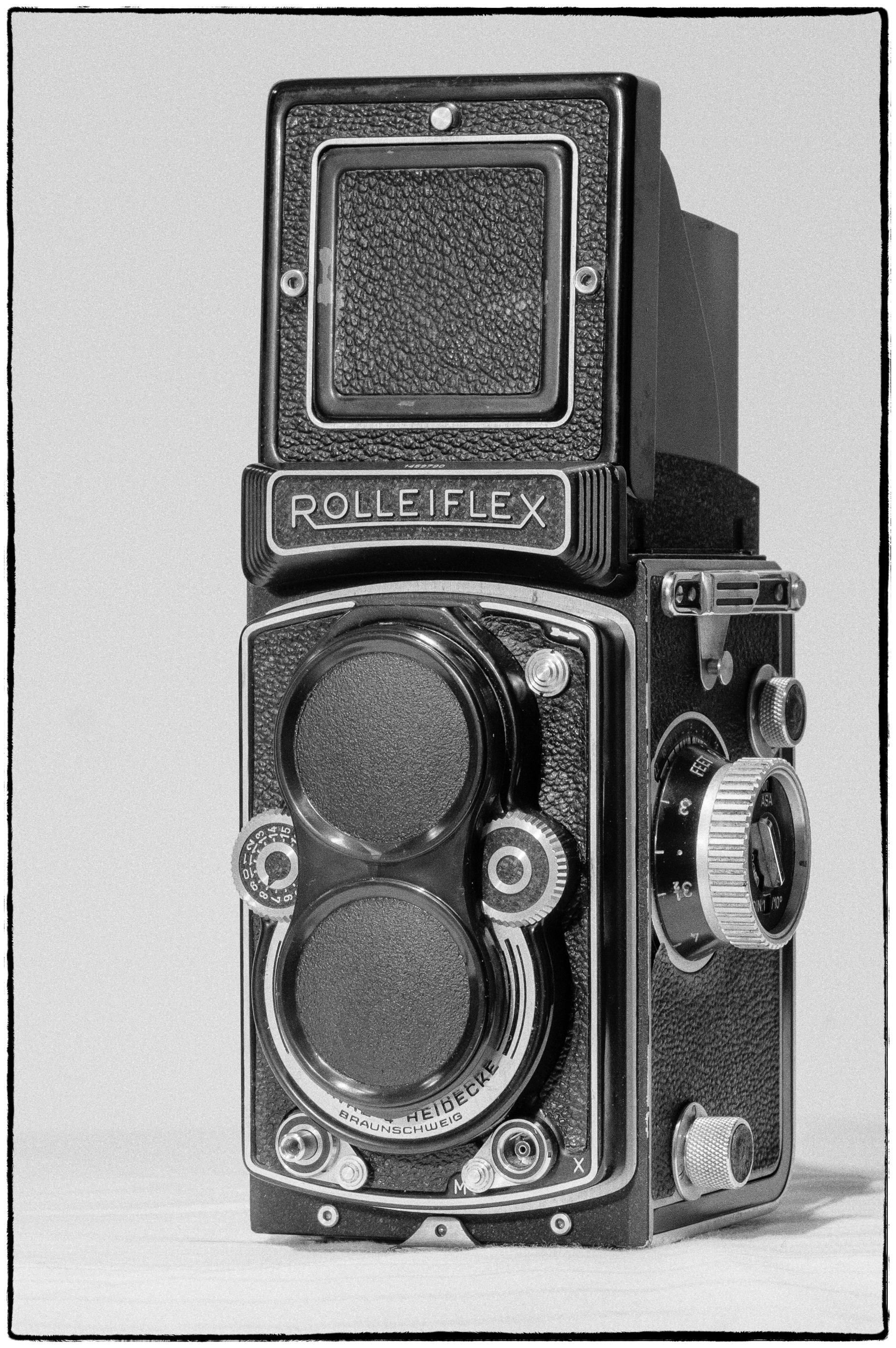
    The camera above is my own Rolleiflex. I’m by no means an expert on the various Rolleiflex models, but according to the lists of serial numbers on the internet it’s a 1954 MX-EVS type 1 with 75mm f3.5 Schneider Xenar lens. This makes it about the same age as myself and it’s in similar condition: cosmetically not great and a bit worn around the edges, but still ticking. I bought it on a whim sometime in the 1980s. I think I used it twice and wasn’t too happy with the results (I’m sure it was because of my lack of familiarity with the camera and my photographic skills, which were much more rudimentary in those days). I tried it out again today. Everything seemed to work. The aperture opened as expected and the shutter fired with no problem. To my untrained ear the shutter speeds seemed to be working OK (e.g. 1/8th second sounded much longer than 1/60th). I’ve read that after not being used for such a long time it’s likely that the shutter speeds are off. I guess I’ll have to try it and find out and then possibly arrange for a thorough CLA. Focus was fine even if the viewfinder is a bit dim.

    I really like TLRs and I have a sneaky feeling that I might be on the verge of a GAS attack.

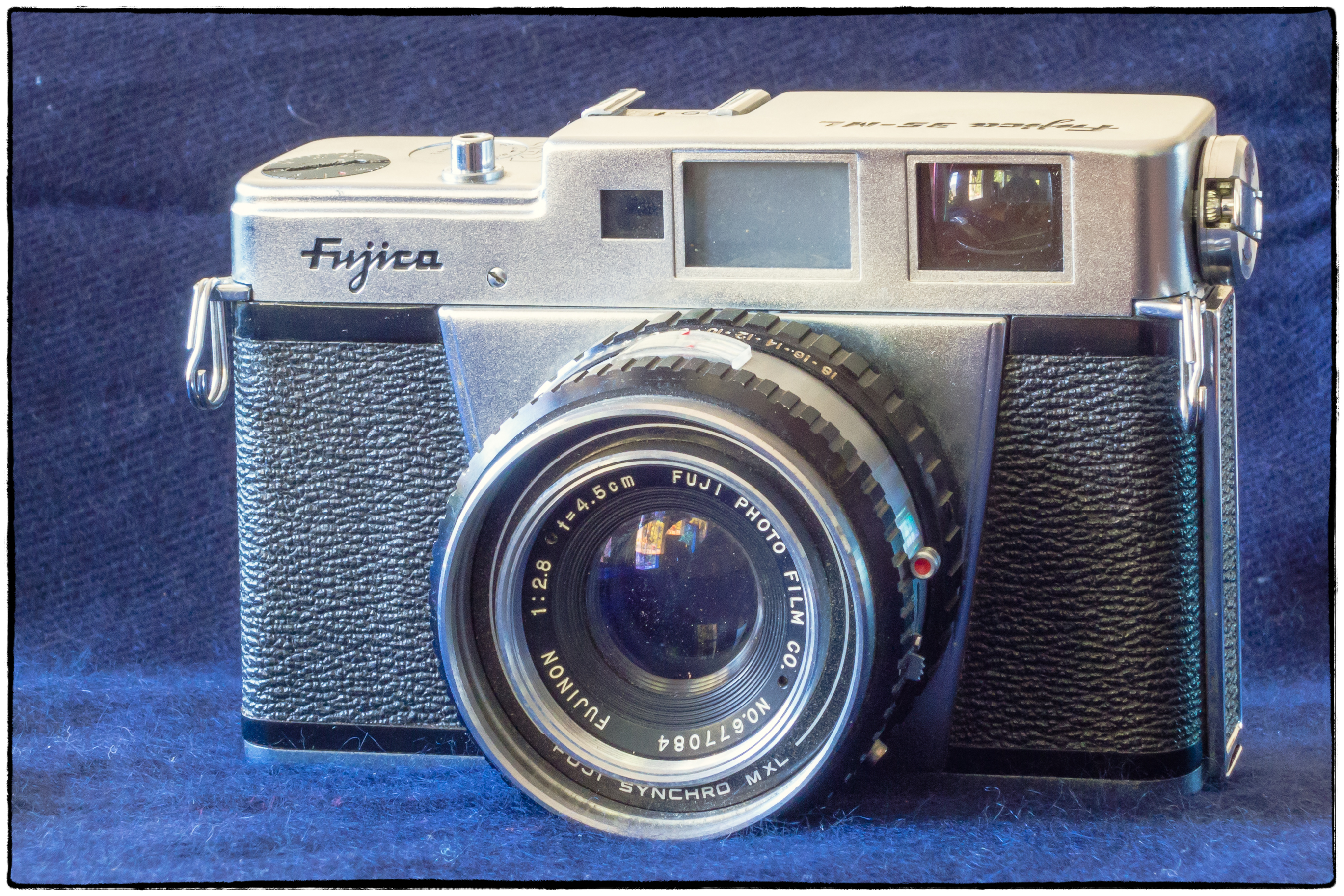
    Fujica 35-ML

    A few years ago I began my camera collection. After getting a couple of rangefinder cameras I started to browse the internet to see what others I might find and bumped into this post on photo.net: The Final Fujica’s Film. I liked the look of the camera and was somewhat taken by the images provided. Time went by and I would occasionally see one for sale, but until now I hadn’t actually gotten around to acquiring one. Recently, however, I saw this one. It was quite inexpensive and looked to be in fairly good condition. So I purchased it.

    According to Sylvain Halgand’s wonderful site:

    This camera has a coupled rangefinder and a parallax correction. An ultra-bright orange framing view is visible in the viewfinder and moves accordingly to the setting of distance. This setting is a first surprise because the setting is not made by turning a ring around the lens, but by turning a knob located where there is most often a film advance lever, it means under the right thumb. Distances are displayed by a rotating plate, located on the cover of the camera (near the frame counter) also serving as depth of field chart.

    Accordingly, the film advance lever is below the camera without doubt in order to leave a body cover as flat as possible; the rewind crank is located on the side, such as a Leica.

    The shutter speed and aperture settings are made by turning the two rings around the lens. A small window on the top of the lens displays the selected values. The values are combined using EV (exposure value).

    The shutter allows shutter speeds from 1 second to 1/500 per sec, plus B. It has a self-timer, and M sync and X sync.

    The lens is a Fujinon 45mm/2.8 with 5 elements.

    In 1959, this camera was sold in the United States, § 69.95.

    I was a little disappointed when it arrived. I’d bought it from a reputable dealer, from whom I’d bought a number of cameras in the past and with whom I’d always been satisfied. The camera was described as working and came with a decent warranty. However, when I examined it I noticed that in fact it wasn’t working – the shutter was stuck. I could have returned it under the warranty, but I’d paid so little for it I couldn’t be bothered. I’ve always had a yen to try fixing these older cameras. I’ve got to start somewhere. Maybe with this one?

    And even if I never get it to work – so what! It still makes a decent display piece.

    Minolta Hi-matic/Ansco Autoset

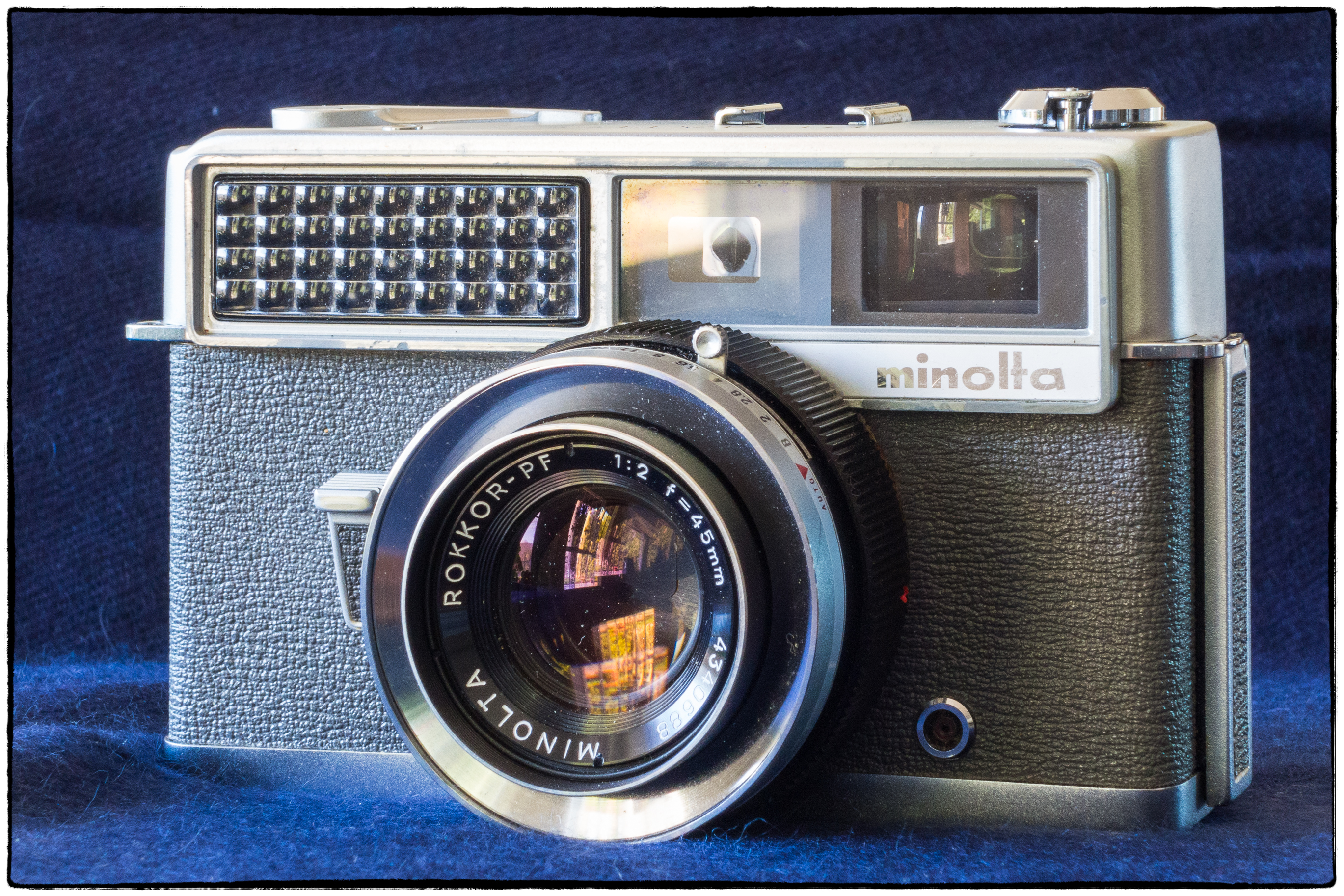
    When I started collecting cameras I insisted on getting cameras that worked. After getting a number of them, however, I resigned myself to using only a few. So I don’t really expect to use this camera much – if at all. So why did I get it? I got it because it fits a couple of niches in my camera collection: 1) It’s a rangefinder camera, which I what I originally started collecting; 2) My original camera was a Minolta Hi-matic 7sii and I’ve always had an idea that I might collect all of the cameras in the series and this is the original Minolta Hi-matic, or as the re-badged US version was called: the Ansco Autoset; 3) The Ansco Autoset has an interesting story behind it – it may well have been the first camera in space:

    Nearly 50 years ago, John Glenn purchased a camera at a drug store that served as the first astronomical experiment performed by a human in space. That three-orbit voyage for Glenn included two cameras, one the Ansco he purchased and the other a Leica supplied by NASA. The flight not only kicked off decades of orbital experiences for U.S. astronauts, but also science experiments, observations, and thousands of rolls of film and digital files created through hand-held photography. The results of those experiments and the photos taken are what people left on Earth use even today to understand human spaceflight.

    Source: Another Journey for John Glenn’s Ansco Camera – AirSpaceAirSpace

    John Glenn’s Ansco camera in front of “Friendship 7”

    As can be seen in the picture above the camera was much modified. Note that the camera is upside down, with a handle added on top (bottom in the picture) and an additional viewfinder has been added to the bottom (top in the picture). Follow the link above to an article with more information.