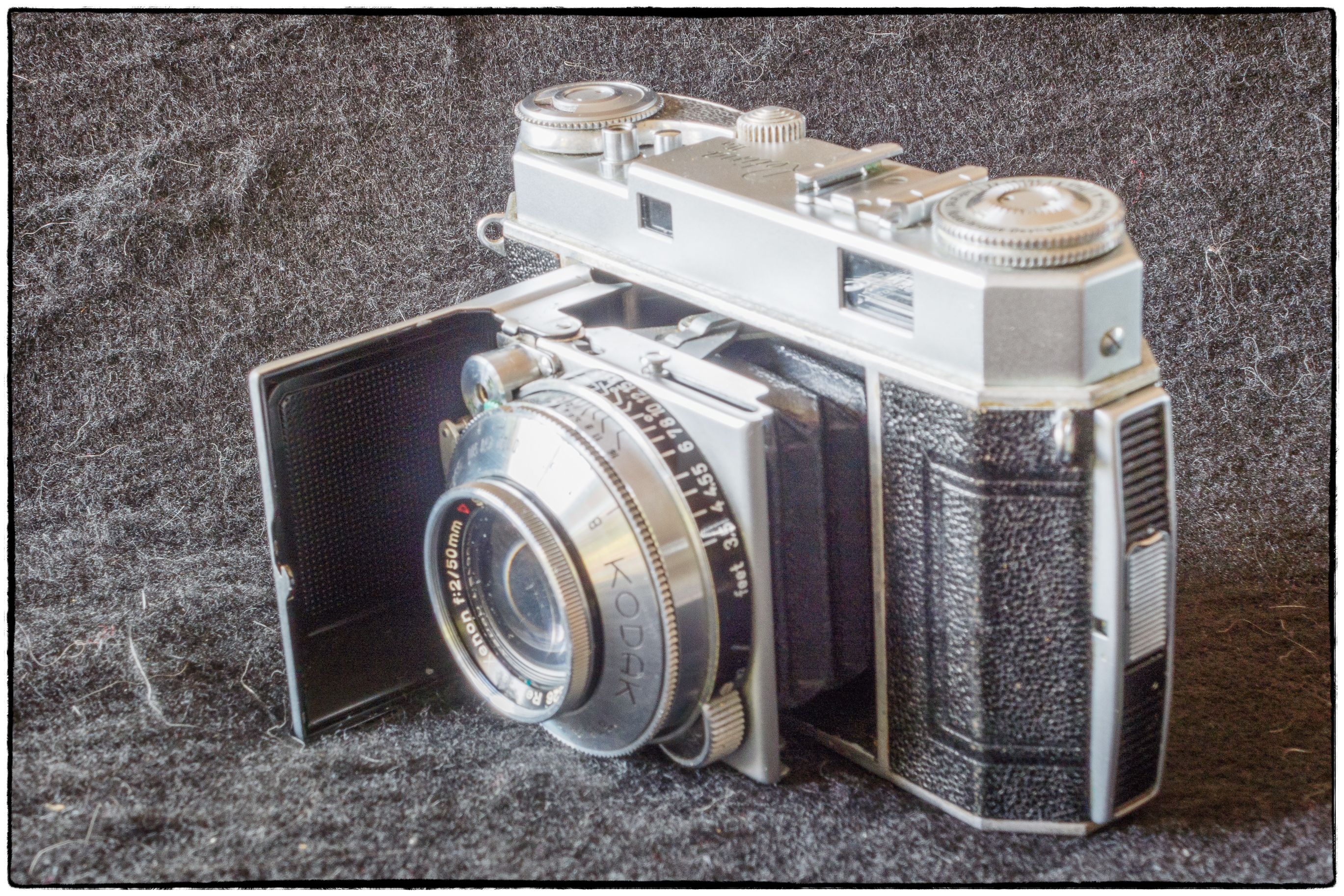
Retina IIa

I love Kodak Retina Cameras. I’ve already posted about the first one I acquired: A Gem of a folding 35mm – Retina IIc. Since then I’ve acquired three more: A IIIc, a IIa, and this one – also a IIa. The IIIc seemed to work except for the slow speeds. When I tried it today that was how it worked, but then suddenly it wouldn’t work on any of the speeds. The first IIa was a bit “beat up” and didn’t seem to be working (that’s why I bought this one), but when I tried it today to my surprise everything seemed to work so now I have two IIa’s. Apart from condition the only difference between them is the shutter. This one has a Syncho-Compur while the other one has the Compur Rapid (an earlier shutter carried over from the Retina II I believe). This one is fairly good cosmetically and everything seems to work. Of course, I won’t know for sure until I try it so we’ll have to wait and see.

Mine has the following features:

  • Combined Rangefinder Viewfinder. No brightlines. No parallax correction
  • Fixed 6 element 50/2 Schneider Xenon focusing to 2.5 ft.
  • Synchro-Compur Shutter with speeds from 1 to 1/500th, plus B. Electronic flash sync at all speeds
  • Screw threads on shutter release for manual cable release.
  • Film counter is manually reset and counts down.
  • No hot shoe but lens has flash connection on bottom.
  • Tripod socket on bottom of camera.

Stephen Gandy of Cameraquest has the following to say about the Retina II and I agree with him entirely:

The Kodak Retina IIa is my favorite of the long lived Retina series, the epitome of a classic small fast lensed 35mm folder. What makes it so good? It’s small size, superb 50/2 Xenon or Heligon lens, better than average finder, quiet leaf shutter, and the simple straightforward design which translates to pleasurable shooting. The IIa was produced only from 1951 to 1954, yet over 100,000 were produced. In a nutshell, many Retina fanatics feel the earlier Retinas had less of the desirable features, while the later Retinas sacrificed too much size and weight for additional features. The IIa is Type 016 in Retina nomenclature.

All shooting controls except f/stop are easily seen from the top, including the frame counter, shutter speed, and focused distance, and depth of field scale. The hinged back opens by pulling downward on the clasp at the rewind edge of the camera. While the Retina IIa lacks the magnificent finish of the Zeiss Contessa or Voigtlander Vitessas, the Retina is the simpler, quicker photographer intuitive camera design. The IIa was among the best sellers of its day, so they are not that hard to find. Yet, it is difficult to find one in mint condition. This sad state of affairs is due to the damn photographers out using Retinas to take pictures.
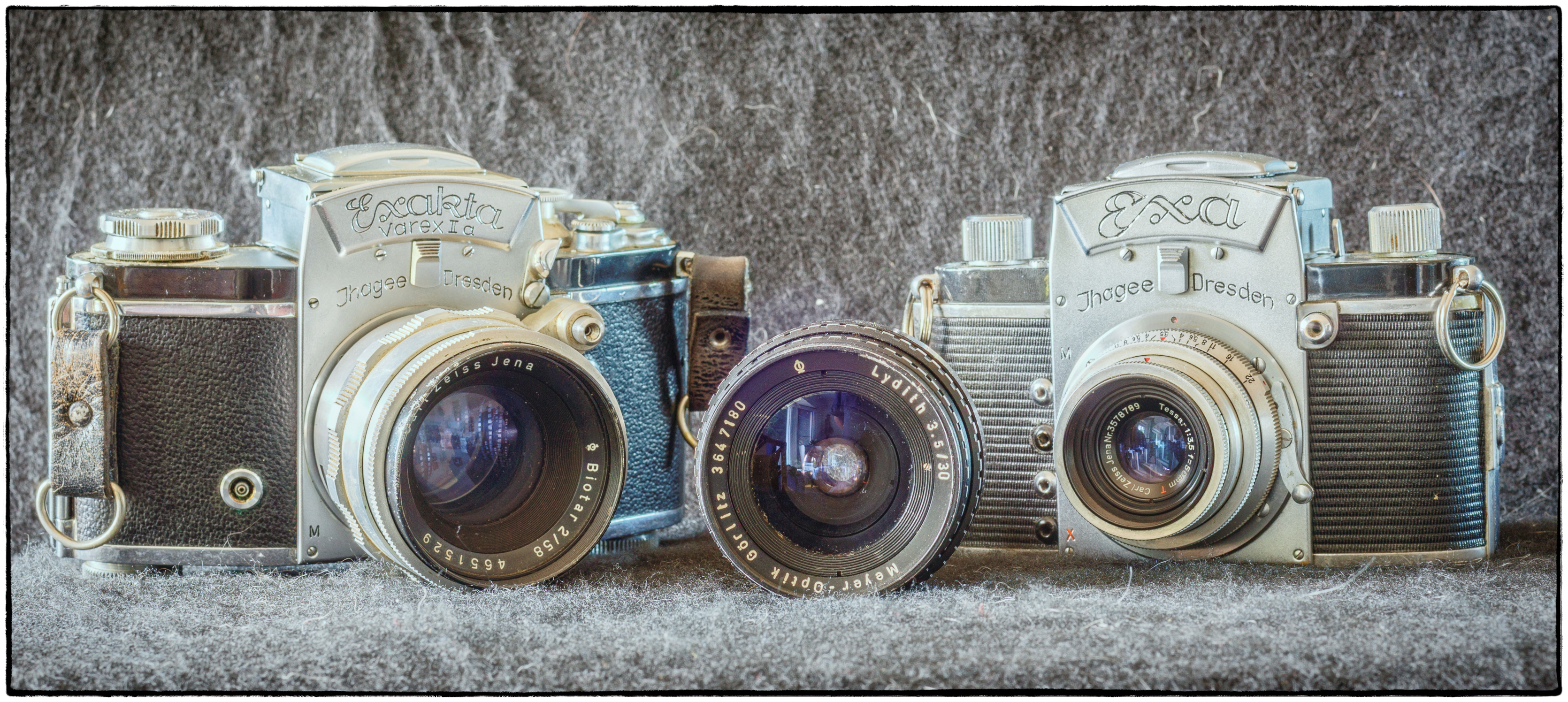
New Acquisitions – Exakta Varex/VX IIa and Exa

Two separate purchases landed me with an Exa (original version) with a 50mm f3.5 Carl Zeiss Jena Tessar; and an Exakta Varex/VX IIa with a 58mm f2 Carl Zeiss Jena Biotar and a 30mm f3.5 Meyer Optik Görlitz Lydith. I think I paid around $100 for the lot so I’d didn’t have very high expectations. I think that they are beautiful cameras though and figured that even if they didn’t work they’d look nice on a shelf. I was surprised to find that both cameras seem to work, although I haven’t run any film through them so I don’t know for sure. Everything definitely needs cleaning though.

The Exakta is in pretty good shape apart from a little lifting of the leather, which can easily be glued back. The Exa has a slightly wonky but functional finder, which doesn’t bother me greatly as I can use the finder from the Exakta (one of the benefits of having replaceable finders). A piece of the leather has worn on the back of the Exa. I might consider replacing it one day depending on whether or not it works.

As for the lenses – I tried out the Lydith on my Nex 5N and really like it. The Lydith and Biotar are somewhat “beat up”, particularly the Biotar, but they all seem to work, although the auto diaphragm is rather sluggish and I fear that the shutter will close long before the lens stops down. This doesn’t bother me much as I don’t mind stopping down manually so I probably won’t use the auto diaphragm. The Tessar seems to be in better condition. More to follow when I’ve tried out the Biotar and the Tessar.

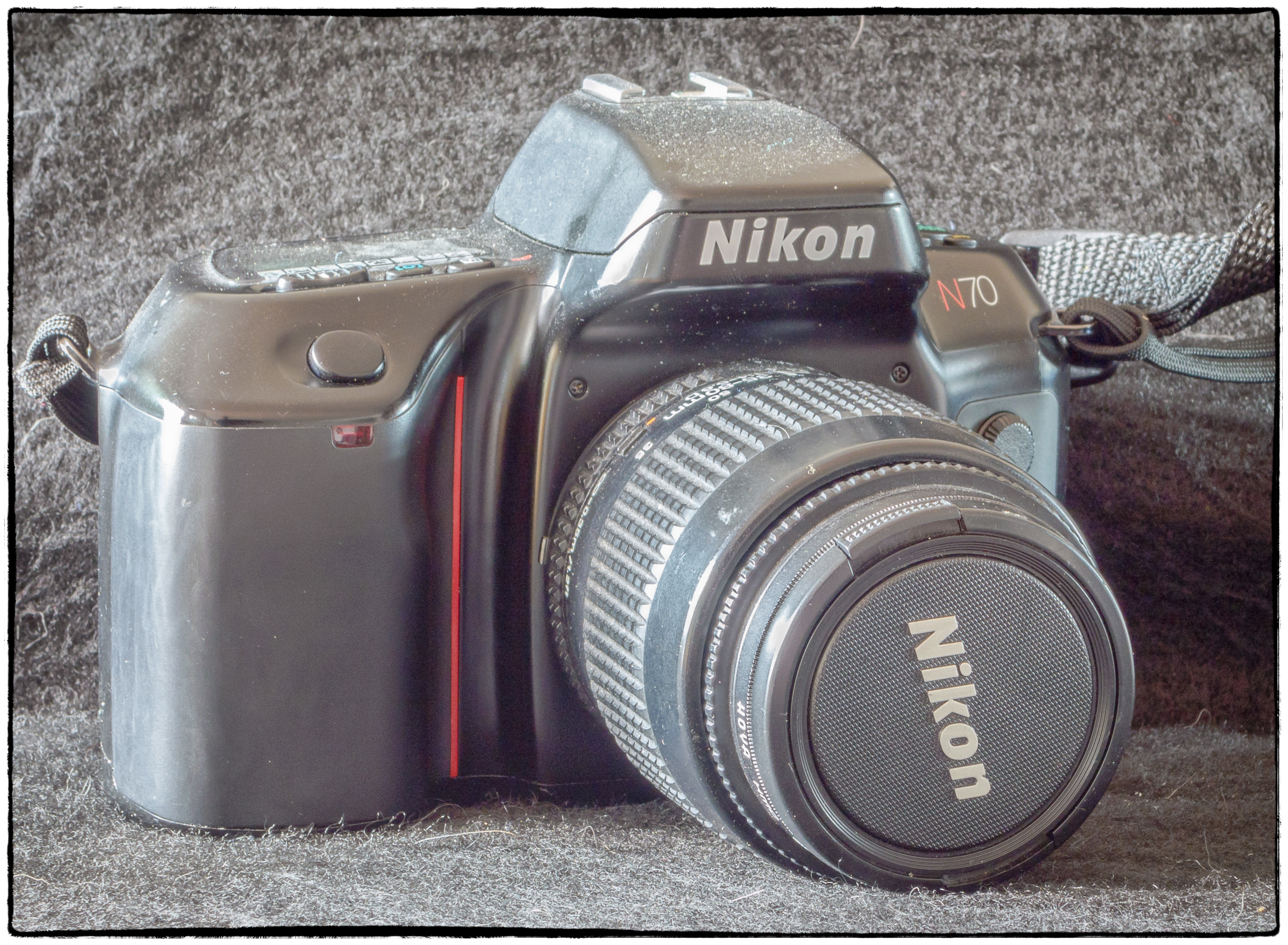
Nikon N70/F70

I didn’t especially want this camera. When I started collecting cameras I though I would stick to rangefinders, but somewhere along the line I got distracted towards SLRs. I bought a Yashica FX-3 in a thrift store because I found myself stuck without a camera and wanted to take pictures. I’d never owned a Nikon so I thought if I’m getting SLRs I might as well get a Nikon – that led to the acquisition of a Nikon F2 body. Then I needed a lens and I found the lens (a manual focus lens) I wanted attached to a Nikon N90s. I liked the N90s and realized that I’d never actually used an autofocus SLR – so I needed an AF lens. I found such a lens attached to this N70, which as I said, I didn’t especially want. I think I spent about $30 for the camera and lens so what did I have to lose. I put a roll of film in it to see if the body worked, put it away and never used it. The other day I remembered there was a film in it and decided to try it. Inevitably I took pictures of what was close to hand: flowers in our garden.

As I was only trying to see if the camera worked I can’t say that I tried it out very thoroughly. I put it into aperture priority and largely “pointed and shot”. I was using an old film and taking pictures at the worst time of day (around noon). All I can really say is that the camera felt comfortable enough in my hands and not too heavy around my neck. The rather strange fan-shaped interface is unique to this camera and I don’t think Nikon used it again – probably because of all the negative feedback. Nikon aficionado Thom Hogan had this to say (I don’t know when this was written):

The F70/N70’s gimmicky LCD interface met with a lot of derision. However, unlike the F60/N60 or F65/N65, the F70/N70 gives its user plenty of feedback on what’s been set and what the other options are. As such, it’s a good learning camera. The F70/N70’s specifications are mostly good (other than the 1/125 flash sync), and the camera is arguably a bargain at its current prices. The metering and autofocus systems are quite good for an amateur camera and the range of abilities of this camera are quite sophisticated. The built-in flash isn’t very powerful and large lenses get in the way of its coverage, so don’t count on not having to buy a Speedlight. Three things keep me from recommending it wholeheartedly to advanced amateurs or aspiring pros:

1. The lack of depth of field (DOF) preview is a serious omission.
2. That LCD interface really does demand that you take your eye from the viewfinder to make many setting changes, which is okay for learning, but frustrating when you need to work fast.
3. The F80/N80 that replaces it in the Nikon lineup is clearly a better camera and fixes nearly all the F70/N70’s shortcomings.

While I agree that the interface is rather “fiddly” I imagine that once you’re used to it it’s not that bad. Definitely a usable camera though. The pictures were very contrasty and the colors were a bit off (probably because of the old film) and so needed “tweaking” in post processing.

Voigtlander Vitomatic II

It’s almost a year since I posted anything related to my camera collection. This doesn’t mean that I haven’t acquired additional cameras. It’s mostly because at some point I decided that I wouldn’t post anything to do with the cameras in my collection unless I could also include some pictures taken with the camera. Unfortunately, the cameras I collect are all film cameras and for some reason I haven’t been doing much film photography of late even though I enjoy the experience of shooting film a lot.

So I’ve been forced to rethink the decision mentioned above. I’ll now post pictures of the cameras themselves and if/when I get around to using them I’ll do another post with the pictures taken.

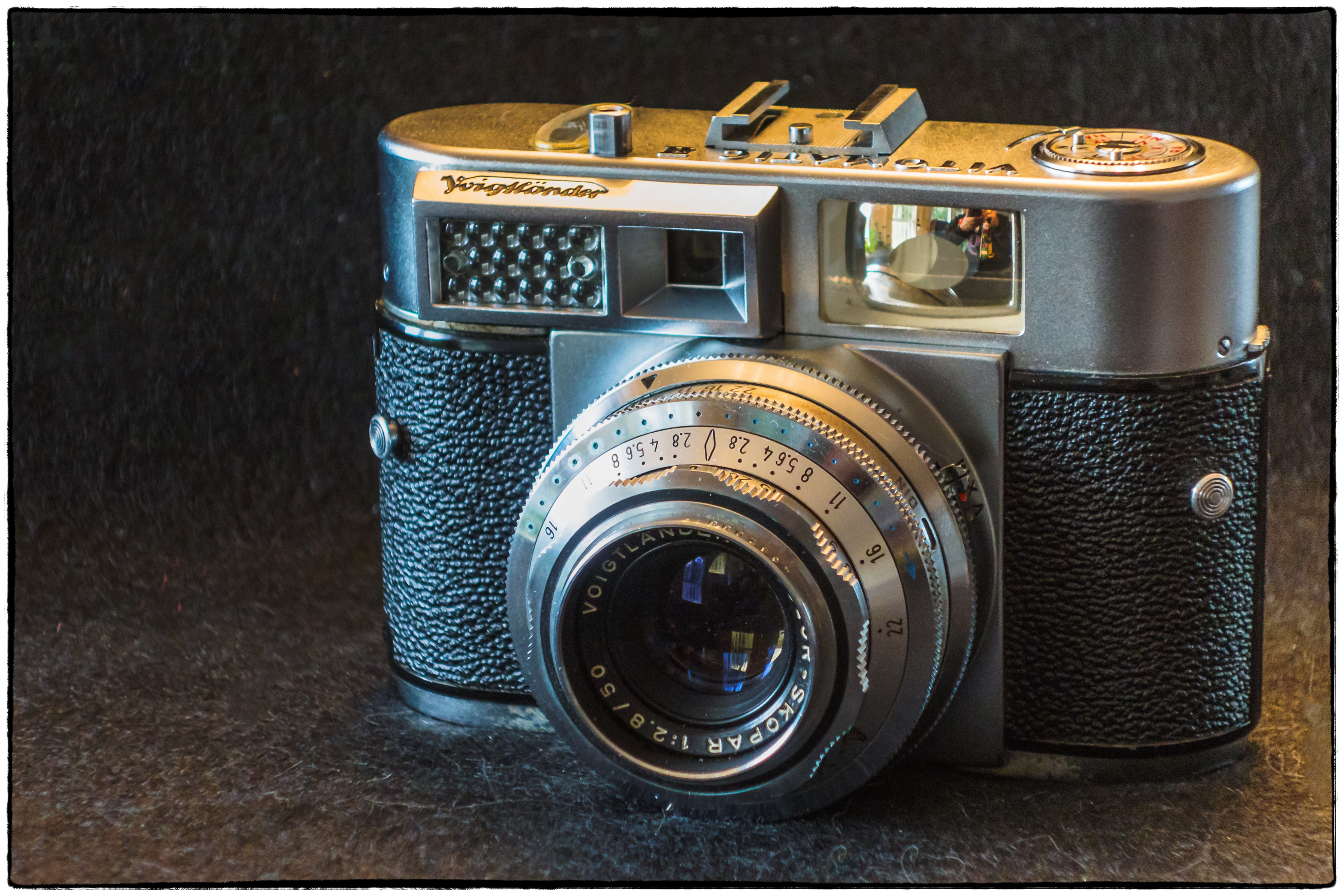
This is one of my latest acquisitions: a Voigtlander Vitomatic II from the late 1950s. It’s solidly made from metal and for a camera of its size (quite small) it’s quite heavy. It has a coupled rangefinder and meter, both of which seem to be working even though the rangefinder patch is a little dim and I’m not entirely convinced that the meter is accurate (which doesn’t bother me since older selenium cell meters rarely work at all and in any case I have a meter I can use). I suspect that the price was good because the seller thought that the shutter wasn’t working. I took a chance on this not being the case as I’d read that because of a peculiar shutter cocking mechanism the shutter won’t cock and fire without a film in the camera. This turned out to be the case and the shutter seems to be working fine. It has a Voigtlander Color-Skopar 50mm f2.8 lens with apertures from f2.8 to f22. I have a modern Color Skopar lens and if it’s anything like that it will be an excellent lens. Shutter speeds top out at 1/300 second, which is fine for me. I don’t do much ‘action’ photography. Cosmetically it’s in pretty good shape. It has a large viewfinder with bright lines.

It’s a beautiful camera. In fact I’m thinking of collecting some of these 1950s/1960s Voigtlander and Zeiss cameras. I love the way they look, they’re pretty well made and are often still working even after all this time. Also most of of them don’t cost a lot, particularly in the condition I’m looking for (I’m not looking for mint condition). This is an important factor as most of the cameras I now want cost more than I’m willing to pay. There are many variants of Vitos, Vitomatics and the like and I could see myself getting a few of these. I’ve got my eye on a Vito B, first version with the smaller viewfinder.

Cameras Galore

We recently had a visit from one of our oldest and dearest friends. She’s being posted to the UK (London) and went to New York City with her husband and two children. On the way back to Ottawa they stopped by and spent the night. It was great to see them again.

As they prepared for their move they came across a number of old cameras as well as other assorted photographic and video stuff. Knowing that I’m interested in old cameras they brought it all down – better that I take it off their hands than it being thrown out or going into storage.

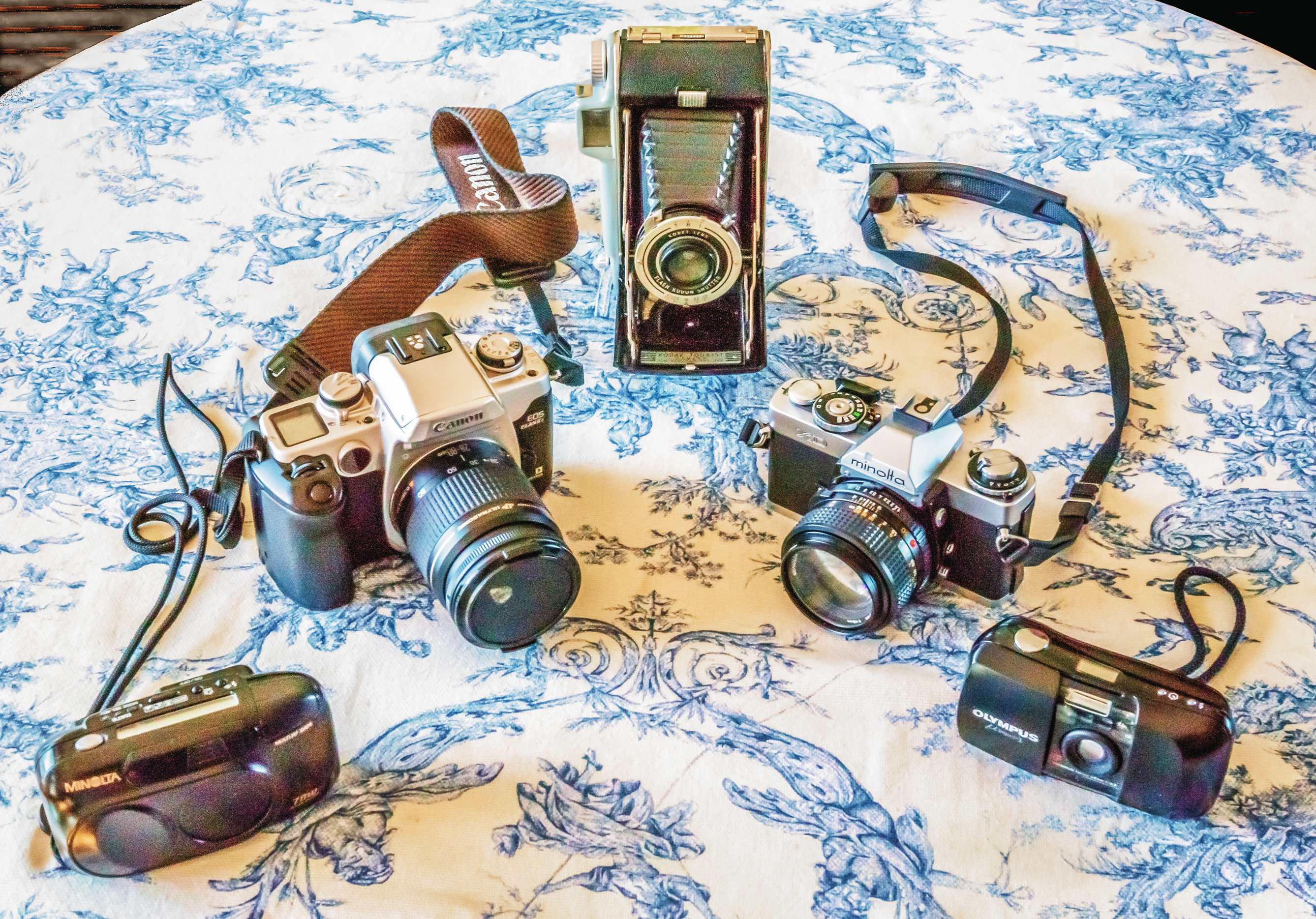
From left to right:

Minolta Riva Zoom 70w (not something I would have sought, but it seems to work so I’ll give it a try).

Canon Elan IIe with 28-80mm Zoom Lens. This camera has either been very carefully used, or not used at all. It’s about the only one of my cameras that I’d truly call mint. Also seems to work. I ran a roll through it and I’m now awaiting the results.

Kodak Tourist. This is the low end of the Kodak Tourist line. It belonged to my friend’s father who I spoke to (via Skype) during their visit. It’s a very simple camera: meniscus lens, single shutter speed (reputed to be 1/50 second); aperture range 12.5, 16, 22, 32. Even worse it takes 620 film, which is I thought is no longer available. However after doing some research I discovered that 620 and 120 film are the same size film on different sized spools. Some enterprising types are re-spooling 120 film onto old 620 spindles. So it is available all be it at a premium price. My regular film processing lab will also process 620 film, again at a slightly higher cost. It’s a very attractive camera though, particularly when it’s open. As far as I can tell it works. I can see the aperture change. The single shutter speed operates and, after shining a flashlight into the bellows in a darkened room I don’t see any leaks. I may give it a shot even though I’m sure the results will not be stellar.

Minolta XD as it was known in Japan. Also known as the XD7 in Europe and the XD11 in the US. It’s equipped with a Minolta 50mm f1.4 MD lens. I’m sure that my eyes lit up when I saw this. To quote one web site specializing in information on older Minolta cameras: “The XD11 was highly praised by critics of the time, and is still regarded by many to be the best manual focus body made by Minolta.” Again it looked to be in very nearly mint condition. I discovered that I had the batteries required in another camera. Out they came and into the XD. I turned it on and …nothing. After overcoming my initial disappointment I took the batteries out again and in doing so noticed some corrosion in the battery compartment. Someone had left batteries in there for too long and they had leaked. I spend some time cleaning it out and then put the batteries back. To my delight it started first time. I can’t wait to try it. I’ve already tried the lens on my Sony Nex 5n with excellent results.

Olympus Mju 1 or Infinity Stylus as it’s know in the US. Excellent and well regarded point and shoot camera although without the “cult” status of its faster and more expensive sibling the Mju II or Infinity Stylus Epic.

Can’t wait to try them all. Thank you Brigitte and Brett.