Yashica TLR

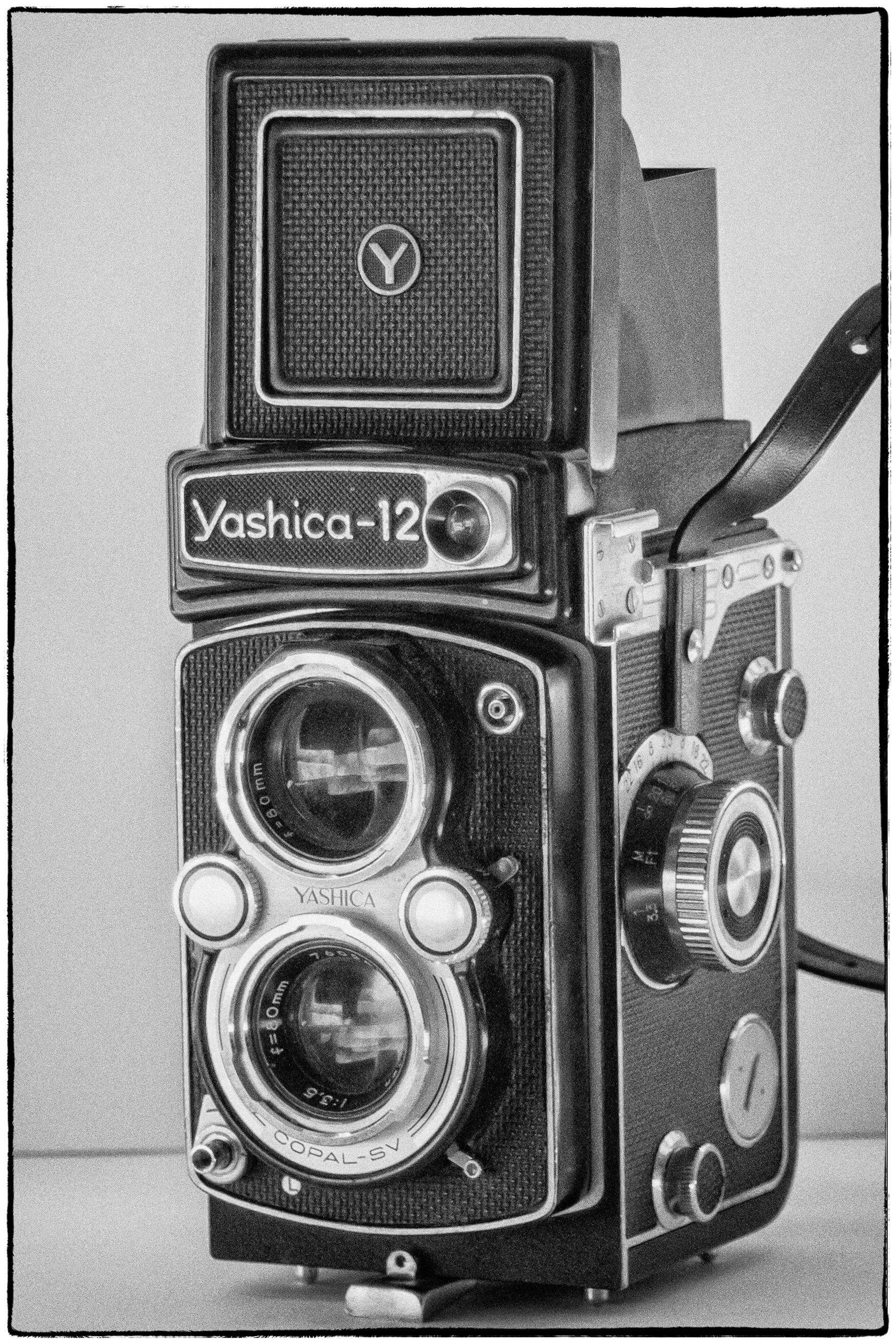
Of late I’ve developed an interest in Twin Lens Reflex (TLR) Cameras (above my own Yashica 12 – unfortunately not working because of a stuck shutter. I’ll get it fixed one of these days). A couple of days ago I was browsing around and I came across this very useful resource related the many models produced by Yashica. The Yashica TLR site describes itself as follows:

The first camera made by the fledgling camera maker, Yashima, later to adopt the name of its Yashica cameras, was a twin lens reflex (TLR) taking twelve 6 cm x 6 cm negatives on 120 format film. Like most other Japanese TLRs, it was patterned on the German made Franke & Heidecke Rolleicord and used a separate viewing lens matched to the taking lens below it, the camera front panel moving in and out to achieve correct focus. The view through the waist level finder is very similar to what the taking lens is seeing except that the view is correct side up but reversed left to right, courtesy of the 45 degree mirror (hence “reflex”). Yashica went on to make movie cameras, sub-miniature cameras and various categories of 35 mm cameras and in 1959, it even claimed to be the “largest manufacturer of cameras and photographic products in Japan”, but the offspring of the first model would continue in production for the next 33 years.

This site is dedicated to understanding and preserving the details and development history of the company’s TLR cameras from the first model Pigeonflex introduced in early 1953 through to the Yashica Mat-124G which ended manufacture in 1986:

Thrift store find – Canon AF35M

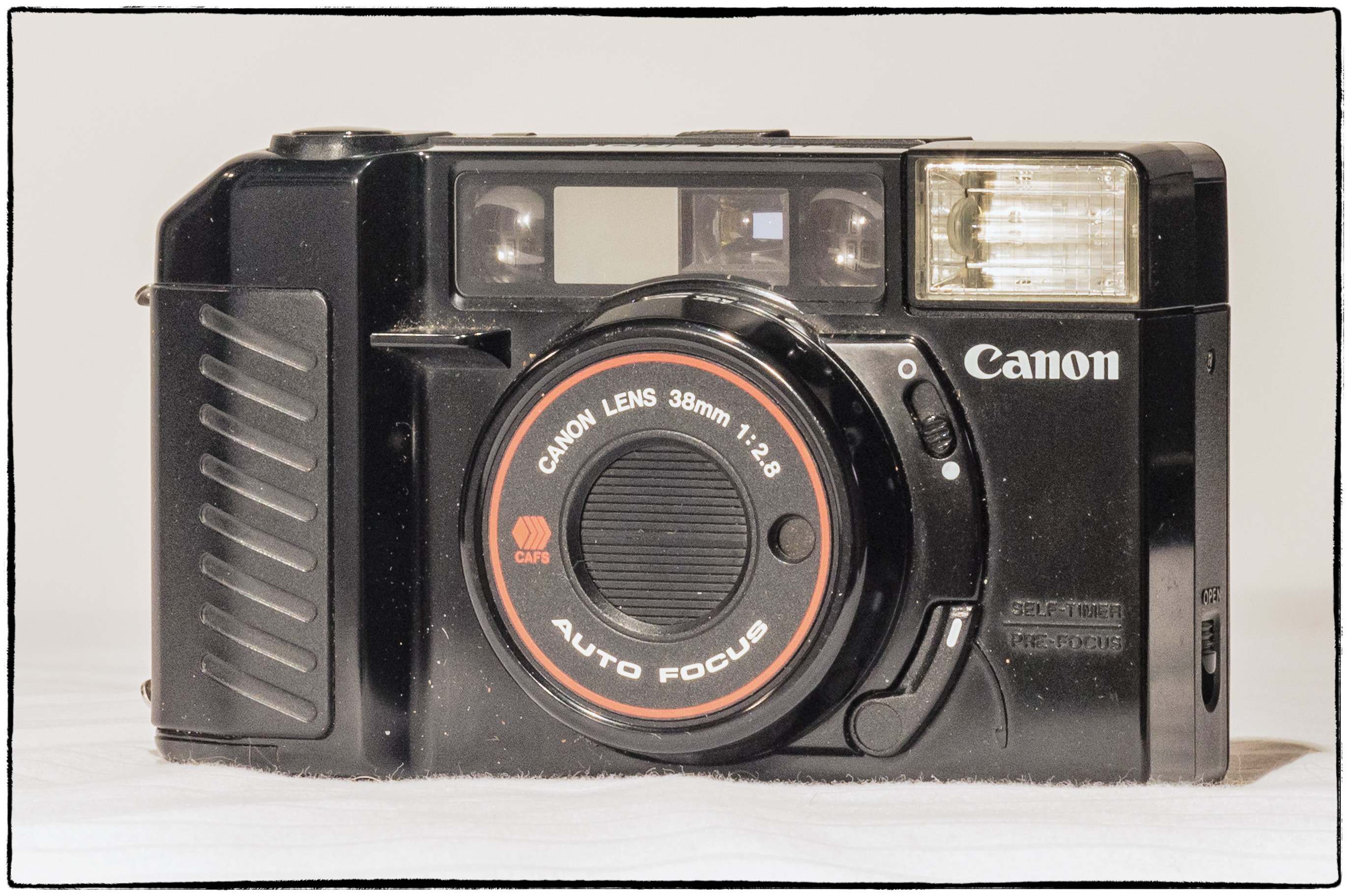
I came across this camera in a nearby thrift store (Goodwill). It seemed to be in pretty good shape and had a solid feel to it. Although I’d already read about this camera before I’d forgotten about it. So I left it. After returning home I looked it up and discovered that it might have some historical significance. The Konica C35 AF (which I also have) was the first autofocus camera, but it apparently had a not particularly impressive passive autofocus system. The Canon AF35M introduced a better active autofocus system, which I believe has formed the basis for camera autofocus ever since.

According to a post (Canon AF 35M), which also provides a detailed review of the camera on Mike Eckman’s excellent site:

In terms of historical significance, the AF35M was the first camera in the world to offer a modern automatic focusing system. The reason I threw the word “modern” in that previous sentence is because its actually the second auto-focus camera released in the late 70s. The first was the Konica C35 AF which came out two years earlier in November 1977. Many people do not consider the Konica C35 AF to be a truly automatic focus camera because Konica “cheated” somewhat in how they accomplished automatic focus.

An ad from 1980 for the AF35M hyped the frustration free simplicity of the camera. Konica employed the use of the Visitronic AF system that was created and produced by Honeywell. This system was a passive auto-focus design which used a traditional two window rangefinder to compare the light entering each window, and through the use of a primitive CPU, it would estimate range and then adjust the focus of the lens to achieve proper focus. Canon’s CAFS (Canon Auto Focus System) from the AF35M used a scanning infra-red light beam that would triangulate distance by reflected light bouncing back to the camera. Konica’s system was easily tricked and could not handle moving or very small objects very well. Canon’s CAFS system was far from fool-proof, but it handled a variety of scenes, including low light situations, much more reliably.

I also discovered that the camera is capable of taking impressive pictures (see A Canon in A Minor – the AF35M on Random Camera Blog).

I had to go back to the same area the following day and I decided that, if the camera was still there, and if the price was less than $10 I’d get it (the camera had no price sticker on it). As it turned out the price was $5 so I got it.

Surprisingly the camera had functioning batteries in it and fired up immediately when I turned it on. Everything else seemed to be working fine too.

I did a bit more research and discovered that this particular model was not the first in the series though. There are a large number of different models from the first in 1979 to the last in 2005. I’m most interested in the early models. The first three models were (the names represent the way the camera was designated in the USA, Europe and Japan):

Canon Sure Shot/AF35M/Autoboy (1979)
Canon Super Sure Shot/AF35ML/Autoboy Super (1981)
Canon (New) Sure Shot/AF35M II/Autoboy 2 (1983)

The one I had was the third: (New) Sure Shot, AF35 M II, Autoboy 2. The problem arises because the first and third US models are both labeled on the top plate as simply ‘Sure Shot’. Of course I decided that I had to have the first. I found one on ebay and hope to receive it soon. Then I’ll have decide if I want the Super Sure Shot with its faster lens (f1.9 instead of f2.8). A quick look at ebay tells me that this model is somewhat more expensive so maybe I’ll just wait and see if I bump into one in a thrift store of flea market.

For those Twin Lens Reflex (TLR) aficionados out there

If you’re into Twin Lens Reflex (TLR) cameras you’ll love this site. It has a very simple name: TLR Cameras Website and it’s not all that attractively presented. It has a very ‘old style’ look to it, but it’s packed with information about TLRs of all kinds. The section on his collection (one of eight sections in all) contains sub-sections on:

  • American TLRs (mostly – some are rebadged Japanese)
  • British TLRs (not very extensive, just MPP from Kingston)
  • Chinese and Hong Kong TLRs
  • Czechoslovak TLRs – some of the nicest made
  • French TLRs (surprisingly many)
  • German – this button takes you to a sub-index
  • Japanese TLRs – this button takes you to another sub-index
  • Polish TLRs – all from WZFO’s factory
  • Russian TLRs – not just Lyubitels!
  • Other sections include:

  • Links to other sites with strong TLR content
  • A very abbreviated history of the TLR
  • Other bits and pieces of TLR history
  • Items for sale – surplus collectables
  • Key reference sources used for this site
  • Cameras I’d like to buy!
  • It’s a veritable treasure trove of information on TLRs. I never knew that there were so many different models of TLRs, from so many different manufacturers.

    The copyright notice on the site extends only as far as 2013, which makes me wonder if the site is still being maintained. A contact link provides a mechanism for getting in touch with the site creator.

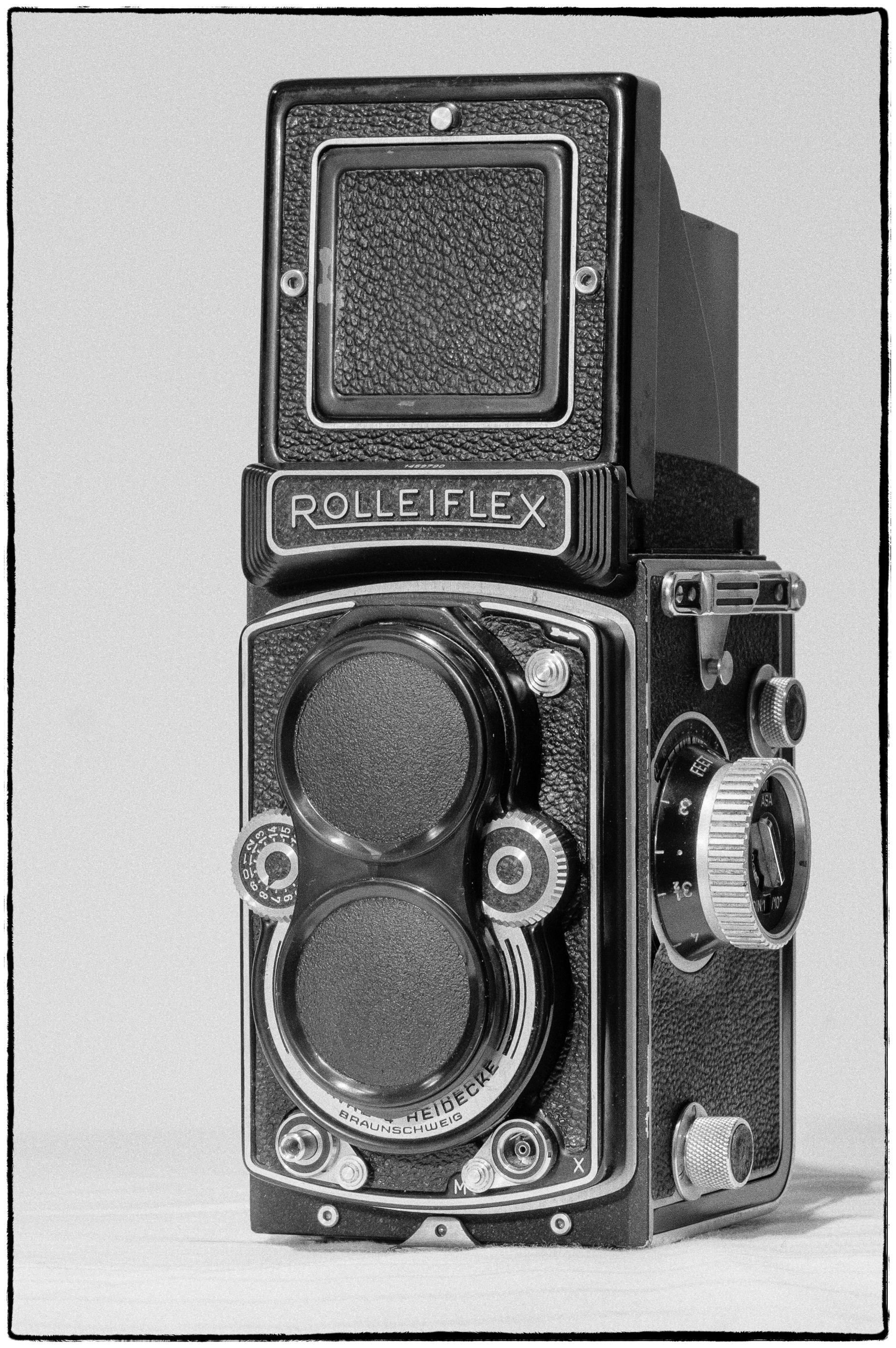
    The camera above is my own Rolleiflex. I’m by no means an expert on the various Rolleiflex models, but according to the lists of serial numbers on the internet it’s a 1954 MX-EVS type 1 with 75mm f3.5 Schneider Xenar lens. This makes it about the same age as myself and it’s in similar condition: cosmetically not great and a bit worn around the edges, but still ticking. I bought it on a whim sometime in the 1980s. I think I used it twice and wasn’t too happy with the results (I’m sure it was because of my lack of familiarity with the camera and my photographic skills, which were much more rudimentary in those days). I tried it out again today. Everything seemed to work. The aperture opened as expected and the shutter fired with no problem. To my untrained ear the shutter speeds seemed to be working OK (e.g. 1/8th second sounded much longer than 1/60th). I’ve read that after not being used for such a long time it’s likely that the shutter speeds are off. I guess I’ll have to try it and find out and then possibly arrange for a thorough CLA. Focus was fine even if the viewfinder is a bit dim.

    I really like TLRs and I have a sneaky feeling that I might be on the verge of a GAS attack.

    Kirk Tuck on obsolescence in cameras

    A Spread from the Kipp School Annual Report. Designed by Gretchen H. Source: The Visual Science Lab / Kirk Tuck. I always wonder what they really mean when people tell me their cameras are “obsolete.“. Read the post to understand the significance of the picture above.

    I think what I hear when people say, “My camera is obsolete, I need to upgrade to….” is really, “I am too lazy to go out and work to get good shots. I am too lazy to perfect my technique. It’s a hell of a lot more fun to just play with new cameras. Maybe this year’s camera will have an auto-pro mode that will make my photographs more interesting.”

    Great post! I agree entirely. I have lots of cameras (mostly vintage) because I like collecting cameras. But I’m under no illusions that they will make my photography better. My digital cameras are all several years old. Sometimes when I read reviews of the latest and greatest cameras I’m tempted by the lure of fancy gadgets, but then I ask myself “what will this camera give you that you don’t already have”. Usually I come up with a list of features that I don’t really need much.

    Bye bye iPhone 3GS’s. Hello iPhone 5s.

    It’s now been raining for seven days in a row and you see what I’ve been reduced to – taking pictures of iPhones!

    Anyway the sad tale of my poor old iPhone 3GS has now come to an end. My wife and myself both got one of these phones back in 2009 when they first came out.

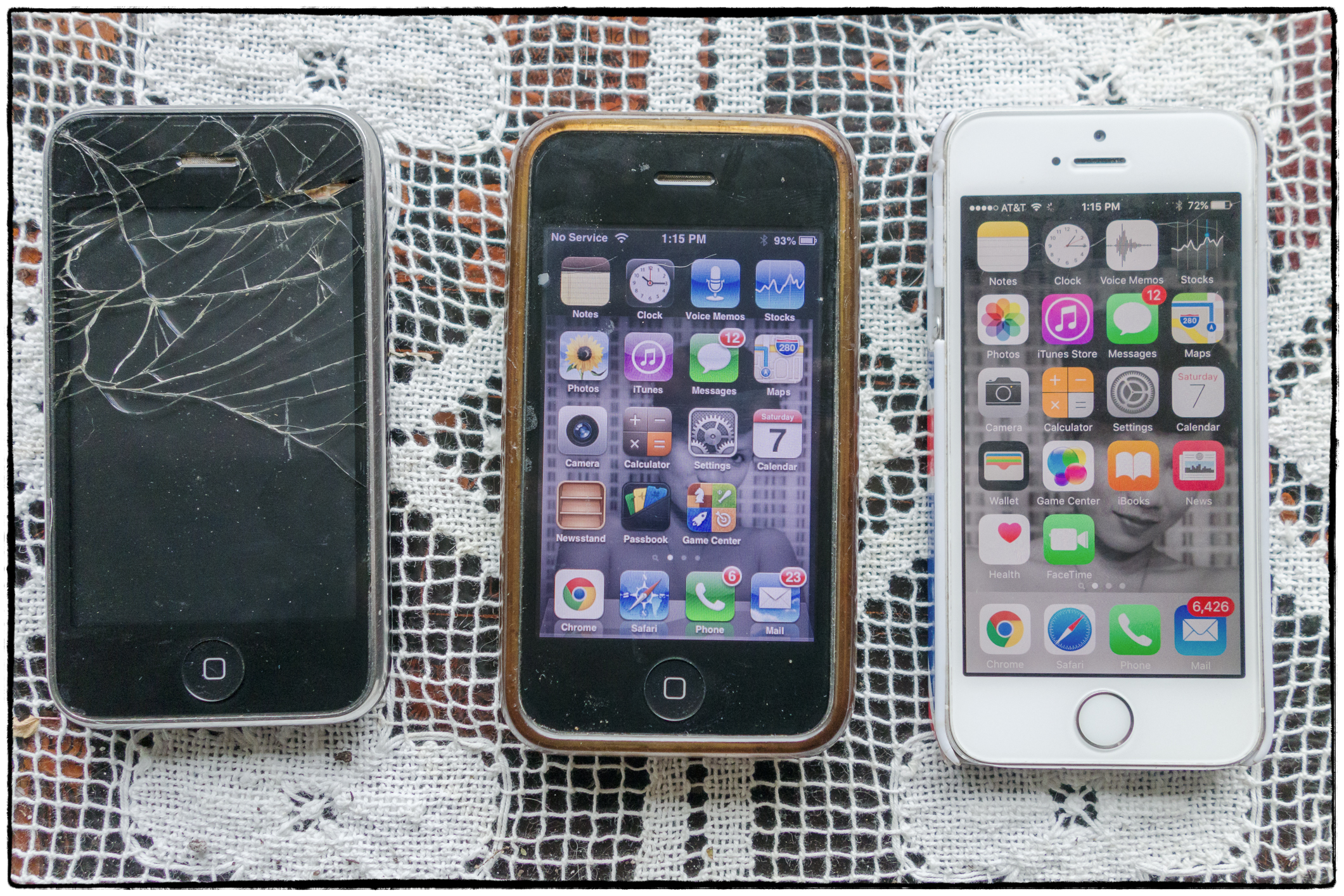
    The one on the left was mine. One day I was sitting outside my wife’s fitness club with our old dog, Jackson browsing away on the phone. Something he saw caused him to rush off, pulling my arm with him. The phone flew out, spiralled up into the air and came down with a crash on the concrete paving (he also destroyed two Amazon Kindle’s in the same way before I figured out that it wasn’t a good idea to hold his leash in the same hand as an electronic device). As you see the screen shattered. But it was still working and I could still read the screen – just. So I kept using it.

    The one in the middle belonged to my wife. Eventually she got an iPhone 5s. I was getting frustrated with my 3GS – not so much because the screen was broken. I could live with that. But because 1) the battery life was gradually decreasing; and 2) newer versions of apps wouldn’t work on the old operating system (OS3). The latter was particularly important as I read a lot and had come to depend on the Amazon Kindle app, which I had unfortunately accidentally deleted and could no longer replace. Then one day I had a brainwave – how about I use my wife’s old phone. I thought at the time that it was an iPhone 4 (it wasn’t) and so it would be a slight step up. I upgraded the OS to version 6, which I figured would support the Kindle app (it did) and all was well with the world – for a while. I had a phone that didn’t have a broken screen and could run my favored apps. OK, it was a bit slow but it got the job done. Then one day – disaster! While it continued to make and receive calls, the person I was calling couldn’t hear me and I couldn’t hear them. Ah well back to the cracked screen.

    Anyway the other day the phone with the cracked screen stopped working altogether. It was probably my fault. I was taking a bath and put the phone on the side of the bath in case my wife called. When I got out of the bath the phone was wet – I must have splashed some water on it. All would probably have been well with an intact phone, but with all those cracks and holes….I switched back to phone number two and lo and behold it worked. I could hear people speaking and they could hear me. Somehow it had miraculously come back to life. But I no longer trusted it. It had stopped working once so it could stop working again. I’d put up with the laughter and sarcasm from my friends for too long. It was time to upgrade.

    My wife had been talking about upgrading for a while (she wanted a better camera and a bigger screen). She got an iPhone 6s and I inherited her two year old 5s. So I have a fairly recent iPhone. The screen isn’t cracked and it will run all my apps. It’s not the latest technology, but it’s good enough for me.

    Since this is primarily a photo blog, you may well ask what all of this has to do with photography. I love cameras and would never dismiss the camera in the iPhone. It’s revolutionized photography. I imagine more people take pictures today with phone cameras than with regular cameras. You always have it with you and within its limitations it can produce great results. I few years ago we were in the Turks and Caicos Islands. My wife went for a spa treatment and took a few pictures inside with her iPhone 3GS. I took some pictures outside with my regular camera. That day the light was gorgeous. I later did a photobook and you really can’t tell the difference. I’ve asked friends if they can identify the pictures taken with the iPhone and they can’t. I recently did another photobook with just iPhone pictures (because I didn’t have another camera with me) as a souvenir for a friend who may be relocating. It came out fine. I’m pleased that the iPhone 5s has a better camera than the 3GS I had before.

    Hopefully I won’t have to worry about upgrading for another seven years.