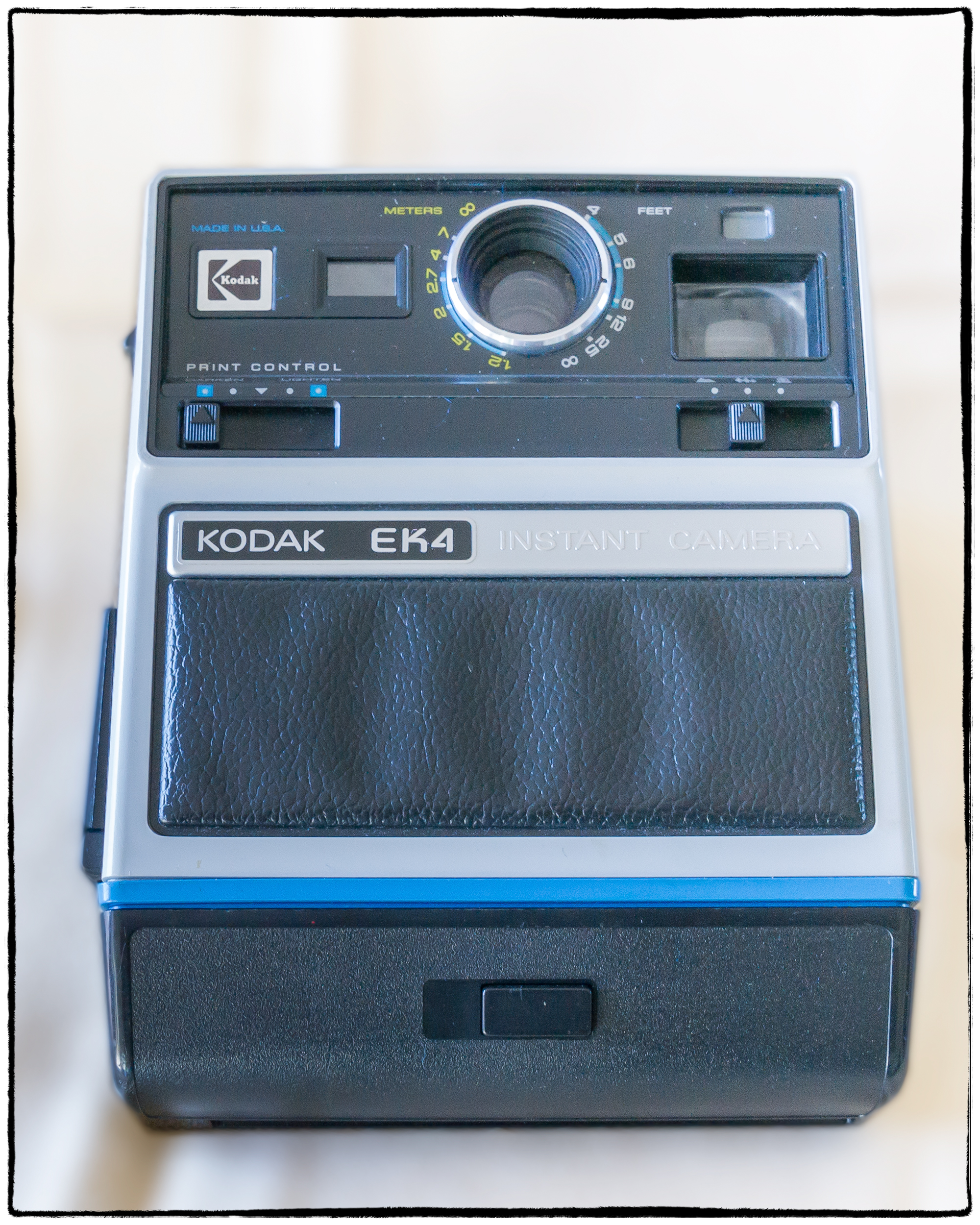
New Addition to the Camera Collection – Kodak EK4

I picked up this old Kodak Instant camera (i.e. as in Polaroid not Instamatic) because of the interesting story behind it. I don’t ever expect to take pictures with it. Kodak stopped making the film almost 30 years ago. It was apparently possible to modify the camera to use Fujifilm FI-800GT film until as recently as 2010 when Fuji discontinued this film. The camera cost practically nothing so even if I could find some leftover Fuji film I wouldn’t be inclined to undertake the modification, and the film was apparently quite expensive.

The story is interesting though. In the 1960s Kodak had manufactured film for Polaroid’s cameras. However, in the 1970s they decided to introduce their own instant cameras. Although Kodak’s design differed from Polaroid’s, Polaroid immediately filed suit for infringement of its patents. The lawsuit dragged on for decades with Polaroid eventually claiming that during the 10 years Kodak had made these cameras Polaroid had lost $12 billion. The lawsuit was finally settled in 1990 with Kodak being found guilty on 7 of the 12 patent infringements.

Polaroid did not get the $12 billion it was asking for, but it did get about $1 billion. Furthemore, Kodak also had to compensate those who had bought any of their instant cameras between 1976 and 1986. Owners were asked to call and register for a compensation package, which would alow them to receive a rebate check for the cameras they had bought. So essentially Kodak had to “buy back” the cameras they had sold.

Kodak was forced out of the instant camera business entirely and never returned.

Kodak made 26 models of their instant cameras (as well as seven types of film) between 1976 and 1986. This is the first of them: the EK4. According to CameraWiki:

The EK4 is a very early model in the Kodak Instant line of cameras released in 1976. It’s features were very basic. It lack an electronic motor for film ejection and requires a hand crank. The nearly identical model EK6 was also available but had motorized ejection. Flip flash socket is on top of the camera. The lens has markings surrounding the lens in both meter and feet. Exposure and focus control is with sliders on the face of the camera. Sliding the focus control rotates the lens indicator to the corresponding distance markers. It used PR10 (PR144) film. It is powered by a 6V flat J sized battery.
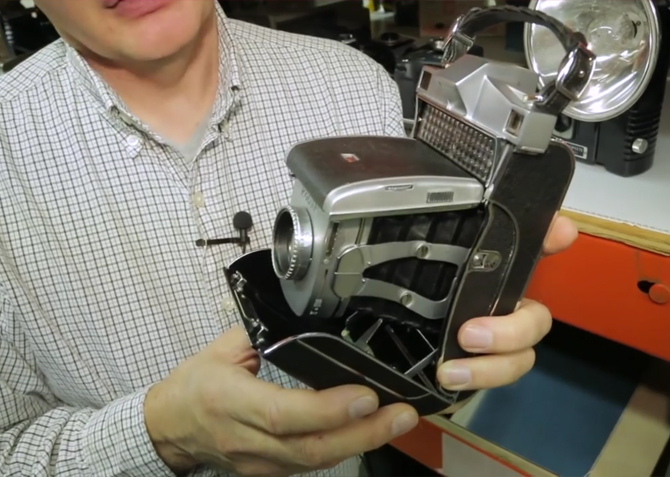
Kodak House Museum Video Illustrating the History of Photography

Kodak Super Six-20: the first camera with automatic exposure, introduced by Kodak in 1938.

If you’re really into old cameras (as I am) you’ll probably love this. If not you’ll probably find it boring. It’s essentially a conversation between Chris Marquardt and Todd Gustavson (from the Kodak Museum) regarding the history of cameras. It’s quite long (over one hour) and at times a bit rambling. I’m not sure that Mr. Marquardt adds much: he interjects a few words here and there, but Mr. Gustavson does most of the talking. I suspect that I would have enjoyed the video more if it has just been Mr. Gustavson talking. I found Mr. Marquardt’s interjections somewhat distracting I’m afraid. I would congratulate him on initiating the video though, which I found quite engrossing.

I have books on the history of cameras, but Todd Gustavson really brought the story to life. I found a number of items particularly interesting: the first zoom lens (the Voigtlander Zoomar); the first auto exposure camera, the Kodak Super 620 (I didn’t realize it was so big); the first flash bulb, the vacublitz (a glass tube filled with magnesium foil – it was absolutely enormous). It also reminded me how recent digital photography is. The first digital cameras (made by Kodak, using Kodak sensors and at various times Canon and Nikon bodies) came out in the early 1990s: only about 25 years ago. Interestingly they cost $25,000.

One word of warning though. My brother-in-law lives in Rochester, and during a visit we went to the Kodak Museum (formerly the Kodak House). While it was somewhat interesting I was a little disappointed. If you go don’t expect to see these vaults. They’re not accessible to the public (although a docent told me that if you give them advanced notice and indicate which areas you’re interested in it is possible to arrange a visit. I don’t know if he was correct). A small room with a limited collection of important historical cameras is open to the public, but this collection is much smaller than I thought it would be.

I can also recommend Mr. Gustavson’s book: Camera: A History of Photography from Daguerreotype to Digital.

From a complicated, time-consuming and expensive process to the simple press of a button, photography has come a very long way since the first cameras came along in the early 1800’s.The vast majority of this fascinating evolution can be seen in this video where Chris Marquardt went on a private tour of Kodak’s technology vault.Think you’ve got an impressive camera collection? Wait until you see this 8,500-strong collection of almost every significant camera invented in the last 200 years.

Source: A Journey Through The History of Photography in Kodak’s Technology Vault – DIY Photography

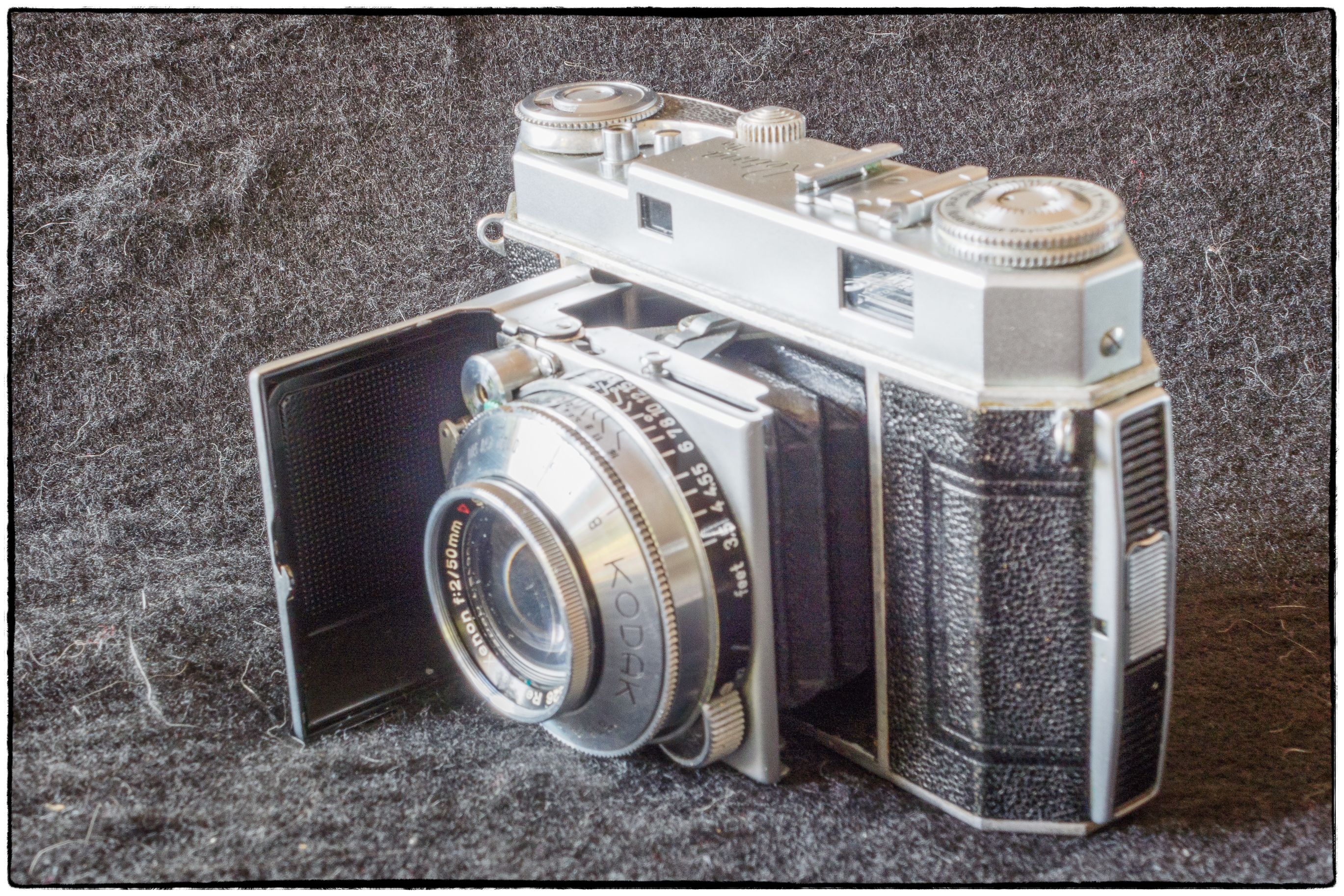
Retina IIa

I love Kodak Retina Cameras. I’ve already posted about the first one I acquired: A Gem of a folding 35mm – Retina IIc. Since then I’ve acquired three more: A IIIc, a IIa, and this one – also a IIa. The IIIc seemed to work except for the slow speeds. When I tried it today that was how it worked, but then suddenly it wouldn’t work on any of the speeds. The first IIa was a bit “beat up” and didn’t seem to be working (that’s why I bought this one), but when I tried it today to my surprise everything seemed to work so now I have two IIa’s. Apart from condition the only difference between them is the shutter. This one has a Syncho-Compur while the other one has the Compur Rapid (an earlier shutter carried over from the Retina II I believe). This one is fairly good cosmetically and everything seems to work. Of course, I won’t know for sure until I try it so we’ll have to wait and see.

Mine has the following features:

  • Combined Rangefinder Viewfinder. No brightlines. No parallax correction
  • Fixed 6 element 50/2 Schneider Xenon focusing to 2.5 ft.
  • Synchro-Compur Shutter with speeds from 1 to 1/500th, plus B. Electronic flash sync at all speeds
  • Screw threads on shutter release for manual cable release.
  • Film counter is manually reset and counts down.
  • No hot shoe but lens has flash connection on bottom.
  • Tripod socket on bottom of camera.

Stephen Gandy of Cameraquest has the following to say about the Retina II and I agree with him entirely:

The Kodak Retina IIa is my favorite of the long lived Retina series, the epitome of a classic small fast lensed 35mm folder. What makes it so good? It’s small size, superb 50/2 Xenon or Heligon lens, better than average finder, quiet leaf shutter, and the simple straightforward design which translates to pleasurable shooting. The IIa was produced only from 1951 to 1954, yet over 100,000 were produced. In a nutshell, many Retina fanatics feel the earlier Retinas had less of the desirable features, while the later Retinas sacrificed too much size and weight for additional features. The IIa is Type 016 in Retina nomenclature.

All shooting controls except f/stop are easily seen from the top, including the frame counter, shutter speed, and focused distance, and depth of field scale. The hinged back opens by pulling downward on the clasp at the rewind edge of the camera. While the Retina IIa lacks the magnificent finish of the Zeiss Contessa or Voigtlander Vitessas, the Retina is the simpler, quicker photographer intuitive camera design. The IIa was among the best sellers of its day, so they are not that hard to find. Yet, it is difficult to find one in mint condition. This sad state of affairs is due to the damn photographers out using Retinas to take pictures.

New Acquisitions – Exakta Varex/VX IIa and Exa

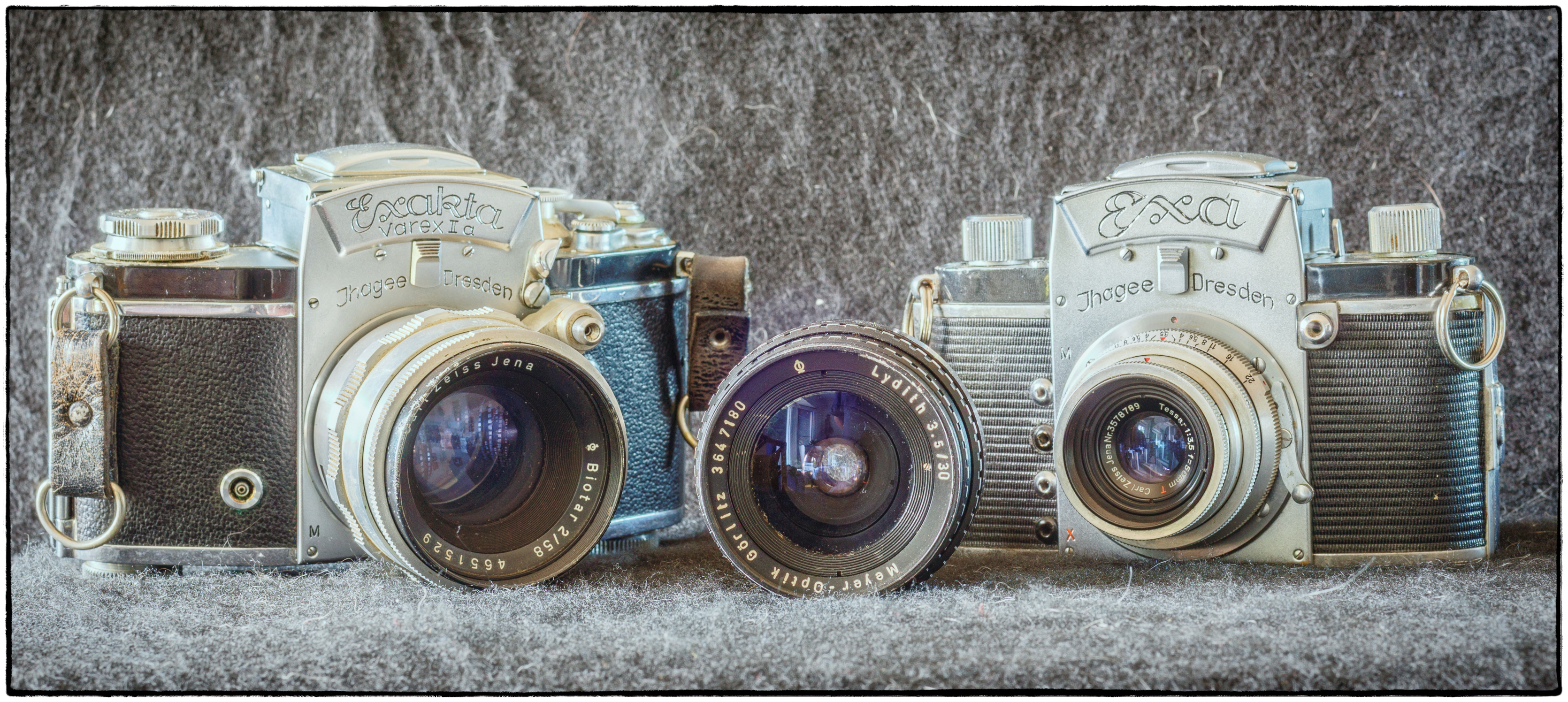
Two separate purchases landed me with an Exa (original version) with a 50mm f3.5 Carl Zeiss Jena Tessar; and an Exakta Varex/VX IIa with a 58mm f2 Carl Zeiss Jena Biotar and a 30mm f3.5 Meyer Optik Görlitz Lydith. I think I paid around $100 for the lot so I’d didn’t have very high expectations. I think that they are beautiful cameras though and figured that even if they didn’t work they’d look nice on a shelf. I was surprised to find that both cameras seem to work, although I haven’t run any film through them so I don’t know for sure. Everything definitely needs cleaning though.

The Exakta is in pretty good shape apart from a little lifting of the leather, which can easily be glued back. The Exa has a slightly wonky but functional finder, which doesn’t bother me greatly as I can use the finder from the Exakta (one of the benefits of having replaceable finders). A piece of the leather has worn on the back of the Exa. I might consider replacing it one day depending on whether or not it works.

As for the lenses – I tried out the Lydith on my Nex 5N and really like it. The Lydith and Biotar are somewhat “beat up”, particularly the Biotar, but they all seem to work, although the auto diaphragm is rather sluggish and I fear that the shutter will close long before the lens stops down. This doesn’t bother me much as I don’t mind stopping down manually so I probably won’t use the auto diaphragm. The Tessar seems to be in better condition. More to follow when I’ve tried out the Biotar and the Tessar.

Nikon N70/F70

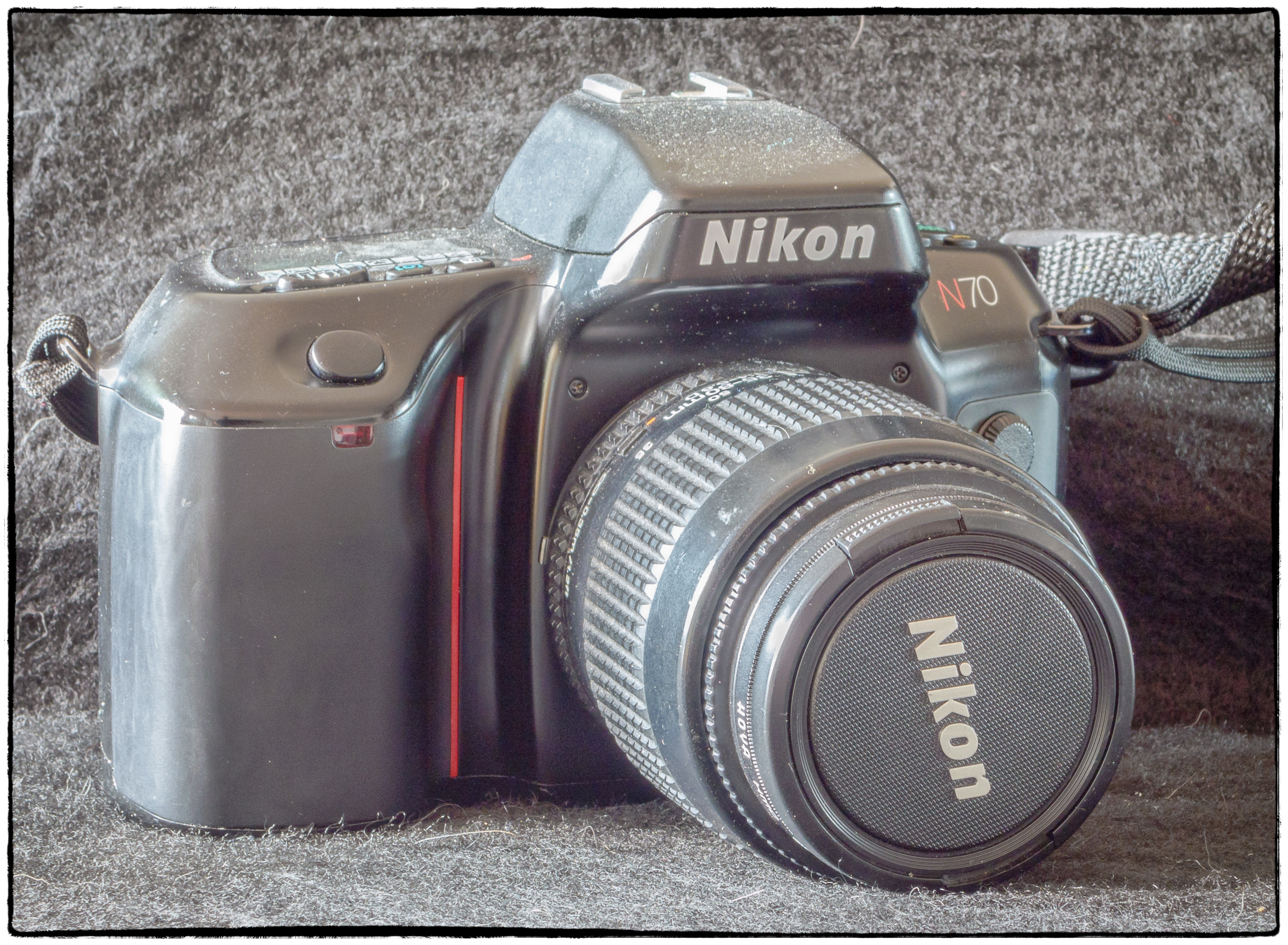
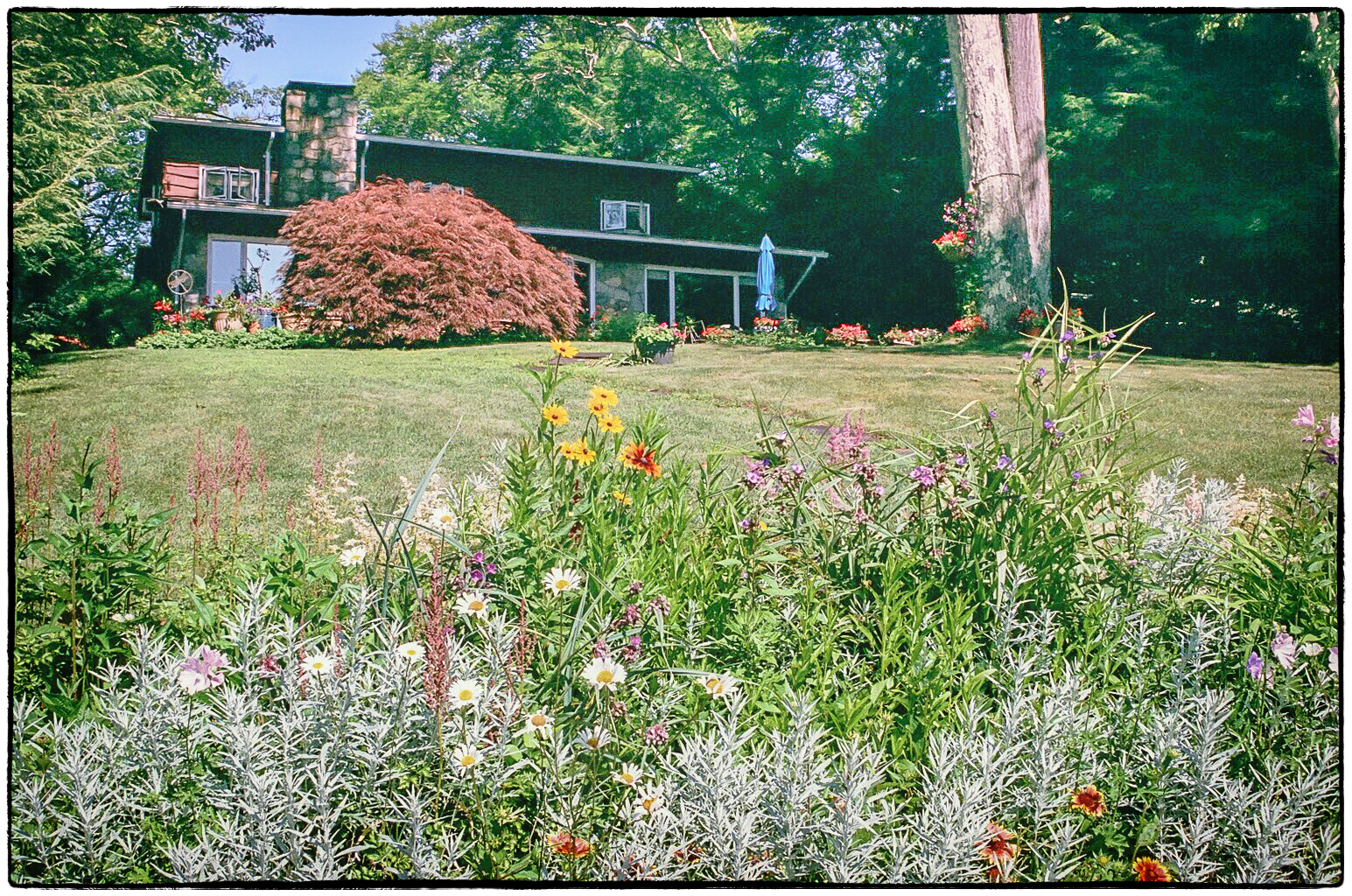
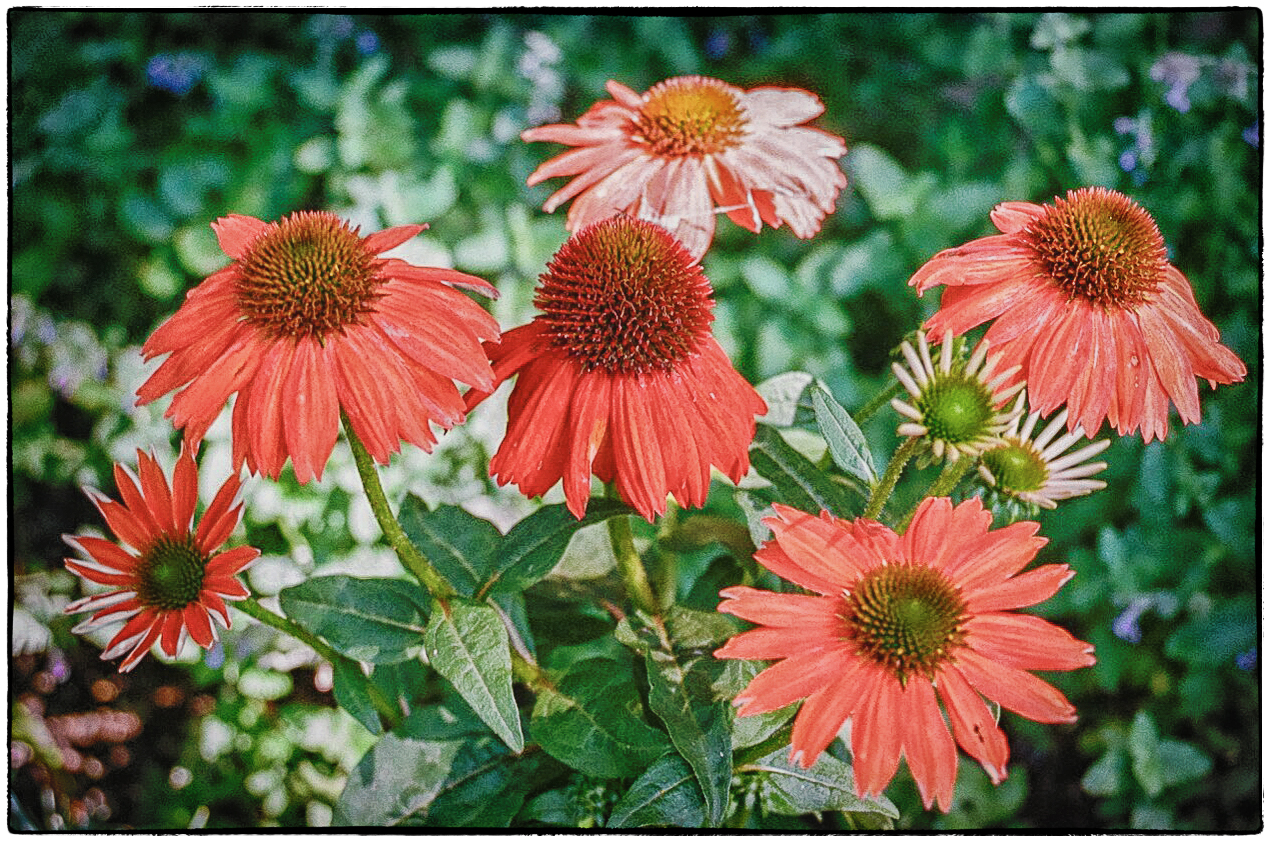
I didn’t especially want this camera. When I started collecting cameras I though I would stick to rangefinders, but somewhere along the line I got distracted towards SLRs. I bought a Yashica FX-3 in a thrift store because I found myself stuck without a camera and wanted to take pictures. I’d never owned a Nikon so I thought if I’m getting SLRs I might as well get a Nikon – that led to the acquisition of a Nikon F2 body. Then I needed a lens and I found the lens (a manual focus lens) I wanted attached to a Nikon N90s. I liked the N90s and realized that I’d never actually used an autofocus SLR – so I needed an AF lens. I found such a lens attached to this N70, which as I said, I didn’t especially want. I think I spent about $30 for the camera and lens so what did I have to lose. I put a roll of film in it to see if the body worked, put it away and never used it. The other day I remembered there was a film in it and decided to try it. Inevitably I took pictures of what was close to hand: flowers in our garden.

As I was only trying to see if the camera worked I can’t say that I tried it out very thoroughly. I put it into aperture priority and largely “pointed and shot”. I was using an old film and taking pictures at the worst time of day (around noon). All I can really say is that the camera felt comfortable enough in my hands and not too heavy around my neck. The rather strange fan-shaped interface is unique to this camera and I don’t think Nikon used it again – probably because of all the negative feedback. Nikon aficionado Thom Hogan had this to say (I don’t know when this was written):

The F70/N70’s gimmicky LCD interface met with a lot of derision. However, unlike the F60/N60 or F65/N65, the F70/N70 gives its user plenty of feedback on what’s been set and what the other options are. As such, it’s a good learning camera. The F70/N70’s specifications are mostly good (other than the 1/125 flash sync), and the camera is arguably a bargain at its current prices. The metering and autofocus systems are quite good for an amateur camera and the range of abilities of this camera are quite sophisticated. The built-in flash isn’t very powerful and large lenses get in the way of its coverage, so don’t count on not having to buy a Speedlight. Three things keep me from recommending it wholeheartedly to advanced amateurs or aspiring pros:

1. The lack of depth of field (DOF) preview is a serious omission.
2. That LCD interface really does demand that you take your eye from the viewfinder to make many setting changes, which is okay for learning, but frustrating when you need to work fast.
3. The F80/N80 that replaces it in the Nikon lineup is clearly a better camera and fixes nearly all the F70/N70’s shortcomings.

While I agree that the interface is rather “fiddly” I imagine that once you’re used to it it’s not that bad. Definitely a usable camera though. The pictures were very contrasty and the colors were a bit off (probably because of the old film) and so needed “tweaking” in post processing.