A walk around Mount Kisco – Native American Statue

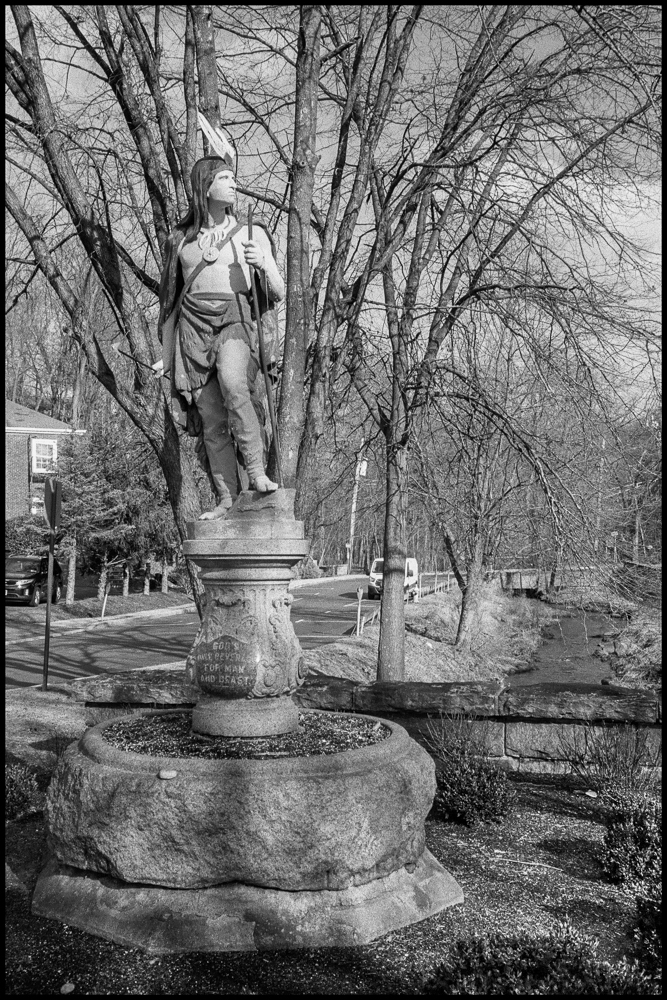
One of the first things I came across was this interesting looking statue.

According to the Village’s website:

There is a statue named “Chief Kisco” in Mount Kisco. There never was a real person with that name. David F. Gorham gave the statue to Mount Kisco in 1907 as a decorative top to a water fountain. On the base of the pedestal are the words “God’s Only Beverage For Man and Beast.” Chief Kisco rules over the village from his perch at the intersection of Routes 133 and 117.

Taken with an Olympus Stylus Epic/Mju II and Kodak Tri-X 400.

A walk around Mount Kisco – Overview

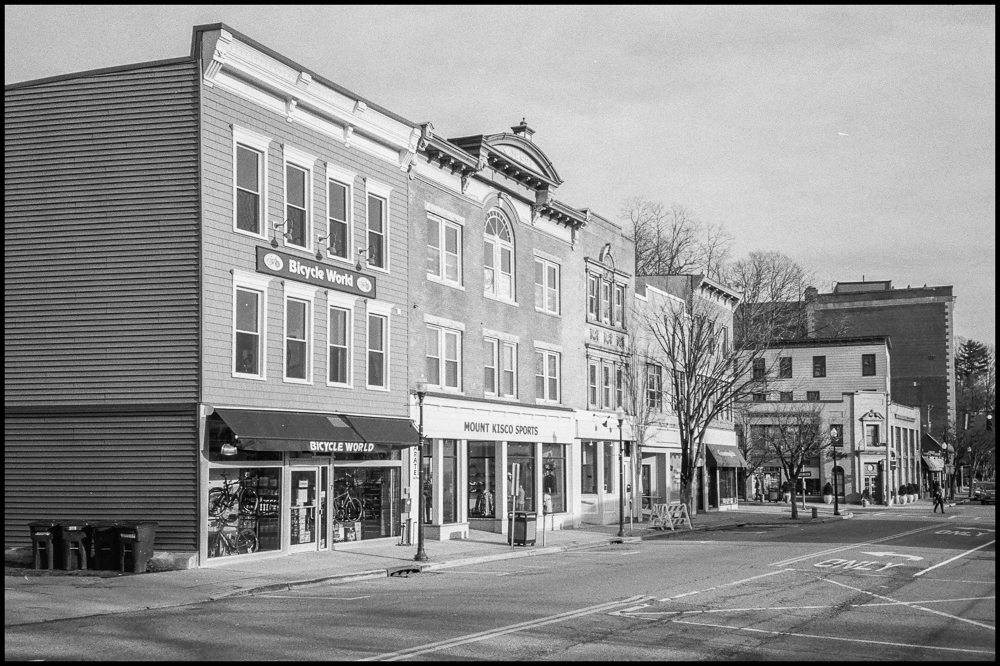
My wife was having lunch in Mount Kisco with some friends. I’d been there a number of times, but had never really walked around. I decided to go along and try out my newly acquired Olympus Stylus Epic/Mju II. Above a view down West Main Street.

According to the village’s website:

Mount Kisco is one of Westchester’s most vibrant communities. Approximately 3 square miles, it is geographically small, but it delivers big. Located 43 miles from New York City, it is easily commutable by train or car, though there is little need to ever leave as Mount Kisco is known as a premier destination for shopping, fine dining, entertainment, and award-winning medical care. Boutiques, bistros, and a movie theater line the walkable downtown urban village, while a variety of residential neighborhoods featuring some sprawling lawns and historic homes fan around it. Part of the highly regarded Bedford Central School District, Mount Kisco is a village of varied faiths, backgrounds, and income levels. Residents and visitors value this tight-knit community, considering it a little village with a big heart.

History:

Mount Kisco was founded in 1850 shortly after the arrival of the railroad. It included two small settlements called Kirbyville and New Castle Corners. Kisco is derived from an Indian word –either kiskamenahook meaning “settlement near a brook” or cisqua meaning “a muddy place.” Mount comes from the 623-foot hill northwest of town.

Since 1875, Mount Kisco has been an incorporated Village under the Village Law of the State of New York. One half of the Village laid in the Town of Bedford, and on half laid in the Town of New Castle. In the mid-seventies, the administrations of the two Towns agreed to support the Village’s effort to “secede” from the Towns. Mount Kisco emerged from the Town of Bedford and the Town of New Castle as a coterminous and independent Village/Town of Mount Kisco effective January 1, 1978.

Mount Kisco comprises 3.1 square miles, has a population of 10,877, and includes 4,289 households according to the 2010 U.S. Census.

Taken with an Olympus Stylus Epic/MjuII and Kodak Tri-X 400.

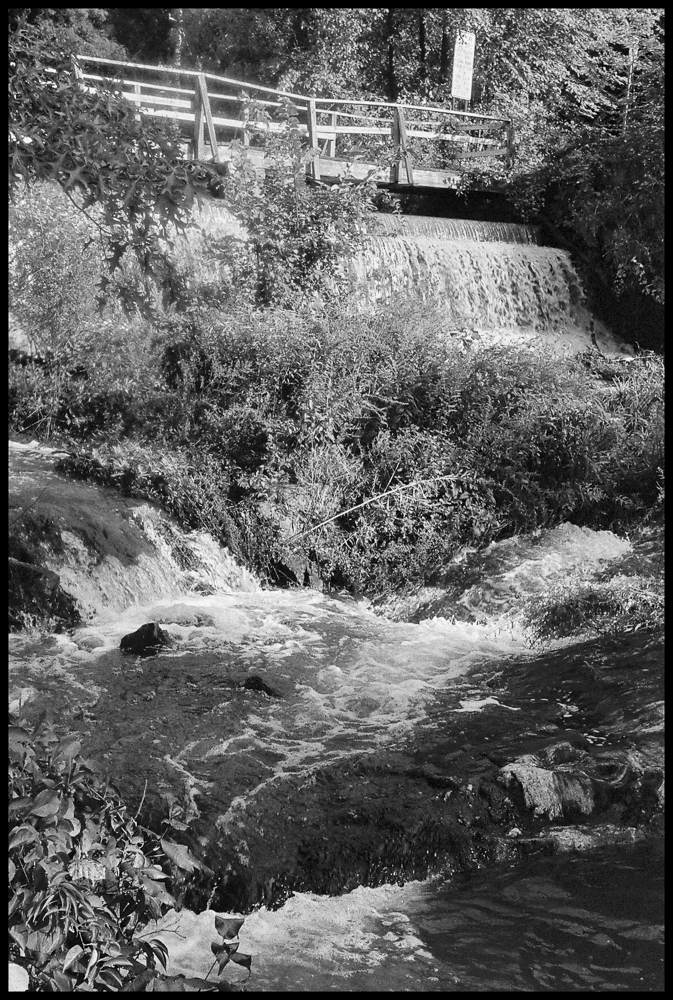
Waterfall at Tarrytown Lakes Park

We used to take the dog for walks here. It’s a short, paved, relatively flat and easy walk alongside the reservoir. My wife is particularly fond of this type of walk. I tend to prefer longer, more remote, more rugged walks in the woods. When I was working she used to walk the dog here. However, since I retired I seem to have taken sole responsibility for dog walking. Consequently I haven’t been here much of late.

For a bit of history see: On the Water: Secret history of Tarrytown Lakes on Lohud.com.

The story of the Tarrytown Lakes begins in a raging fire. On Feb. 23, 1876, a blaze on Lower Main Street in Tarrytown devoured 19 buildings and caused $150,000 in damage. Hampered by an unreliable water supply and insufficient water pressure, firefighters struggled to douse the flames.

Alarmed, village leaders decided to act. In 1887, Tarrytowners approved construction of a new reservoir in a valley behind the hills that rose up from the central village. Railroad magnate Jay Gould, whose Lyndhurst estate remains a historic riverfront landmark, contributed $100,000 for the project.

When completed in 1897, the two lakes had the capacity to hold up to 200 million gallons of water. A pump station was built on the eastern shore of the larger lake, known as the Lower Lake. Two wells stood on small islands near the edge of the lake, one of them still there today.

The new lakes weren’t the only landmark in the valley.

The New York & Putnam Railroad had been established in 1880, with a single rail line that connected Brewster to the Bronx. During its lifetime the railroad had stops in White Plains, Elmsford, Pocantico Hills, Carmel and Brewster. Also along the route were stops at Tarrytown Heights, at the southernmost tip of the reservoir near the present-day intersection of Neperan Road at Sunnyside Avenue, and at Eastview.

The railroad’s initial path in the area went over a wobbly 80-foot-high trestle bridge at Eastview, which so frightened passengers that a portion of the rail line was relocated closer to Rockefeller’s estate in Pocantico Hills.

Remnants of the park’s history remain. The popular biking and hiking trail along the southern end of the lakes follows the path of the old rails. A small rail bridge can still be seen along the southern end of the park, behind the Marymount convent and not far from the site of the old Tarrytown Heights station (See: Tarrytown Heights to Tower Hill – Old Putnam Line). Among the structures near that spot is an aging wooden building known to locals as “the skate shack,” used in past years when ice skating was common on the smaller lake. Village officials said the lake has not frozen over enough in recent years to allow skating.

In addition to the hiking and biking opportunities, Hudson River Recreation added kayaking on the lakes during summer weekends in recent years. Fishing requires both a state license and a Tarrytown village permit reserved for residents — 155 of which were issued in 2016.

Taken with a Zorki 4 and FED 50mm f3.5.

Film Camera 2018/3 – Nikon N6006 – Results

I rather like this camera. It’s a little on the heavy side, but I like its solid feel. Judging from the results the matrix metering is accurate and I like that it will also meter with manual lenses (but unfortunately not in matrix mode). If found the controls to be simple, intuitive and easy to use. I was pleased to see that the camera uses a standard cable release rather than the proprietary electronic releases that you generally find.

To me the most significant negative aspect was the lack of a depth of field preview. It also lacks mirror lockup and a provision for multiple exposures, but since I don’t use these I don’t miss them as much as I do the DOF preview. I’m a fan of vertical grips, but unfortunately the N6006 doesn’t support one. The autofocus is a bit slow and noisy, but since I’m not into either action or wildlife photography it met my needs quite well. The top panel LCD is not backlit so you cant read it at night, which is a bit of a disadvantage. Also the batteries are relatively expensive and not all that easy to find.

For more pictures taken with this camera see:

A walk around brewster – Brewster Station
A walk around brewster – First National Bank of Brewster
A walk around brewster – Bob’s Diner
A walk around brewster – Brewster Iron Works
A walk around brewster – Wells Park – A strange sign
A walk around brewster – Wells Park – Water feature
A walk around brewster – Hallowe’en’s coming
A walk around brewster – Rocking chairs on a porch
A walk around brewster – Brewster Public Library
A walk around brewster – Loading the car
A walk around brewster – Brewster Presbyterian Church
A walk around brewster – Overview