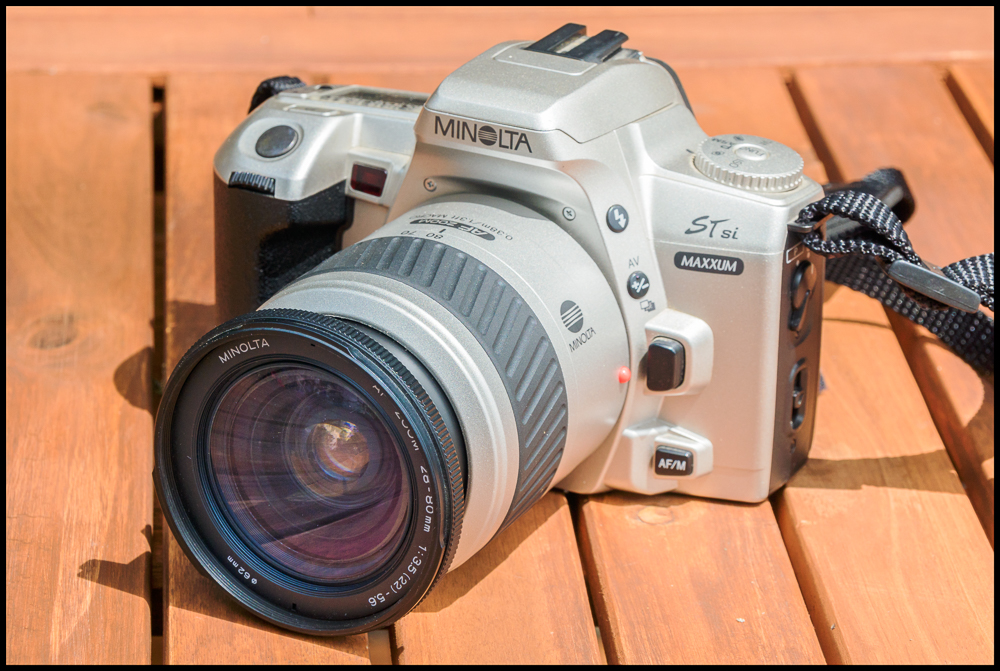
I wasn’t really interested in another Minolta body, but what caught my eye was what came with it: A Minolta AF 50mm F1.7 Lens; Minolta AF Zoom 28-80mm f3.5-5.6; Minolta AF Zoom 70-210mm f4.5-5.6 plus other assorted goodies – all for an extremely low price. I have an old A-mount camera (specifically a Konica Minolta Maxxum 5D). I’ve been thinking of giving it away to one of my grandkids (if any of them are willing to accept such old technology of course), but I didn’t want to sacrifice any of my Sony/Minolta lenses. These seemed to be a good solution.
According to camera-wiki.org The STsi was:
…an entry level autofocus 35mm film SLR camera using the Minolta AF mount, manufactured by Minolta and released in 1999. In the Americas it was known as Maxxum STsi and in Japan it was called α Sweet S (Alpha Sweet S).
The electronic controlled shutter is vertical travelling with speeds from 20s to 1/2000 sec, plus bulb and a flash sync of 1/90 of a sec. The metering is a TTL based system using a 8 segment silicon photo cell. It has a sensitivity of 1 to 20 EV and in spot mode 4 to 20 EV (ISO 100, 50mm f/1,4. Metering is based on using DX encoded film, which can also be manually set from 6 to 6400 ISO in 1/3 inc. The exposure modes include, program, aperture priority, shutter priority, manual exposure along with settings for portrait, landscape, close-up, sport, night. The film transport has a motorized drive with film automatically advancing after exposure. Drive modes includes single frame, continuous for up to 1 fps, self-timer and multiple exposure. The built-in flash has a GN of 12. The camera is powered by two CR2 batteries.
For a full list of specifications see here.
As you’ll see from the specs it’s quite small and light, somewhat ‘plasticky’ feeling (as I suppose were most of the cameras from this era) but nonetheless with quite a solid feel. A dial on the top left of the camera allows you to select from various options: manual ISO selection; Flash options; Exposure modes – it has the usual array of exposure modes including Programme, Aperture priority, Shutter priority and Manual selected by using the ‘func’ button in the center of this dial in conjunction with the dial on the front right of the camera. Options for drive mode and wireless flash are also controlled from here. Scene modes are available including: portrait, landscape, macro, sport and night. There’s also an option for spot metering. If you get stuck and want to return to the programme mode just press the large button marked ‘P’. On the left near the lens barrel there are two buttons, one to pop up the flash and the other for exposure compensation. On the bottom left you find a switch to toggle between manual and autofocus. The fairly large and bright viewfinder displays the following information: Autofocus frame; LEDs for AE lock, aperture, shutter speed, flash ready. On the left side of the body there’s a dial to switch between regular and panorama mode. Mine has a date back, which I’ll never use.
Although this might be an entry level camera there’s plenty of functionality to play with. It’s much less spartan than the Canon EOS 888 I looked at last September (see September Film Camera – Canon EOS 888).
So now to try it out.
Picture taken with a Sony A77II and Tamron A18 AF 18-250mm f3.5-6.3.