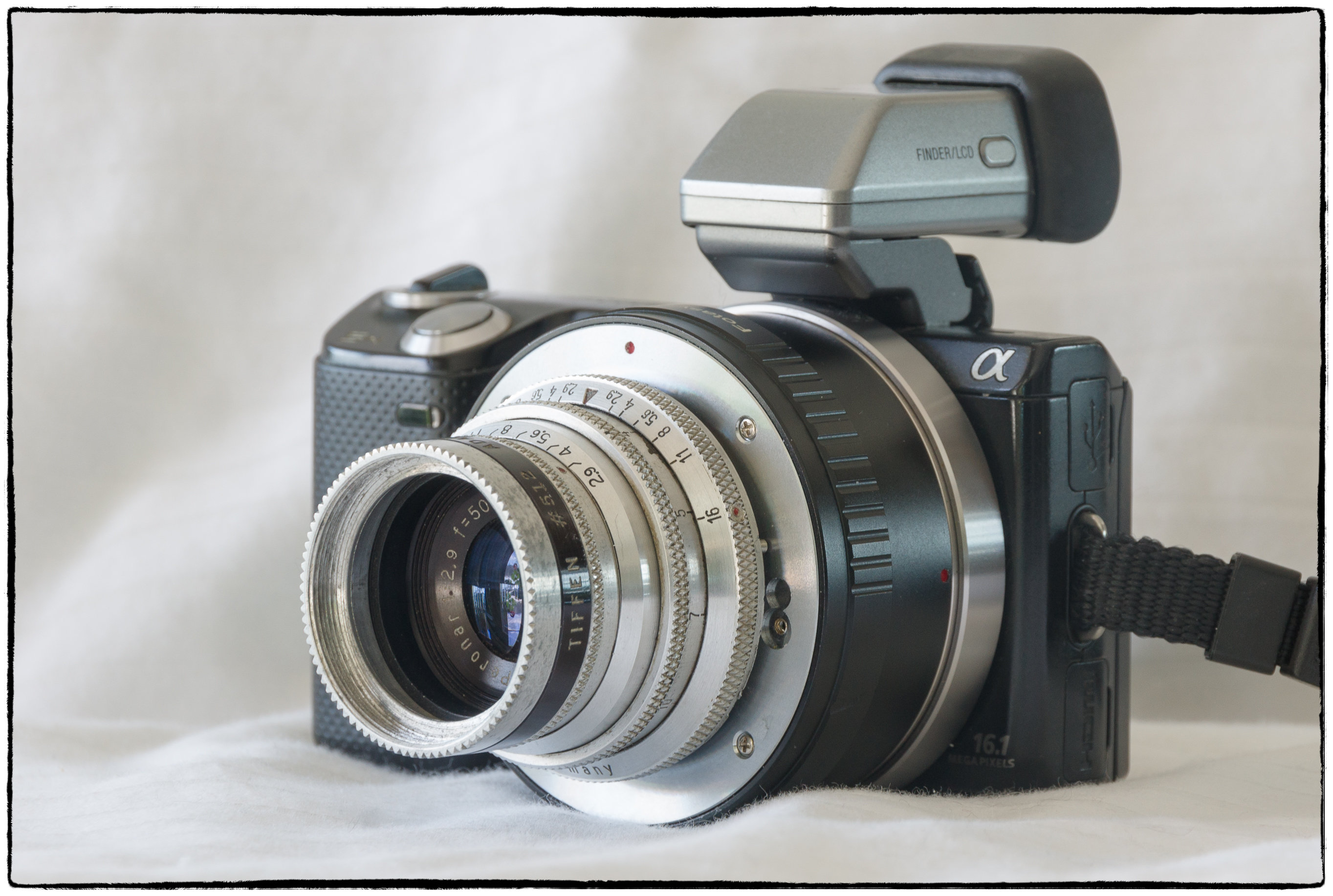
Ernst Ludwig 50mm f2.9 Peronar

Four or five months ago I bought a lot of four cameras for what seemed to me to be a very attractive price. I only really wanted one of them (A contax S/D/Hexacon with Carl Zeiss Jena 50mm f2.8 Tessar) and didn’t really care about the other three, including an Agfa Super Silette, which is a total write off – bits missing, everything completely frozen etc.; An Ansco Speedex Standard, which looks great (and will make a nice display piece of nothing else) and may work (I haven’t checked out and at this point don’t really know how it’s supposed to work); and an Ihagee Exa, which appears to work and which came with a Ludwig 50mm f2.9 Peronar.

I’d never heard of this lens, but after a bit of searching I was able to discover the it’s apparently the export version of the almost universally maligned Meritar. According to the German Photo but More site:

On the other hand, in the first production years, some Exa cameras for the US market were delivered with a special version “Peronar 1: 2.9 f = 50mm”. The Peronar is a version similar to the Meritar.

The same site describes it as being made between 1951 and 1953. As you can see from the picture it’s very small and focuses down to about 2.3 feet. I already had a Exacta mount-Sony NEX adapter and the lens is so small that the adapter is bigger than the lens is. It’s made of aluminum and unfortunately its size requires that the aperture and focus rings be placed close together, making it easy to confuse one with the other. It’s quite a low contrast lens and was difficult to focus on the NEX. The usual NEX focusing aids (focus peaking and focus magnification) didn’t seem to work well. These two factors (aperture and focus rings close together and difficulty focusing) made the lens hard to use. I would set the aperture and then, with some difficulty, focus the lens. Then I’d decide that I needed a different aperture and try to set it only to find that I’d inadvertently touched the wrong ring and thrown the focus off. So I had to start again. Very annoying.

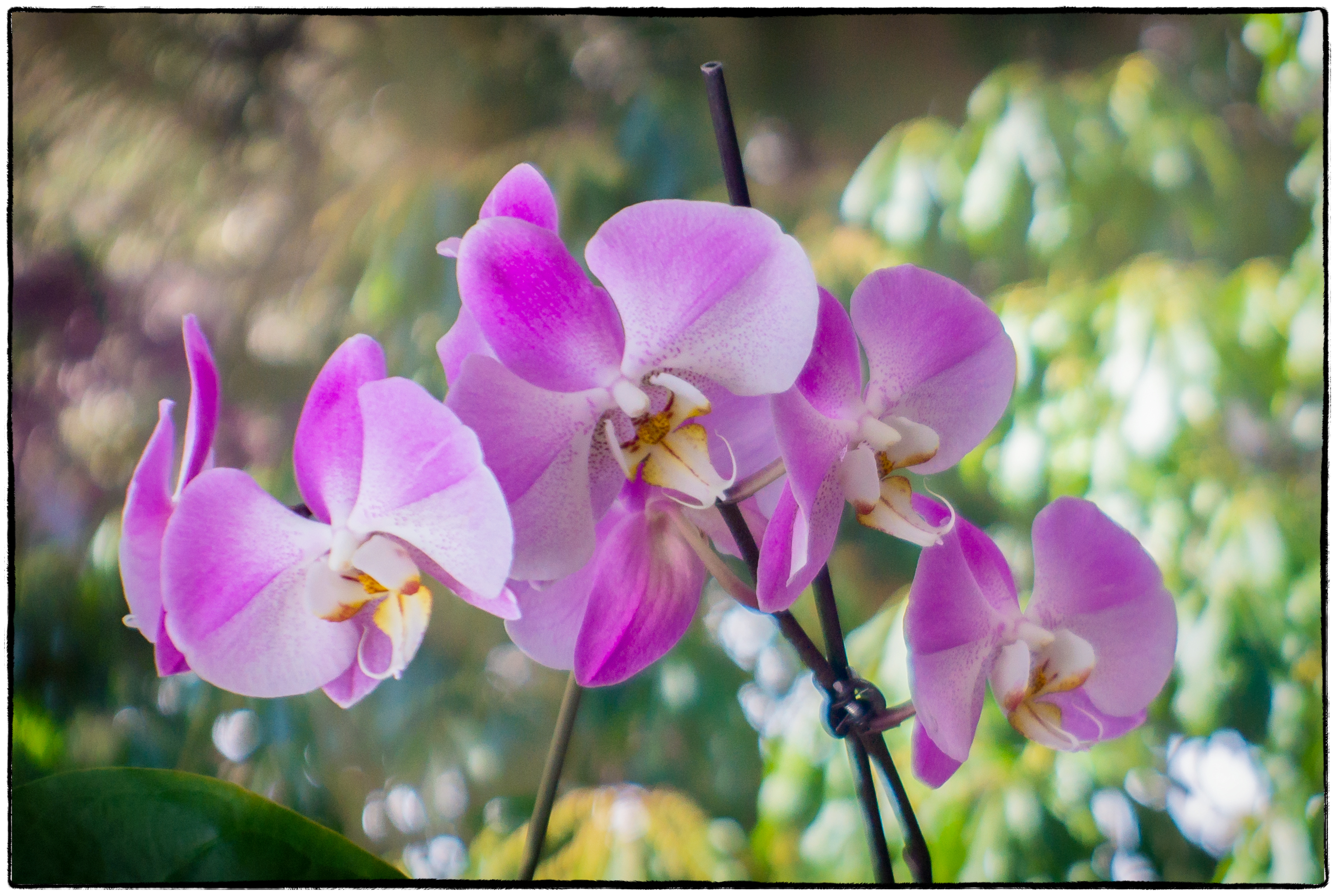
It’s a Cooke triplet design scheme with three elements in three groups. When wide open, it’s quite soft, but I was surprised to find that around f8 it became rather sharp. It has five rounded aperture blades, which are said to produce interesting “twisty” out of focus areas when the lens is wide open: smooth pentagons, which transform into ovals at the edge of the frame. Unfortunately I had great difficulty producing this as I found it so hard to focus when wide open. My best attempt can be seen below.
I found the lens difficult and uncomfortable to use. However, I liked it small size (1.6 inches) and light weight (4.4 oz.). It can be quite sharp when stopped down. In a few cases I found that that the lens produced a low contrast, rather soft effect with an interesting color rendition, which I found quite appealing. The fact that the lens is un-coated (I believe) contributes to this look. I wouldn’t use it for a general purpose lens, but with its 75mm equivalent focal length, soft focus, lack of contrast and interesting out of focus areas I suppose it might make a useful portrait lens. I’ll have to try a few portraits to find out.

For more pictures taken with this lens see:

Seagull on a post
Farmers Market Mural
Rushes
The color purple
A twig in the snow
In a thai restaurant
Orange roses
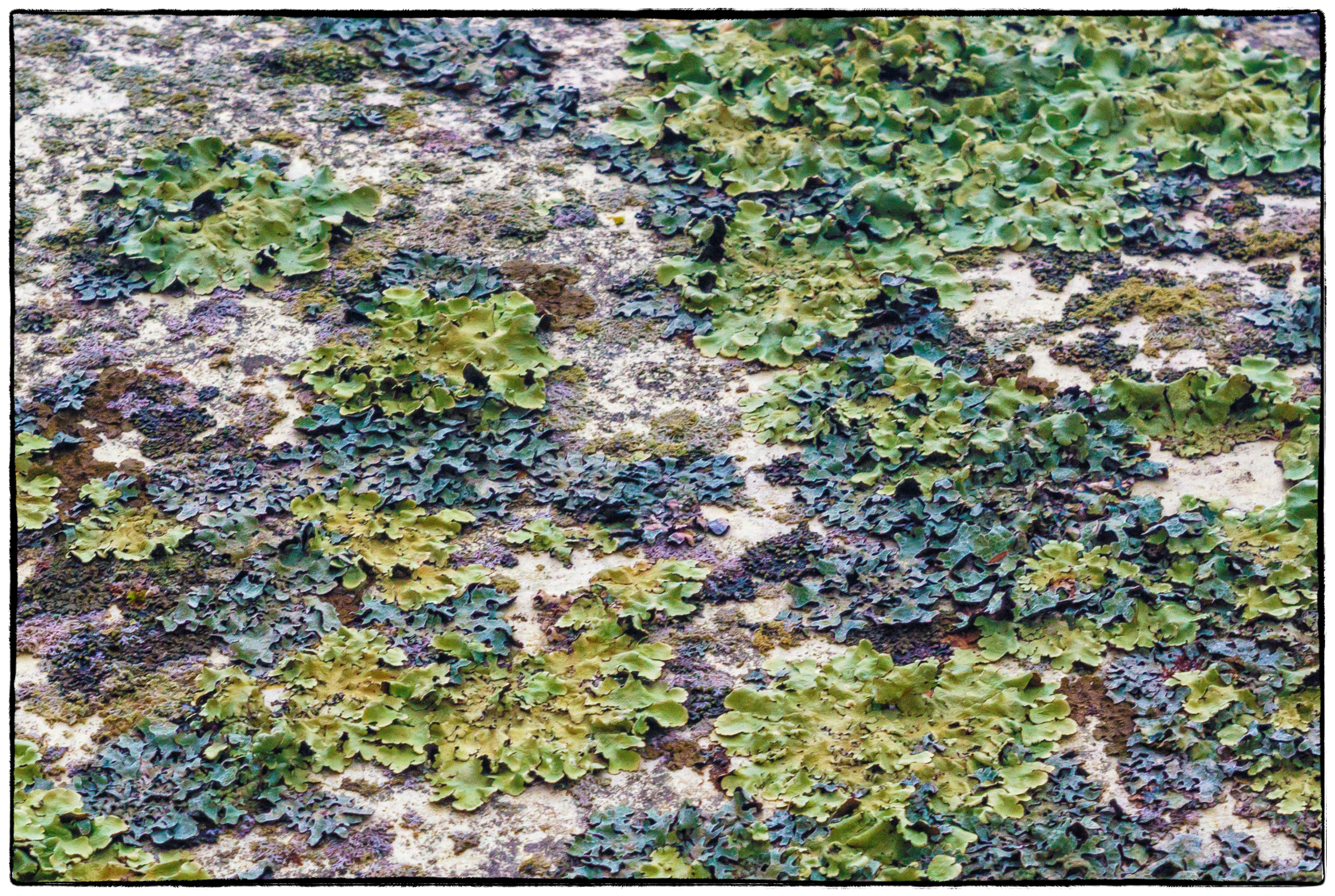
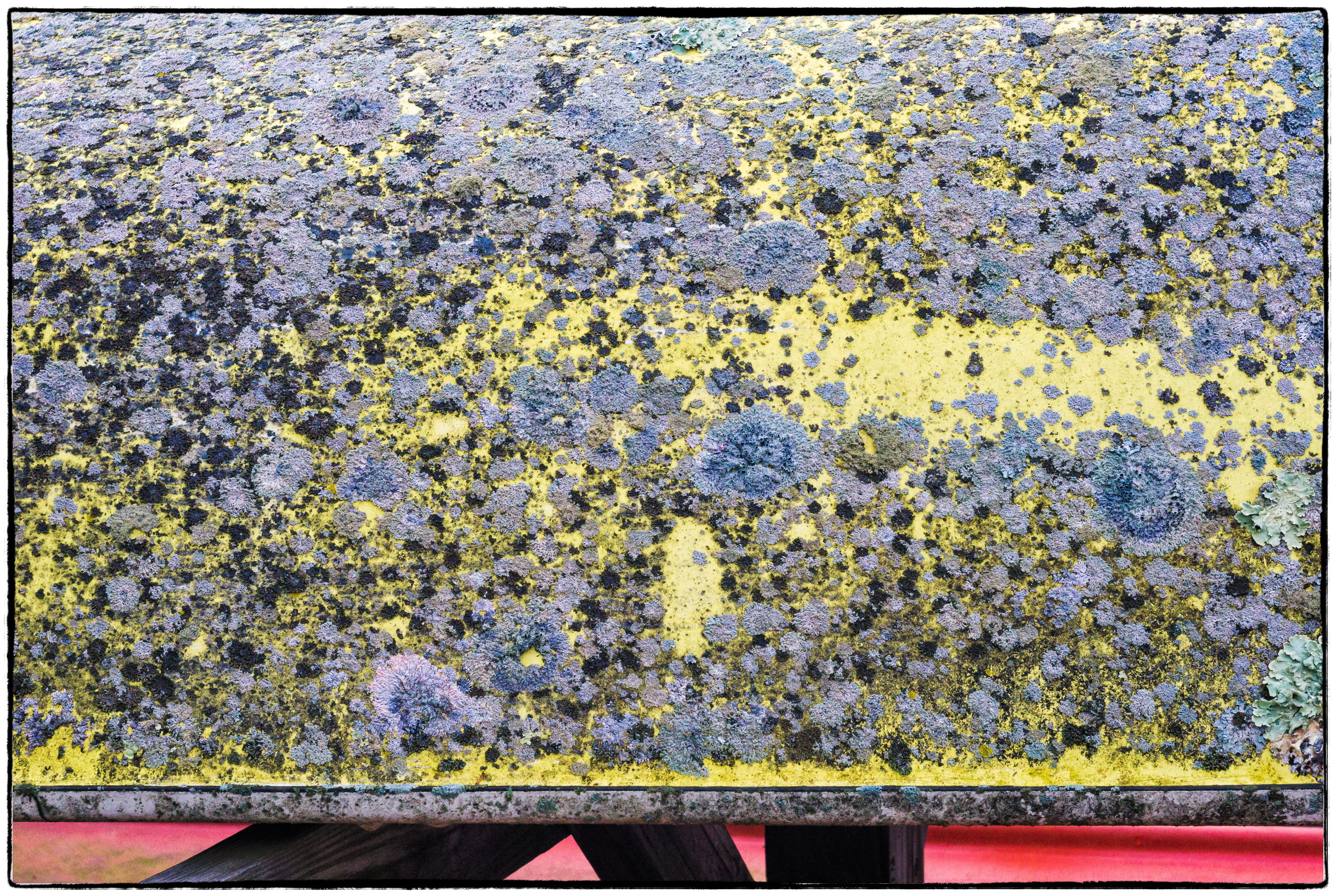
Lichen

I came across these lichen (if indeed that’s what they are) at a nearby beach. There’s a rack where people put their rowboats, canoes and kayaks when they’re not actually in the water. The first picture was taken on one side of the canoe and the second on the other.

According to the US Dept. of Agriculture:

Lichens are a complex life form that is a symbiotic partnership of two separate organisms, a fungus and an alga. The dominant partner is the fungus, which gives the lichen the majority of its characteristics, from its thallus shape to its fruiting bodies. The alga can be either a green alga or a blue-green alga, otherwise known as cyanobacteria. Many lichens will have both types of algae.

I liked the bright colors and the color contrasts as well as the organic, and often repeating forms.

Taken with a Sony NEX 5N and Carl Zeiss Jena 50mm f3.5 T coated Tessar lens.

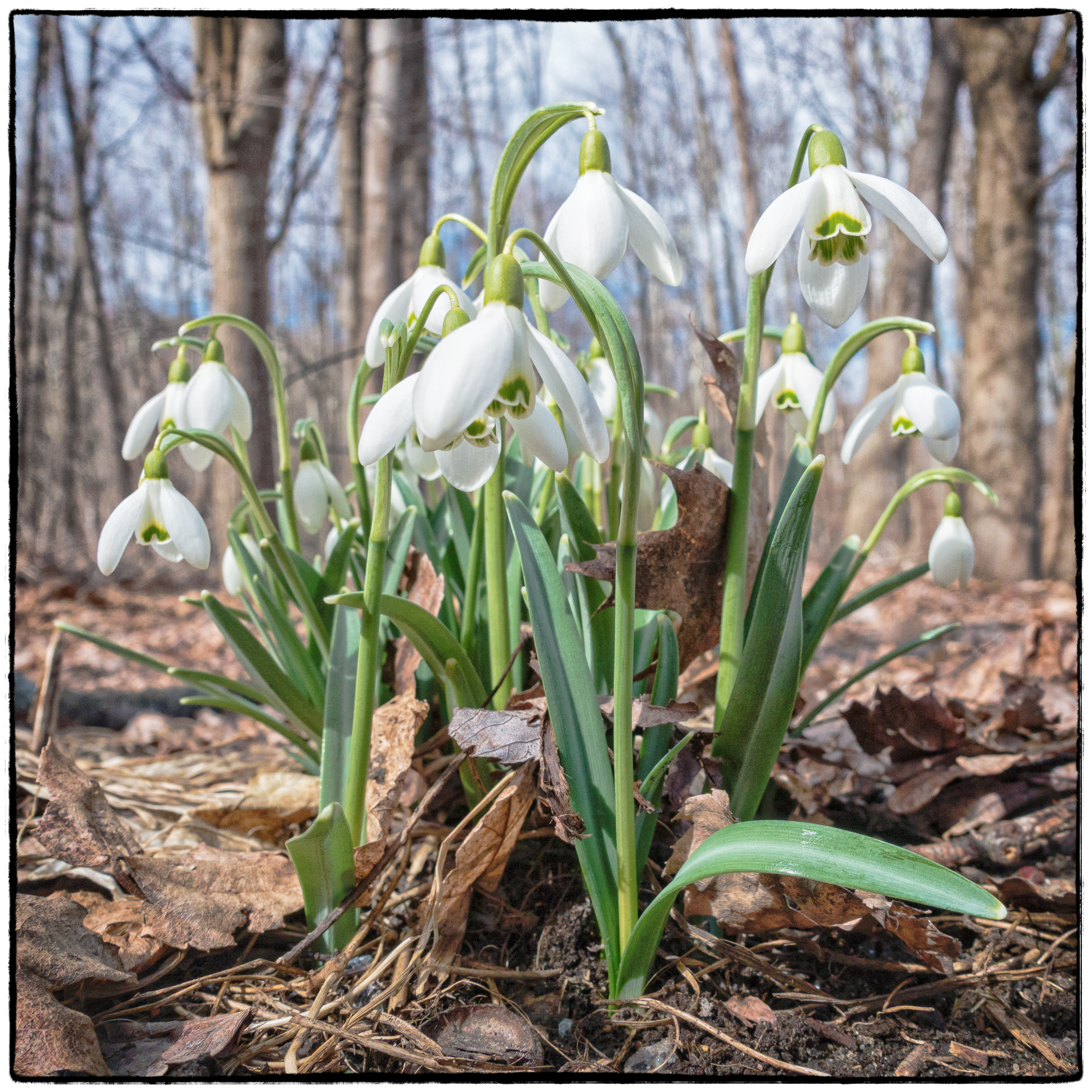
By the roadside 21: Galanthus

Otherwise known as the ‘Snowdrop‘. According to Wikipedia the snowdrop

…is a small genus of about 20 species of bulbous perennial herbaceous plants in the family Amaryllidaceae. The plants have two linear leaves and a single small white drooping bell shaped flower with six petal-like (petaloid) tepals in two circles (whorls). The smaller inner petals have green markings.

Snowdrops have been known since the earliest times under various names but were named Galanthus in 1753. As the number of recognised species increased various attempts were made to divide the species into subgroups, usually on the basis of the pattern of the emerging leaves (vernation). In the era of molecular phylogenetics this characteristic has been shown to be unreliable and now seven moleculary defined clades are recognised corresponding to the biogeographical distribution of species. New species continue to be discovered.

Most species flower in winter, before the vernal equinox (20 or 21 March in the Northern Hemisphere), but some flower in early spring and late autumn. Snowdrops are sometimes confused with the two related genera within the tribe Galantheae, snowflakes Leucojum and Acis.

It’s been a fairly mild Winter so far and I’ve seen a lot of shoots already. However, this clump represents the first flowers that I’ve seen. I wonder how they’ll fare with the 3-5 inches of snow we’re supposed be get today.

Another orchid

I’ve been taking pictures of this orchid off and on for ages, but I never seem to get it quite to my satisfaction: either the lens isn’t right; or I miss that the background is too cluttered; or the exposure is off; or it’s not sharp enough.

This time I took a few pictures and then noticed that I had failed to spot that the window frame was intruding into the picture. How do I avoid this?: move a foot or so to the left and get down much lower (I was taking the pictures at eye level). So that is what I did even though my creaky old legs rebelled a bit at the idea.

I prefer this shot to any of the others.

Taken with a Sony NEX 5N and Minolta MD 50mm f1.4.

Leitz 90mm Elmar LTM in Color

When I was writing the earlier post on this lens (see: Leitz 90mm f4 Elmar LTM) I realized that I’d only shown black and white images. So since the weather wasn’t particularly pleasant I decided to take some color pictures using it in and around our house:

Above – Orchid.

One of my wife’s plants (I have no idea what it is).

Still life

Another orchid

Blue and white vessels on a red cabinet

Clouds. Taken while walking the dog after the weather had picked up a bit.