Peter Lindbergh on Fashion Photography

I haven’t shown a lot of interest in Fashion photography. It’s not that I don’t appreciate it – I do, and I have a number of photobooks by/about well known Fashion photographers including Irving Penn, Helmut Newton, Annie Leibovitz and Edward Steichen. I’m also somewhat familiar with the work of others including Cecil Beaton, Richard Avedon, David Bailey, Horst P. Horst, William Klein, David LaChapelle, Lord Snowden, and Mario Testino. It’s just that I don’t think, much as I might like to take pictures of gorgeous women on a beach I don’t think I’ll ever have the opportunity to do so. Moreover, I’m not really comfortable taking pictures of people in general.

However, my interest was piqued when I saw this video on one of my favorite YouTube channels: Alex Kilbee’s: The Photographic EyeThe Photoshoot Which Changed Fashion Photography

I’d heard of Peter Lindbergh, but had not really appreciated how influential he had been. So I immediately ordered “Peter Lindbergh. On Fashion Photography“, Taschen Books, 2020. In his introduction Lindbergh says:

In 1987, I got a call from Alexander Liberman then the creative director of Condé Nast

I’ve got a couple of books by/about him too. I decided that I would get them after being invited over to the house of, as it turned out, someone who used to work for him). But back to the post:

He couldn’t understand why I didn’t want to work for American Vogue. I told him, “I just can’t take the types of photographs of women that are in your magazine.” I simply felt uninspired by the ways women were being photographed”. He said: “OK, show me what you mean, show me what kind of women you’re talking about.” I wanted a change from a formal, particularly styled, supposedly “perfect” woman – too concerned about social integration and acceptance – to a more outspoken and adventurous woman, in control of her own life and emancipated from masculine control. A woman who could speak for herself.

A few months later, following Mr. Liberman’s proposition, I put together a group of young and interesting models and we went to the beach in Santa Monica. I shot very simple images; the models wore hardly any makeup, and I wanted everyone to be dressed the same, in white shirts. This was quite unusual at the time. Linda Evangelista, Christy Turlington, Tatjana Patitz, and Karen Alexander were all there that day.

Back in New York, Vogue’s editor in chief at the time, Grace Mirabella, refused to print the images. But six months later, Anna Wintour became the the magazine’s editor and discovered the proofs somewhere in a drawer. She put one of them in Condé Nast’s big retrospective book “On the Edge: Images from 100 years of Vogue (1992)”, calling it the most important photograph of the decade. The “supermodel” would go on to represent the powerful woman that I had articulated, and their images dominated fashion visuals for the next 15 years.

The book consists of two distinct parts: a short, but very interesting introduction by Lindbergh himself followed by the heart of the book – Over 300 hundred images (that’s what the book’s sleeve says, but the book actually has 505 pages and the introduction – in English, German, and French – takes up only about 30 of them, and itself contains a number of photographs). Such a large number of images requires some kind of organization and in this case it’s alphabetical by client e.g. Azzedine Alaïa, Heider Ackermann, Giorgio Armani etc.

I like this series of Taschen books. Most photobooks are quite expensive, large format, heavy and difficult to hold. This series is more compact (6×9 inches) and fairly inexpensive. I have a number of them. I guess the only problem with them is that the photographs are relatively speaking rather small, but they’re good enough to provide a thorough overview of his work. Taschen also has a larger format series. I have a few of them too (e.g. Sebastião Salgado‘s wonderful “Genesis” (10×14 inches, but still quite inexpensive for a photobook of this quality), but I find them too big and too heavy to comfortably hold and read.

The Europeans

I’m a huge fan of Henri Cartier-Bresson. So it’s somewhat surprising that until recently I had only one, very small, very thin and not very thorough book on or by him.

So when I was compiling my Christmas Amazon wishlist (the best way for my family to buy me gifts that I actually want) I included a couple of books about him. This is the first. It’s called “Europeans” and in his introduction, Jean Clair states:

In 1955 a collection of photographs called Les Européens was published. It was conceived and designed by Tériade, with a jacket by Jen Miró. Henri Cartier-Bresson had worked on it for five years, a short period if one considers that the celebrated photographs in Images à la Sauvette (1952, published in English as The Decisive Moment) were selected from work spanning twenty years. The book offered a closely woven portrait of Europe after the war: accumulated ruins and the marks of hunger and woe on people’s faces still appearing very clearly.

After that it was all downhill for the introduction as far as I was concerned. I didn’t know who Mr. Clair was so I looked him up. He’s described as follows:

Jean Clair is the pen name of Gérard Régnier (born 20 October 1940 in Paris, France). Clair is an essayist, a polemicist, an art historian, an art conservator, and a member of the Académie française since May, 2008. He was, for many years, the director of the Picasso Museum in Paris. Among the milestones of his long and productive career is a comprehensive catalog of the works of Balthus. He was also the director of the Venice Biennale in 1995.

I suppose I shouldn’t have been surprised by what followed in the introduction: lots of big, arcane words and tortured sentences. The following is fairly typical:

Now, as a wizard of speed, he needed a certain lightness of touch, something airy, mercurial. Hermes, god of commerce and thieves, could well be the god of photographers. With quicksilver as the escutcheon of his equipment, this disciple of hermetic knowledge, borrowing the the powers of the god with winged hat and shoes, sets out to purloin the the fulgurating moment at the crossroads of appearances and to conserve something of Mercury’s spark.

Maybe it’s just me, but I don’t relate well to this kind of “criticspeak”. When I was in university many years ago I had to read a book by Messrs. René Wellek and Austin Warren. I can’t remember the title (I’ve probably blotted it out) but it was something to do with principles of literary criticism. Their best know work seems to be Theory of Literature, but that title doesn’t ring any bells. Anyway I read that book from cover to cover and after I finished it I found that I couldn’t remember a single thing. Still, I remember thinking that the book must have been important or why would they have made us read it. So I read it again with the same result. Maybe now I’m older I should read it again. Who knows – third time lucky.

But on to the pictures. They are of course remarkable, for the most part. We’re so used to seeing Cartier-Bresson’s masterpieces that it’s easy to forget that not all of his pictures fall into that class. Of the 200 or so pictures I only really liked about 43.

Unfortunately, it’s not immediately obvious how the photographs are organized. There’s no table of contents and at first I thought that the pictures were randomly organized. However, after a bit of study I realized that they are in fact organized by country, but that the order of the countries is not alphabetical. Rather it goes as follows (with the number of photographs for each country in parentheses): France (36); Portugal (7); Spain (18); Italy (20); Switzerland (5); Yugoslavia (5); Greece (6); Turkey (5); Romania (4); Hungary (3); Austria (3); Germany (16); Belgium (1); Netherlands (3); Poland (6); USSR (17); Sweden (3); Denmark (1); UK (13); Ireland (10).

Still despite the minor criticisms I really enjoyed the book.

Now on to the second book: Henri Cartier-Bresson. The Modern Century , but first I have to figure out how to read it comfortably. It’s longer, bigger and heavier that the above book.

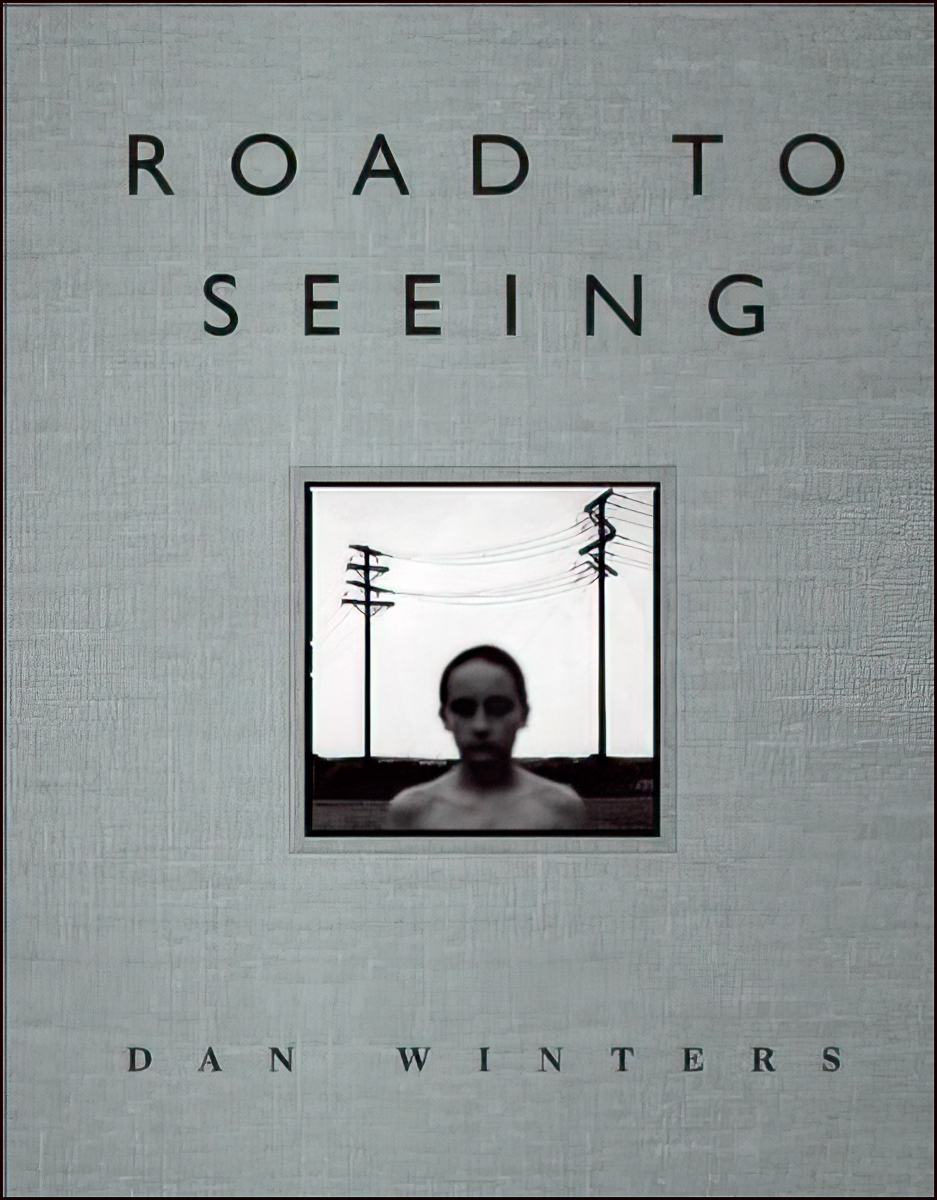
Dan Winters – Road to Seeing

Last month I posted a YouTube video of an interview with Dan Winters (See: Interesting Interview with Dan Winters). I didn’t really know his work and It interested me enough that I decided to get one of his books, specifically “Road to Seeing”. I usually order hardcover versions of photobooks, but this time I was impatient and I ordered the Kindle version. The fact that the hardcover version was over six times more expensive may also have had something to do with it! I don’t recommend that you do this unless you have the flashier color versions (or are willing to read it on your computer) as many of the images are in color and you lose a great deal by viewing them in black and white.

In his introduction he states: “My purpose in writing this book is rooted in a desire to share, on a human level, some of the moments in my life that have significance to me as a photographer, and a man” so it is at least in part autobiographical.
The book features many beautiful images. But in addition each chapter tells the story behind the image and how it was created. His focus, however, is not on technical matters. Rather he concentrates on such areas as what he was thinking in the run up to the photograph; how he collaborates with his subjects etc.

In addition to Winter’s own pictures the book contains many photographs from such photographic luminaries as : Alfred Stieglitz, Lewis Hine, Dorothea Lange, Eddie Adams, Gregory Heisler, William Wegman, Nadar, Henry Fox-Talbot, Eugène Atget, William Klein, Saul Leiter, Walker Evans, Henri-Cartier Bresson and many others.

He’s best know for his portraits of celebrities, done in his studio often using sets he has built himself (in an earlier existance he built models for a living and so has expertise in this area.) His work has been featured in National Geographic, Vanity Fair, The New York Times Magazine and many other newspapers and magazines. This work takes up much of the book.

However, he also produced a lot of personal (i.e. Non-commercial) work and this is where I have a bit of a difficulty. He almost seems to be apologetic of his commercial work almost as if he considers it a bit inferior to his personal work. Personally, I’m not wild about the personal work. Don’t get me wrong – It’s good, but I’ve seen better examples in the various genres that he’s tackled.

Even though it’s quite a long book (almost 700 pages) it’s quite easy to read and I got through it in no time. I very much enjoyed it and I’m glad I bought it. You can get a copy for yourself here.

Interesting Interview with Dan Winters

One of my favorite YouTube channels is Alex Kilbee’s The Photographic Eye. Today I watched this fascinating interview with Dan Winters.

According to the biography on his website:

After studying photography Moorpark College in Southern California, Dan Winters finished his formal education at the documentary film school at Ludwig Maximilian University of Munich, Germany. He began his career in photography as a photojournalist in his hometown in Ventura County, California. After winning several regional awards for his work, he moved to New York City, where magazine assignments came rapidly. Known for the broad range of subject matter he is able to interpret, he is widely recognized for his unusual celebrity portraiture, his scientific photography, photo illustrations, drawings and photojournalistic stories. Winters has won over one hundred national and international awards from American Photography, Communication Arts, The Society of Publication Designers, PDN, The Art Directors Club of New York, Life Magazine. He was awarded a World Press Photo Award in the Arts and Entertainment category in 2003. He was also awarded the prestigious Alfred Eisenstaedt Award for Magazine Photography. In 2003, he was honored by Kodak as a photo “Icon” in their biographical “Legends” series.

He has had multiple solo gallery exhibitions in New York and Los Angeles and a solo exhibition at the Telfair Museum Jepson Center for the Arts in Savannah. His work is in the permanent collections at the National Portrait Gallery, Museum of Fine Art, Houston, The Harry Ransom Center and the Wittliff Collection at Texas State University, San Marcos. His books include “Dan Winters’ America: Icons and Ingenuity”, “Last Launch”, “Periodical Photographs”, “Road To Seeing”, which chronicles his path to becoming a photographer and “The Grey Ghost”, which is a selection from 30 years of his New York street photography.

Clients include Esquire, GQ, Vanity Fair, The New York Times Magazine, The New Yorker, New York Magazine, TIME, WIRED, National Geographic, Smithsonian Magazine, Fortune, Variety, W, Entertainment Weekly, Rolling Stone, Newsweek, Golf Digest, Vanity Fair and many other national and international publications. Advertising clients include Apple, Netflix, Samsung, Microsoft, Nike, Target, LG, Hewlett-Packard, Sony, Bose, Amazon, HBO, Saturn, Sega, Fila, Cobra, Warner Brothers, NBCUniversal, Paramount, DreamWorks, Columbia TriStar and Twentieth Century Fox, RCA, Atlantic Records, A&M, Sony, Warner Brothers, Elektra, Interscope and Epitaph.

Old Paris and Changing New York

I came across this book in my local library and liked it so much that I got a copy for myself. It’s “Old Paris and Changing New York. Photographs by Eugène Atget and Berenice Abbott” by Kevin Moore.

I’m a long time fan of Atget and to a lesser extent of Abbott and found the content of the book to be particularly interesting. There’s a, too me, ideal mix of text and photographs. An 81 page essay by Moore including a number of photographs followed by 52 full page plates: photographs by both Atget and Abbott.

Photobooks are often large and heavy. I understand the need to present the photographs as well as possible. I have a number of such photobooks. The problem is that I find them too heavy and cumbersome to comfortably read so I rarely look at them. This book is not too large and not too heavy, but still presents its materials effectively.


Atget to the left. Picture taken by Abbott. 1927. Abbott to the right. Self Portrait. 1928.

Taken with a Sony A7IV and Samyang 45mm f1.8