Not the brightest period in US history: Dorothea Lange’s photographs of Japanese internment camps

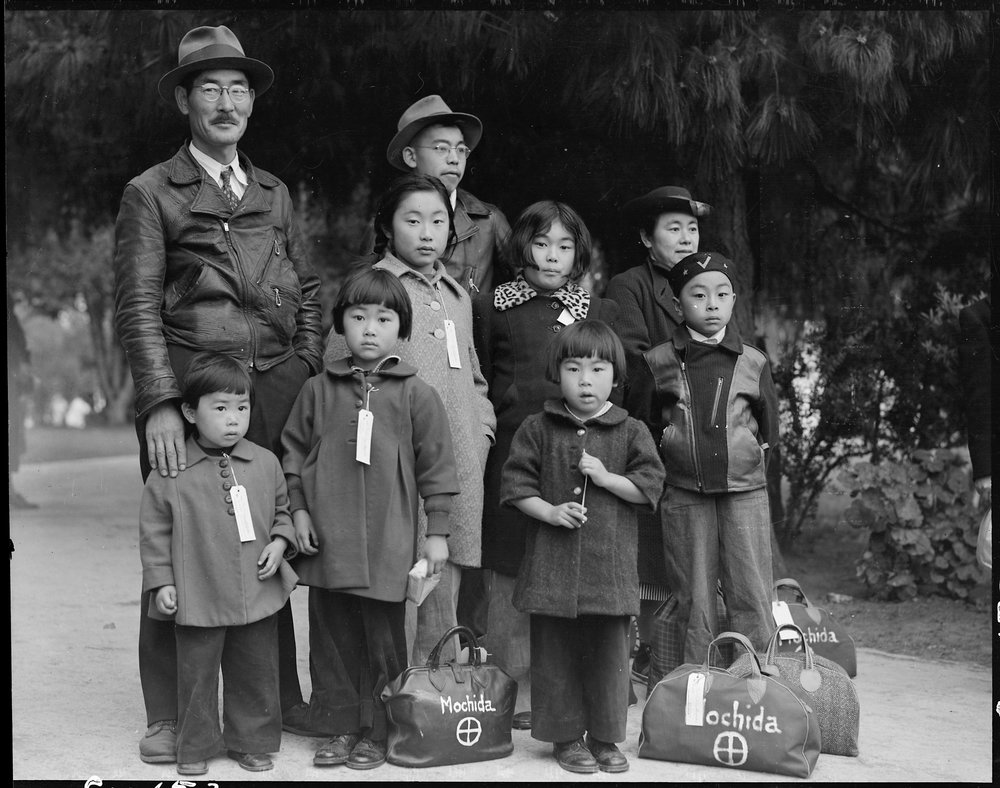
May 8, 1942 — Hayward, California. Members of the Mochida family awaiting evacuation bus. Identification tags are used to aid in keeping the family unit intact during all phases of evacuation. Mochida operated a nursery and five greenhouses on a two-acre site in Eden Township. He raised snapdragons and sweet peas. Evacuees of Japanese ancestry will be housed in War Relocation Authority centers for the duration.

Dorothea Lange—well-known for her FSA photographs like Migrant Mother—was hired by the U.S. government to make a photographic record of the “evacuation” and “relocation” of Japanese-Americans in 1942. She was eager to take the commission, despite being opposed to the effort, as she believed “a true record of the evacuation would be valuable in the future.” The military commanders that reviewed her work realized that Lange’s contrary point of view was evident through her photographs, and seized them for the duration of World War II, even writing “Impounded” across some of the prints. The photos were quietly deposited into the National Archives, where they remained largely unseen until 2006.

Source: Dorothea Lange’s Censored Photographs of FDR’s Japanese Concentration Camps — Anchor Editions

PIC – Photographers’ Identities Catalog

The New York Public Library has come up with an interesting new tool:

Photographers’ Identities Catalog (PIC) is an experimental interface to a collection of biographical data describing photographers, studios, manufacturers, and others involved in the production of photographic images. Consisting of names, nationalities, dates, locations and more, PIC is a vast and growing resource for the historian, student, genealogist, or any lover of photography’s history. The information has been culled from trusted biographical dictionaries, catalogs and databases, and from extensive original research by NYPL Photography Collection staff.

The interface allows you to filter according to a number a criteria: Name or ID; Date Range (year); Location (Type e.g. birth; Country or Geographical Area; In Map Area); Nationality; Gender; Process (e.g. Autochrome); Role (e.g. Collector or Dealer); Format (e.g. Panoramic Photographs); Source; Collections.

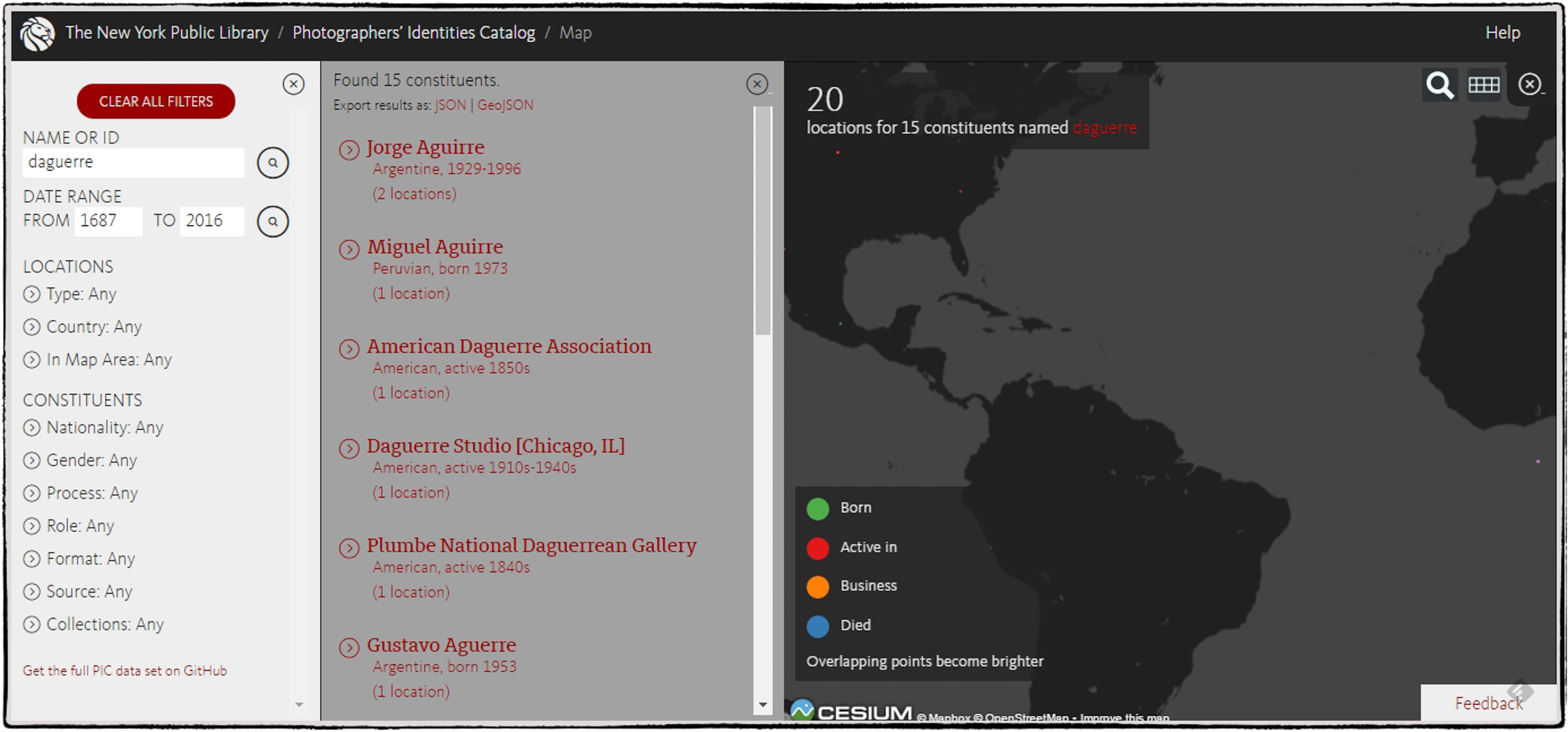
Once you’ve applied your filters you then get a list of results (since the system uses a “fuzzy search” algorithm you usually get more than you really want. For example, setting the name filter to ‘Daguerre’ produces ‘Aguirre’, ‘Aguerre’, and Ministere de la Guerre’ as well. The ‘Daguerre’ I was looking for was 9th in the list.

I’m a fan of Joseph Sudek so I thought I’d see if I could find him with some general criteria and not using his name. I imagined that I only knew that he was male; from somewhere in Eastern Europe; and was known for panoramic photographs (among other things). So I set up the filters: Gender – Male; Country – There was no Eastern Europe so I had to select Europe instead; Format – Panoramic Photographs. Unfortunately my attempt was not successful. His name did not appear on the results list.

The map takes up a lot of screen space and I’m not entirely sure how useful it is. This may well be because of my ignorance of how it’s supposed to work however.

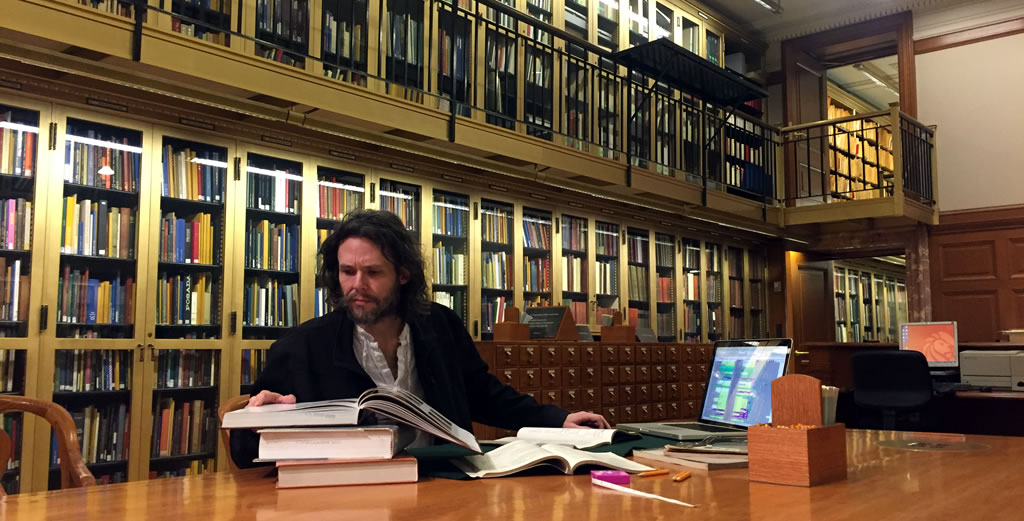
David Lowe, Photography Specialist at the New York Public Library, and the primary editor of PIC, in the Photography Room.

So many thanks to the New York Public Library for such a useful tool. Over time I’m sure it will become even more useful in terms of additional content and system improvements. One of the FAQs is: “I have information PIC lacks, or I’ve spotted an error. How do I contribute or request a correction?” The answer is “Please let us know! Use the feedback link in the bottom right of the map. It is helpful if you include the Record ID number to identify the photographer in question. That ID can be found after the Name, Nationality and Dates of the constituent.”

Source: PIC – Photographers’ Identities Catalog

John Cohen at L. Parker Stephenson Photographs in New York

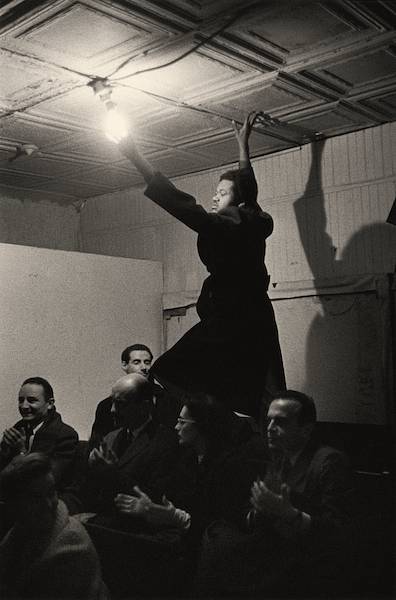
Bob Thompson, The Burning Building, 1959, Tanager Gallery, 1959 by John Cohen, courtesy of L. Parker Stephenson Photographs

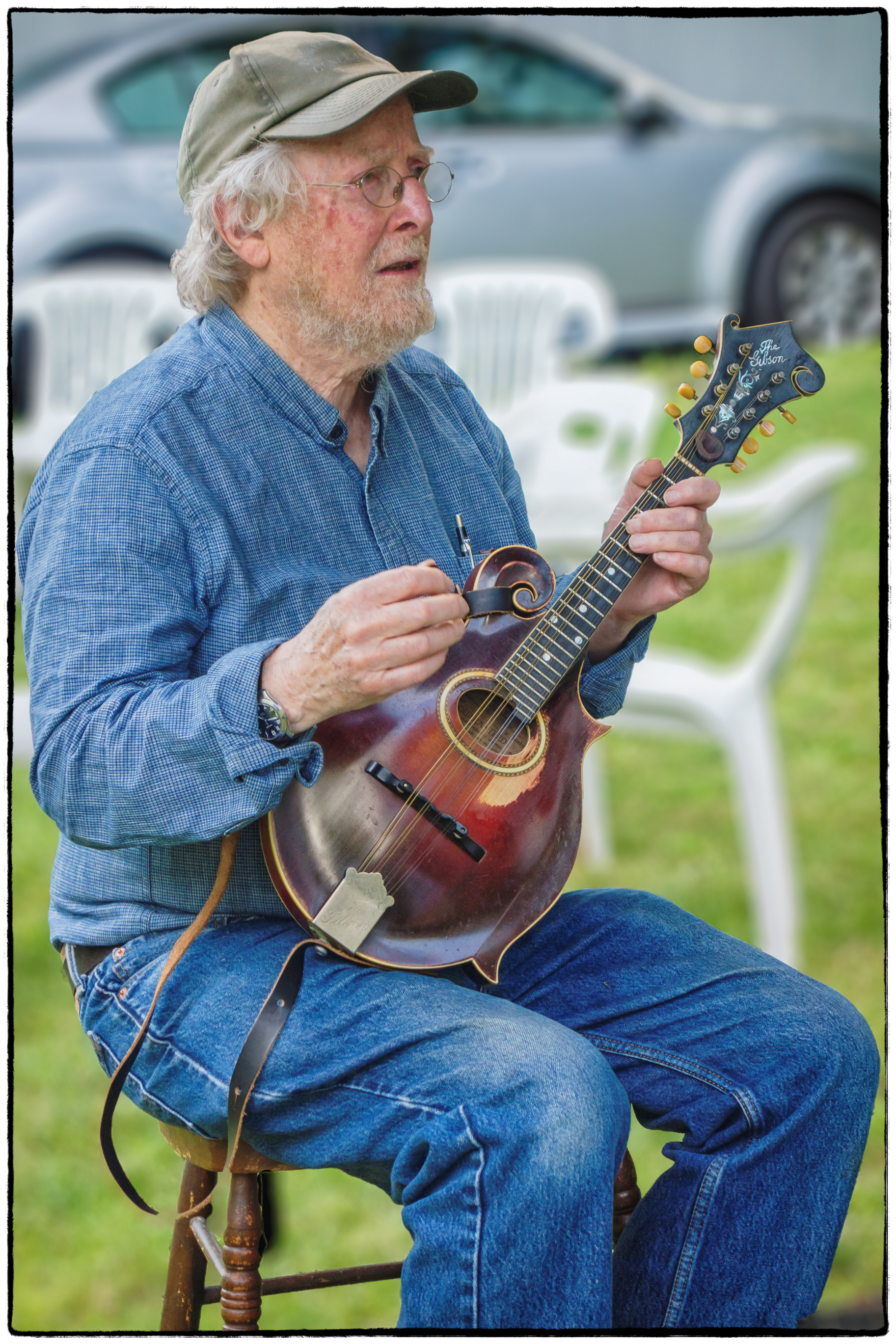
John Cohen lives near us and often performs at the Tompkins Corners Cultural Center, which opened not too long ago in the Tompkins Corners Cultural Center (formerly the Tompkins Corners Baptist Church). Here’s a picture of him performing:

The late 1950’s and early 60’s was the booming period of artistic freedom — and freedom will only get better from that era.Photographer John Cohen witnessed the shift of the New York social landscape — normal society was becoming a community of artists, writers and musicians whom cohabit along New York’s East 10th Street. The birth of Abstract Expressionism owes its creation through the works of Philip Guston and Frank Kline. The Beat Movement was also in its early days. John Cohen was both an observer and participant of such a divided time.

Catch the on-going show John Cohen: The 10th Street Art at the L. Parker Stephenson Photographs in New York.

Source: The Early Photographs of John Cohen · Lomography

Photographs from the edge

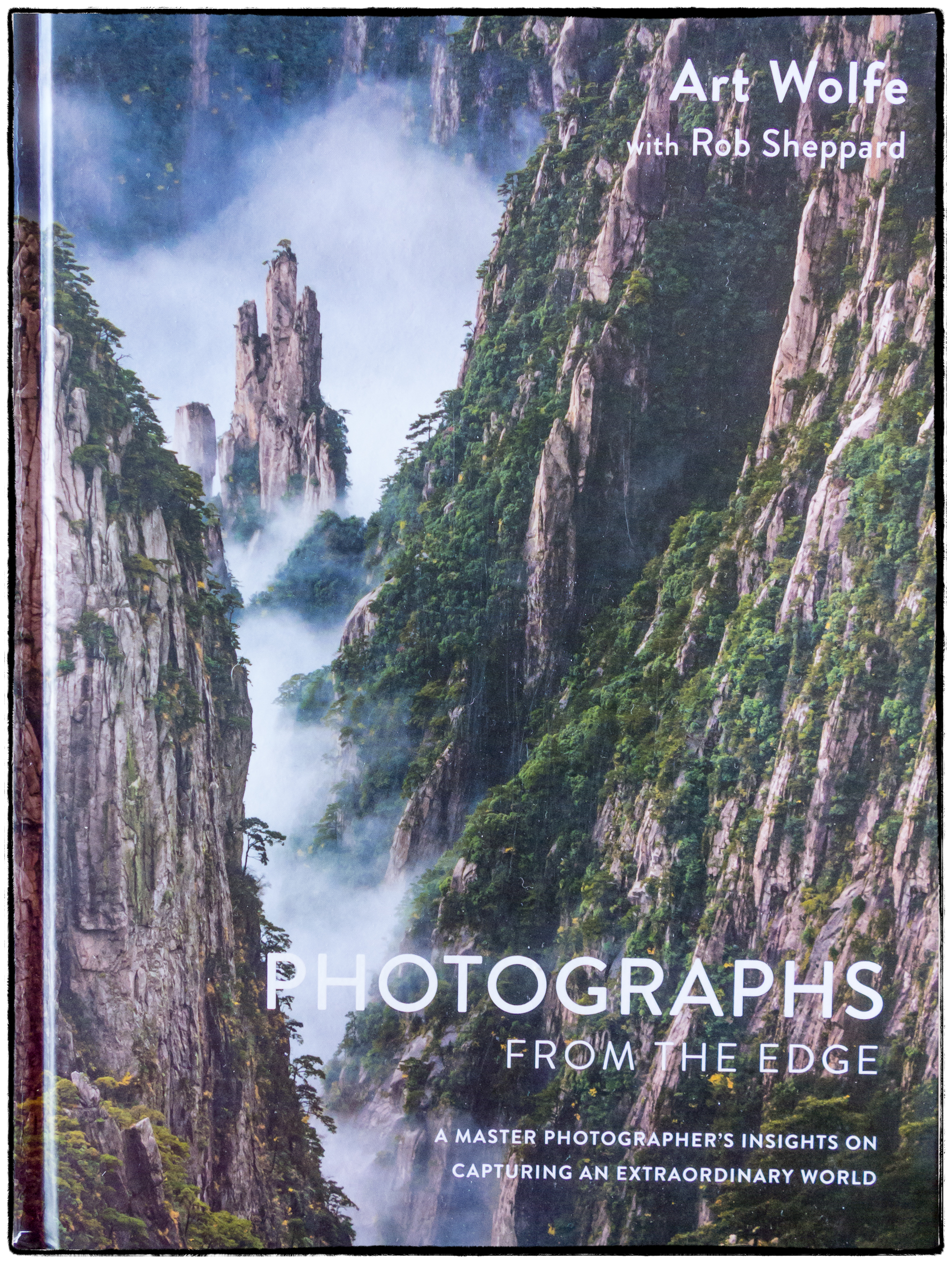
I recently bought a copy of Photographs from the edge. A master photographer’s insights on capturing an extraordinary world by Art Wolfe (with Rob Sheppard).

The photographs are mostly along the lines of: animals in exotic locations; people in exotic locations; exotic locations all by themselves. In total there are about 130 color pictures (two pictures on the inside of the front and back covers are in black and white) spanning a period from the 1980s to the present. They’re striking pictures and well worth studying. However, they’re not really my cup of tea. While I can recognize the skill and ability required to produce such pictures they don’t move me all that much.

So why did I buy the book? Each picture is accompanied by technical information on the camera and lens used; settings chosen; and where appropriate the type of film used. In addition as Rob Sheppard says in his preface:

For each of Art’s photographs, we have included a section on the nature of the photograph, a short piece inspired by the subject matter of the image. To do each image justice, I often learned something new, especially about cultures and out-of-the-way places.

As a photographer, I enjoy learning how other photographers handle their way of seeing. Exploring another person’s approach to this art and craft can even illuminate your own pieces by way of both contrast and empathy with the work.

It’s this background to each picture, when read in conjunction with the pictures themselves, that I find appealing.

As an example I include below the full text relating to the picture on the book’s cover (see above).

October 2008
Huangshan
Anhui Province, China
Canon EOS-1Ds Mark III, EF70-200mm F2.8 lens +1.4x, f/14 for 1/13 sec., ISO 100

I first visited Huangshan, or the Yellow Mountains of China, in 1984. I had been in the first Western expedition to Tibet and the slopes of Mount Everest. On our return, several of us stopped in eastern China to visit Huangshan. This is a sacred place for the Chinese people. In contrast to the grayness and the ice of Mount Everest, it is like being inside a giant sumi brush painting.

I had studied the sumi brush masters of both Japan and China during my college years in art history, and I remembered the imaginative landscapes of those artists. I long thought that they imagined those scenes, maybe from trips to the opium den! When I traveled to Huangshan, I discovered they were much more literal paintings than I had thought. There were indeed landscapes of vertical granite faces, contorted pine trees, and swirling mists.

Since that first visit, I have returned to the area on three distinct trips. Each time I renewed my fondness for this landscape and photographed new formations of the land. What I love about these shots is the scale. Pinnacles of rock rise out of the swirling mists, while tiny pine trees cling to the windswept slopes. The mist and the landscape formations provide a balance of positive and negative space, of light and dark areas.

The nature of the photos

Huangshan has long been a popular location for artists because of its spectacular mountains and cliffs. The pine trees growing on the rocks are endemic (exclusively native) to the area and so have gained the name “Huangshan pine”.

Photo Tip

Fog and changing weather can provide unique views of any landscape. Don’t be afraid of the clouds. Just avoid using large areas of blank clouds in your composition.

Happy Birthday, M. Daguerre

Louis-Jacques-Mandé Daguerre was born on 18 November 1787 in Cormeilles-en-Parisis, Val-d’Oise, France. Best known as one of the first pioneers of photography he was also an accomplished painter, businessman and advocate of the diorama.

His positive daguerrotype process for a while dominated photography until ultimately supplanted by William Henry Fox Talbot‘s, negative calotype process.