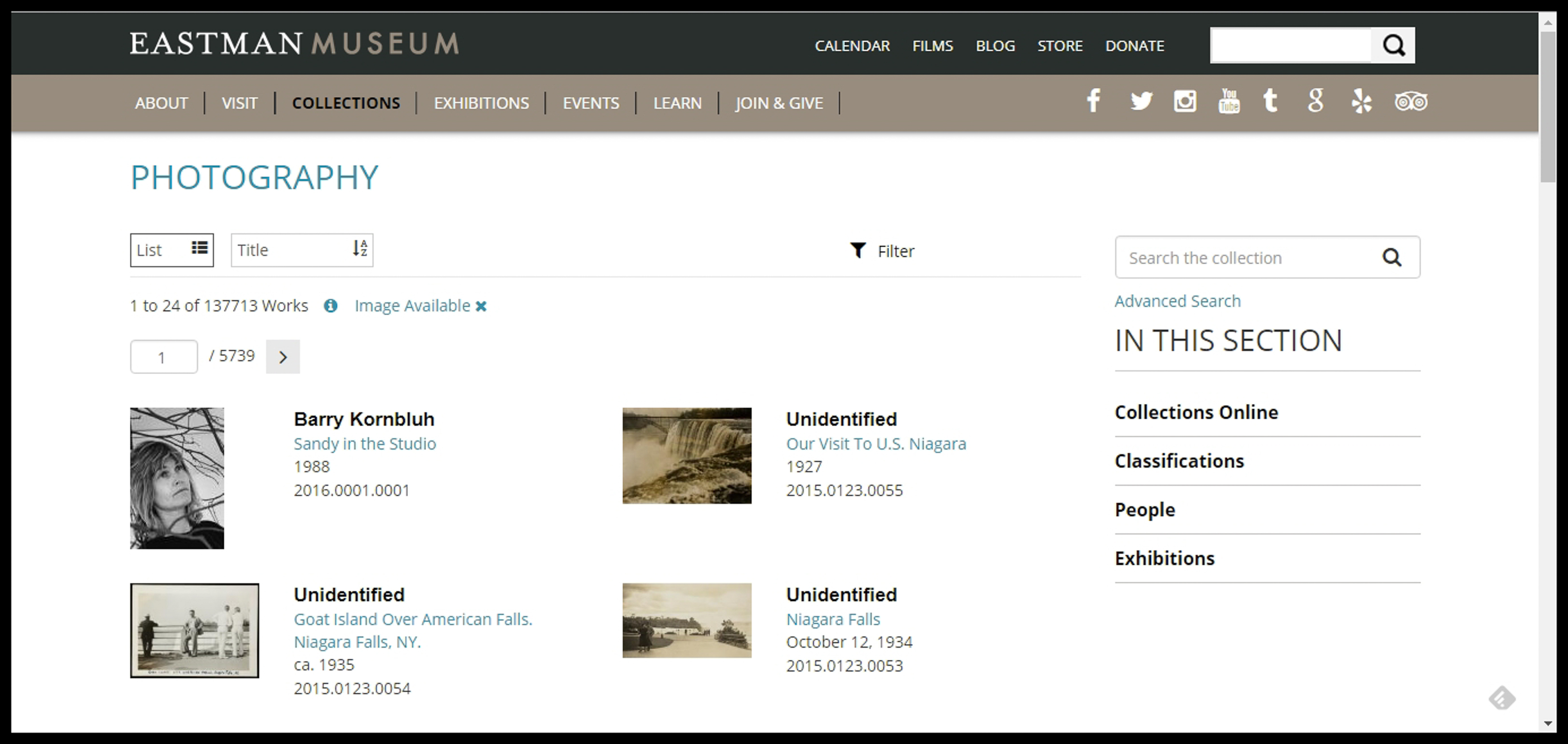
Online portal at George Eastman House

According to a November 6, 2016 Shutterbug article:

The famous George Eastman Museum has created a new, public portal where you can view over 250,000 images and other objects from their vast collections. The database is searchable by artist, collection, classification and date, and includes a wealth of photography, cinema, and technology related to imaging.

The 250,000 objects currently on the site are but a mere fraction of the museum’s collections of several million objects, but additional holdings are being added to the portal weekly.

It’s certainly an impressive undertaking. I briefly browsed through it and there’s a lot to see. Unfortunately they seem have started off with the image metadata, to which they are gradually adding images. I imagine it’s faster to add the metadata than it is to scan all the images. So the end result is that many of the entries indicate that the image is “not available”. For example I searched for Ansel Adams and got 18 pages of results. On the first page there were 24 entries. 18 of them indicated that the image was not available. I’m sure that over time these gaps will be filled.

It’s potentially a great resource.

More from Christies

I mentioned in an earlier post (See: Self portrait with Cindy) that we went to Christies in New York City the other day. Here are a few other items that caught my attention. Above: The star of the show.

Leonardo da Vinci (1452-1519)
Salvator Mundi
oil on panel
25 7/8 x 18 in. (65.7 x 45.7 cm.)
Painted circa 1500.
Estimate: Only available on request. Some sources (e.g. NY Times – Contemporary Art Sales: Do I Hear $100 Million?) anticipate that it will fetch $US100 million or more. UPDATE: It eventually sold for the to me obscene amount of $US450 MILLION!

Louise Bourgeois (1911-2010)
Spider II
signed with the artist’s initials and stamped with the edition number ‘LB 5/6’ (on underside)
bronze
73 x 73 x 22 1/2 in. (185.4 x 185.4 x 57.2 cm.)
Executed in 1995. This work is number five from an edition of six plus one artist’s proof.
Estimate: $US10,000,000-15,000,000.

David Smith (1906-1965)
Voltron XXIV
signed, titled and dated ‘XXIV Voltron David Smith 3-25-63’ (on the base)
steel
98 5/8 x 33 x 13 in. (230.1 x 83.8 x 33 cm.)
Executed in 1963.
Estimate: US5,000,000-$US7,000,000.

Cindy Sherman (b. 1954)
Untitled #408
signed, numbered and dated ‘Cindy Sherman 3/6 2002’ (on the backing board)
chromogenic print
54 x 36 in. (137.2 x 91.4 cm.)
Executed in 2002. This work is number three from an edition of six.
Estimate: $US80,0000-$120,000.

Richard Avedon (1923-2004)
Marilyn Monroe, actress, New York City, May 6, 1957
signed and numbered ‘Avedon 34/50’ and stamped with title, date and photographer’s copyright credit (on the reverse)
gelatin silver print flush-mounted on linen
image: 18 3/4 x 15 1/2 in. (47.6 x 39.4 cm.)
sheet: 20 x 15 7/8 in. (50.8 x 40.3 cm.)
Printed in 1980. This work is number thirty-four from an edition of fifty.
Estimate: $US70,000-$US100,000.

Two Exhibitions of photographs by Joel Meyrowitz

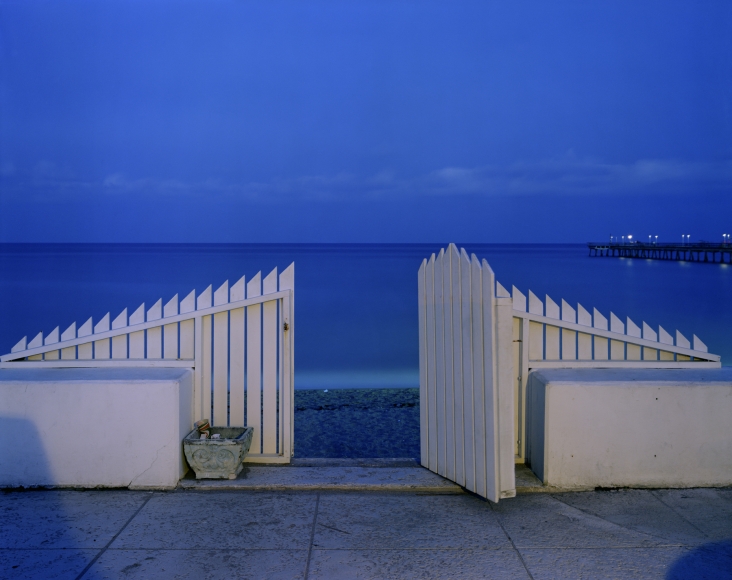
Fort Lauderdale Florida, 1977.  Archival Pigment Print printed 2017 29 1/4 x 37 inches.  From an edition of 10

Fort Lauderdale Florida, 1977. Archival Pigment Print printed 2017 29 1/4 x 37 inches. From an edition of 10. Source: Howard Greenberg Gallery.

According to a press release from the Howard Greenberg Gallery:

TWO EXHIBITONS BY JOEL MEYEROWITZ

BETWEEN THE DOG AND THE WOLF and MORANDI, CÉZANNE AND ME

HOWARD GREENBERG GALLERY
September 7 – October 21, 2017

NEW YORK – Two exhibitions of photographs by Joel Meyerowitz will be on view at Howard Greenberg Gallery from September 7 to October 21, 2017. Between the Dog and the Wolf presents images from the 1970s and 80s made in those mysterious moments around dusk. Many of the works will be on display for the first time. Morandi, Cézanne and Me surveys Meyerowitz’s recent still lifes of objects from Paul Cézanne’s studio in Aix-en-Provence and Giorgio Morandi’s in Bologna. The exhibitions will open with a reception on September 7, from 6 to 8 p.m.

Two new books of photographs by Meyerowitz are to be published: Joel Meyerowitz: Cézanne’s Objects (Damiani, October 2017) and Joel Meyerowitz: Where I Find Myself: A Lifetime Retrospective (Laurence King, January 2018).

The exhibition title Between the Dog and the Wolf is a translation of a common French expression “Entre chien et loup,” which refers to oncoming twilight. As Meyerowitz notes, “It seemed to me that the French liken the twilight to the notion of the tame and the savage, the known and the unknown, where that special moment of the fading of the light offers us an entrance into the place where our senses might fail us slightly, making us vulnerable to the vagaries of our imagination.”

The majority of the photographs in the exhibition are from a period when Meyerowitz was spending summers on Cape Cod and had just begun working with an 8×10 view camera. “My whole way of seeing was both challenged and refreshed. I found that time became a greater element in my work. The view camera demands longer exposures, and I began looking into the oncoming twilight and seeing things that the small cameras either couldn’t handle or didn’t present in significant enough quality,” Meyerowitz explains. “What seems of more value to me now, 30 years later, is how that devotion to the questions back then taught me to see in a new and simpler way.”

The exhibition features photographs taken concurrently with Meyerowitz’s iconic series Cape Light, widely recognized for his use of color and appreciation of light. A young woman is perched on a wall that overlooks the Cape Cod Bay in a 1984 print, with the last of the daylight fading into a pink haze. A 1977 view of a dark house with one lit window has a sandy front yard with a sagging badminton net, an abandoned tricycle, and a blue doghouse with peeling paint. In a nearly abstract image from 1984, the viewer can barely see lights from a house on the beach as night falls. Other locations show a view of a serene sky with St. Louis’ Gateway Arch from 1977 and a palm tree in fading blue light in Florida from 1979.

As Meyerowitz notes, “I am grateful that my experience has allowed me to work both as a street photographer and as a view-camera photographer, and that I’m comfortable with both vocabularies. I speak two languages, classical and jazz. Street photography is jazz. The view camera, being so much slower, is more classical, more meditative, it has a different way of showing its content. You can be a jazz musician and play classically, and you can be a classical musician and love the immediacy and improvisation of jazz.”

Morandi, Cézanne and Me reflects Meyerowitz’s fascination with everyday objects, which also served as inspiration to Paul Cézanne and Giorgio Morandi. He was granted permission to photograph in both artists’ studios in 2013 and 2015.

Meyerowitz was struck by the grey walls in Cézanne’s studio, and how every object in the studio seemed to be absorbed into the grey of the background. He photographed just about every object there – from vases, pitchers, and carafes to a skull and Cézanne’s hat. This project spurred him to visit Morandi’s studio to observe the objects that the master still life painter had used as inspiration for over 60 years. Meyerowitz was allowed access to all 275 of Morandi’s famous objects at his home and studio. He worked near the same window, sitting at Morandi’s table, photographing shells, pigment-filled bottles, funnels, watering cans, and other dusty aged objects against the same paper that Morandi had left on the wall, now brittle and yellow with age. Meyerowitz also began to look anew at items he found in Italian flea markets – a dented brass tube, a rusted tin flask, a capped container — and he photographed them placed in grey corners and against heavy canvas backdrops in his studio in Tuscany.

Says Meyerowitz, “My underlying motive – while, of course doing this for my own pleasure – was to provide a catalogue of the objects these painters used in the course of their lives, and show to scholars and other interested viewers, the actual, and for the most part humble, cast-offs and basic forms that these great painters drew their inspiration from.”

About Joel Meyerowitz

Joel Meyerowitz (born 1938) is an award-winning photographer whose work has appeared in over 350 exhibitions in museums and galleries throughout the world. After a chance encounter with Robert Frank, the New York native began photographing street scenes in color in 1962, and by the mid-1960s became an early advocate of color photography and was instrumental in the legitimization and growing acceptance of color film. His first book, Cape Light (1979) is considered a classic work of color photography and has sold more than 100,000 copies. He has authored 17 other books, including Legacy: The Preservation of Wilderness in New York City Parks (Aperture, 2009). As the only photographer given official access to Ground Zero in the wake of September 11th, he created the World Trade Center Archive, selections of which have toured around the world. Meyerowitz is a two-time Guggenheim fellow and a recipient of awards from both the NEA and NEH. He is a recent winner of the Royal Photographic Society’s Centenary Award, its highest honor. For his 50 years of work in 2012, he received the Lifetime Achievement Award at the Lucie Awards, an annual event honoring the greatest achievements in photography. This January, Meyerowitz was inducted into the Leica Hall of Fame for his contribution to the photographic genre. His work is held in the collections of many museums, including The Museum of Modern Art, New York; the Whitney Museum of American Art, New York; and the Museum of Fine Art, Boston. Meyerowitz lives and works in Tuscany and New York City.

Stanley Kubrick, Photographer

Source: 17-Year-Old Stanley Kubrick’s Photos Of 1940s New York Prove That He Was Born Genius

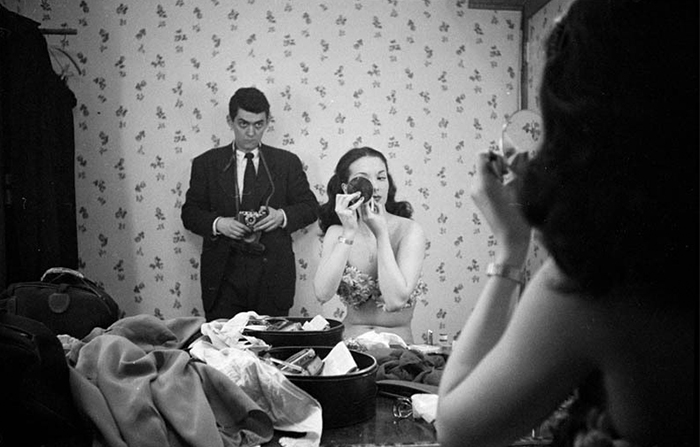
Self Portrait with showgirl Rosemary Williams, 1948. Source: 17-Year-Old Stanley Kubrick’s Photos Of 1940s New York Prove That He Was Born Genius

I’ve always been a fan of Stanley Kubrick’s films, particularly “Doctor Strangelove“. While I was aware that he was a still photographer before he turned to making movies, I had seen very few examples of his work. This article from Bored Panda presents about 70 of them. While for the most part they’re not masterpieces, they’re not bad for a 17 year old either.

Before Stanley Kubrick directed arguably some of the best movies ever made like “2001: Space Odyssey” or “The Shining,” he was a simple teenager in New York looking for a job. But even then, when the 17-year-old got his hands on a photo camera, he couldn’t hide the talent within.

Bored Panda has gathered a collection of his photos of New York from 1945 to 1950, when he was working in the Look magazine. During that time Stanley got many insights into what makes a photograph work: “I think aesthetically recording spontaneous action, rather than carefully posing a picture, is the most valid and expressive use of photography.”

He quickly made a name for himself by telling stories through photos, which eventually led him to moving pictures and his place in the filmmakers’ hall of fame.
Oh, and if you’re into street photography as well, let Stanley himself give you a tip: “Think up ideas for stories, go out and shoot them, and then send them into the magazines. I was lucky; I figured that out when I was young.”

Source: 17-Year-Old Stanley Kubrick’s Photos Of 1940s New York Prove That He Was Born Genius.

Autochromes

Source: DYT. These Autochrome Photos From The 1920s And ’30s Resulted An A Painting-Like Quality That Not Even Today’s Best Instagram Filters Can Replicate

Source: DYT. These Autochrome Photos From The 1920s And ’30s Resulted An A Painting-Like Quality That Not Even Today’s Best Instagram Filters Can Replicate

A number of years ago I went with a friend to see an exhibition of works by Alfred Stieglitz, Edward Steichen and Paul Strand at the NY Metropolitan Museum. While there I noticed some small photographs with vibrant colors and almost a glow to them. At that moment I fell in love with autochromes.

According to Wikipedia:

The Autochrome Lumière is an early color photography process. Patented in 1903 by the Lumière brothers in France and first marketed in 1907, it was the principal color photography process in use before the advent of subtractive color film in the mid-1930s.

Autochrome is an additive color “mosaic screen plate” process. The medium consists of a glass plate coated on one side with a random mosaic of microscopic grains of potato starch dyed red-orange, green, and blue-violet (an unusual but functional variant of the standard red, green, and blue additive colors) which act as color filters. Lampblack fills the spaces between grains, and a black-and-white panchromatic silver halide emulsion is coated on top of the filter layer.

Unlike ordinary black-and-white plates, the Autochrome was loaded into the camera with the bare glass side facing the lens, so that the light passed through the mosaic filter layer before reaching the emulsion. The use of an additional special orange-yellow filter in the camera was required to block ultraviolet light and restrain the effects of violet and blue light, parts of the spectrum to which the emulsion was overly sensitive. Because of the light loss due to all the filtering, Autochrome plates required much longer exposures than black-and-white plates and films, which meant that a tripod or other stand had to be used and that it was not practical to photograph moving subjects. The plate was reversal-processed into a positive transparency — that is, the plate was first developed into a negative image but not “fixed”, then the silver forming the negative image was chemically removed, then the remaining silver halide was exposed to light and developed, producing a positive image.

The luminance filter (silver halide layer) and the mosaic chrominance filter (the colored potato starch grain layer) remained precisely aligned and were distributed together, so that light was filtered in situ. Each starch grain remained in alignment with the corresponding microscopic area of silver halide emulsion coated over it. When the finished image was viewed by transmitted light, each bit of the silver image acted as a micro-filter, allowing more or less light to pass through the corresponding colored starch grain, recreating the original proportions of the three colors. At normal viewing distances, the light coming through the individual grains blended together in the eye, reconstructing the color of the light photographed through the filter grains.

I’ve tried to re-create the look digitally myself with no success. I’ve acquired filters that professed to produce this look – but they didn’t. I’m forced to conclude that, as the article suggests, you just can’t produce a digital equivalent. And I’m not inclined, nor am I skilled enough, to try the original process myself, so I’ll just have to admire them from afar.

Of the pictures shown in the article my favorites are the one above, and that of the soldiers (I thought at first Austrian because of the double headed eagle flag, but they could also be Russian or one of the other countries that uses such an eagle on its flag).