A Walk Through Croton-On-Hudson – Church of the Holy Name of Mary

According to the church’s website:

Catholics attending Mass from ‘Croton Landing’ had to walk over five miles to St. Patrick’s in Verplanck until 1850; then they walked three miles to St. Augustine’s in Ossining. From 1850 to 1874, priests from Ossining would celebrate Mass weekly in the Edward White residence on Mt. Airy Road and then later on Riverside Avenue when more space was needed. The first Church was built in 1868 by Reverend William McClennan, the pastor in Ossining.

In 1895, a rectory was purchased on Grand Street, formerly the John Sharpe residence. In 1898, Rev. John J. Owens, pastor of St. Augustine’s Church, erected the parish Church on Grand Street. The cornerstone was dated July 10, 1898. The old Church (on Church Street) was sold by Father Owens to the Kelly family for $1,000. Mr. Milano acquired it late in 1934 from the Kelly family children. The Coleman family, builders of the Dam, donated the resources for the second Church (and also the Chapel at Croton Dam).

The first Mass was celebrated at Christmas 1898 at 8 AM and the Church was formally dedicated on April 30, 1899 by Archbishop Corrigan. The Rt. Rev. Monsignor John J. Keane, of St James Church in lower NY, was preacher that day.

The Chapel of the Good Shepherd was built in the Harmon section of the village in 1929. In 1990 and 1991, both the main church and Good Shepherd Chapel were remodeled and renovated.

The main church underwent a big renovation during the winter of 2008/2009 and is now more beautiful than ever. The outside has been water-sealed and the inside received all new paint with gold trim, new carpet, the pews have been re-varnished, and the altar area has a new hardwood floor. The area behind the altar has been opened up to give a larger, more spacious feeling and the pews have been rearranged to allow better seating. The look is bright and beautiful.

Taken with a Sony RX-100 M3.

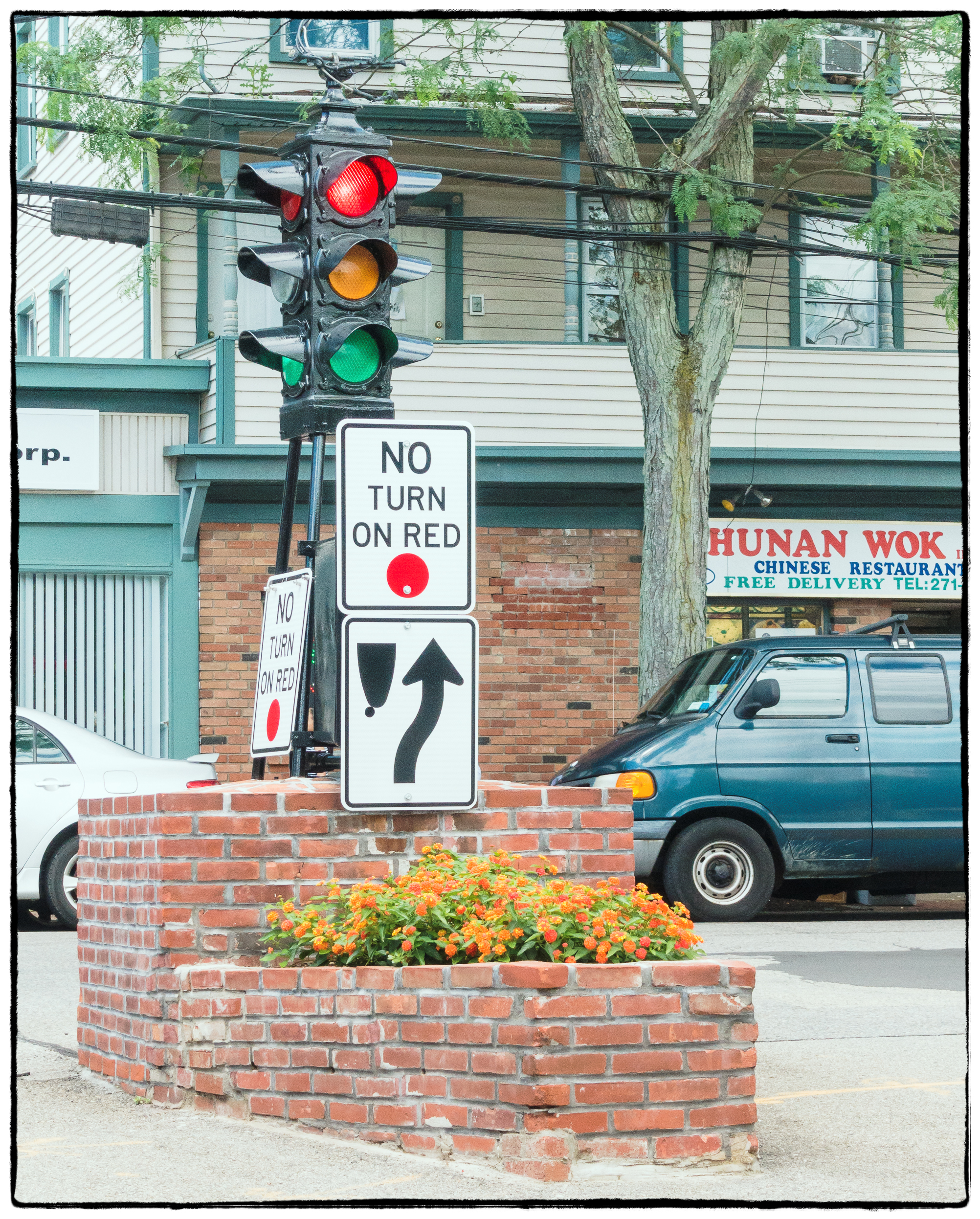
A Walk Through Croton-On-Hudson – No Turn on Red

This curious structure stands at the intersection of Grand Street and Old Post Road South. Called a “Dummy Light” it’s one of a dying breed as explained in an article in Westchester Magazine entitled: Red-Light District:

The term “dummy light” is something of a misnomer, in that the upright, freestanding traffic-control mechanism functions the same way modern traffic lights do. “But some Crotonites speculate that they’re called ‘dummy’ lights because anything that stands still in the middle of traffic all day can’t be very smart,” offers a tongue-in-cheek Carl Oechsner, president of the Croton Friends of History and a self-described backyard historian.

One of three such traffic lights left in New York State and only a few more nationwide, the Croton dummy light—perched proudly on Old Post Road South and Grand Street—was installed circa 1926. After 75 years of faithful service to the community, says Oechsner, the seven-foot structure got a facelift when the son of former mayor Roland Bogardus reinforced the original base. With a dozen 15-watt LEDs supplying the luminosity, this red-brick remnant of a time since passed is but one more example of what’s cool about Croton.

A more complete description (with numerous illustrations) by the same author can be found in A Dummy Forever! on the Croton Friends of History site.

The Beacon “Dummy” light can been seen as the fourth image in another post on this site Main street, Beacon.

Taken with a Sony RX-100 M3.

A Walk Through Croton-On-Hudson – St. Augustine’s Episcopal Church

Saint Augustine’s Church was formally organized in 1842. The first rector was Augustus Clarkson. The church as modeled on the Chapel of Christ Episcopal Church in Tarryton and was built in 1857 on land donated by Philip Van Wyck. Two additional buildings (the Parish Hall and vesting room were built in 1880.

Clarksons health deteriorated in 1904 requiring the church to be closed from 1905-1907, when it was reopened with the parish taking responsibility for the church finances. A new rectory was built in 1909. However, attendance declined and the parish had to apply to the Diocese for assistance. This situation continued until 1923 when it once again became independent. The problem continued and in 1926 the church again became an aided parish, this time for the next 24 years.

The population of Croton gradually increased and became more diverse and the church began to move away from the ‘low church’ favored by Clarkson towards a more ‘high’ church orientation. Not all of the parishioners were in favor of this change, which led to a number of physical changes in the church including the establishment of the Chapel of the Virgin Mary. Other modifications included a major renovation of the chancel and sanctuary.

Bad times came with The Depression and the Diocese was unable to help. Heating systems failed, a tree fell on the roof and the parish was unable to pay Father Young’s salary. By 1936 Sunday attendance had fallen to 25 people. By 1939 there was serious discussion regarding closing the church for a few months.

The church’s fortunes revived somewhat under Father Leeming (appointed 1941) and improved further under Father Garardus Beekeman (served 1947-1952) who was successful in rectifying the drastic state of disrepair and making the parish self supporting again. Sunday attendance increased to 125.

In the 1960s Sunday school attendance increased to a point where overcrowding became a problem. A new rectory was purchased a block away at the end of Van Wyck Street, and the old one was repurposed as the Sunday School.

By the 1970s financial problems again became an issue and the church once again became an aided parish (for 5 years), this situation continued throughout the 80s and 90s, with attendance again declining and the loss of a full time rector.

During the period 1996-2005 Father David Carlson the church’s fortunes improved. Membership surged and pledges increased. Initially Father Carlson was called “priest in charge” but evenutally his status as changed to “rector”. More renovations were undertaken and a new rectory was purchased.

The above is my own summary of a longer (but still quite short) A Brief History of Saint Augustine’s. I apologize for any mistakes I may have made in making this summary. The history concludes with these two paragraphs:

There are a number of themes that run through this history. One is surely the grit and determination of the congregation in the face of difficult challenges. This is a congregation that has faced terrible times financially and possible extinction as a congregation on several occasions, but there have always been people who were willing to work hard and keep the congregation going. A second is the willingness to embrace change. The church has responded positively to the need to rethink its organizational assumptions, to changes in the prayer book, to the changing role of women in the church, and to changing ideas about sexuality.

A third is a commitment to ecumenicalism. St. Augustine’s has been in the forefront of interfaith activities in the village since its inception. Closely allied to these characteristics are other historic hallmarks of this church: inclusiveness, joyful fellowship, concern for children, and a desire to play a role in the larger world through various forms of outreach. Finally, although it has not been mentioned in this brief history, the congregation has expressed itself by the effort it has put into beautifying the church buildings and grounds, the care it has devoted to its formal worship, and concern for its musical heritage

I find it sobering that the “high church”/”low church”) controversy continued as long as it did and found one paragraph in the history to be quite disturbing:

This [the move towards “high church”] was resented by many and was only gradually accepted. Although St. Augustine’s was firmly established as a high church by the end of Father Stewart’s ministry, the grumbling did not finally end until Father Armfield’s ministry in the 1960’s. The controversy was serious enough that in the climate of the Red Scare following World War I, the local Ku Klux Klan burned a cross on the hill across the Post Road from the church in condemnation of the “papish service of the Episcopal Church”.

A Walk Through Croton-On-Hudson – Overview

We’d often driven through Croton-on-Hudson on our way up to the lake, but it wasn’t until we went to dinner there with a couple of friends that I realized that I’d never actually been to the main town center. It was quite quaint and I determined to go back there some day to take some pictures – and then promptly forgot to do so.

Then my wife decided to change doctors. Her previous doctor had moved farther south and it was just a little inconvenient for us to continue with her. We sought recommendations from friends and eventually found a doctor in, of all places, Croton-on-Hudson. When she went for her first visit I went along with our dog and while waiting for her took a walk around.

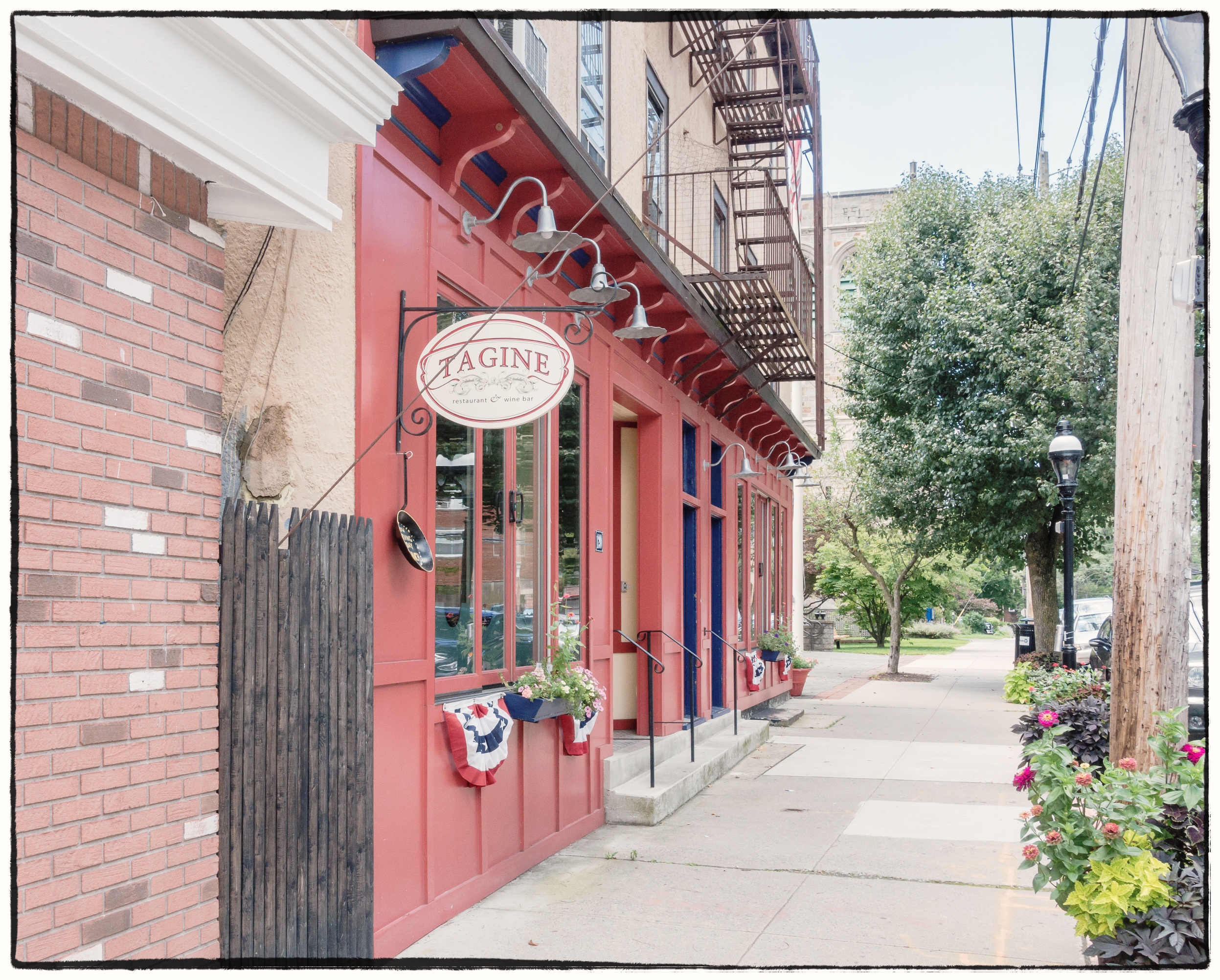
Above, Tagine the excellent French/Moroccan bistro style restaurant that brought us to the center of Croton-on-Hudson in the first place.

Taken with a Sony RX-100 M3.

Another picture taken in Croton-on-Hudson can be found in Croton-on-Hudson – Fire Department, Hook and Ladder Company No. 1. Chemical Engine Company No. 1

Rickshaws, Kathmandu, 1999

Taken during a visit to Nepal in 1999 probably with a Canon AE-1 camera and I can’t recall what lens. I say Canon AE-1 because the only other camera I had at that time was a Minolta Hi-Matic 7sii. Some of the other pictures in this batch could not have been taken with the wider than normal lens on the Minolta, so by process of elimination it must have been the Canon and probably a zoom lens of some kind.