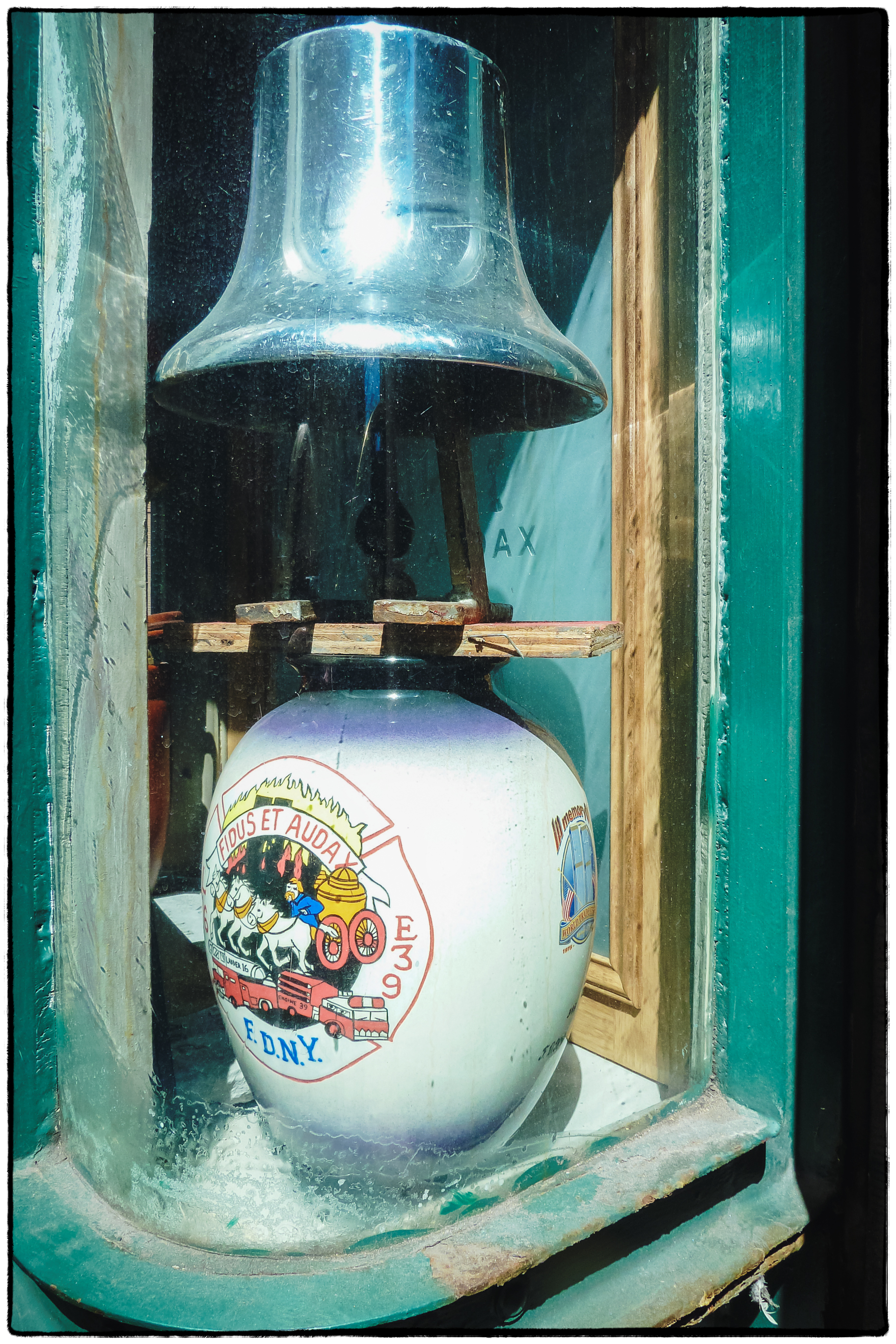
I took this picture back in March, 2012. I don’t really remember why, but I suspect it was because of the contrast between the ceramic jar (or whatever it is) and the bell. They looked kind of incongruous together. Looking at it today I realized that I didn’t really know what is was and I’d forgotten where it was. After a bit of “googling” I tracked it down to a display window at a fire station house around 136 East 67th Street in Manhattan, NY City. I must have seen the station house at the time – it has two large, bright red doors so I could hardly have missed it. In fact I’m surprised that I don’t have a picture of the facade. The display is right at the edge of the station house and I suspect that I didn’t even realize that it was part of it when I took the picture.
So as the title of this post suggests this is Engine Company 39, Ladder Company 16, FDNY. It’s now a historic landmark. The proceedings of the Historic Landmarks Commission can be found here. They provie a lot more information including the following summary:
Fire Engine Company 39 and Ladder Company 16 Station House is an outstanding example of late nineteenth century civic architecture. Built in 1884-86, the six-story Romanesque Revival structure was designed by N. LeBrun & Son for the headquarters of the New York Fire Department and to provide fire protection in a neighborhood that was experiencing considerable growth and change. Between 1879 and 1894 LeBrun was closely associated with the department, designing more than 40 buildings. Unlike many modest mid-block firehouses, the East 67th Street building served multiple functions, providing space for two fire companies, the offices of the Commissioners, and various departmental bureaux. Restored in 1992, the East 67th Street building provides a superb centerpiece in one of New York’s best-preserved rows of nineteenth century public architecture
There’s also a photographic connection to this company. See Lasting Image Of 9/11 An Inspiration To Engine 39 & Ladder 16 In Manhattan. As the article states:
A photo showing two of New York City’s bravest that died on that day hangs in the firehouse on East 67th Street. The scene is repeated, etched on the front doors and forever in the hearts of the firefighters who work there today.
…
Rattazzi has worked there for 13 years. On Sept. 11, 2001, he raced to the World Trade Center with Lt. Raymond Murphy and Firefighter Robert Curatolo. He snapped the picture just after the first tower collapsed.
“We’re in the middle of West Street walking south. I’m probably 15 feet behind them. I was just pointing at the steel in street and, fortunately, they came out,” Rattazzi said.
Rattazzi pointed out where Murphy was in the picture, in the lower corner, and that only Curatolo’s shoulder was visible.
DuBois: “This is literally the last time you saw these guys?”
Rattazzi: “Yes.”
In the chaos after the collapse the men separated. While Rattazzi assisted an injured firefighter Murphy and Curatolo headed into the rubble to find other victims.
But minutes later, as the North Tower collapsed, both men were lost. Rattazzi was the only man to make it back that day.