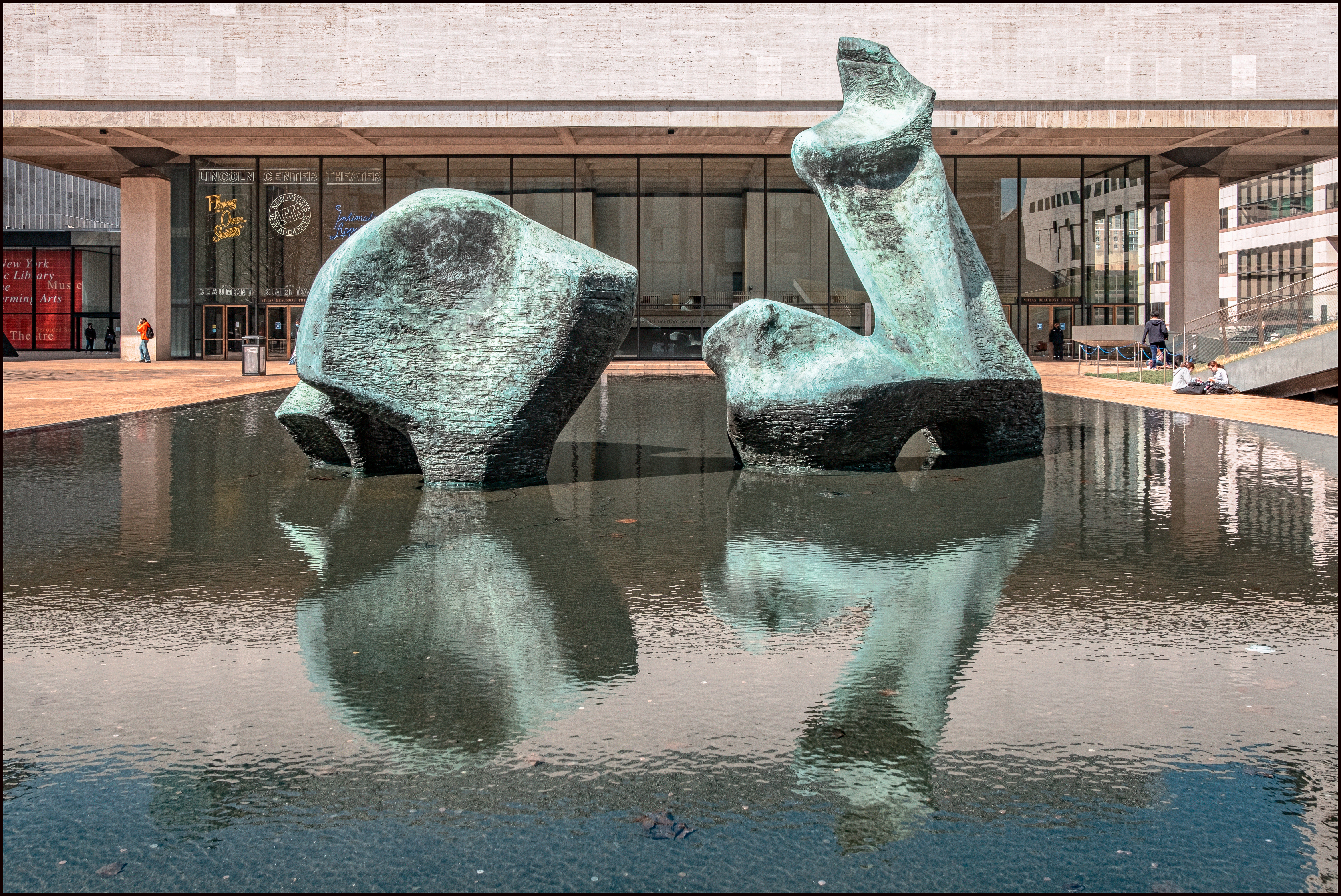
In New York City – Lincoln Center – Reclining Figure

“Reclining Figure” 1963–5 (LH 519) is a statue by Henry Moore. The original two-part bronze statue of a human figure was commissioned for the Lincoln Center for the Performing Arts in New York City, where it has been displayed outdoors since 1965 in a pool of water to the north of the new Metropolitan Opera House. Other copies in plaster or bronze exist, and are displayed in other cities.

Taken with a Fuji X-E1 and Fuji XC 16-50mm f3.5-5.6 OSS II

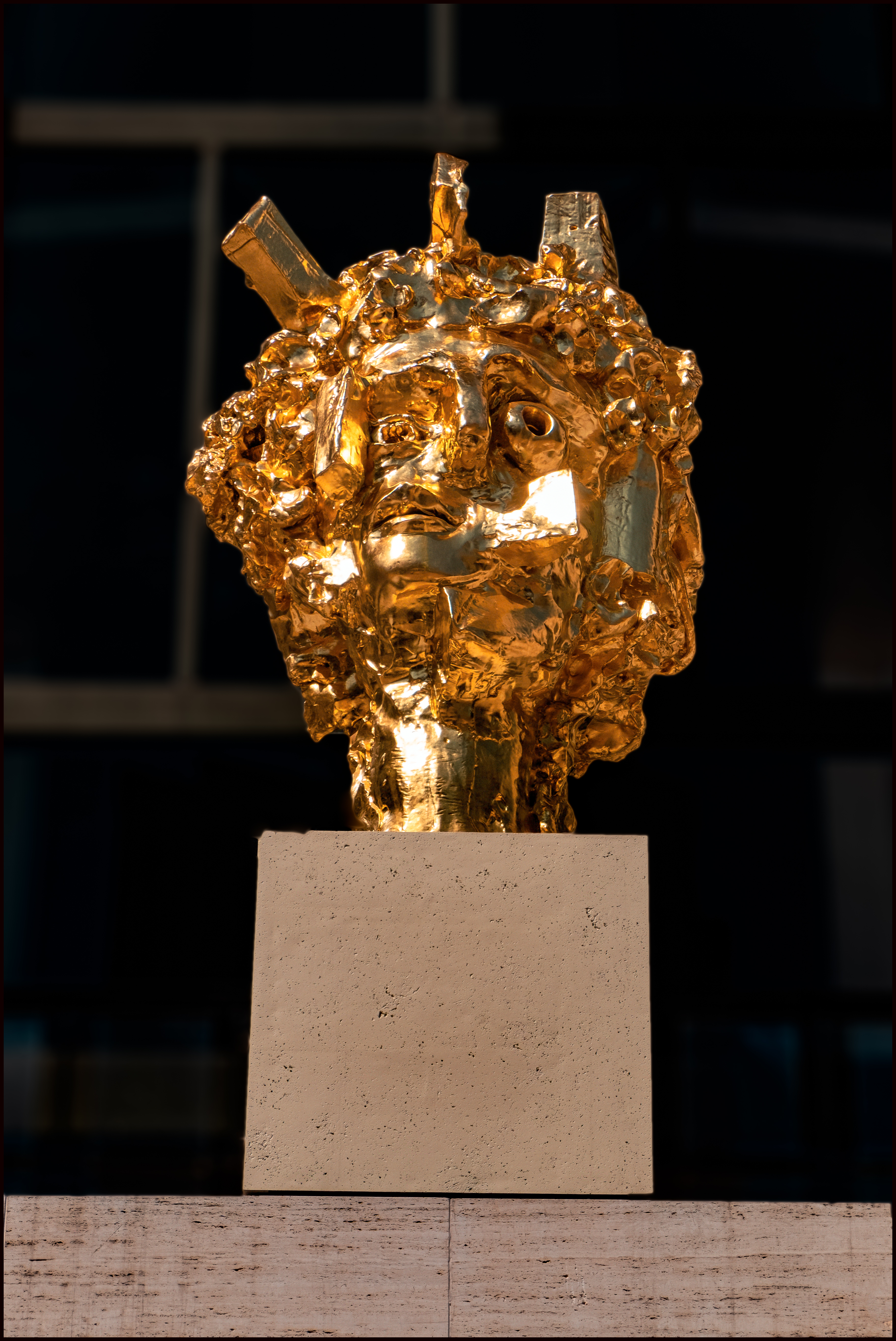
In New York City – Lincoln Center – Constellation of Voices

“Constellation of Voices” by George Condo, a golden sculpture that somehow evokes deities, lowly human performers and the anxiety of life in 2019 simultaneously. The figure, which resembles a head that’s been deformed by conflicting desires, is also pockmarked and pitted as though it’s been riddled with projectiles. There’s a distinct majesty to it too. “I took it out of the realm of gods and wanted it to echo the feeling of our time, with this idea of a constellation of voices—when so many people have taken to the streets and want to be heard,” Condo told the New York Times.

Taken with a Fuji X-E1 and Fuji XC 16-50mm f3.5-5.6 OSS II

At ‘The Met’ – Surrealism Beyond Borders

Although we didn’t plan it that way we ended up spending most of the time at the Surrealism Beyond Borders Exhibition. For those who might be interested the exhibition runs until January 30. Above: Armoire surréaliste (Surrealist Wardrobe), 1941. Marcel Jean.


Landru in the Hotel, Paris (Landru en el hotel, Paris), 1932. Antonio Berni.


An onlooker considers one of my personal favorites: La durée poignardée (Time Transfixed), 1938. René Magritte


La durée poignardée (Time Transfixed) again. This time with no obstructions.


Le rêve de Tobie (The Dream of Tobias), 1917.Giorgio de Chirico


Nus (Nudes), 1945. Samir Rafi.


Pas de deux (Amanecer) (Pas de Deux [Dawn]), 1953. Luis Maisonet Crespo.


Towards the Tower (Hacia la Torre), 1960. Remedios Varo.


Viewers studying Construction molle avec des haricots bouillis (Premonition de la guerre civile) (Soft Construction with Boiled Bean [Premonition of Civil War]), 1936. Salvador Dalí


Construction molle avec des haricots bouillis (Premonition de la guerre civile) (Soft Construction with Boiled Bean [Premonition of Civil War]) again.


Finial from a Slit Gong (Atingting Kon), early to mid-20th century. Ambrym Island

Taken with a Fuji X-E3 and Fuji XF 35mm f1.4 R

Inside St. Patrick’s Cathedral


It’s been almost 10 years since I was at St. Patrick’s Cathedral. At that time I was using a newly acquired Sony NEX-5N (which I still have) and an adapted vintage manual focus lens: a Canon FD f1.4. I was unfamiliar with the camera, particularly some of the features (e.g. focus zoom and focus peaking) that make focusing a manual focus lens easier. Although I got a number of decent pictures I also missed a lot.

“The story of New York’s great cathedral mirrors the story of the city itself. Created to affirm the ascendance of religious freedom and tolerance, St. Patrick’s Cathedral was built in the democratic spirit, paid for not only by the contributions of thousands of poor immigrants but also by the largesse of 103 prominent citizens who pledged $1,000 each. St. Patrick’s Cathedral proves the maxim that no generation builds a cathedral. It is rather, a kind of ongoing conversation linking generations past, present and future.

The cornerstone of St. Patrick’s Cathedral was laid in 1858 and her doors swept open in 1879. It was over 160 years ago when Archbishop John Hughes announced his inspired ambition to build the “new” St. Patrick’s Cathedral.

In a ceremony at Old St. Patrick’s Cathedral, Archbishop Hughes proposed “for the glory of Almighty God, for the honor of the Blessed and Immaculate Virgin, for the exaltation of Holy Mother Church, for the dignity of our ancient and glorious Catholic name, to erect a Cathedral in the City of New York that may be worthy of our increasing numbers, intelligence, and wealth as a religious community, and at all events, worthy as a public architectural monument, of the present and prospective crowns of this metropolis of the American continent.”

Ridiculed as “Hughes’ Folly,” as the proposed, near-wilderness site was considered too far outside the city, Archbishop Hughes, nonetheless, persisted in his daring vision of building the most beautiful Gothic Cathedral in the New World in what he believed would one day be “the heart of the city.” Neither the bloodshed of the Civil War nor the resultant lack of manpower or funds would derail the ultimate fulfillment of Hughes’ dream and architect, James Renwick’s bold plan. ” (St. Patrick’s Cathedral website).


Taken with a Fuji X-E3 and Fuji XF 35mm f1.4 R